

To value my company, start with its normalized earnings (SDE for owner-operated businesses, EBITDA for larger ones), apply a multiple drawn from comparable private-company sales, and then adjust for risk, growth and how well the business runs without you. That produces a defensible range rather than a single number, and the range is what you carry into conversations with buyers and advisors.
This guide moves from fundamentals to practical use. It covers what a valuation is, the main methods, how to calculate each step, what shifts the multiple, and how to get ready for a sale in 2026.
What does it mean to value a company?
A company valuation is a reasoned estimate of what a business would sell for between a willing buyer and a willing seller. It is an opinion supported by evidence, not a fixed fact, and it changes with earnings, market conditions and buyer appetite.
Three terms are worth separating early:
- Enterprise value is the price of the operating business, regardless of how it is financed.
- Equity value is what remains for owners after debt is subtracted and cash is added.
- Deal value is the final negotiated price including terms such as earn-outs, seller notes and working capital adjustments, which is why it often differs from the headline number. Aligned IQ explains this distinction in its overview of deal value.
Owners considering an exit benefit most from understanding value before a sale begins. The reasoning is laid out in Aligned IQ's piece on understanding business value as the first step before a sale.
How do you find out the value of your company?
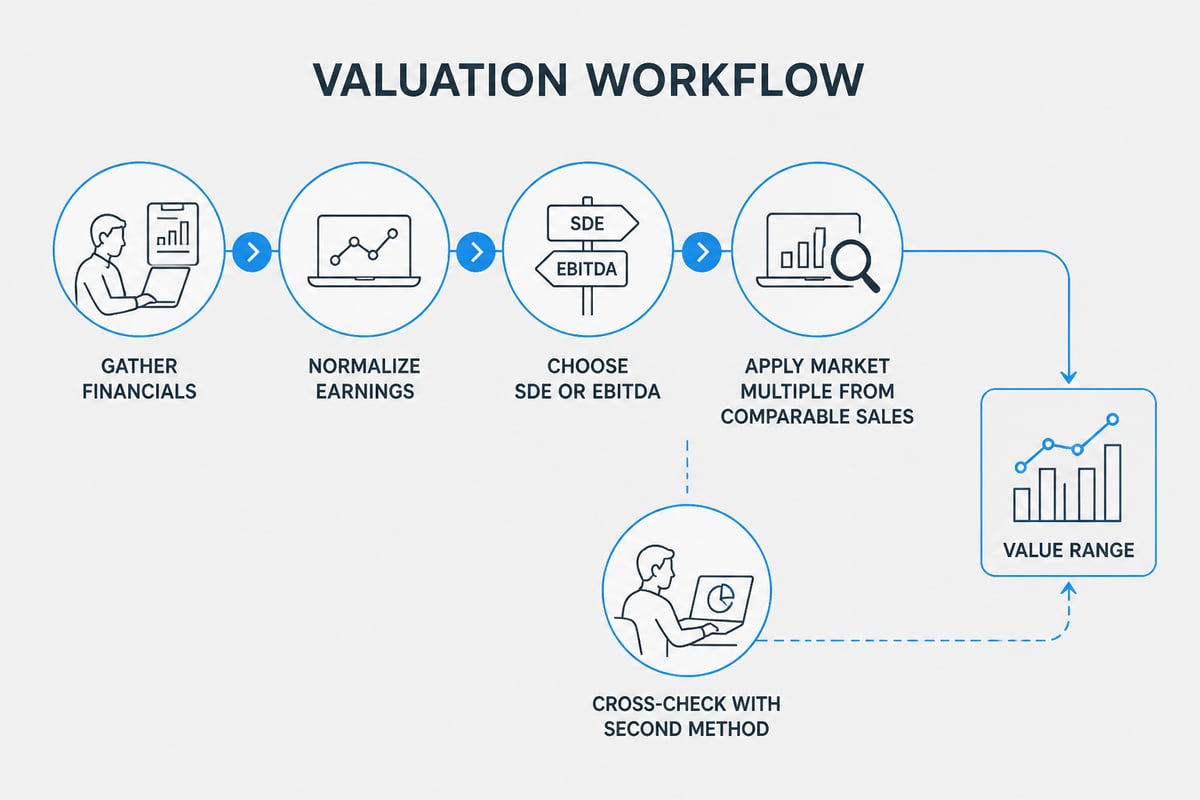
You find the value of your company by combining three inputs: reliable financials, an earnings measure adjusted for owner-specific items, and market evidence from similar businesses that have sold. No single input is enough alone.
Work through these steps in order:
- Gather three to five years of financial statements and current-year year-to-date figures.
- Normalize earnings by removing one-time costs and personal expenses, and by setting owner compensation at a market rate.
- Choose the right earnings measure: SDE for owner-operated businesses, EBITDA for companies with a management layer.
- Select a multiple from comparable transactions, adjusted for your size, industry and risk.
- Cross-check with a second method, then settle on a range.
Online calculators can give a rough first reading, but they rarely capture the quality of your revenue, customer concentration or reliance on you personally. Treat them as a starting point, not a conclusion.
What are common valuation methods?
The common valuation methods fall into three families: earnings-based, market-based and asset-based. Most real-world valuations of operating companies lean on the first two and use the third as a floor or a cross-check.
| Method | How it works | Best suited to |
|---|---|---|
| Earnings multiple (SDE or EBITDA) | Normalized earnings times a market multiple | Profitable, stable businesses |
| Comparable transactions | Prices paid for similar private companies | Industries with active deal flow |
| Discounted cash flow | Future cash flows discounted to today's value | Businesses with predictable, growing cash flow |
| Asset-based | Fair value of assets minus liabilities | Asset-heavy or underperforming businesses |
| Revenue multiple | Revenue times an industry factor | Recurring-revenue or high-growth models |
A revenue multiple is the quickest to compute but the least precise, because it ignores profitability. Aligned IQ discusses its limits in a guide to company value based on turnover.
Discounted cash flow is theoretically sound, yet it depends heavily on forecast assumptions. Small changes in the growth rate or discount rate move the result substantially, so many advisors use it as a check rather than the lead method for smaller companies.
Is a business worth 5 times profit?
A business can be worth five times profit, but that multiple is neither a rule nor a default. It depends on the size of the company, the industry, the quality of earnings and the level of risk a buyer assumes.
Recent data shows how much range exists. In the DealStats data summarized by Kaufman, Rossin & Co. for Q4 2025, the all-industry median selling-price-to-EBITDA multiple was 3.5x, down from 3.7x in Q3 2025. A five-times multiple sits above that median, which typically requires strong growth, recurring revenue, low customer concentration or a management team that operates independently.
Multiples also differ by measure. A multiple applied to SDE, which adds back one owner's compensation, will usually be lower than one applied to EBITDA for a larger company. Comparing a quoted multiple without knowing which earnings figure it applies to produces misleading conclusions.
How do you calculate value using SDE, EBITDA and multiples?
To calculate value, take normalized earnings and multiply by an appropriate market multiple. The arithmetic is simple; the judgment sits in defining earnings and choosing the multiple.
Step one: define the earnings figure
Seller's discretionary earnings (SDE) equals net profit plus owner compensation, interest, taxes, depreciation, amortization and non-recurring or personal expenses. It suits businesses where one owner works in the company full time.
EBITDA equals earnings before interest, taxes, depreciation and amortization, with owner compensation set at what a hired manager would cost. It suits businesses with a team that could run without the owner. For a fuller walk-through, see Aligned IQ's explanation of EBITDA and company value.
Step two: scrutinize the add-backs
Adjustments are where valuations are won or lost. Lincoln International reported that EBITDA adjustments represented approximately 24% of reported earnings among the companies it tracked, alongside a 6.3% rise in adjusted EBITDA over the 12 months through Q2 2025. Buyers know add-backs are common, so they test each one. Keep documentation for every adjustment: invoices, contracts and a clear explanation of why the cost will not recur.
Step three: apply the multiple
Hypothetical example: a company with $800,000 of normalized EBITDA and an applicable multiple range of 3.5x to 5x would indicate an enterprise value between $2.8 million and $4.0 million. Where the company lands in that range depends on the factors covered below.
How much is a business worth with $1,000,000 in sales?
A business with $1,000,000 in sales has no single value, because revenue alone does not determine price. Two companies with identical sales can differ several times over in value depending on profit margin, growth and risk.
Hypothetical example: one company converts a high share of its sales into earnings while a similar-sized company converts a much smaller share. At the same earnings multiple, the more profitable one is worth substantially more. This is why buyers ask for profit and cash flow before they discuss price, and why growing revenue without improving margins may not raise value. Aligned IQ explores this in its article on why simply increasing profit may not increase business value.
Where revenue multiples are used, they tend to apply to recurring or subscription revenue, where sales are predictable and customer retention is documented.

How do comparables and market conditions shape the number?
Comparable transactions anchor a valuation in what real buyers have paid, and market conditions determine whether those prices are rising or falling. Using both keeps your estimate realistic.
The comparables method compares your business with similar private companies that have sold, adjusting for size, geography, growth and profitability. Private-company data is harder to find than public-company data, so sources and definitions matter. Aligned IQ outlines the process in its guide to using comparables to estimate business value.
Market direction matters as well. The Lincoln Private Market Index reported that U.S. privately held companies' enterprise value increased 1.9% in Q4 2025, with EBITDA growth of 4.7% for 2025. Steady, modest growth like this suggests stable rather than frothy conditions, which favors well-prepared sellers whose numbers hold up under scrutiny.
What factors raise or lower what buyers will pay?
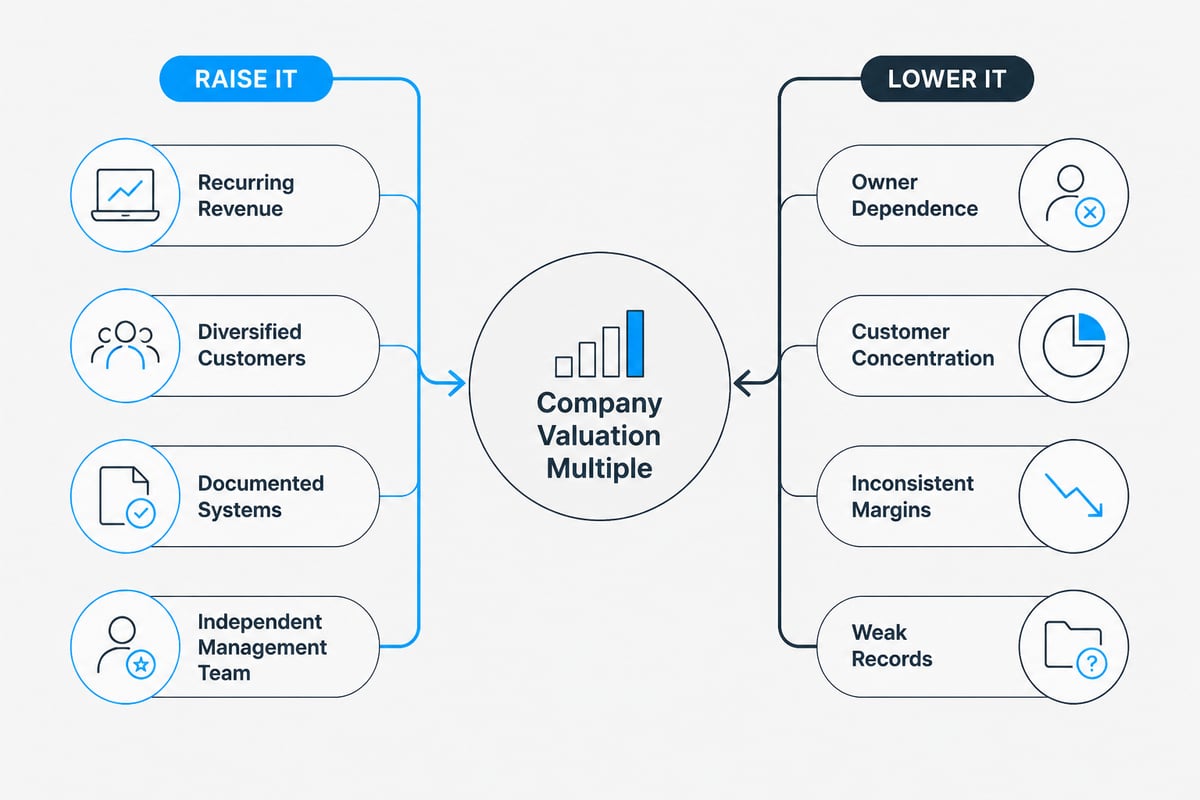
Buyers pay more for earnings that are predictable, transferable and growing, and less for earnings that depend on one person, one customer or one lucky year. These qualitative factors move the multiple more than most owners expect.
Factors that tend to raise value:
- Recurring or repeat revenue with documented retention
- Diversified customers, with no single account dominating sales
- Documented systems that let the business run consistently, as described in Aligned IQ's article on putting the right systems in place to drive value
- A capable management layer so the business does not depend on the owner
- Clean, accurate financial records that survive due diligence
Factors that tend to lower value:
- Heavy owner dependence for sales, relationships or technical knowledge
- Customer or supplier concentration
- Declining or erratic margins
- Deferred maintenance or unclear capital spending history
- Weak risk management, covered in Aligned IQ's discussion of risk management and long-term value
The concept tying these together is transferable value: the portion of earnings a new owner can realistically expect to keep. If you want to understand why it matters, read Aligned IQ's explanation of transferable value.
Why strategic fit changes a valuation
Strategic fit changes a valuation because the same company is worth different amounts to different buyers. A buyer that gains customers, capabilities or geography from your business can justify a higher price than one purchasing earnings alone.
This is the point where the "Traditional M&A Process" often falls short for owners. In a broad auction, a seller opens financials and a confidential memorandum to many parties before knowing whether any of them is a genuine strategic match. That exposes sensitive information to employees, customers and competitors, and it can pull the process toward price alone.
Aligned IQ M&A takes the opposite order. It is a private, B2B match-making platform that puts strategy first, so buyers and sellers agree on goals before deep diligence starts. Matches are based on transaction priorities, deal size and industry experience and expertise. For sellers, this is a lower-risk, confidential route to finding counterparties who understand the business. For buyers, it is a proprietary-style stage to present themselves as an attractive exit option to owners, rather than competing as one name in a crowded list. Owners who want support preparing for this can review Aligned IQ's sell-side M&A advisory for business owners.
How should you prepare your numbers for a buyer?
Prepare your numbers by organizing records so a buyer can verify every claim, which protects your valuation during due diligence. Unverified figures are the most common reason buyers reduce an offer late in a process.
A practical preparation checklist:
- Reconcile three to five years of financial statements with tax returns.
- Build a schedule of add-backs with supporting evidence.
- Document customer concentration, contract terms and renewal history.
- Summarize capital expenditures and their effect on performance, an area covered in Aligned IQ's article on the cumulative impact of past capex decisions.
- Assemble contracts, leases, licenses and employee information in a single organized location.
For that last step, the Aligned IQ VDR is a separate product from Aligned IQ M&A: a secure virtual data room for lower middle-market buyers, sellers, M&A advisors, investment bankers and other advisors. It is complimentary for Aligned IQ M&A sellers once a match is completed, and it is competitively priced for other users. Details are on the Aligned IQ VDR pricing page.
Owners based in France who also want to review the structure of their personal and business finances before a sale may find Oakfin useful, as it supports independent professionals and business owners with financial structure optimization.
How often should you value my company, and what should you do with the result?
You should revisit the value of your company at least once a year, and again before any major decision such as a sale, a partnership or a significant investment. A regular cadence shows whether your actions are building value or only increasing activity.
Use each result in three ways:
- Compare against your goals. If the range falls short of what you need for retirement or reinvestment, you have time to close the gap.
- Identify the biggest lever. Reducing owner dependence, improving revenue quality or documenting systems often moves value more than chasing short-term profit. Aligned IQ covers one route in its piece on improving revenue quality.
- Plan the transition. A multi-year plan to shift from hands-on to hands-off management, as described in the article on moving from head-down to head-up management, directly supports a higher and more durable price.
Owners who intend to sell eventually, even years from now, gain the most from this discipline. Valuation and marketability are linked, a relationship examined in Aligned IQ's discussion of business value and marketability.
FAQ
Can I rely on an online calculator to value my company?
An online calculator gives a rough, directional estimate based on a few inputs, usually revenue or earnings and an industry multiple. It cannot assess customer concentration, owner dependence or the quality of your earnings, so use it to frame a conversation rather than to set an asking price.
Should I hire an advisor to value my company?
An independent advisor is worth considering when the decision is significant, such as a sale or a transfer between partners, because an outside opinion is more credible to buyers. Many owners begin with their own estimate, then use an advisor to test the add-backs and the chosen multiple.
Does a higher valuation guarantee a better sale outcome?
A higher valuation does not guarantee a better outcome, because terms, structure and the fit of the buyer affect what you actually receive. An offer with a lower headline price but more cash at closing and less risk can be worth more than a higher offer loaded with contingencies.
The next step is to calculate your normalized earnings for the last three years and write down every add-back you can support with documents. From there, a clearer picture of strategic fit helps you decide who the right buyers might be, and Aligned IQ can help you take a tour of how the match-making platform works, including its private, confidential approach, so contact the team to see how it fits your plans. Owners preparing to sell can also review Aligned IQ's sell-side M&A advisory for business owners to understand the support available.
No responses yet