

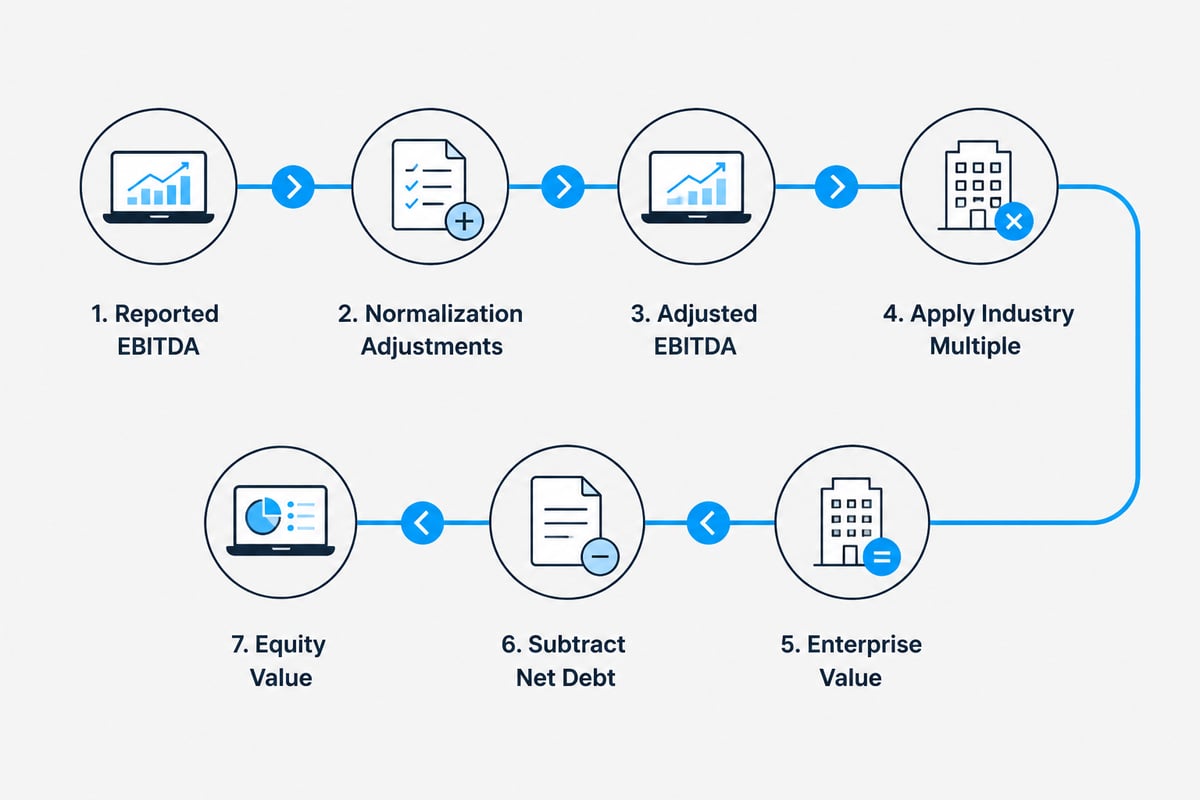
EBITDA company value is typically calculated by multiplying a company's adjusted EBITDA by an industry-specific multiple to estimate enterprise value, then subtracting net debt to arrive at what the owners actually receive. The method is popular because it strips out financing, tax, and accounting choices, which lets buyers compare businesses on operating earnings alone. For an owner considering a sale, understanding both halves of the equation, the earnings number and the multiple, is the fastest way to set realistic expectations.
What EBITDA Measures and Why Buyers Rely on It
EBITDA stands for earnings before interest, taxes, depreciation, and amortization, and it approximates the cash profit a business generates from operations before capital structure and accounting policy are considered. A buyer cares about it because it shows what the business could earn under new ownership, regardless of how the current owner financed it or which depreciation schedule an accountant chose.
The calculation is straightforward:
- Start with net income.
- Add back interest expense.
- Add back income taxes.
- Add back depreciation.
- Add back amortization.
Because two companies with identical operations can report very different net income, EBITDA creates a common baseline. It also underpins lending decisions, since lenders use it to size debt and test coverage. It is not the same as profit, however. EBITDA ignores capital spending, working capital needs, and debt service, so a company can report strong EBITDA and still generate little free cash. Buyers know this, which is why they examine capital expenditures alongside it. Owners who want to understand that interplay can read about the cumulative impact of past capex decisions on business value.
The EBITDA Company Value Formula
The core formula is enterprise value equals adjusted EBITDA multiplied by an EV/EBITDA multiple. Enterprise value represents the price of the whole operating business, independent of how it is financed. The Corporate Finance Institute explains the EV/EBITDA formula and how enterprise value is built from equity value, debt, and cash.
Here is the logic in three steps:
- Step one: Determine adjusted EBITDA for the trailing twelve months, or a normalized average of recent years.
- Step two: Select a multiple drawn from comparable transactions or public companies in the same sector.
- Step three: Multiply the two to get enterprise value, then subtract debt and add cash to reach equity value.
A simple illustration of the math, not a real transaction: a business with $2.0 million of adjusted EBITDA and an applicable multiple of 5.0x would have an enterprise value of $10.0 million. If it carries $1.5 million of net debt, the equity value available to the owner before transaction costs and taxes is $8.5 million. That gap between enterprise value and what an owner nets is where many sellers are surprised, so it is worth modeling early.
Which Multiple Applies to Your Business
The right multiple depends on industry, size, growth, and risk, and published market averages are a starting point rather than a price. As of January 2026, the US total-market EV/EBITDA multiple was 19.73x for firms with positive EBITDA, according to NYU Stern’s Damodaran dataset. Excluding financial firms, the figure was 16.95x for positive-EBITDA firms.
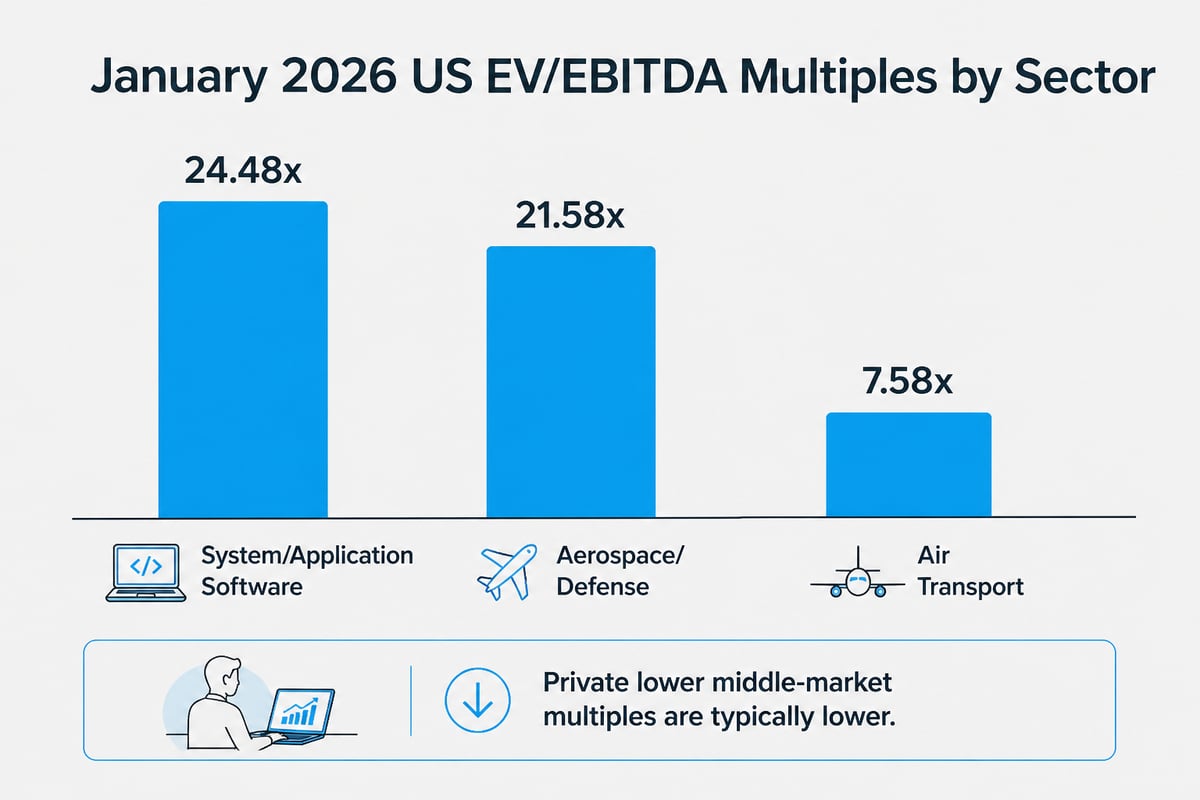
Those numbers describe large public companies. Privately held lower middle-market businesses usually trade at lower multiples because they are smaller, less liquid, and often more dependent on their owners. The spread between sectors is the more instructive lesson. In the same January 2026 dataset, positive-EBITDA multiples included 24.48x for system and application software, 21.58x for aerospace and defense, and just 7.58x for air transport.
Different data providers also disagree. Equidam's July 2025 update, based on analysis of more than 30,000 public companies as of July 15, 2025, lists an aerospace and defense multiple of 15.27x, down 37.42% from its prior figure of 24.4x. Two reputable sources produced very different figures for the same industry, which shows why no single published multiple should be treated as a quote.
Some categories carry no meaningful multiple at all. Damodaran's table reports regional banks and money-center banks without an EV/EBITDA figure, because debt is part of a bank's operating model and the metric does not fit.
Calculating Adjusted EBITDA Before You Apply a Multiple
Adjusted EBITDA is reported EBITDA modified to reflect the true ongoing earning power of the business, and it is the number a buyer will actually capitalize. Owners of private companies routinely run personal or one-time items through the business, and a credible valuation removes them.
Common adjustments include:
- Owner compensation above or below a market-rate replacement salary
- Personal expenses paid by the company, such as vehicles or travel
- One-time legal settlements, relocation costs, or restructuring charges
- Non-recurring revenue or unusually large one-off contracts
- Related-party rent set above or below market
Each add-back increases value at the multiple, so a $100,000 adjustment at 5.0x is worth $500,000 in enterprise value. That leverage is exactly why buyers scrutinize them. Aggressive or poorly documented add-backs erode trust and invite price reductions, a dynamic covered in Aligned IQ's discussion of how unrealistic EBITDA addbacks affect buyer negotiations. For a fuller treatment of the methodology, see this overview of adjusted or normalized EBITDA and the adjusted EBITDA reference page.
The standard of proof matters. Every adjustment should be supported by invoices, payroll records, or contracts, because a buyer's quality-of-earnings review will test each one.
What Pushes Your Multiple Higher or Lower
A multiple reflects a buyer's confidence that the earnings will continue, so anything that lowers perceived risk or raises expected growth supports a higher number. Two companies with identical EBITDA can sell at very different prices for these reasons.
Factors that typically support a higher multiple:
- Recurring or contracted revenue, and a diversified customer base
- A management team that can run the business without the owner
- Documented processes and reliable financial reporting
- Consistent growth and healthy margins
- Modest capital intensity
Factors that typically compress it:
- Customer concentration, where one client represents a large share of sales
- Heavy dependence on the founder for relationships or technical knowledge
- Declining or volatile earnings
- Deferred maintenance or pending large capital needs
Transferable value is the common thread. A business that functions without its owner is worth more because a buyer is purchasing a system, not a job. This idea is explored in Aligned IQ's guides to transferable value and improving revenue quality to raise value and marketability.
Where EBITDA Valuation Falls Short
EBITDA is a useful shortcut, but it can mislead when used alone. It ignores capital expenditures, so an asset-heavy company with high maintenance spending looks healthier than its cash flow justifies. It ignores changes in working capital, which can absorb cash in a growing business. It also says nothing about debt levels, which is why the enterprise value bridge to equity value matters.
Buyers frequently cross-check the result against other approaches, including discounted cash flow analysis and comparable transactions. EV/EBITDA comparisons vary meaningfully across industries, which reinforces the need to compare like with like. See the Investopedia overview of the enterprise multiple. Owners can learn how to build that peer set in using comparables to estimate the value of your business.

What Percentage of Revenue Should EBITDA Be?
There is no universal target, because EBITDA margin varies widely by industry. Software and professional services tend to sit toward the higher end, while distribution, construction, and retail often run lower. The more useful comparison is your margin against close peers and against your own trend over several years.
A rising margin supports a higher multiple, since it signals pricing power or operating leverage. A falling margin at constant revenue is a warning that buyers will price in. If your margin is below peers, the gap itself is often a value-creation opportunity before a sale.
Why Is EBITDA Important to Investors and Buyers?
EBITDA matters to investors because it offers a quick, comparable view of operating profitability that is largely unaffected by financing and tax decisions. A buyer evaluating several acquisition targets can line up their EBITDA and see which businesses generate the most operating earnings per dollar of price.
It also connects directly to financing. Lenders size acquisition debt as a multiple of EBITDA and test whether earnings cover interest and principal, so the same number that sets the price also sets how much a buyer can borrow. That is one reason a defensible EBITDA figure influences both valuation and deal certainty.
Preparing Your EBITDA Case Before Going to Market
A defensible valuation depends on preparation done well before a buyer asks questions. Owners who know their adjusted EBITDA, can document every add-back, and understand their likely multiple range negotiate from a position of confidence.
A practical preparation sequence:
- Reconcile three to five years of financials and identify trends.
- Build a documented schedule of normalization adjustments.
- Identify the risk factors a buyer will raise and address what you can.
- Benchmark against comparable transactions in your sector.
- Organize supporting records so diligence moves quickly.
For a broader frame on this stage, understanding business value before a sale is a useful starting point, and valuation and managing company value in M&A covers how value is measured and tracked over time.
How Aligned IQ Supports Valuation and Sale Preparation
Aligned IQ pairs two distinct offerings, and it helps to keep them separate.
Aligned IQ M&A is a private web platform where prospective buyers and sellers meet to explore deals. Its match-making process puts strategic fit first, so goals are aligned before anyone invests in deep diligence. Matches are based on transaction priorities, deal size, and industry experience and expertise. For sellers, this is a lower-risk and more confidential route than the traditional M&A process, in which a business is often marketed broadly and exposed to employees, customers, and competitors before a serious counterparty is identified. For buyers, the platform offers a stage to present themselves as an attractive exit option for owners. Business owners can learn about sell-side M&A advisory support through the Aligned IQ platform, which also supports exit planning and valuation in one place.
Aligned IQ VDR is a separate secure virtual data room for sharing deal documents, which matters once buyers begin testing your EBITDA adjustments. It is complimentary for Aligned IQ M&A sellers after a match is completed. You can review the product itself at vdr.alignediq.net.
The practical point for a seller is that a well-supported EBITDA schedule is only useful if it can be shared securely and on your terms. Taking a tour of both products is a low-commitment way to see how the pieces fit.
FAQ
Does EBITA equal profit?
No. EBITA is earnings before interest, taxes, and amortization, so it still deducts depreciation, which makes it a closer measure of operating profit than EBITDA. Net profit comes only after interest and taxes are also subtracted, so EBITA is an intermediate figure rather than the bottom line.
What does the EBITDA coverage ratio measure?
The EBITDA coverage ratio measures how many times a company's EBITDA can cover its fixed financial obligations, such as interest and lease payments. Lenders use it to judge repayment capacity, and a higher ratio indicates more cushion. Buyers who plan to finance an acquisition with debt will often be tested against it.
Should I use EBITDA or a different method to value my business?
EBITDA multiples are a common starting point for profitable operating businesses, but they work best alongside a discounted cash flow analysis and comparable transactions. Capital-intensive companies and businesses with uneven earnings may need more weight on cash flow methods.
The most useful next step is to assemble your last three years of financials and draft a documented schedule of adjustments, because that single exercise tells you what your EBITDA is worth to a buyer. Aligned IQ supports sellers through valuation and exit planning in one place, with a confidential match-making approach that puts strategic fit before the deal; if you want to see how it works, contact Aligned IQ to take a tour of the platform.
No responses yet