

Business valuation using EBITDA means multiplying a company's normalized earnings before interest, taxes, depreciation, and amortization by a multiple drawn from comparable businesses or transactions, which produces an estimate of enterprise value. For owners considering a sale, the method is popular because it strips out financing and accounting choices and gives buyers a common yardstick. The sections below show how to calculate the figure, choose a defensible multiple, and convert the result into what you would actually receive.
Is EBITDA a Measure of Profit?
EBITDA is a measure of operating earnings, not net profit, and it is not a substitute for cash flow. It shows what the business earns from its core operations before interest, taxes, depreciation, and amortization are subtracted. Net income is lower because it reflects those costs.
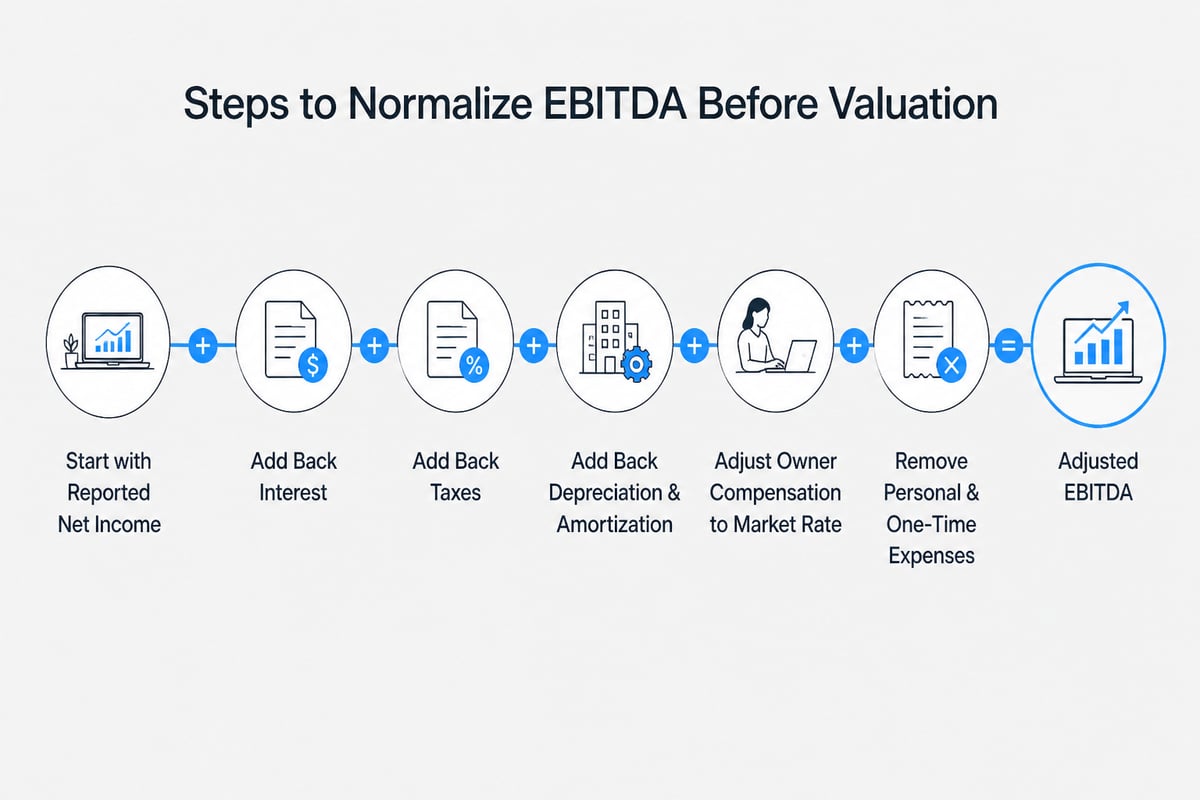
The calculation is straightforward:
- Start with net income.
- Add back interest expense.
- Add back income taxes.
- Add back depreciation and amortization.
Buyers favor the metric because it allows a clean comparison between companies with different debt loads, tax positions, and asset bases. It also has limits. EBITDA ignores capital expenditures, working capital needs, and the cash required to replace aging equipment. A business with high EBITDA and heavy ongoing capital spending is worth less than the headline figure suggests, which is why sophisticated buyers examine both. For a deeper look at the metric itself, see Aligned IQ's guide to EBITDA and valuation in M&A transactions.
Where Business Valuation Using EBITDA Fits Among Valuation Approaches
An EBITDA multiple is one application of the market approach, and it works best when read alongside the other accepted methods. The Internal Revenue Service recognizes three generally accepted approaches: asset-based, market, and income. Its guidance directs appraisers to consider all three and select the approach and method best suited to the business interest.
An EBITDA multiple sits inside the market approach because the multiple comes from what buyers have paid, or what public investors pay, for similar earnings. A discounted cash flow model belongs to the income approach, and a net asset calculation belongs to the asset-based approach. MPI’s overview of business valuation methods explains how comparable companies and transactions are used to derive these multiples.
The IRS guidance also contains a principle that matters in practice: a multiple must be consistent with the benefit stream being measured, whether pre-tax or after-tax income or cash flow. An EBITDA multiple applies to EBITDA, not to net income or revenue. Mixing them produces numbers that look precise and mean nothing.
Step One: Normalize EBITDA Before You Apply Any Multiple
The earnings figure you multiply must reflect what a new owner would earn, so adjusted or normalized EBITDA is the correct starting point, not the number on your tax return. Normalization removes items that are unusual, non-recurring, or specific to the current owner.
Common adjustments include:
- Owner compensation. Replace the owner's actual pay with the market salary of a manager who would do the same job.
- Personal expenses. Remove vehicles, travel, or family payroll that run through the business but would not continue under a new owner.
- One-time events. Exclude legal settlements, a unique equipment sale, or pandemic-era subsidies.
- Below-market arrangements. Adjust rent paid to a related party if it differs from market rates.
This is where valuations are won or lost. Aggressive addbacks that a buyer cannot verify tend to be removed during diligence, and the purchase price drops with them. Aligned IQ's article on how unrealistic EBITDA addbacks affect buyer negotiations covers the pattern in detail, and its piece on adjusted or normalized EBITDA explains why judgment is involved.
Step Two: Choose an EBITDA Multiple You Can Defend
The right multiple reflects how similar businesses have actually sold, adjusted for your company's size, growth, risk, and industry. There is no single correct number, and published averages are starting points rather than answers.
Multiples vary widely by sector and shift with market conditions. Equidam's July 2025 update, which drew on public companies with data as of July 15, 2025, shows how sharply they can move. An estimate built on a stale multiple can be significantly off.
Public-company multiples also overstate what a private business can expect. Smaller companies usually sell at lower multiples than large public ones because buyers face greater concentration, key-person, and liquidity risk.
Factors that typically push a multiple higher or lower:
| Factor | Tends to raise the multiple | Tends to lower the multiple |
|---|---|---|
| Customer base | Diversified, recurring revenue | One or two customers drive most sales |
| Management | Team can run the business without the owner | Owner holds key relationships |
| Growth | Steady, documented growth | Flat or declining earnings |
| Systems | Documented processes and clean financials | Informal records, undocumented processes |
| Capital needs | Low ongoing capex | Heavy equipment or facility reinvestment |
Aligned IQ's guide on using comparables to estimate the value of your business walks through sourcing transaction data, and the Xero overview of business valuation methods and earnings multiples discusses the factors that affect the multiplier.
How to Go From EBITDA to Enterprise Value
To move from EBITDA to enterprise value, multiply normalized EBITDA by the chosen multiple. The result is the value of the operating business, independent of how it is financed.
For a typical scenario, consider a business with $1.2 million in normalized EBITDA and a defensible multiple range of 4.0x to 5.0x. Enterprise value would fall between $4.8 million and $6.0 million. Presenting a range is more credible than a single figure, because buyers will negotiate within it based on risk and fit.
Keep two practical points in mind:
- Use a trailing figure, with context. Many buyers look at the last twelve months, and some weigh a three-year average if earnings are volatile.
- Document every adjustment. A figure supported by invoices, payroll records, and contracts holds up under diligence. An unsupported figure invites a lower offer.
What Is Enterprise Value for a Private Company?
Enterprise value for a private company is the total value of its operating business, covering both the owners' equity and any debt financing, before deducting that debt or adding surplus cash. It answers the question of what the business itself is worth to a buyer who acquires it on a cash-free, debt-free basis.
Private company deals are commonly structured this way. The buyer pays for the operations, the seller settles outstanding debt from the proceeds, and cash is typically kept by the seller or paid for separately. This is why a quoted "enterprise value" and the check you receive are different numbers.

From Enterprise Value to What You Take Home
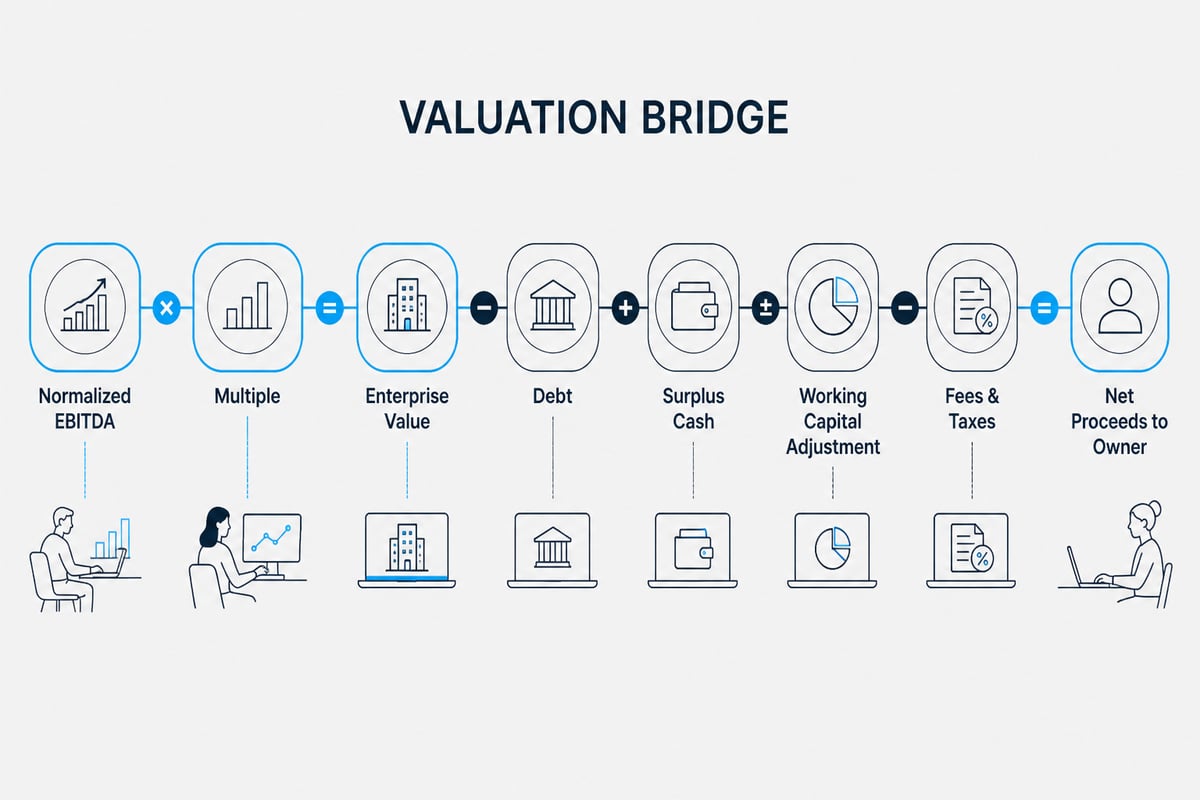
Equity value, the amount available to owners, equals enterprise value minus debt plus surplus cash, then reduced by transaction costs and taxes. Owners who skip this step often anchor on a headline number that never reaches their bank account.
A typical scenario illustrates the bridge:
- Start with enterprise value, for example $5.4 million.
- Subtract interest-bearing debt, such as term loans and equipment financing.
- Add excess cash not needed to run the business.
- Adjust for a working capital target agreed with the buyer.
- Deduct advisory fees and expected taxes to estimate net proceeds.
Deal structure also changes the result. Earnouts, seller notes, and rollover equity all shift how much value is paid at closing versus later. When buyer and seller disagree on price, earnouts can bridge valuation gaps, and Aligned IQ's article on bridging valuation gaps in M&A covers other options.
When Would You Use EV/EBITDA vs. P/E?
EV/EBITDA is the better choice when comparing businesses with different capital structures, while price-to-earnings (P/E) suits companies with similar debt levels and tax profiles. Because EV/EBITDA measures the whole operating business, it is neutral to how the company is financed. P/E measures only the equity and is distorted by leverage and tax differences.
For owner-operated and lower middle-market companies, EV/EBITDA is the standard. Private businesses vary widely in debt, owner pay, and accounting treatment, and P/E multiples depend on net income figures that those differences can distort. A buyer financing an acquisition cares about operating cash generation, which EBITDA approximates more closely than net income. P/E can still serve as a cross-check when a business is debt-free and tax treatment is simple.
Where EBITDA Multiples Mislead
An EBITDA multiple can overstate value when earnings are low quality, capital intensive, or dependent on the owner. Recognizing these cases before a buyer does gives you time to address them.
- Capital-intensive operations. If equipment must be replaced regularly, EBITDA overstates distributable cash. Review how past investment decisions affected value, as discussed in Aligned IQ's piece on the cumulative impact of capital expenditure decisions.
- Owner dependence. If customers buy from you personally, the earnings may not transfer. Transferable value is the central test, explored in unlocking transferable value.
- Intangible assets. A company whose worth rests on patents or proprietary technology may be undervalued by a pure earnings multiple. In those cases, specialist review such as patent intelligence from Patent Intelligence Group can help establish what the intellectual property contributes.
- Early-stage or loss-making businesses. With little or no positive EBITDA, a multiple has nothing to act on, and revenue or asset-based methods are more appropriate. Aligned IQ's guide to business value based on revenue addresses these cases.
Building Value Before You Go to Market
The most reliable way to raise a valuation is to raise normalized EBITDA and lower perceived risk well before a sale process begins. Because the multiple applies to every dollar of adjusted earnings, small improvements compound.
Practical steps include documenting processes, diversifying customers, developing a management team that can operate without you, and cleaning up financial reporting so that addbacks are easy to verify. Aligned IQ's ten tips for making your business exit-ready and its article on understanding business value before a sale give a practical checklist.
How Aligned IQ M&A and Aligned IQ VDR Support the Process
Aligned IQ M&A and Aligned IQ VDR are two distinct tools that serve different stages of a sale. Keeping them separate helps owners understand what each one does.
Aligned IQ M&A is the private match-making web platform. Strategy comes before the deal: buyers and sellers agree on goals first, and matches are based on transaction priorities, deal size, and industry experience and expertise. Because buyers and sellers meet privately on the platform, owners can explore interest in a low-risk, confidential setting, which differs from the traditional M&A process of broad outreach and public marketing. For buyers, the platform is a semi-proprietary way to present themselves as an attractive exit option to owners who may not be actively listing a business. Owners preparing to sell can learn more about sell-side M&A advisory for business owners and the platform's exit planning and valuation support.
Aligned IQ VDR is the secure virtual data room for sharing deal documents, including the financial records that support your normalized EBITDA. It is complimentary for Aligned IQ M&A sellers after a match is completed, and it is available to other buyers, sellers, intermediaries, and M&A service providers at competitive rates. Current plans are listed on the Aligned IQ VDR pricing page.
FAQ
Can I value my business using EBITDA if I am the only employee?
Yes, but the owner's compensation adjustment becomes the most important step. You must replace your actual pay with the market cost of a manager so that EBITDA reflects what a buyer would earn. Businesses that depend entirely on the owner typically receive lower multiples because the earnings may not transfer.
How often should I update my EBITDA valuation?
Review it at least annually, and again before any conversation with a buyer or advisor. Multiples shift with market conditions, and your own earnings and risk profile change as the business develops. A current estimate keeps your price expectations realistic.
Should I rely on an EBITDA multiple alone?
No. Treat it as one input and cross-check it against other approaches, as the IRS guidance recommends. Comparing results from the market, income, and asset-based methods shows whether your estimate is reasonable. Aligned IQ's guide to calculating business valuation methods outlines best practices for doing so.
Your next step is to calculate normalized EBITDA for the last three years, with documentation for every adjustment, so you know where you stand before any buyer asks. From there, Aligned IQ M&A lets you explore privately with buyers whose strategy fits yours, and Aligned IQ VDR keeps your supporting documents organized and secure. To see how both work, Contact Aligned IQ and take a tour of the platform.
No responses yet