

A certified valuation is a business valuation prepared or reviewed by a professional who holds a recognized credential, most often the Certified Valuation Analyst (CVA) designation issued by NACVA. For owners preparing to sell and buyers pricing an acquisition, that credential signals a defined education standard, tested technical knowledge, and a documented method behind the number. This guide explains how someone earns the CVA, what it costs, how long it takes, and how to use a credentialed valuation in a real transaction.
What a Certified Valuation Means in Practice
A certified valuation is an opinion of value produced by a credentialed analyst who follows professional standards and documents the methods, assumptions, and data behind the conclusion. The credential does not guarantee a higher or lower number. It confirms that the person producing the number met specific qualification and testing requirements.
Related terms cause confusion, so it helps to separate them:
- Business valuation is the process of estimating what a company is worth using income, market, and asset-based approaches.
- A valuation certificate is a document stating a value as of a specific date. Its credibility depends on who signed it and what support sits behind it.
- ABV certification is a separate credential from the AICPA, the Accredited in Business Valuation designation, which is also held by CPAs.
- CVA is the NACVA credential this guide covers.
For a deeper look at how value is built from financial inputs, Aligned IQ's overview of business valuations and its guide to financial valuation methods are useful companions.
Who Qualifies for the CVA Credential?
Eligibility starts with an active professional license: applicants must hold an active, valid, unrevoked CPA license, and NACVA’s qualification requirements also list a business degree and substantial business-valuation experience.
NACVA describes substantial experience, for example, as two or more years of full-time-equivalent valuation work or participation in at least 10 valuations in a significant role. In plain terms, the CVA is built for working accounting and finance professionals, not newcomers to the field.
A typical candidate looks like one of these:
- A CPA in a mid-sized firm who is increasingly asked to value client companies for succession planning
- A transaction advisory professional who wants a formal credential behind fairness and pricing analyses
- A finance leader at an acquirer who wants to evaluate targets with a recognized framework
If you are an owner rather than a practitioner, you will rarely pursue the credential yourself. You will hire someone who holds it, which makes understanding the path useful for judging the person you hire.
The Certification Path, Step by Step
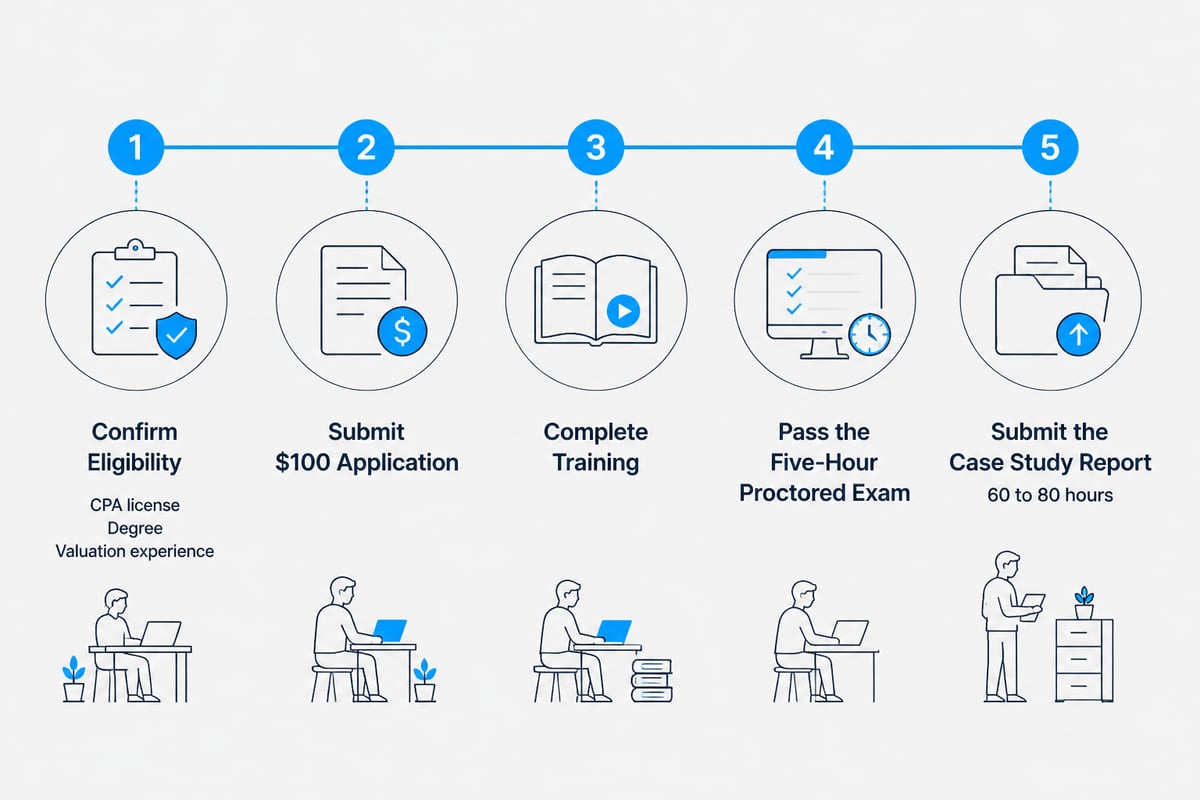
The path has five stages: confirm eligibility, apply, complete the training, pass the exam, and submit the case study.
- Confirm eligibility. Verify the license, degree, and valuation experience described above.
- Apply. The CVA application page lists a one-time application fee of $100.
- Complete training. Candidates prepare through coursework and review. NACVA's training center lists scheduled courses and training and exam package prices.
- Pass the exam. The CVA exam is a five-hour, proctored, multiple-choice examination.
- Submit the case study. NACVA estimates the case study requires 60 to 80 hours and involves preparing a comprehensive business valuation report.
The case study is where many candidates slow down. It is a full report, not a quiz, and it has to hold up under review the way a client deliverable would.
How Much Does the CVA Cost?
The published fixed fees are modest compared with the preparation time. NACVA lists a CVA exam fee of $625 and a one-time application fee of $100, so the baseline for those two items is $725.
| Cost item | Listed amount | Source of figure |
|---|---|---|
| Application fee (one time) | $100 | NACVA application page |
| CVA exam fee | $625 | NACVA certifications page |
| Training and exam packages | Varies by course and package | NACVA training center |
Training is the variable. Package prices depend on format and schedule, so check the training center for current figures rather than relying on an estimate. Beyond fees, the larger cost is time: the case study alone represents 60 to 80 hours that a practitioner cannot bill to clients.
For owners, a related cost question matters more: what does a credentialed analyst charge to value your company? Aligned IQ addresses that in its piece on business valuation cost.
How Long Does It Take to Become a CVA?
Most candidates should plan on several months from application to credential, with the case study driving the schedule. NACVA says exam results are typically provided within two weeks, while case-study results typically take two to four months.
A realistic timeline for a working professional looks like this:
- Weeks 1 to 2: Verify eligibility and submit the application.
- Weeks 3 to 10: Complete training and study for the exam.
- Exam day plus two weeks: Receive the exam result.
- Following 2 to 3 months: Write the 60 to 80 hour case study alongside regular client work.
- Two to four months after submission: Receive the case-study result.
Added together, a focused candidate can finish in several months, and a candidate balancing a full billable load may need longer. NACVA publishes credentialing resources with timing guidance, which is worth reading before you commit to a schedule.
What Is the Pass Rate for the CVA Exam?
NACVA does not publish a CVA exam pass rate in the sources reviewed for this guide, so no reliable figure can be quoted here. Rather than rely on forum estimates, treat the exam as a demanding professional test: five hours, proctored, and multiple choice, taken by candidates who already hold a CPA license and valuation experience.
What the available facts do tell you is where the risk sits. The exam result returns quickly, within about two weeks. The case study carries the longer review cycle and the heavier workload, so planning your time around it matters more than hunting for a pass-rate statistic.

Why a Certified Valuation Matters in a Sale or Acquisition
A credentialed valuation gives both sides of a deal a shared, defensible starting point, which narrows the disputes that stall transactions. Sellers use it to set expectations before going to market. Buyers use it to test whether an asking price rests on sound methodology or optimistic projections.
Consider a typical scenario: an owner has an informal number in mind based on a competitor's rumored sale, and a buyer's model lands well below it. When a credentialed analyst documents the normalized earnings, the chosen multiple, and the reasoning, both parties are debating assumptions rather than personalities. That is often where a valuation gap begins to close, sometimes with structural tools such as earnouts.
Tax and regulatory contexts raise the bar further. The IRS publishes business-valuation guidelines for its personnel who develop, resolve, and report valuation issues, which shows how closely a valuation can be scrutinized when estates, gifts, or compensation are involved.
How to Judge Whether a Credentialed Analyst Fits Your Deal
A credential is a floor, not a match. The right analyst for your transaction also needs relevant industry exposure and a clear explanation of their method. Before you engage someone, ask:
- How many valuations have they completed in your industry and size range?
- Which approach will they weight most heavily, and why?
- How do they normalize owner compensation and one-time expenses?
- What will the deliverable look like, and how will they defend it in a negotiation?
If you are comparing providers, Aligned IQ's guides to business valuation firms and the role of a business valuation specialist outline what to look for.
Where Valuation Fits Before You Sell: Strategy First
Many owners order a valuation and then discover their goals were never clear. The number alone does not tell you whether to sell now, wait, or restructure, and valuation is most useful when it sits inside a broader exit plan.
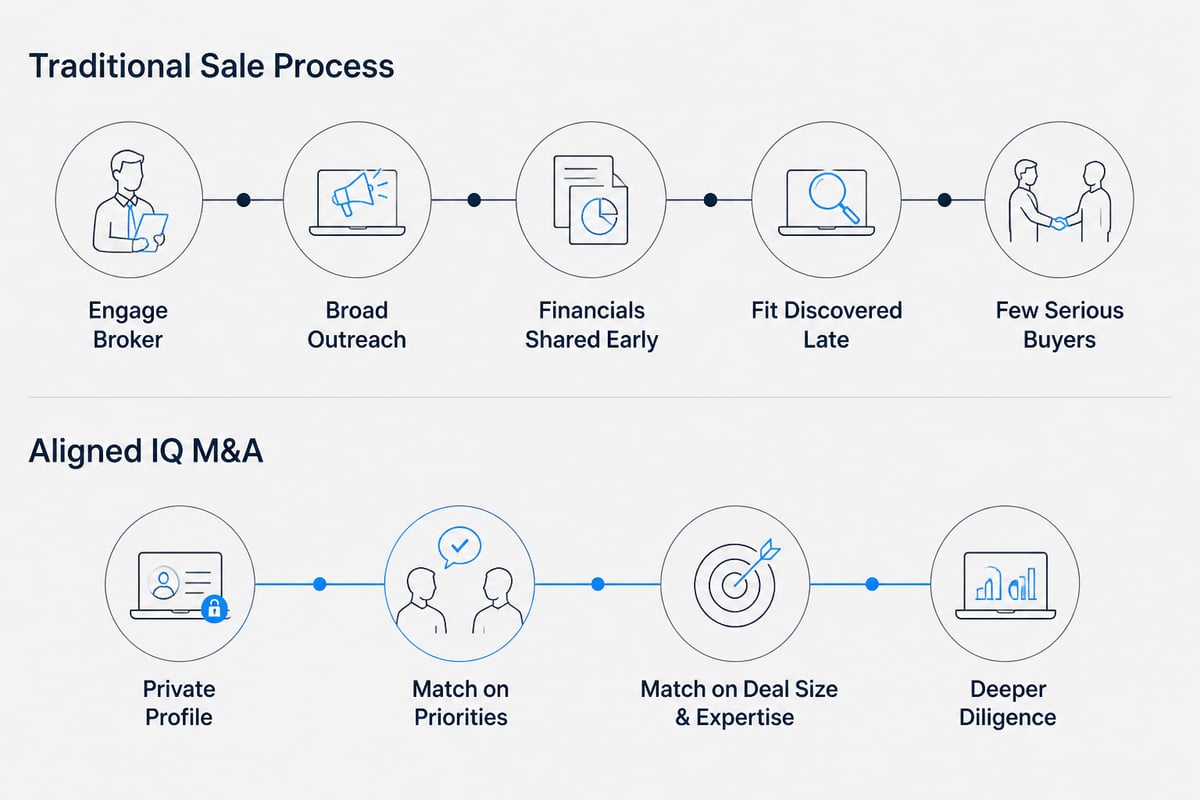
This is where the sequence matters. In a traditional M&A process, an owner often hires a broker, shares financials broadly, and only later learns whether a buyer's priorities match theirs. That exposes confidential information early and invests time before fit is established.
Aligned IQ M&A is a private, B2B web platform that reverses that order. Strategy comes before the deal, so buyers and sellers agree on goals first. Matches are based on transaction priorities, deal size, and industry experience and expertise, which means a seller's valuation work can be tied to counterparties whose strategic fit is already visible. For acquirers, the platform offers a stage to present themselves as an attractive exit option for owners. Because the process is private and fit-driven, sellers can limit who sees their details before a match is established.
Aligned IQ M&A and Aligned IQ VDR: Two Different Tools
These are separate products that serve different stages of a deal, and it helps to keep them distinct.
Aligned IQ M&A is the match-making platform. It is where buyers and sellers meet privately and explore potential deals based on strategic fit. Its focus is finding the right counterparty.
Aligned IQ VDR is a secure virtual data room for sharing deal documents. It serves lower middle-market buyers, sellers, M&A advisors, investment bankers, and other advisors. It is complimentary for Aligned IQ M&A sellers after a match is completed.
In practice, a seller might use a credentialed valuation report as one of the first documents placed in the data room, giving a matched buyer a documented basis for the conversation. Valuation professionals who work on deals can also explore M&A support for service providers, which describes how professionals can showcase their services and earn sell-side referrals.
FAQ
What is a valuation certificate?
A valuation certificate is a document stating the estimated value of a business or asset as of a particular date. Its weight depends on who prepared it, the methods used, and the support behind the conclusion, which is why a credentialed analyst's work is generally more persuasive in negotiations.
What is ABV certification?
ABV stands for Accredited in Business Valuation, a separate credential offered by the AICPA to CPAs who specialize in valuation. It is distinct from the CVA, though both aim to demonstrate competence in business valuation.
Do I need a CVA to value my own company before a sale?
No. Owners typically engage a credentialed professional rather than earn the credential themselves. The CVA matters mainly as a quality signal when you choose who prepares or reviews your valuation.
Your next step is to gather three years of financial statements and write down your goals for a sale, then use those to brief a credentialed analyst. When you are ready to see how a private, strategy-first process works, take a tour of Aligned IQ M&A and, if you are preparing documents for a deal, review the Aligned IQ VDR as the secure place to share them. To see how it fits your transition plans, Contact Aligned IQ and ask for a Take a Tour walkthrough.
No responses yet