

To value my business for sale, start with a normalized earnings figure, either Seller's Discretionary Earnings (SDE) or EBITDA, and multiply it by a market multiple drawn from comparable sales. That result gives you a working price range. Methods based on income and assets then test whether the range holds up. This guide explains each step, from the earnings numbers buyers care about to the factors that push a multiple up or down.
What Does It Mean to Value a Business Before a Sale?
Valuing a business means estimating the price a willing buyer would pay a willing seller, with both parties informed and neither under pressure. That definition matters because it separates fair market value from the figures owners often carry in their heads, such as total revenue, years of effort invested, or what a neighbor's company reportedly sold for.
Value is not the same as price. Value is an analytical estimate. Price is what a buyer actually agrees to pay after negotiation, financing, and deal structure come into play. A sound valuation gives you a defensible starting point for that negotiation.
Scale helps frame expectations. BizBuySell’s 2025 Fourth Quarter Insight Report recorded small-business sales in 2025 with a median sale price of $350,000. If your company sits near that size, the methods below apply directly. Larger companies lean more heavily on EBITDA and income-based analysis.
For a deeper look at why this step comes first, see understanding business value before a sale.
Which Earnings Number Do Buyers Use: SDE or EBITDA?
Buyers of owner-operated businesses typically use SDE, while buyers of larger, manager-run companies use EBITDA. Choosing the wrong one is a common source of pricing errors, so confirm which applies to you before you pick a multiple.
Seller's Discretionary Earnings (SDE) shows the total financial benefit available to a single full-time owner-operator. Calculate it as:
- Net profit before taxes
- Plus the owner's salary and benefits
- Plus interest, depreciation, and amortization
- Plus one-time or non-recurring expenses
- Plus personal expenses run through the business
EBITDA (earnings before interest, taxes, depreciation, and amortization) measures operating profit after paying a market-rate salary to a manager. It suits companies where the owner could be replaced by a hired executive.
Both figures should be normalized. That means adjusting the books so they reflect how the business would perform under a new owner, removing the one-time legal bill, the family member on payroll who does no work, or the personal vehicle expensed to the company. Every add-back should be documented, because buyers will test each one.
How Do I Figure the Value of My Business? A Step-by-Step Process
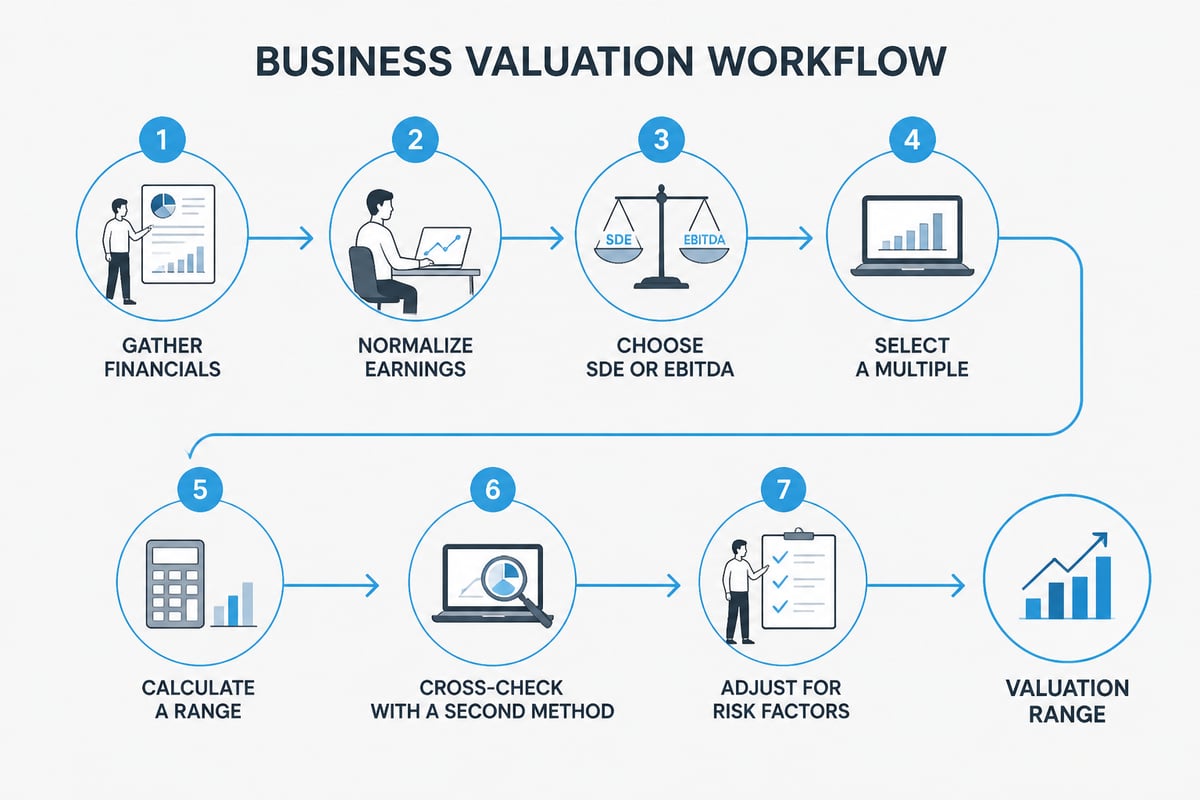
You figure the value of your business by normalizing earnings, selecting a method, applying a multiple, and cross-checking the result. Follow these steps in order:
- Gather three to five years of financial statements and tax returns.
- Normalize earnings by documenting every add-back and adjustment.
- Choose the appropriate earnings measure, SDE or EBITDA.
- Select a multiple from comparable transactions in your industry and size band.
- Calculate a range, not a single number, using low, mid, and high multiples.
- Cross-check with a second method, such as discounted cash flow or net asset value.
- Adjust for company-specific factors such as customer concentration or growth trend.
Owners who want a structured walkthrough of the pricing logic can also read about calculating business value for M&A success.
What Are the Common Business Valuation Methods?
The three common valuation methods are the market approach, the income approach, and the asset approach. Each answers a slightly different question, and most credible valuations use at least two.
Market approach: multiples of earnings
The market approach prices your business by comparing it with similar companies that have sold. You apply a multiple of SDE or EBITDA drawn from those transactions. It is the most common method for small and lower middle-market sales because buyers think in multiples when they screen opportunities.
Income approach: capitalization and discounted cash flow
The income approach values the business based on the cash it is expected to produce. Capitalization of earnings divides a single normalized earnings figure by a required rate of return. Discounted cash flow (DCF) projects several years of cash flow and discounts them to present value. DCF works best for companies with predictable, growing earnings, and it is highly sensitive to the assumptions you feed it.
Asset approach: net asset value
The asset approach totals the fair market value of the company's assets and subtracts liabilities. It sets a floor for asset-heavy businesses such as manufacturers, distributors, or companies with significant real estate or equipment. It undervalues companies whose worth lies in customer relationships, brand, or recurring revenue.
| Method | Best suited for | Main limitation |
|---|---|---|
| Market (multiples) | Most small and lower middle-market sales | Depends on quality of comparable data |
| Income (capitalization, DCF) | Stable or growing cash flow businesses | Sensitive to forecast assumptions |
| Asset (net asset value) | Asset-heavy or underperforming companies | Ignores goodwill and earnings power |
Is a Business Worth 5 Times Profit?
A business is sometimes worth five times profit, but many small businesses sell for far less, and the right multiple depends on size, industry, and risk. Five times earnings is a reasonable figure for a larger, stable, well-managed company. For a typical owner-operated small business, it would sit above the average.
The published data shows the spread. According to averages cited in the AI Biz Hub valuation guide, BizBuySell's 2021 to 2025 SDE multiples were 2.15x for restaurants, 2.58x for service businesses, and 2.62x for retail, and 3.10x for IT and software services, 3.32x for websites and e-commerce, and 3.31x for software, app, and SaaS businesses.
Those numbers cluster between roughly two and three and a half times SDE. Multiples above that range tend to appear when profit exceeds seven figures, earnings are recurring and documented, and the business runs without the owner.
How Much Is a Business Worth That Makes $300,000 a Year?
A business that makes $300,000 a year in SDE would typically be valued between about $600,000 and $1,000,000 using multiples of roughly 2x to 3.3x. The final number depends on what that $300,000 represents and how reliable it is.
Consider a typical scenario: a service company reports $300,000 in normalized SDE. At the service-sector average cited above, the indicated value would be roughly $750,000 to $800,000. A software-enabled business with the same earnings, at the roughly 3.3x average for that category, would indicate about $1,000,000. Both figures are starting points, and both shift with the factors covered in the next section.
If the $300,000 is EBITDA instead of SDE, the multiple often rises because the figure already reflects a market-rate manager salary. Be explicit about which measure you are using before comparing your result with any benchmark.
What Factors Move Your Multiple Up or Down?
A multiple rises when a buyer sees lower risk and clearer growth, and it falls when earnings depend on the owner, a few customers, or undocumented processes. Buyers adjust the multiple for the following:
- Owner dependence: Businesses that run without the owner command higher multiples.
- Customer concentration: A single customer above 20 to 25 percent of revenue is a common red flag.
- Recurring revenue: Contracts and subscriptions are valued above one-time sales.
- Growth trend: Rising revenue and margins support a higher multiple than flat or declining results.
- Financial quality: Clean, accurate, ideally reviewed or audited statements reduce perceived risk.
- Industry and size: Larger companies in favored sectors attract more buyers and higher multiples.
- Transferability: Documented systems, trained staff, and assignable contracts ease the transition.
Median figures also give context. BizBuySell reported a 2025 median cash flow of $158,950 and median revenue of $703,000 for businesses sold, as cited in the AI Biz Hub guide. Companies well above those medians often attract a broader buyer pool, including private equity and corporate acquirers.

How Do Deal Structure and Buyer Type Change the Number?
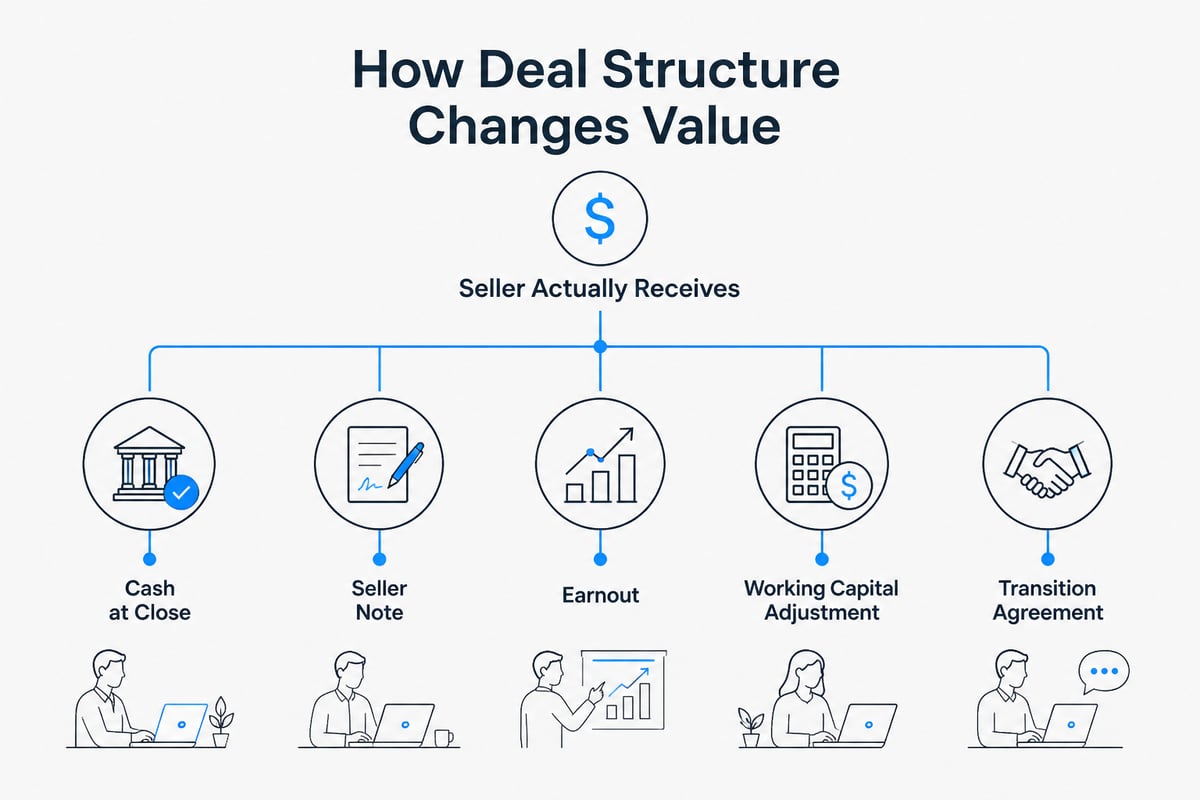
Deal structure can change what you actually receive without changing the headline price. A $1,000,000 offer paid entirely in cash at closing is worth more than a $1,100,000 offer with a large seller note, an earnout, or a long transition requirement.
Common structural elements include:
- Cash at close: The most certain portion of the price.
- Seller financing: A note you carry, which adds risk and delays proceeds.
- Earnouts: Contingent payments tied to future performance.
- Working capital adjustments: True-ups that can reduce proceeds at closing.
- Transition or consulting agreements: Time commitments that carry personal cost.
Buyer type matters as well. A private equity group may value scalability and add-on potential, a strategic corporate buyer may pay for synergies, and an individual buyer will focus on income replacement. The same business can reasonably be worth different amounts to each, which is why finding the right counterparty matters as much as the valuation itself.
How Do I Choose Between a Calculator, an Advisor, and a Formal Appraisal?
Online calculators give a fast first estimate, advisors give a market-tested opinion, and formal appraisals give a documented, defensible figure. The right choice depends on the stakes and the purpose.
A calculator is useful for a rough range when you are still deciding whether to sell. Its output is only as good as the inputs, and it cannot see your customer concentration or contract terms. An M&A advisor or broker brings real transaction experience and can calibrate the multiple to current buyer demand. A certified valuation appraisal is appropriate for estate planning, partner buyouts, divorce, or tax reporting, where the figure may need to withstand scrutiny.
Many owners combine approaches: a calculator for orientation, then an advisor for a pricing opinion before going to market. Related guidance is available on how to price your business for sale and business valuation for sale.
How Can I Raise My Valuation Before Selling?
You raise your valuation by reducing buyer risk and improving documented earnings, ideally twelve to thirty-six months before a sale. Most gains come from operational changes rather than financial engineering.
Priorities that tend to pay off:
- Reduce owner dependence by delegating key relationships and decisions.
- Diversify customers so no single account carries disproportionate weight.
- Convert one-time work to recurring revenue where the model allows.
- Clean up the financials and separate personal from business expenses well before a buyer reviews them.
- Document processes so a new owner can operate without guesswork.
- Resolve open issues such as pending disputes, expired licenses, or unclear contracts.
A structured plan helps. Aligned IQ's resources on how to prepare my business for a sale cover the preparation steps in more detail, and its financial planning guidance addresses the personal side of an exit.
How Does Aligned IQ Support Valuation and the Sale Process?
Aligned IQ puts strategy before the deal, so buyers and sellers agree on goals before detailed negotiation begins. Aligned IQ M&A is the web-based matching platform. It pairs sellers with buyers based on transaction priorities, deal size, and industry experience, and it keeps early conversations private. Compared with a traditional M&A process that often involves broad marketing of a listing, this approach is designed to be lower risk and more confidential for owners who want control over who learns their company is available.
For owners preparing to sell, the sell-side M&A advisory for business owners offering provides exit planning and valuation support in one place, delivered through the Aligned IQ platform.
Aligned IQ VDR is a separate product: a secure virtual data room for sharing deal documents with buyers, advisors, and bankers. It is complimentary for Aligned IQ M&A sellers once a match is completed, and it is competitively priced for other buyers, sellers, intermediaries, and M&A service providers. Current rates are listed on the Aligned IQ VDR pricing page.
Organized documentation also supports your valuation. A tidy data room that holds normalized financials, contracts, and add-back support helps a buyer verify your number rather than discount it.
What Should I Do If Real Estate Is Part of the Business?
If your business owns real estate, value the operating company and the property separately, because each is priced by different logic. The operating business is priced on earnings multiples, while the property is priced on appraisal or comparable sales.
Separating them also gives you options. You might sell both together, sell the business and lease the property to the buyer, or sell the property to an investor. When property transactions are part of your exit, regional specialists can help: for property sales on Spain's southern coast, Costa del Sol Specialist offers independent advisors for buyers and sellers, and for homeowners who want a fast cash sale of a residential property in Pittsburgh, JayZ Property Solutions LLC buys homes for cash without agent commissions.
FAQ
How often should I revalue my business?
Revalue at least annually if a sale is on the horizon, and again after any major change such as losing a key customer or signing a large contract. A regular refresh shows you which value drivers are improving and which need attention before buyers see them.
Do I need an appraisal to sell my business?
A formal appraisal is not required for most private sales, but it is useful when a figure must be defended to lenders, partners, tax authorities, or courts. For a standard sale, a pricing opinion from an experienced advisor combined with comparable transaction data is usually sufficient.
Does revenue or profit determine what my business is worth?
Profit determines value far more than revenue, because buyers pay for the earnings they can take home. Two companies with identical revenue can sell for very different prices if one has stronger, better documented, and more transferable profits.
Start by pulling together three years of financials and listing every add-back you can document, since that single exercise anchors every valuation method above. From there, Aligned IQ helps owners move from a number to a strategy, with a platform that prioritizes strategic fit and confidentiality ahead of the deal itself. To see how matching and the data room work together, Contact Aligned IQ and take a tour of the platform.
No responses yet