

You can value a company online by combining your own financial statements with one or more recognized valuation methods, then testing the result against comparable sales. A self-built estimate will not replace a formal appraisal, but it gives you a defensible range before you speak with a buyer, a banker or an advisor. This guide walks through the inputs you need, the three methods worth using, and the point at which a calculator stops being useful.
What a Company Valuation Online Can and Cannot Tell You
A company valuation online gives you an informed estimate of what your business might sell for, not a binding price. Online calculators and worksheets take your revenue, earnings and assets, apply a standard formula, and return a figure or range. The quality of that figure depends entirely on the quality of what you put in.
Where these tools work well:
- Setting a realistic expectation before you commit to an exit timeline
- Identifying which part of your financials drives value most
- Comparing your estimate against what a prospective buyer might offer
- Preparing for early conversations with potential counterparties
Where they fall short:
- They cannot see owner dependence, customer concentration or contract risk unless you adjust for it
- They rely on generic multiples that may not fit your sub-industry
- They do not reflect how a specific buyer values your strategic fit
Treat the output as a starting point. For a broader view of how estimates become negotiated prices, see this company valuation overview.
What You Need Before You Start
Accurate inputs matter more than the choice of tool, so gather your financial records before opening a calculator. Most valuation methods draw on the same small set of documents.
- Three to five years of profit and loss statements. Trends matter as much as the latest year.
- Current balance sheet. Assets and liabilities feed the asset-based method directly.
- Tax returns. These help reconcile reported income with actual performance.
- A list of owner expenses. Personal costs run through the business, above-market owner pay and one-time items all need adjusting.
- Customer and contract summaries. Concentration and renewal terms affect risk.
The most important step is normalizing earnings. Add back discretionary and non-recurring expenses, and adjust owner compensation to a market-rate salary for a replacement manager. The resulting figure, often called adjusted EBITDA or seller's discretionary earnings, is the number most buyers actually value. If you want to understand this metric first, this explainer on EBITDA company valuation covers the mechanics.
The Three Valuation Methods You Can Run Yourself
Three methods cover most small and midsize businesses: income, market and asset-based approaches. The U.S. Small Business Administration identifies these as the common valuation methods, describing the income approach as projected revenue adjusted for risk, the market approach as a comparison with similar recent sales, and the asset approach as asset value minus liabilities.
| Method | Core input | Best suited to | Main weakness |
|---|---|---|---|
| Earnings multiple (market) | Adjusted EBITDA or SDE | Profitable, stable operating businesses | Depends on finding relevant comparables |
| Discounted cash flow (income) | Cash flow forecasts | Companies with predictable or growing cash flow | Sensitive to forecast and discount rate assumptions |
| Asset-based | Assets minus liabilities | Asset-heavy or underperforming companies | Ignores earning power and goodwill |
Running all three and comparing them is more reliable than trusting any single output. If the numbers cluster, your estimate is probably sound. If they diverge widely, that gap is itself useful information.
How to Value a Company With an Earnings Multiple
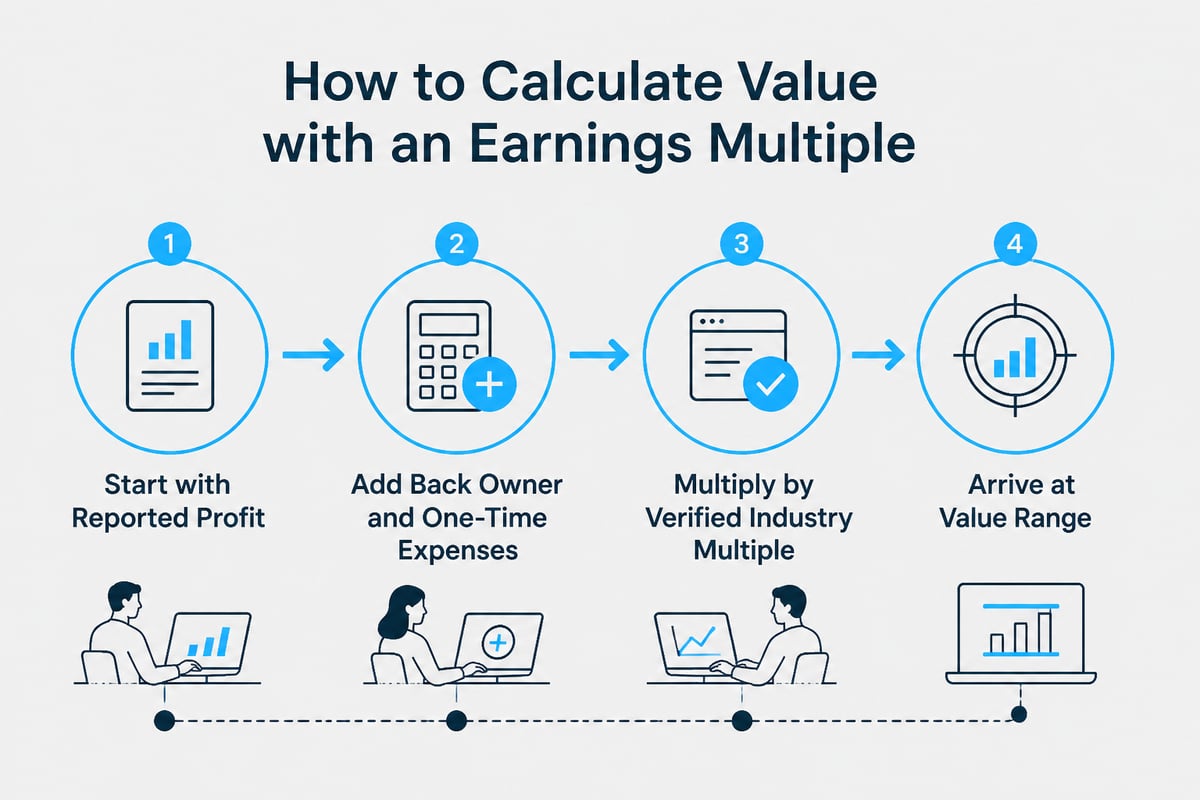
The earnings multiple method multiplies your adjusted earnings by a factor drawn from comparable business sales. Bank of America describes this approach, which applies a multiple based on comparable firms' recent sales to EBITDA, as a common method for small and midsize businesses being considered for sale.
The calculation is simple:
Estimated value = Adjusted EBITDA × Industry multiple
Suppose a business shows adjusted EBITDA of $400,000 and comparable companies in its sector have sold at multiples in a range the owner has verified against recent sales. The implied value is the EBITDA multiplied by that verified range. Where you land inside that range depends on factors such as growth, margin stability, customer diversification and how much the company relies on you personally.
Two cautions apply. First, multiples vary by industry, size and deal structure, so a number you read in a general article may not match your sector. Second, a single multiple hides risk. Two companies with identical EBITDA can deserve very different multiples if one depends on a single customer and the other does not.
For revenue-based shortcuts and when they are appropriate, read about company valuation based on revenue.
Using Discounted Cash Flow When Earnings Are Changing
Discounted cash flow, or DCF, values a company by projecting future cash flows and converting them to present value. Bank of America notes that the DCF method estimates value by discounting projected cash flows, and that it depends on forecasts of future cash generation.
That dependency is the central limitation. A DCF built on optimistic growth assumptions will produce an impressive and unreliable number. Use it when your cash flows are reasonably predictable, such as a business with recurring contracts, or when growth is changing materially and a simple multiple would miss it.
A practical approach for an owner working alone:
- Project cash flow for five years using conservative, base and downside scenarios
- Choose a discount rate that reflects the risk of a small private company, which is typically higher than the rate for a large public one
- Calculate a terminal value for the years beyond your forecast
- Compare the three scenarios to see how sensitive the result is to your assumptions
If the value changes dramatically with small changes in the discount rate, treat the DCF as a sanity check rather than a headline figure.
The Asset-Based Method as a Floor
The asset-based method sets a floor value by subtracting liabilities from the value of assets. The SBA lists this asset approach as one of the three common methods, and it works as follows: list tangible assets at fair market value, add identifiable intangibles where they can be supported, and deduct all obligations.
This method suits businesses where assets are the main source of value, such as equipment-heavy operations, real estate holdings or companies being wound down. It undervalues service, software and brand-driven companies, where most of the worth sits in earnings, relationships and goodwill that never appear on a balance sheet.
For most operating businesses, the asset-based figure works best as a lower bound. If your earnings-based estimate falls below your net asset value, that is a signal to examine whether the business is underperforming or whether assets are better sold than held.
Matching Your Business Type to the Right Approach
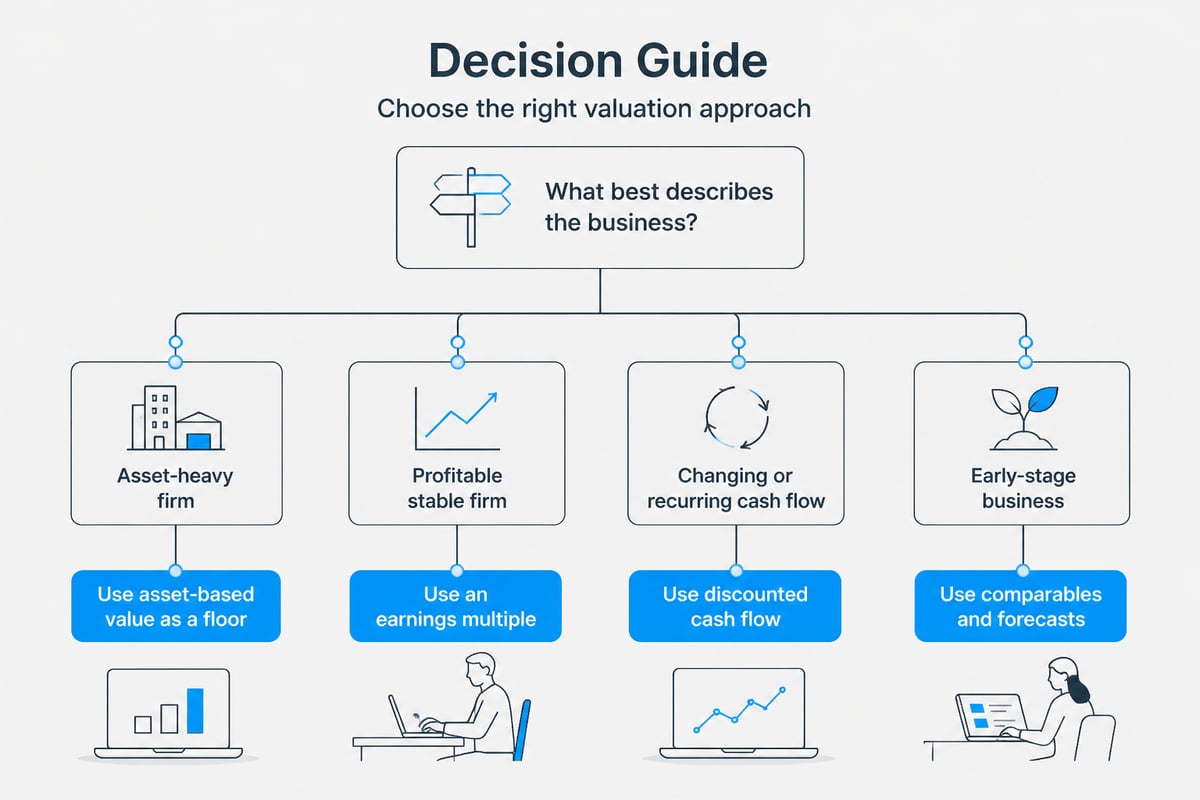
The right method depends on how your company makes money, so choose accordingly rather than defaulting to one formula. Several business types have their own conventions:
- Established service or manufacturing firms: Earnings multiples anchored on adjusted EBITDA, cross-checked with a DCF
- Asset-heavy businesses: Asset-based value as a floor, earnings multiple as the ceiling
- Subscription and software companies: Recurring revenue and retention metrics often matter alongside profit; see the guidance on valuation of a SaaS company
- Early-stage companies: Limited profit history makes comparables and forecasts more important; the page on startup company valuation covers the specifics
- Smaller owner-operated firms: Seller's discretionary earnings often replaces EBITDA; the notes on small company valuation explain the distinction
Can AI Do a Business Valuation?
AI tools can assist with a business valuation by organizing financials, suggesting comparable multiples and running scenario math, but they cannot produce a reliable value without verified inputs and human judgment. A general-purpose AI model does not have access to current private-company transaction data, and it may state a multiple with confidence that nothing supports.
Use AI for the mechanical parts: formatting statements, building a spreadsheet, drafting a list of add-backs to review. Verify every number it supplies against a source you can name. Where an output depends on a comparable multiple, confirm that multiple independently. Dedicated company valuation software can also structure the calculation, though the same input-quality rule applies.
How Much Is a Business Worth With $500,000 in Sales?
A business with $500,000 in sales has no fixed value, because worth is driven by profit, not revenue alone. Two companies with the same sales can produce very different earnings, and they would be priced very differently.
Revenue multiples exist, and they are sometimes used as a rough cross-check, but they ignore margin entirely. If you are working from sales figures, find out how earnings relate to them first.

Is a Business Worth Three Times Profit?
A multiple of profit is a common way to frame small business value, but it is a rule of thumb that varies by company and must be checked against comparable sales. Smaller, owner-dependent companies often sell at lower multiples of adjusted earnings, while larger, more diversified or faster-growing ones can command more.
Treat any single multiple with caution. Specific factors that push a multiple up or down include:
- Dependence on the owner or a few key employees
- Customer concentration
- Recurring versus project-based revenue
- Growth trend and margin stability
- Quality of financial records
Cleaner books and a less owner-dependent operation justify a higher multiple. If you find your estimate sits well below what you expected, our piece on bridging valuation gaps discusses how sellers and buyers close the difference.
When an Online Estimate Is Not Enough
An online estimate is enough for planning, but a transaction needs a number that survives a buyer's scrutiny. Buyers conduct their own analysis, test your add-backs, and often adjust for risks you underweighted. The more your estimate depends on judgment calls, the more it will be challenged.
An independent opinion is worth considering when you face any of these situations:
- A legal, tax or estate purpose that requires a formal appraisal
- A buyer who disputes your add-backs or earnings quality
- A business with complex structure, multiple entities or significant intangible assets
- A valuation gap you cannot explain with your own analysis
Many owners find that the biggest risk in selling is not the valuation but the process around it. In a traditional sale, a seller may broadcast information widely and negotiate before confirming that the counterparty fits. A private company valuation is only the first step in a longer path.
Where Aligned IQ Fits Into the Process
Valuation is one part of preparing an exit, and Aligned IQ combines exit planning and valuation support in one place. Aligned IQ M&A is a proprietary B2B match-making platform where business owners and potential buyers can meet privately. Matches reflect transaction priorities, deal size, and industry experience, so strategic fit is considered before either side invests heavily in the process. For sellers, this offers a low-risk, confidential, secure alternative to the traditional M&A process, where a business may be marketed broadly before fit is known.
Its sell-side support for business owners preparing for a sale runs through this platform, and buyers on it are positioned as attractive exit options for owners. This semi-proprietary approach means owners can explore interest without publicly listing the company. For detailed service terms, consult the Aligned IQ site directly.
Sharing Valuation Documents Securely
Once a serious conversation starts, your valuation inputs and supporting documents need to move through a secure channel. The Aligned IQ VDR is a separate product from Aligned IQ M&A: a secure virtual data room for lower middle-market buyers, sellers, M&A advisors, investment bankers and other advisors. It is complimentary for Aligned IQ M&A sellers once a match is completed, and it is competitively priced for other users. Review the competitive VDR pricing for current details.
To keep the two straight: Aligned IQ M&A is where you find and vet a counterparty, and Aligned IQ VDR is where you share financials, contracts and diligence materials once a deal is moving. Organizing your documents in a data room early can also show buyers that your records are well organized.
A Practical Workflow for Your Own Estimate
A repeatable process produces a more reliable estimate than a single calculator run. Follow these steps in order:
- Collect financials for the last three to five years.
- Normalize earnings by removing personal, one-time and non-market expenses.
- Run an earnings multiple using a defensible range from comparable sales.
- Build a conservative DCF if cash flow is predictable or changing.
- Calculate net asset value as a floor.
- Compare the three outputs and note where they diverge.
- Document your assumptions so you can explain every figure to a buyer.
- Stress test the result by lowering earnings and raising the discount rate.
The output should be a range, not a point. A range of, for example, $1.4 million to $1.9 million, supported by a clear explanation of what pushes the value up or down, is far more useful in a negotiation than a single confident number. For a deeper look at the methodology behind each approach, the guide to calculating company valuation is a useful companion.
FAQ
What are the top three valuation methods?
The three most widely used methods are the income approach, the market approach and the asset-based approach. The income approach projects future cash flows or earnings, the market approach compares your company with similar recent sales, and the asset-based approach subtracts liabilities from the value of assets.
How accurate is an online valuation?
An online valuation is only as accurate as the financial data and multiples behind it. It works well as a planning range, but it typically does not capture risks such as owner dependence or customer concentration unless you adjust for them. Expect a buyer to test your numbers independently.
Should I get a formal valuation before I sell?
A formal valuation is worth considering when a legal, tax or estate requirement calls for one, or when a buyer disputes your figures. For early planning, a self-built range from several methods is often sufficient. Many owners start with their own estimate and add an independent opinion later.
Your next step is to gather three years of financial statements and calculate adjusted EBITDA, since every method above depends on that figure. Once you have a defensible range, Aligned IQ can help you move from estimate to action: Aligned IQ M&A lets owners explore confidential matches where strategic fit comes first, and the Aligned IQ VDR gives you a secure place to share deal documents after a match. Take a Tour to see how the platform works.
No responses yet