

The net value of a business is what remains after you subtract total liabilities from total assets, which gives you its book value. A buyer, however, pays for earning power and risk, so the figure that matters in a sale is usually a market-based estimate built on top of that starting point. This article walks through both calculations and shows how they connect.
What Does the Net Value of a Business Mean?
The net value of a business is the owner's stake in the company: everything it owns minus everything it owes. On paper, this is the same as equity on the balance sheet.
The formula is simple. According to Xero, book value is total assets minus total liabilities, and it represents the accounting value of the owner's stake, not necessarily the price a buyer would pay. That distinction drives most of the confusion owners face when they begin thinking about a sale.
Three terms are often used interchangeably, and they should be separated:
- Book value (net asset value): assets minus liabilities as recorded on the balance sheet.
- Fair market value: the price a willing buyer and willing seller would agree on, with neither under pressure and both reasonably informed.
- Enterprise value: the value of the operating business before considering debt and cash, which buyers often use as a headline figure.
Net value is a floor for thinking, not a ceiling. For a profitable service business with few physical assets, book value may be a small fraction of what a buyer will pay. For a capital-heavy business with weak earnings, book value may overstate it.
How to Calculate Book Value Step by Step
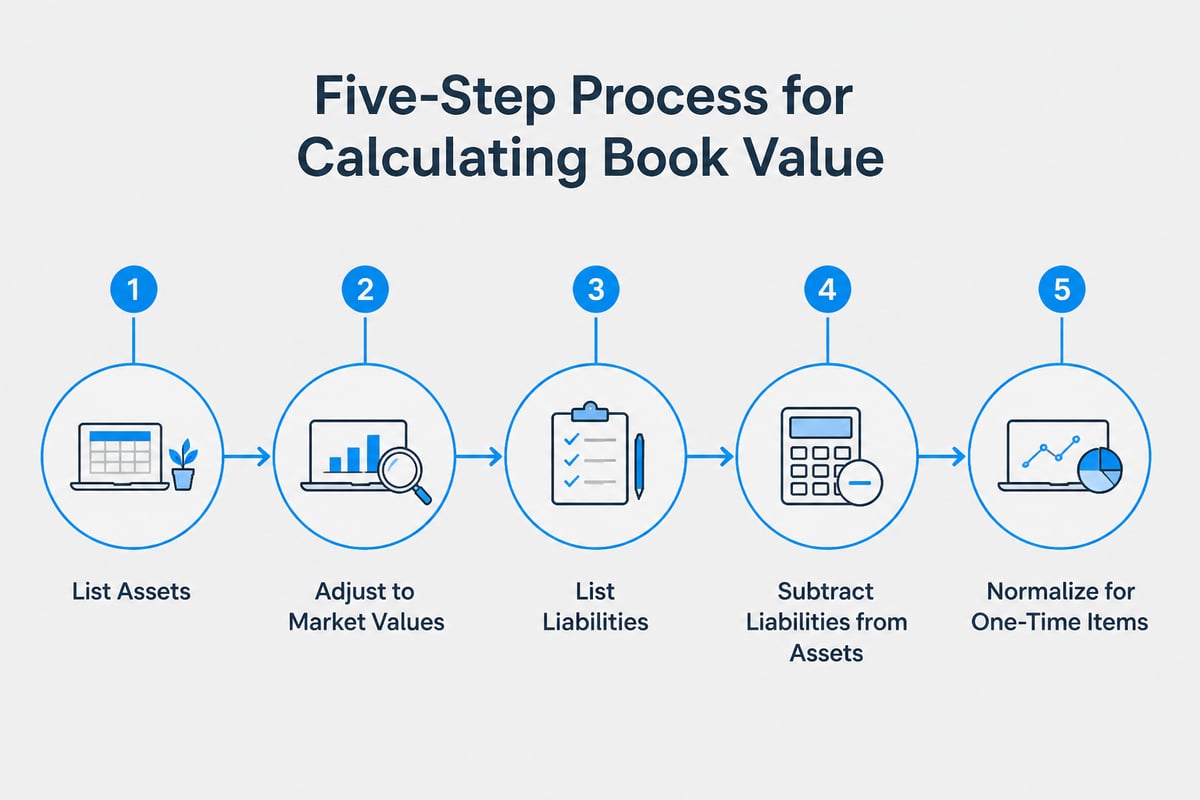
You can calculate book value in five steps using your most recent balance sheet.
- List all assets. Include cash, accounts receivable, inventory, equipment, real estate, vehicles, and any other items you own.
- Adjust assets to realistic values. Balance sheets often record equipment at depreciated cost, which may differ from what it would fetch today. Balance sheets often record assets at historical cost, which can differ from current market value, so decide which basis to use for each asset.
- List all liabilities. Include accounts payable, accrued expenses, loans, lines of credit, leases, deferred taxes, and any known legal or warranty obligations.
- Subtract liabilities from assets. The result is your book value.
- Normalize for one-time items. Remove personal expenses run through the business, non-recurring gains, and unusual write-offs so the figure reflects ordinary operations.
Here is a simple layout to follow:
| Line item | What to include | Common adjustment |
|---|---|---|
| Current assets | Cash, receivables, inventory | Write down slow-moving inventory and uncollectible receivables |
| Fixed assets | Equipment, property, vehicles | Restate to current market value rather than depreciated cost |
| Current liabilities | Payables, accruals, short-term debt | Confirm nothing is missing or unrecorded |
| Long-term liabilities | Loans, leases, deferred obligations | Include obligations a buyer would assume |
| Net value | Assets minus liabilities | Normalize for one-time items |
Run the calculation twice: once at book figures and once at adjusted market figures. The gap between the two tells you how much your balance sheet understates or overstates reality.
Why Book Value Rarely Equals What a Buyer Will Pay
Book value rarely equals the sale price because buyers pay for future earnings, transferable systems, and reduced risk, none of which appear fully on a balance sheet.
Intangible assets are the largest source of the gap. Asset-based valuation is typically a baseline, with tangible assets separated from intangibles such as intellectual property and customer lists. Customer relationships, brand reputation, proprietary processes, trained staff, and recurring contracts all carry value that accounting rules may not record.
Consider what a buyer actually evaluates:
- Earnings quality: how stable and repeatable profits are. Recurring revenue from long-standing customers supports a stronger price than project-based income. Aligned IQ discusses this in its piece on improving revenue quality.
- Owner dependence: whether the business runs without you. A company that relies on one person's relationships is harder to transfer, a theme covered in unlocking transferable value.
- Risk profile: customer concentration, key-person exposure, regulatory issues, and weak controls all reduce what a buyer will pay.
- Growth potential: credible opportunities that a buyer can pursue after closing.
A useful rule of thumb: the more your value sits in people, relationships, and processes rather than in assets, the wider the gap between net value and market value.
How to Estimate the Net Value of a Business Using Earnings
To estimate the value of your company on an earnings basis, adjust your profit to reflect what a new owner would actually earn, then apply a multiple that reflects your industry and risk.
The most common earnings measure for smaller private companies is seller's discretionary earnings (SDE) or EBITDA. The steps are:
- Start with net income from your income statement.
- Add back interest, taxes, depreciation, and amortization.
- Add back owner compensation above or below market rate, personal expenses, and one-time costs.
- Arrive at adjusted earnings.
- Multiply by an industry-appropriate multiple.
Multiples vary widely by industry, size, growth, and risk, so no single number applies to every company. For a deeper walkthrough, Aligned IQ explains business valuation using EBITDA and how to use comparables to estimate value.
Hypothetical example: a business with adjusted earnings of $400,000 and an industry multiple of 3.5 would produce an enterprise value estimate of $1.4 million. Buyer and seller then negotiate adjustments for debt, cash, and working capital to arrive at the equity value the owner receives.
Is a Business Worth 3 Times Profit?
Some owners use a rule of thumb of a multiple of annual profit, but no single multiple fits every company. Small, owner-dependent businesses often sell at lower multiples, while companies with recurring revenue, strong management, and growth can command more.
Treat any single multiple with caution. The multiple moves with these factors:
- Industry norms and buyer demand
- Size of earnings (larger earnings generally attract higher multiples)
- Revenue stability and customer diversification
- Dependence on the owner
- Growth trend over the last three to five years
Use a multiple as a cross-check against your book value and comparables, not as the sole basis for a price expectation. Aligned IQ's article on business valuation mythology addresses several common shortcuts owners rely on.
How Much Is a Business Worth With $1,000,000 in Sales?
A business with $1,000,000 in sales has no fixed value, because price depends on profit, not revenue alone. Two companies with identical sales can differ widely in worth if one earns a 25 percent margin and the other earns 5 percent.
Revenue-based methods exist, and they work best as a rough screen. Aligned IQ outlines these in guides on valuing a business based on revenue and business value based on turnover.
To move from sales to a credible estimate, you need three numbers: adjusted earnings, the nature of your revenue (recurring versus one-time), and your debt and working capital position. Without those, any figure is a guess.

Which Valuation Method Should You Use?
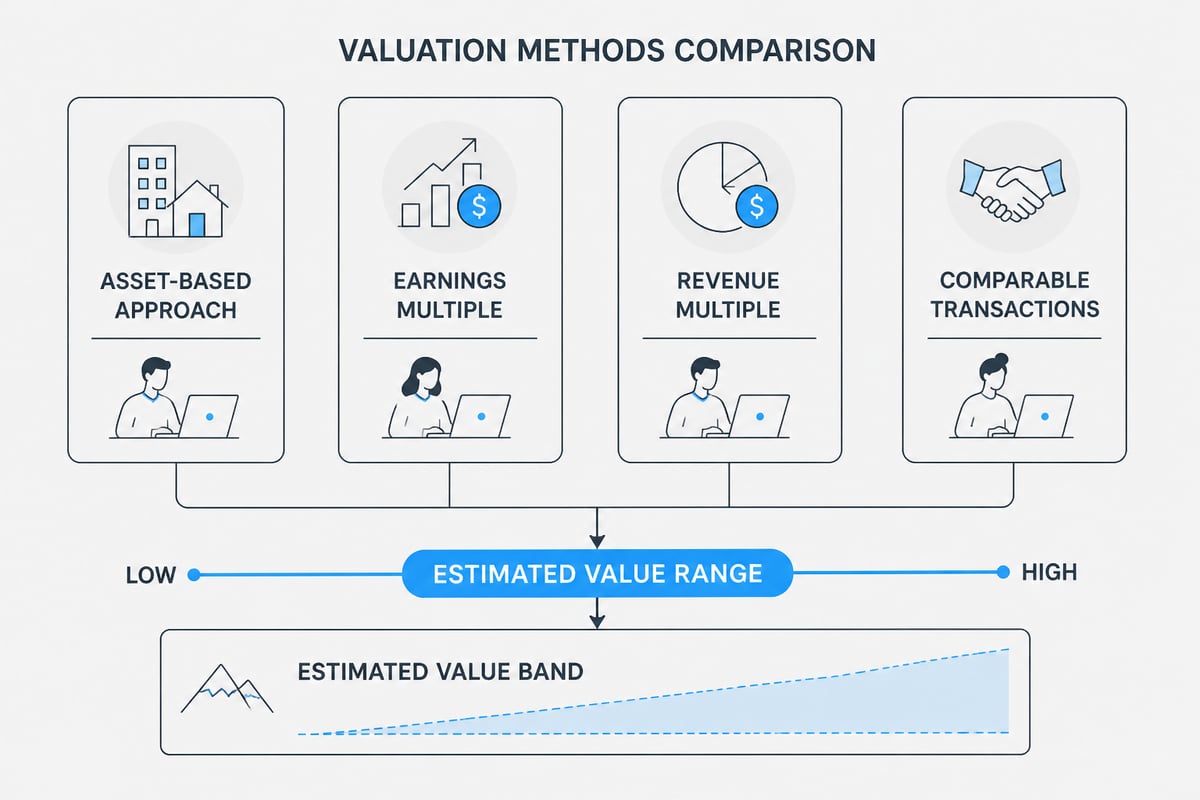
Use the method that matches how your business creates value, and compare at least two so you have a range instead of a single number.
| Method | Best suited to | Main limitation |
|---|---|---|
| Asset-based (book value) | Asset-heavy or struggling businesses | Ignores earning power and intangibles |
| Earnings multiple (SDE or EBITDA) | Profitable, stable operating businesses | Multiple selection is subjective |
| Revenue multiple | Quick screening, some recurring-revenue models | Ignores profitability |
| Comparable transactions | Industries with visible deal data | Private deal data can be limited |
Triangulating across methods is more reliable than relying on one. If the asset-based figure is $600,000 and the earnings-based figure is $1.4 million, the difference is your intangible and goodwill value, and it is worth understanding why a buyer would pay for it.
What Raises the Net Value of Your Business Before a Sale?
You can raise the value a buyer assigns by reducing risk and making earnings more transferable, and these changes usually take twelve months or more to show up in the numbers.
Focus on the factors buyers scrutinize most:
- Document your systems. Written processes make the business less dependent on you. See how putting the right systems in place can drive value.
- Reduce concentration. If one customer or supplier represents a large share of revenue or cost, work to diversify.
- Strengthen the management team. A capable second tier signals that the business survives your departure.
- Clean up the financials. Reliable, consistently prepared statements shorten diligence and protect price.
- Review capital spending. Past investment decisions affect current earnings; this is examined in Aligned IQ's piece on the cumulative impact of capex decisions.
For a structured checklist, the ten tips to make your business exit-ready are a practical starting point. For owners who want guided preparation, sell-side M&A advisory for business owners through the Aligned IQ platform provides support as you prepare to sell.
How Aligned IQ M&A and Aligned IQ VDR Fit Into the Process
Aligned IQ M&A and Aligned IQ VDR are two separate tools, and each addresses a different stage of a sale.
Aligned IQ M&A is a B2B web platform where prospective buyers and sellers meet privately to explore potential deals. Its match-making approach prioritizes strategic fit before either side goes deep into the process. Matches are based on transaction priorities, deal size, and industry experience and expertise. For owners, that means exploring interest confidentially and with lower risk than a traditional M&A process, in which a business is often marketed broadly. Buyers gain a stage to present themselves as an attractive exit option, and access to the platform's matching is semi-proprietary rather than an open listing board. The platform puts strategy first, so buyers and sellers agree on goals before a deal advances, and it brings exit planning and valuation support together in one place. Take a tour to see how that works.
Aligned IQ VDR is a secure virtual data room for sharing deal documents. It is complimentary for Aligned IQ M&A sellers after a match is completed, and it is available to other buyers, sellers, intermediaries, and M&A service providers at competitive rates.
A typical scenario: an owner completes a valuation exercise, identifies a realistic range, and then uses the platform to find counterparties whose goals align with theirs, with documents shared through the data room only after a match. For preparation help, Aligned IQ also offers business valuation services.
Common Mistakes When Calculating Net Value
Most errors in calculating net value come from inconsistent inputs rather than complicated math.
- Mixing book and market figures. Pick a basis for each asset and apply it consistently.
- Forgetting off-balance-sheet liabilities. Leases, pending claims, and warranty exposure can reduce what you net.
- Overstating add-backs. Buyers challenge aggressive normalization, and unsupported adjustments erode trust during diligence.
- Applying a multiple without comparing it. A multiple borrowed from a different industry or size band will mislead.
- Ignoring taxes and transaction costs. The figure you receive after taxes, fees, and debt payoff is lower than the headline price.
- Treating one estimate as the answer. A range, built from two or more methods, is more honest and more useful.
Reviewing your numbers with an advisor before you share them with any buyer reduces the chance of a surprise during diligence, which is one of the most common points at which price is renegotiated.
FAQ
What is considered a rich net worth?
There is no single threshold, and definitions vary by source and by the wealth of the surrounding population. For a business owner, the more useful question is how much of your personal net worth sits inside the company, since that concentration shapes how much a sale will matter to your financial future.
How can I estimate the value of my company?
Start with book value, then calculate an earnings-based figure using adjusted earnings and an industry multiple, and compare both against comparable sales. Using at least two methods gives you a range to test with an advisor before approaching buyers.
Is net value the same as the price I will receive at sale?
No. Net value is an accounting measure, while the sale price reflects negotiation, buyer demand, deal structure, and adjustments for debt and working capital. What reaches you after taxes and fees is lower again.
Start by pulling your last three years of financial statements and calculating book value alongside an adjusted earnings figure, so you have a range to work from. From there, Aligned IQ can help you move from estimate to action: explore sell-side M&A advisory for business owners and take a tour of Aligned IQ to see how a private, strategy-first process can connect you with the right buyer.
No responses yet