
Understanding how to accurately value a business remains one of the most critical challenges in mergers and acquisitions. Among the various methodologies available, company valuation based on revenue offers a straightforward approach that resonates with both buyers and sellers, particularly in the lower middle market where EBITDA may be inconsistent or heavily adjusted. Revenue multiples provide a common language for deal discussions, allowing parties to establish preliminary valuations quickly before diving into detailed due diligence. For business owners exploring exit options and strategic buyers seeking acquisition opportunities, mastering revenue-based valuation creates a foundation for meaningful negotiations and realistic expectations throughout the transaction process.
Understanding Revenue-Based Valuation Fundamentals
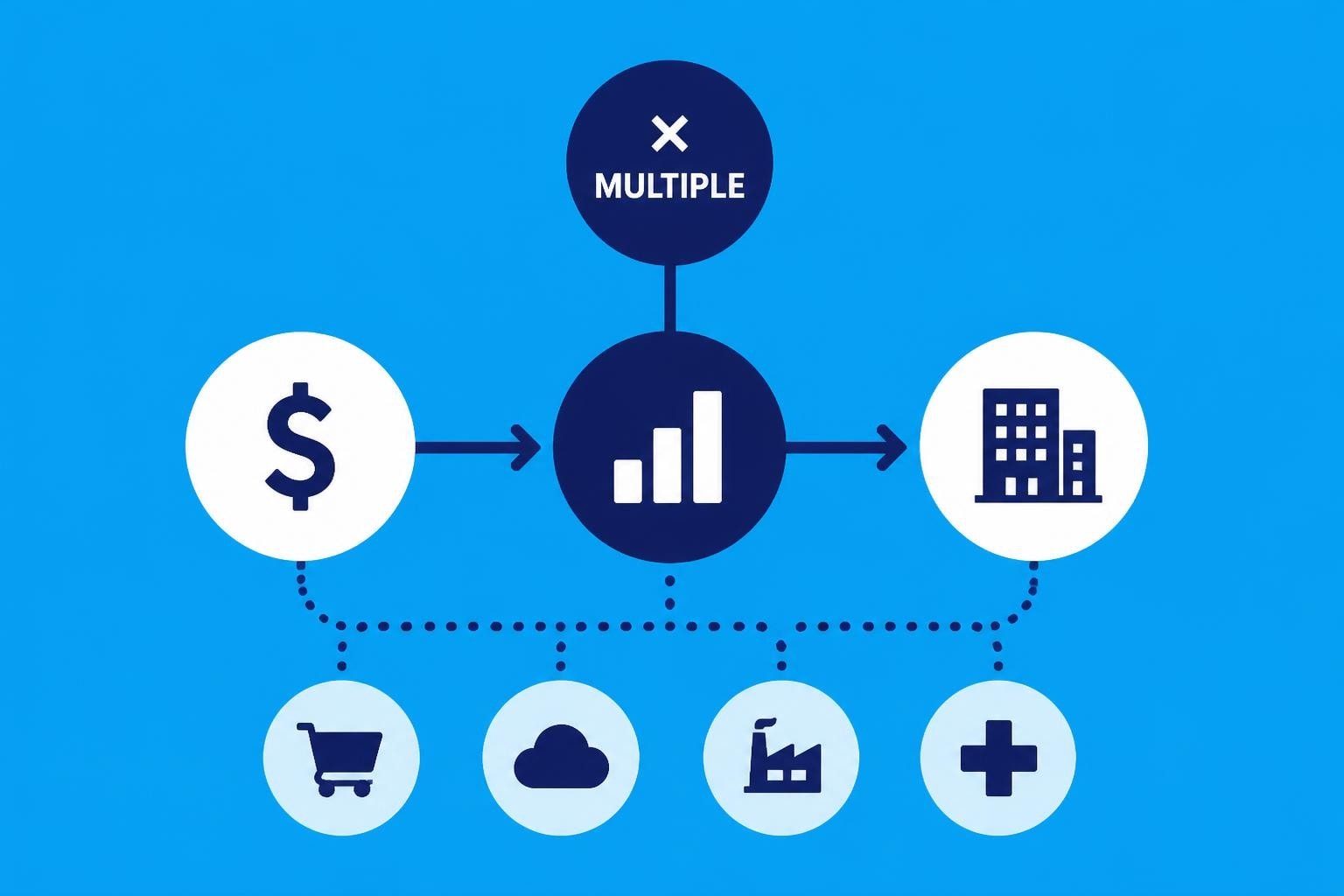
Company valuation based on revenue uses a business's top-line sales figures as the primary metric for determining enterprise value. This approach calculates value by applying an industry-specific multiple to annual revenue, typically measured as trailing twelve months (TTM) or projected forward revenue.
The formula is elegantly simple: Enterprise Value = Annual Revenue × Revenue Multiple. For instance, if a software company generates $5 million in annual recurring revenue and comparable companies trade at 4x revenue, the estimated enterprise value would be $20 million before adjustments.
Why Revenue Multiples Matter in M&A
Revenue-based approaches offer distinct advantages in specific contexts:
- Consistency across industries: Revenue is rarely disputed or heavily adjusted, unlike EBITDA
- Early-stage valuations: Pre-profitable companies lack earnings to multiple
- SaaS and subscription models: Recurring revenue predictability makes multiples particularly relevant
- Quick screening: Buyers can rapidly assess deal opportunities within their target range
The Corporate Finance Institute provides comprehensive guidance on EV/Revenue multiples, emphasizing their role as a first-pass valuation tool. However, revenue multiples should never stand alone-they work best alongside other methodologies when valuing a company for acquisition.

Industry-Specific Revenue Multiple Benchmarks
Revenue multiples vary dramatically across industries, reflecting differences in profitability, growth rates, capital requirements, and market dynamics. Understanding these nuances is essential for accurate company valuation based on revenue.
Technology and SaaS Businesses
Software-as-a-Service companies command premium revenue multiples due to recurring revenue models and high gross margins. According to Bessemer’s State of the Cloud 2024 report, public SaaS companies trade at a median of 4.5x to 8x revenue depending on growth rates and profitability metrics.
| Growth Rate | Typical Revenue Multiple | Key Drivers |
|---|---|---|
| 40%+ annually | 8x – 15x | High growth, strong retention, emerging category |
| 20-40% annually | 5x – 8x | Solid growth, proven model, competitive position |
| Below 20% | 2x – 5x | Mature market, profitability focus, limited expansion |
The PitchBook public SaaS compensation guide provides quarterly updates on these multiples, offering real-time benchmarks for comparing private company valuations to public market comparables.
Manufacturing and Distribution
Traditional manufacturing businesses typically trade at lower revenue multiples-often 0.5x to 2x revenue-reflecting lower margins, higher capital intensity, and cyclical demand patterns. Distribution businesses fall in a similar range, though specialized niches may command premiums.
Professional Services and Agencies
Service businesses generally receive 0.75x to 2.5x revenue multiples. Recurring client relationships, proprietary methodologies, and specialized expertise can push multiples higher, while businesses dependent on key individuals face multiple compression.
E-commerce and Direct-to-Consumer Brands
E-commerce businesses show wide variation, from 0.5x to 3x revenue, depending on brand strength, customer acquisition costs, repeat purchase rates, and supply chain control. Brands with strong customer lifetime value metrics and owned audiences command premium multiples.
When buyers explore opportunities through a private equity deal sourcing platform, understanding these industry-specific benchmarks helps them quickly identify deals within their investment criteria and avoid pursuing businesses with unrealistic valuation expectations.
Factors That Influence Revenue Multiples
Not all revenue dollars are valued equally. Several critical factors drive multiple expansion or compression when determining company valuation based on revenue.
Revenue Quality and Predictability
Recurring revenue commands the highest multiples. A software company with 90% annual contract renewal rates will trade at significantly higher multiples than a project-based consulting firm with the same total revenue.
- Subscription models (ARR/MRR)
- Long-term contracts with renewal provisions
- Maintenance and support agreements
- Consumable products with repeat purchasing patterns
Growth Trajectory and Market Position
Revenue growth rate directly impacts valuation multiples. A company growing revenue 30% annually will command double or triple the multiple of a flat-growth competitor in the same industry.
Market leadership also drives premium valuations. The number two or three player in a fragmented market may trade at 60-70% of the leader's multiple, all else being equal.
Profitability and Unit Economics
While revenue multiples don't explicitly account for profitability, they're implicitly adjusted for it. Two companies with identical revenue but vastly different EBITDA margins will receive different revenue multiples. The SaaS metric "Rule of 40" (growth rate + profit margin should exceed 40%) illustrates how growth and profitability together drive valuation.
Customer Concentration and Diversification
A business with 40% of revenue from a single customer faces multiple compression due to concentration risk. Conversely, thousands of small customers with low individual concentration supports higher multiples through diversification benefits.
| Concentration Level | Typical Multiple Impact | Risk Assessment |
|---|---|---|
| Top customer <10% of revenue | Neutral to positive | Low concentration risk |
| Top customer 10-25% | 10-20% discount | Moderate risk, manageable |
| Top customer >25% | 25-40% discount | High risk, significant discount |
The CFA Institute curriculum on market-based valuation emphasizes proper adjustment of comparables for such differences when applying multiples methodology.

Calculating and Applying Revenue Multiples
Executing company valuation based on revenue requires methodical analysis and appropriate comparable selection. The process involves several deliberate steps to ensure accuracy and credibility.
Step 1: Identify Comparable Companies
Select companies similar in:
- Industry and business model: Direct competitors or same market segment
- Size and scale: Revenue within 50-200% of target company
- Geography: Similar market dynamics and economic conditions
- Growth stage: Early growth vs. mature businesses have different multiples
For lower middle-market PE firms evaluating acquisition targets, finding true comparables can be challenging since many benchmarks focus on larger public companies. Industry association data and advisor networks become valuable resources.
Step 2: Normalize Revenue Figures
Ensure consistency in revenue calculation:
- Use TTM (trailing twelve months) or most recent fiscal year
- Remove one-time revenue events or discontinued operations
- Adjust for accounting policy differences
- Consider seasonality and normalize accordingly
Step 3: Calculate the Multiple Range
Gather revenue multiples from comparable transactions and companies. Calculate the mean, median, 25th percentile, and 75th percentile to understand the distribution.
A typical scenario might reveal:
- Low: 2.2x revenue
- 25th percentile: 2.8x revenue
- Median: 3.5x revenue
- 75th percentile: 4.2x revenue
- High: 5.8x revenue
Step 4: Adjust for Company-Specific Factors
Position your target company within the comparable range based on differentiating factors. A business with superior growth, better margins, or stronger market position justifies placement in the upper quartile or above median.
Step 5: Apply the Multiple and Triangulate
Calculate enterprise value using your selected multiple. Then validate against other methodologies-discounted cash flow, EBITDA multiples, or asset-based approaches-to ensure reasonableness.
Revenue Multiples vs. EBITDA Multiples
While company valuation based on revenue offers simplicity, EBITDA multiples remain the gold standard in many M&A transactions. Understanding when to emphasize each approach optimizes valuation discussions.
Revenue multiples work best when:
- The company is pre-profitable or has inconsistent earnings
- Revenue quality is high (recurring, contracted, predictable)
- Industry norms favor revenue-based valuations (SaaS, media, biotech)
- Quick screening of multiple opportunities is required
EBITDA multiples are preferred when:
- The company has stable, positive cash flow
- Operational efficiency varies significantly among comparables
- Capital structure and working capital requirements differ substantially
- Traditional industries where EBITDA multiples are standard practice
Many sophisticated buyers use both methodologies to establish a valuation range. When businesses connect through platforms like Aligned IQ M&A, having prepared both revenue-based and EBITDA-based valuations demonstrates professionalism and facilitates productive initial conversations about value expectations.
| Valuation Method | Primary Use Case | Key Advantage | Main Limitation |
|---|---|---|---|
| Revenue Multiple | Early stage, high growth, SaaS | Simple, consistent metric | Ignores profitability |
| EBITDA Multiple | Profitable, mature businesses | Accounts for operational efficiency | Can be manipulated through adjustments |
| DCF Analysis | Stable, predictable cash flows | Intrinsic value focus | Highly sensitive to assumptions |
| Asset-Based | Capital-intensive, distressed | Tangible floor value | Ignores intangibles and goodwill |

Strategic Considerations for Buyers and Sellers
Company valuation based on revenue creates different opportunities and challenges for buyers and sellers navigating M&A transactions.
For Sellers: Maximizing Your Revenue Multiple
Business owners preparing for eventual sale should focus on factors that drive multiple expansion:
Build recurring revenue streams. Transform one-time transactions into subscription relationships. A consulting firm moving from project work to retained monthly engagements can double its revenue multiple.
Demonstrate consistent growth. Three consecutive years of 20%+ revenue growth tells a compelling story that justifies premium valuations. Document your growth drivers and show they're sustainable beyond the transaction.
Reduce customer concentration. Systematically diversify your customer base years before sale. The effort required to reduce a top customer from 30% to 15% of revenue pays dividends in valuation.
Document revenue quality. Maintain detailed metrics on renewal rates, customer lifetime value, gross revenue retention, and net revenue retention. These metrics prove revenue predictability and quality.
For sellers using Aligned IQ M&A's proprietary matching process, the platform's emphasis on strategic fit over immediate price discovery allows you to identify buyers who will value your specific revenue characteristics most highly, potentially unlocking premium multiples from the right strategic or financial buyer.
For Buyers: Evaluating Revenue-Based Valuations
Buyers must look beyond the headline multiple to assess true value:
- Decompose revenue streams: Understand what percentage is recurring vs. one-time, high-margin vs. low-margin, growing vs. declining
- Assess revenue sustainability: Evaluate customer churn, contract renewal rates, and competitive threats to revenue continuation
- Calculate implied EBITDA multiple: Work backward from the revenue multiple to understand what profitability assumptions are embedded
- Identify revenue synergies: Determine how your ownership could accelerate revenue growth through cross-selling, geographic expansion, or operational improvements
The confidential nature of Aligned IQ M&A allows buyers to explore multiple opportunities simultaneously while maintaining discretion, enabling comparative revenue multiple analysis across potential acquisitions before committing to intensive due diligence on any single target.
Common Pitfalls in Revenue-Based Valuation
Even experienced acquirers make mistakes when applying company valuation based on revenue. Avoiding these common errors protects both parties from valuation disputes.
Mixing Public and Private Company Multiples
Public company multiples typically trade at 20-40% premiums to private company multiples due to liquidity, regulatory oversight, and access to capital markets. Directly applying public multiples to private companies without adjustment creates inflated valuations.
Ignoring Revenue Mix and Quality
A $10 million revenue business composed of 80% one-time project revenue is fundamentally different from a $10 million business with 80% recurring subscription revenue. Applying the same multiple to both creates a $4-8 million valuation error.
Overreliance on Stale Comparables
Market conditions shift rapidly. Using comparable transaction data from 2023 to value a 2026 transaction ignores two years of market evolution, interest rate changes, and industry dynamics. Always use the most current data available.
Neglecting Working Capital and Debt Adjustments
Revenue multiples typically calculate enterprise value, not equity value. Sellers sometimes confuse the two, expecting enterprise value to flow entirely to them at closing without adjusting for debt, working capital requirements, and transaction expenses.
Applying Single-Point Multiples
Using a single multiple (e.g., "3.5x revenue") rather than a range creates false precision. Valuation inherently involves judgment; presenting ranges (e.g., "3.0x to 4.0x revenue") more accurately reflects valuation uncertainty and provides negotiating flexibility.
Platforms supporting deal sourcing strategies help buyers access professional advisors who can validate valuation approaches and identify these pitfalls before they derail negotiations.
The Role of Professional Valuation in M&A
While understanding company valuation based on revenue empowers buyers and sellers to establish preliminary expectations, professional valuation expertise remains invaluable for significant transactions.
When to Engage Valuation Professionals
Consider professional valuation services when:
- Transaction value exceeds $5 million
- Complex earn-outs or contingent consideration structures are proposed
- Tax or regulatory reporting requires formal valuation opinions
- Significant valuation gaps exist between buyer and seller expectations
- Multiple business units or product lines require separate valuation
Business valuation firms bring rigorous methodologies, independence, and credibility to the valuation process. Their opinions can bridge gaps between parties and provide defensible support for transaction pricing.
Valuation Reports and Due Diligence
Professional valuation reports serve multiple purposes beyond price determination. They identify value drivers, highlight risks, benchmark against industry standards, and provide documentation for board approval, lender requirements, or tax compliance.
During due diligence, these reports become reference documents that guide investigation priorities. Revenue multiples identified in valuation analysis direct buyer focus toward revenue sustainability, customer retention, and growth opportunity validation.
The Deloitte reference on market approach and multiples in accounting contexts demonstrates how revenue-based valuations integrate with financial reporting requirements, particularly for purchase price allocation and goodwill calculations post-acquisition.
Emerging Trends in Revenue-Based Valuation
The landscape of company valuation based on revenue continues to evolve as new business models emerge and market dynamics shift.
AI and Technology Business Valuations
Companies leveraging artificial intelligence and machine learning face unique valuation challenges. Traditional revenue multiples may undervalue proprietary algorithms, data assets, and platform effects. Bessemer’s State of AI 2025 research explores how AI businesses are valued differently, with some commanding 10x+ revenue multiples despite modest current revenue due to exponential growth potential and market position.
Subscription Economy Expansion
The subscription model continues spreading beyond software into physical products, services, and hybrid offerings. This shift elevates the importance of revenue-based valuations across industries historically valued on asset or EBITDA bases.
Key subscription metrics now influencing revenue multiples include:
- Monthly Recurring Revenue (MRR) growth rate
- Annual Recurring Revenue (ARR) and contracted ARR
- Net Revenue Retention (NRR) above 100%
- Customer Acquisition Cost (CAC) to Lifetime Value (LTV) ratios
- Logo retention vs. dollar retention
Market Volatility and Multiple Compression
Interest rate changes, economic uncertainty, and public market corrections directly impact private company revenue multiples. The 2021-2022 period saw SaaS multiples compress from 15x+ revenue to 5x revenue for many businesses as cost of capital increased and growth expectations moderated.
Buyers and sellers must remain attuned to current market conditions rather than anchoring to historical peak multiples. Professional advisors and current market data prevent outdated assumptions from derailing transactions.
Integrating Revenue Valuation into M&A Strategy
Successfully applying company valuation based on revenue requires integration into broader M&A strategy and deal execution.
Setting Realistic Price Expectations
Sellers benefit from understanding revenue-based valuations early in exit planning-ideally 2-3 years before anticipated sale. This timeline allows strategic initiatives to improve revenue quality, growth rate, and other multiple-driving factors.
Buyers should establish revenue multiple parameters within their investment criteria. A typical scenario might involve a private equity firm targeting SaaS businesses generating $3-10 million in ARR, trading at 4-6x revenue, with 25%+ growth rates. These parameters focus deal sourcing efforts and enable rapid screening.
Facilitating Initial Discussions
Revenue multiples provide common ground for initial valuation discussions before parties invest significant time and resources. Starting conversations with "We're seeing companies in this space trade at 2.5x to 3.5x revenue; where does your business fit in that range?" grounds discussions in market reality.
The Aligned IQ M&A platform's focus on strategic fit before detailed valuation discussions allows parties to determine compatibility on business model, culture, and transaction structure before potentially contentious pricing negotiations. This sequencing improves deal success rates and reduces wasted effort on misaligned opportunities.
Supporting Due Diligence Priorities
Revenue-based valuations inform due diligence scope and focus. If a 4x revenue multiple implies specific margin assumptions, due diligence must validate whether those margins are sustainable. If high multiples rest on revenue growth assumptions, customer pipeline and market opportunity analysis becomes critical.
After matching through Aligned IQ M&A, sellers receive complimentary access to Aligned IQ VDR, a secure virtual data room that facilitates organized due diligence document sharing. This streamlined process helps buyers validate the revenue quality and growth assumptions underlying their valuation models efficiently and securely.
Structuring Creative Deal Terms
When valuation gaps exist, creative deal structures bridge the divide. Earn-outs based on future revenue achievement align incentives and allow sellers to capture upside if growth projections materialize. Revenue-based milestone payments similarly distribute risk between parties.
A typical scenario might involve a base purchase price at 3x current revenue plus earn-outs paying an additional 1x revenue if the business achieves specified revenue targets in years one and two post-acquisition. This structure addresses buyer concerns about sustainability while allowing sellers to benefit from continued success.
Virtual Data Rooms and Valuation Transparency
Modern M&A transactions require organized information sharing to support revenue-based and other valuation methodologies. Virtual data rooms have become essential infrastructure for this process.
Aligned IQ VDR offers competitively priced virtual data room services with transparent pricing accessible to lower middle-market participants, M&A advisors, investment bankers, and other transaction professionals. The platform provides secure document sharing, granular permission controls, activity tracking, and organized folder structures that facilitate efficient due diligence.
For sellers, maintaining organized financial records, customer contracts, revenue reports, and operational metrics in a VDR demonstrates professionalism and supports valuation claims. Buyers can validate revenue quality, customer concentration, renewal rates, and growth trends directly from source documentation.
This transparency reduces valuation disputes and accelerates deal timelines. When revenue multiples are proposed, supporting evidence is immediately accessible rather than requiring multiple information requests and delayed responses that create negotiating friction.
Revenue-based valuation provides a practical framework for establishing preliminary business values and facilitating productive M&A conversations, particularly when applied with appropriate industry context and quality adjustments. Whether you're a business owner exploring exit options or a strategic buyer identifying acquisition opportunities, Aligned IQ offers a confidential platform to connect with aligned counterparties based on transaction priorities, deal size, and strategic fit before diving into detailed valuation negotiations. Take a tour of our platform to discover how our unique matching process can help you find the perfect partner for your M&A goals.
No responses yet