

Valuation advisory services are professional engagements in which a qualified valuation firm estimates what your business is worth, documents how it reached that figure, and helps you apply the result to a sale, transition, tax, or planning decision. For an owner considering an exit, the right engagement replaces guesswork with a defensible number and a clear view of what buyers will pay for.
Many owners approach a sale with a figure in mind drawn from a rule of thumb, a conversation with a peer, or hope. A formal valuation tests that figure against how buyers, lenders, and tax authorities actually evaluate a company. The sections below explain what these services include, how the methods work, what drives cost, and how to use the results before you go to market.
What Valuation Advisory Services Include
A typical engagement covers four activities: scoping the purpose of the valuation, gathering and normalizing financial information, applying recognized methods, and delivering a written conclusion with supporting analysis.
Purpose matters because the same company can carry different values depending on the question being asked. A valuation for a sale negotiation, a gift or estate filing, a shareholder buyout, or a financial reporting requirement each follows different standards and different assumptions.
Common service lines include:
- Business valuation: An estimate of the value of the whole company or a defined ownership interest.
- Pre-sale advisory: Analysis of value drivers, risks, and likely buyer reactions before a process begins.
- Intangible asset valuation: Brand, customer relationships, intellectual property, and proprietary processes.
- Tax and estate valuation: Gift, estate, and succession planning work that must withstand review.
- Purchase price allocation and impairment testing: Mostly relevant after a transaction closes.
- Dispute and litigation support: Shareholder disagreements, divorce, and partnership dissolutions.
For owners preparing to sell, the first two lines matter most. Aligned IQ publishes more detail on business valuation services and on how valuation connects to sell-side advisory work.
How Valuation Methods Work
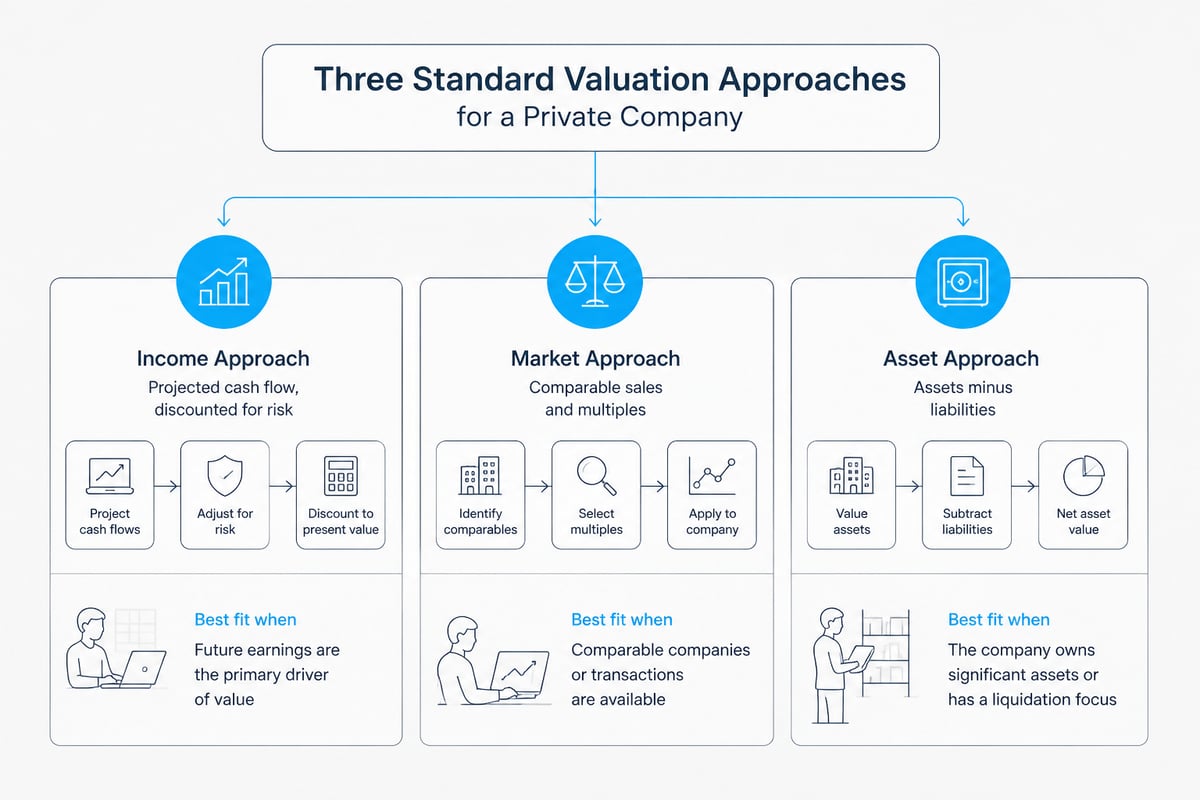
Valuation professionals rely on three accepted approaches, and a credible report explains why each was used or set aside. The U.S. Small Business Administration identifies them as income, market, and assets: the income approach considers projected revenue and risk, the market approach compares similar businesses that recently sold, and the assets approach subtracts liabilities from assets.
The Internal Revenue Service says appraisers should consider the asset-based, market, and income approaches and use professional judgment to select the approaches and methods that best indicate the value of the business interest. That instruction is useful to owners because it shows that no single formula is correct for every company.
Income approach
This approach estimates value from the cash a business is expected to generate, discounted for risk. It suits companies with stable, forecastable earnings. Its weakness is sensitivity: small changes in growth or discount rate assumptions move the answer considerably.
Market approach
This approach uses pricing from comparable transactions or public companies, often expressed as a multiple of earnings. Owners are usually familiar with it because it resembles how buyers talk. A closer look at the earnings metric behind many multiples is available in this guide to EBITDA company valuation.
Asset approach
This approach totals the value of assets and subtracts liabilities. It carries the most weight for asset-heavy businesses, holding companies, and companies that are not earning a return on their capital.
What a Valuation Report Delivers
A formal valuation report delivers a stated conclusion of value, the standard of value used, the methods applied, the assumptions behind them, and the financial adjustments made to reach a fair picture of earnings. The conclusion can be a single figure or a range, and a range is often more honest.
Several details inside the report deserve a careful read:
- Standard of value. The IRS defines fair market value in Publication 334 as the price at which property would change hands between a willing buyer and seller, neither compelled to act, with both having reasonable knowledge of relevant facts. Strategic buyers may pay more than that figure, and distressed sellers may accept less.
- Normalizing adjustments. Owner compensation above or below market, personal expenses run through the company, and one-time costs are adjusted so earnings reflect what a new owner would receive.
- Control and marketability. The IRS notes that valuation analysis may need to account for whether an ownership interest is marketable and whether it gives the holder control over the business, its sale, or its liquidation. A minority stake in a private company is typically worth less per share than control of the whole.
- Intangible assets. The SBA advises owners to include intangibles such as brand presence, intellectual property, customer information, and projected future revenue when valuing a small business.
- Sensitivity analysis. A good report shows how the conclusion shifts if key assumptions change.
How Much Valuation Advisory Services Cost
Fees depend on scope, company size, complexity, and the standard the report must meet, so no single price applies. A short indication of value for internal planning costs far less than a full report built to withstand tax authority review or a courtroom.
Factors that move the fee up or down:
- Purpose and audience. Reports that third parties will rely on require more documentation.
- Business complexity. Multiple entities, several revenue streams, or significant intangibles add analysis time.
- Quality of records. Clean, reconciled financials reduce the hours spent on cleanup.
- Timeline. Compressed schedules often carry a premium.
- Engagement type. A fixed-fee report differs from an ongoing advisory relationship.
Ask every provider for a written scope, a fee basis, a delivery date, and a statement of which standard the report follows. If a quote arrives without those four items, the comparison between providers is not reliable.
Choosing a Valuation Provider
Choose a provider whose credentials, experience with companies of your size, and independence match the purpose of the valuation. Larger accounting and advisory firms, boutique valuation shops, and independent appraisers all offer these services, and each has a different strength.
Questions worth asking before you sign:
- Which credentials do the analysts hold, and how many valuations like yours have they completed?
- Is the firm independent, or does it earn a fee only if a transaction closes?
- Who performs the work, and who signs the report?
- How does the firm handle management interviews and site visits?
- What is the process for questions after delivery, such as a buyer challenging a figure?
Independence deserves particular attention. A firm paid on transaction success has a different incentive from one paid a fixed fee for an opinion. Neither is automatically wrong, but you should know which one you are hiring. Aligned IQ's overview of valuation firms and their role in M&A transactions covers the distinction in more depth.
Valuation Before a Sale vs. Valuation for Planning
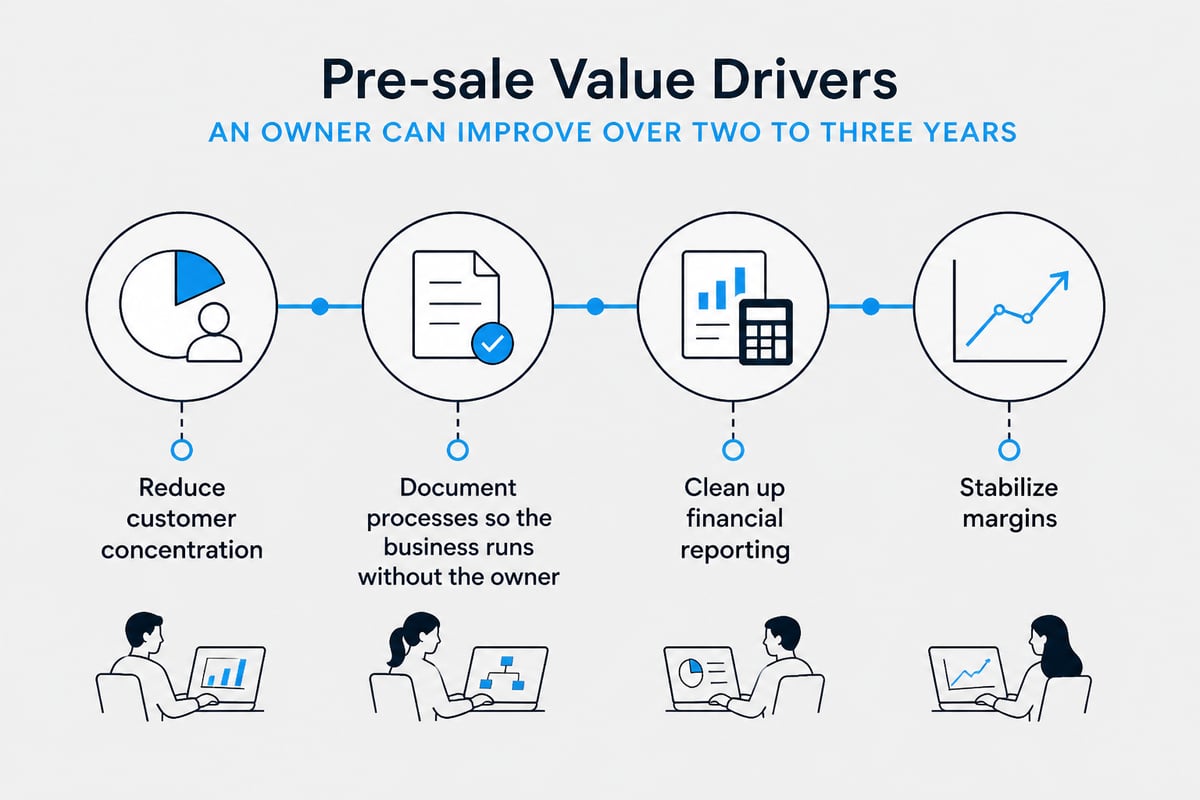
Valuation done well ahead of a sale gives you time to change the outcome, while valuation done after a buyer appears only tells you what to defend. Owners who commission an assessment two to three years before an anticipated exit can address the issues that depress value, including customer concentration, dependence on the owner, inconsistent margins, and weak financial reporting. Owners who want an outside advisor to guide this work can review how valuation consulting works, including what advisors deliver and how to prepare.
Planning-stage valuation also helps you answer a question that is easy to avoid: is the business worth selling now, or is more value available by waiting? Aligned IQ discusses timing in its piece on when to sell for peak value.
Valuation Gaps and How They Get Resolved
A valuation gap is the difference between what an owner believes the business is worth and what a buyer is willing to pay. It is among the most common reasons deals stall, and a professional valuation does not eliminate it, although it gives both sides a shared framework for discussion.
Gaps often come from different views of the future. An owner expects continued growth, while a buyer prices in risk. For background on why the gap persists, see The Perpetual Valuation Gap.

Preparing for a Valuation Engagement
Preparation shortens the engagement, lowers cost, and produces a more reliable conclusion. Gather the following before the first meeting:
- Three to five years of financial statements and tax returns
- A current-year budget and year-to-date results
- A schedule of owner compensation and personal expenses paid by the company
- Customer, product, and revenue concentration data
- Key contracts, leases, and debt agreements
- A description of intellectual property, licenses, and proprietary processes
- An overview of management, staffing, and any dependence on you personally
Be candid about weaknesses. A valuation that omits a known issue will be corrected by a buyer's diligence team, usually at a worse moment and with a harder negotiating posture.
Where Valuation Fits in a Sale Process
Valuation is one input among several in a sale. Once you know a defensible range, you still need to decide who should buy the business, on what terms, and with what level of confidentiality. The SBA notes that a business sale agreement should identify inventory and the parties, explain how the business will operate before closing and buyer access to information, and record adjustments, broker fees, and other relevant terms. Those terms are negotiated after value is established, not before.
In a traditional sale, owners often hire a broker, circulate a teaser, and accept broad exposure to the market, which creates confidentiality risk for employees, customers, and competitors. Aligned IQ M&A is built differently. It is a private B2B web platform where prospective buyers and sellers meet to explore deals, and it matches participants on transaction priorities, deal size, and industry experience and expertise. Because strategic fit is considered before detailed deal work begins, owners can assess counterparties discreetly instead of marketing the company widely. Buyers on the platform are not anonymous bidders; they present themselves as attractive exit options, and access is limited to participants on the platform, which gives it a more proprietary character than an open listing site.
Once a match is completed, document sharing becomes the next practical need. Aligned IQ VDR is a separate product: a secure virtual data room for lower middle-market buyers, sellers, M&A advisors, and investment bankers. It is complimentary for Aligned IQ M&A sellers after a match is completed. In short, Aligned IQ M&A helps you find the right counterparty, and Aligned IQ VDR helps you share and organize documents once a deal is moving.
For owners who want support preparing for a sale, Aligned IQ also offers sell-side M&A advisory for business owners through the platform, which pairs exit planning and valuation support in one place.
Valuing a Business Before Acquisition Activity
Owners who plan to sell often also consider buying, merging, or taking on a partner first. In those cases the same valuation discipline applies to the other side of the table. The SBA's guidance on valuing a business before an acquisition recommends researching valuation methods and considering a qualified appraiser. Knowing how a counterparty will be valued helps you read offers more accurately, whichever side you are on.
FAQ
Which firms are considered the Big 4 for valuation work?
The Big 4 are Deloitte, PwC, EY, and KPMG, the four largest global accounting and professional services networks. Each has a valuation practice, and owners of smaller businesses often find that boutique firms or independent appraisers are a better fit.
How much does a company valuation cost?
Cost varies with scope, complexity, and the standard the report must satisfy, so there is no flat rate. A basic indication of value costs considerably less than a full report prepared for tax filings or litigation. Request a written scope and fee basis from each provider so you can compare quotes accurately.
Is a valuation the same as an asking price?
No. A valuation is an independent estimate of value under a stated standard, while an asking price is a negotiating position. The final price depends on buyer interest, deal structure, timing, and terms, all of which can move the outcome above or below the valuation.
Your next step is to gather three to five years of financial statements and list the factors that make your business dependent on you, because those two items shape every valuation conversation. When you are ready to see how strategic fit and private matching can work for your exit, take a tour of Aligned IQ to see how the platform works, and start with sell-side M&A advisory for business owners if you want valuation and exit planning support in one place.
No responses yet