

An accredited business valuation is an appraisal of a company's worth prepared by a professional who holds the Accredited in Business Valuation (ABV) credential from the AICPA, a designation that signals tested valuation skill, documented experience, and adherence to professional standards. For business owners considering a sale or transition, the credential matters because a defensible value is the foundation of every negotiation, tax filing, and succession plan that follows. This article explains what the ABV credential is, who qualifies, how the exam works, and how owners can use an ABV-backed valuation when preparing to exit.
What Does ABV Stand for in Accounting?
ABV stands for Accredited in Business Valuation, a specialty credential awarded by the American Institute of CPAs (AICPA) and its CIMA affiliate to professionals who demonstrate expertise in valuing businesses and intangible assets. The AICPA offers an overview of the ABV credential that summarizes the main eligibility categories and the application steps.
The designation is not a stand-alone license. It sits on top of an existing foundation in accounting or finance and certifies that the holder has added specialized valuation training, practical experience, and ethical commitments. For an owner, it works as a quality filter: the person preparing your valuation has met a published, verifiable standard rather than simply calling themselves a valuation expert.
You will see ABV holders working in several settings:
- Independent valuation boutiques and regional accounting firms
- Large advisory practices serving mid-sized and lower middle-market companies
- Litigation support and forensic accounting teams
- Transaction advisory groups that support buyers and sellers
Who Is Eligible for the ABV Credential?
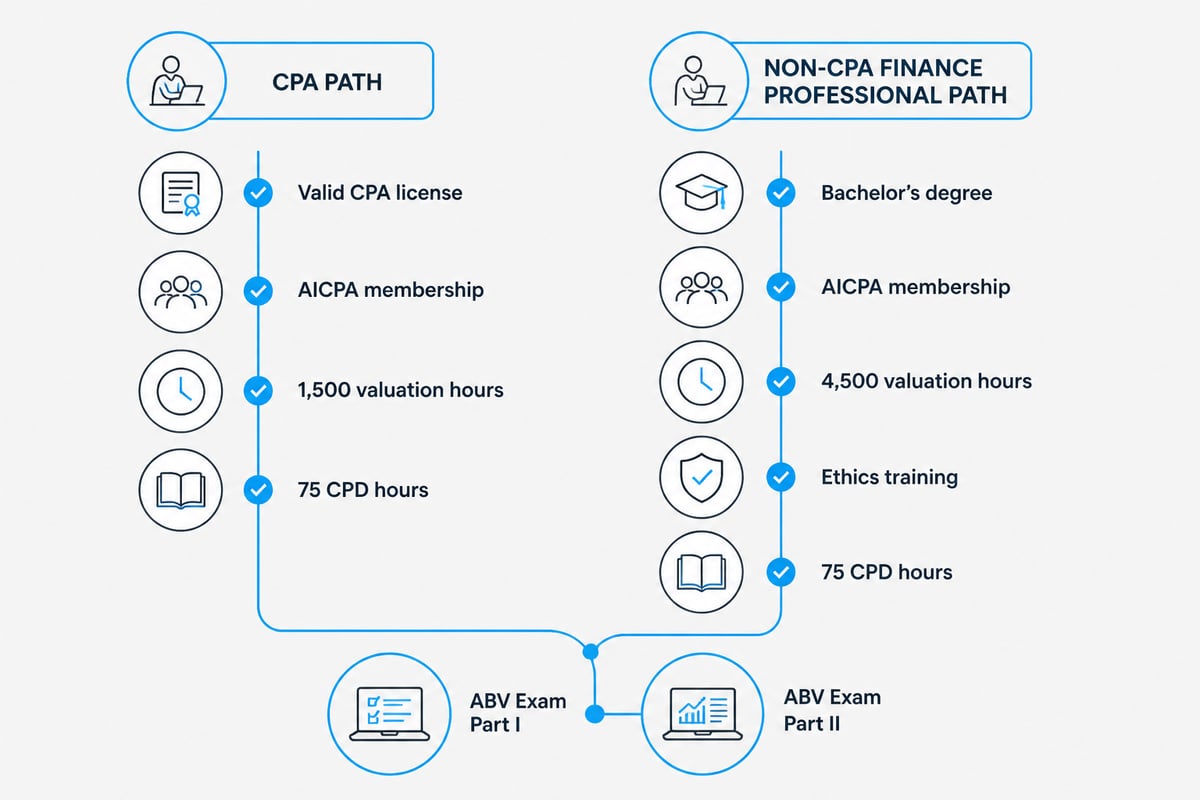
Eligibility depends on whether the candidate is a licensed CPA or a finance professional without a CPA license, and the two paths carry different experience thresholds.
For CPAs, the AICPA requires a valid, unrevoked CPA license or certificate and qualifying AICPA membership in good standing. Finance professionals who are not CPAs need a bachelor's degree or equivalent, AICPA membership in good standing, and specified ethics training within 30 days of submitting the application. Both requirements are listed on the AICPA and CIMA ABV credential requirements page.
The two paths differ most in experience:
| Requirement | CPA path | Non-CPA finance professional path |
|---|---|---|
| Licensure or education | Valid CPA license or certificate | Bachelor's degree or equivalent |
| Membership | Qualifying AICPA membership in good standing | AICPA membership in good standing |
| Valuation experience | At least 1,500 hours within five years before applying | At least 4,500 hours within five years before applying |
| Continuing education | 75 hours of valuation-related CPD within five years | 75 hours of valuation-related CPD within five years |
The difference between the two thresholds is substantial, with non-CPA finance professionals required to document considerably more valuation experience than CPAs.
What Are the Requirements to Obtain the ABV Certification?
To obtain the ABV certification, a candidate must meet the eligibility conditions for their path, document qualifying valuation experience, complete valuation-related continuing education, and pass a two-part exam.
The core requirements break down as follows:
- Hold the right foundation. CPAs need an active license. Non-CPA professionals need a bachelor's degree or equivalent plus the required ethics training.
- Maintain AICPA membership. Membership must be in good standing at the time of application.
- Log valuation experience. The hours must be recent, falling within the five years before the application, and must involve qualifying valuation work.
- Complete 75 hours of valuation CPD. These hours also fall within the five-year window and must be valuation related, according to the AICPA's published criteria.
- Pass both exam parts. More on the exam format below.
- Submit the application and fees. The AICPA reviews documentation before awarding the credential.
Candidates should keep careful records from the start. Experience hours are easiest to verify when engagement dates, roles, and the nature of the valuation work were documented as they happened rather than reconstructed years later.
How the ABV Exam Works
The ABV exam has two parts, and candidates must pass both within 12 months. Candidates can sit for it at a test center or through remote proctoring, according to the AICPA and CIMA exam registration page.
That registration page lists a fee range and states that one retake is included with an exam purchase. Fees can change, so candidates should confirm current pricing before registering.
The 12-month window deserves planning. A sensible approach is to schedule the first part only after finishing core study, then book the second part while the material is fresh. Candidates who let months pass between parts often find they must relearn content, which wastes part of the retake allowance and the calendar.
Preparation typically covers the full valuation process: engagement acceptance, data gathering, normalization of financial statements, selection of valuation approaches, discount and capitalization rate development, discounts for lack of control and marketability, and report writing.
The Three Core Valuation Methods an ABV Holder Applies
The top three valuation methods are the income approach, the market approach, and the asset-based approach, and an accredited professional is trained to choose among them based on the company and the purpose of the valuation.
- Income approach. Estimates value from expected future cash flows, usually through a discounted cash flow analysis or a capitalization of earnings. It suits companies with stable, forecastable earnings.
- Market approach. Derives value from comparable transactions or comparable public companies, adjusted for size, growth, and risk. It reflects what buyers have actually paid for similar businesses.
- Asset-based approach. Totals the fair value of assets minus liabilities. It fits asset-heavy companies, holding companies, or businesses with weak earnings.
A credentialed analyst rarely relies on one method alone. Reconciling two or three approaches, and explaining why one carries more weight, is what makes a report defensible when a buyer, lender, or tax authority questions the conclusion.

Is a Business Worth 3 Times Profit?
A business is not automatically worth three times profit; that figure is a rule of thumb that fits some small, owner-dependent companies and misses many others. Multiples vary with industry, growth, customer concentration, recurring revenue, owner dependence, and the quality of financial records.
A company with predictable recurring revenue and a management team that runs without the owner may command a higher multiple, while a business that depends on a single customer or on the founder's personal relationships may trade lower. Treating a quick multiple as a valuation invites disappointment at the negotiating table, because buyers will test every assumption behind it.
This is where an accredited business valuation earns its cost. It replaces a headline multiple with a documented analysis that shows how value was derived. Aligned IQ's articles on business valuation myths, part I and part II address several of these common misconceptions.
Why Accreditation Matters When You Plan to Sell
Accreditation matters in a sale because buyers, lenders, and tax authorities give more weight to valuations built on recognized standards and prepared by a professional who is accountable to a credentialing body.
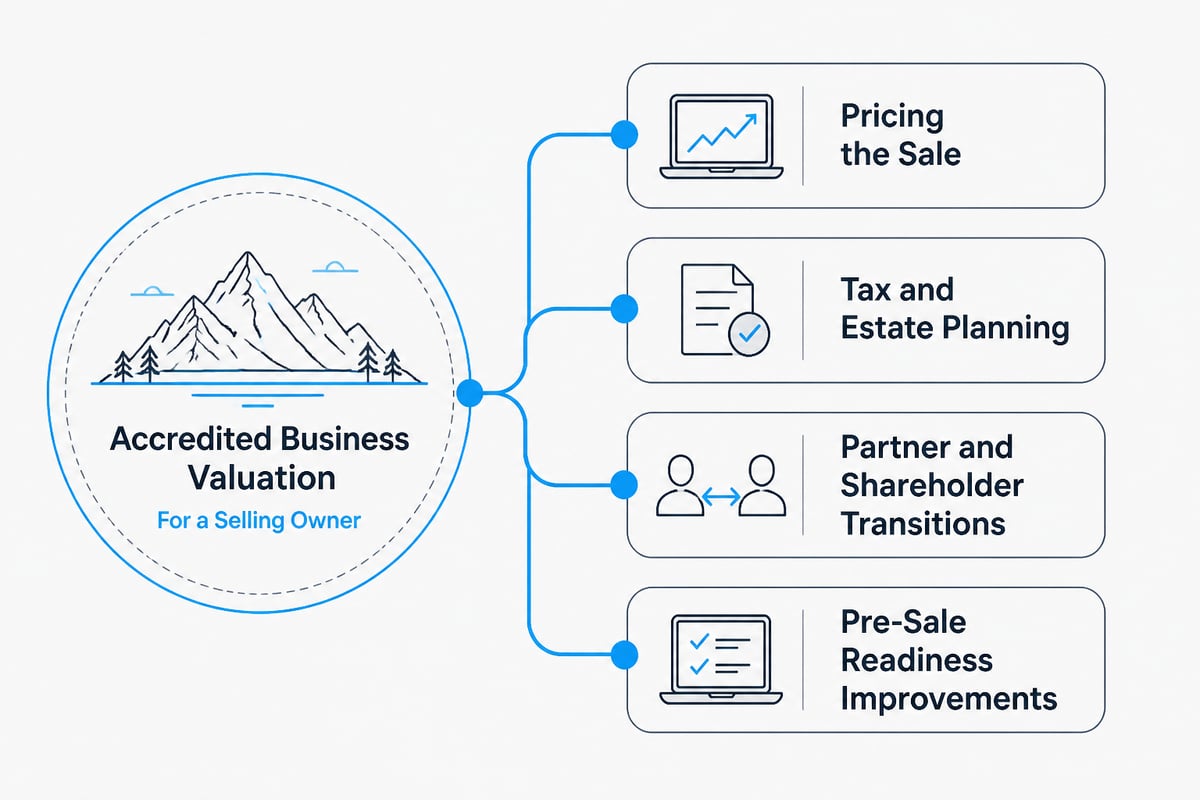
Consider the practical uses of an ABV-backed valuation:
- Pricing a sale. A well-supported value gives you a realistic asking range and a basis to respond to a buyer's counteroffer.
- Tax and estate planning. Gifts of company shares, buy-sell agreements, and estate filings often require a supportable fair market value. The IRS maintains its own business valuation guidelines, which apply to IRS personnel developing, resolving, and reporting issues involving business valuations, and a rigorous report is better prepared to withstand that scrutiny.
- Partner and shareholder transitions. An independent value reduces disputes when ownership changes hands internally.
- Pre-sale readiness. A valuation can reveal which factors depress value, giving you time to address them before going to market.
Owners should also distinguish between the types of engagements. A full valuation report, a calculation engagement, and an informal estimate differ in scope, cost, and defensibility. Aligned IQ's guides to certified business valuation and business valuation cost help owners understand what each option involves.
How to Choose an Accredited Valuation Professional
Choose a valuation professional by verifying the ABV credential, then testing their experience with companies of your size and industry and their ability to explain the work in plain terms.
Use this short screening process:
- Confirm the credential. Ask for the ABV designation and verify it with the AICPA rather than relying on a website claim.
- Match the experience. A professional who regularly values lower middle-market companies will understand deal dynamics better than one who mostly handles litigation work.
- Ask about the report. Request a description of the deliverable, the methods used, and how conclusions are reconciled.
- Clarify independence. Confirm there is no conflict that could compromise objectivity, particularly if the same firm may advise on the sale.
- Discuss timing and fees in writing. Scope drives cost, so agree on both before work starts.
Owners comparing providers can also review Aligned IQ's overview of business valuation firms and its guide to working with a business valuation expert.
Where Aligned IQ Fits Into the Valuation and Exit Process
Aligned IQ approaches exit planning by putting strategy before the deal, so buyers and sellers agree on goals before they spend time on diligence. Two distinct tools support that approach, and they serve different purposes.
Aligned IQ M&A is the web platform where potential buyers and sellers meet privately to explore deals. It matches users on transaction priorities, deal size, and industry experience and expertise, and it gives buyers a stage to present themselves as an attractive exit option for owners. For a future seller, the appeal is a low-risk, confidential, and secure alternative to the traditional M&A process, where a business is often marketed broadly before strategic fit is confirmed. Because matching happens before deep diligence, owners can explore interest without exposing their plans to employees, customers, or competitors. For buyers, the platform's semi-proprietary nature offers access to opportunities that may not circulate in open marketplaces.
Aligned IQ VDR is the separate virtual data room for sharing deal documents securely. It is complimentary for Aligned IQ M&A sellers after a match is completed, and it is competitively priced for other buyers, sellers, intermediaries, and M&A service providers. You can review the current Aligned IQ VDR pricing before deciding whether it fits your process. An accredited valuation report is exactly the kind of document owners place in a data room, so buyers can review the analysis in an organized, permissioned environment.
A typical scenario looks like this: an owner commissions an ABV-backed valuation, uses it to set realistic expectations, explores strategic fit with potential buyers on Aligned IQ M&A, and then shares the report and supporting records through the data room once a match is made.
Valuation professionals who advise sellers can also take part. M&A support for service providers lets professionals showcase their services and get paid for sell-side referrals. For owners who want to understand the broader valuation landscape first, the complete guide to private business valuation is a useful starting point.
FAQ
How long does it take to earn the ABV credential?
The timeline depends on how quickly a candidate accumulates the required valuation hours, since the experience requirement is the longest part of the process. A CPA with 1,500 qualifying hours and 75 hours of continuing education can often move to the exam within months, while a non-CPA finance professional needing 4,500 hours typically needs several years of focused valuation work. The two exam parts must be passed within 12 months of each other.
Do I need an ABV to value my own business?
No credential is legally required for you to form your own view of what your company is worth. An accredited valuation is worth commissioning when the number must withstand outside scrutiny, such as a sale negotiation, a lender review, a shareholder dispute, or a tax filing. In those settings, the credential adds credibility that an internal estimate cannot.
Is the ABV the only valuation credential available?
No. Several organizations offer valuation designations, and each has its own requirements and emphasis. The ABV is distinct because it is issued by the AICPA and builds on CPA or finance credentials, so owners should compare credentials against the purpose of the valuation rather than assume one fits every situation.
Your next step is to request a scoped quote from an ABV-credentialed professional, confirming the credential with the AICPA and agreeing in writing on the report type and timeline. Once you have a defensible value in hand, Aligned IQ M&A lets you explore strategic fit with buyers confidentially before committing to a traditional sale process, and you can take a tour of the platform to see how matching works, or contact the team to discuss your goals.
No responses yet