

Understanding how to properly assess a company's worth is fundamental for both entrepreneurs seeking capital and investors evaluating opportunities. For business owners contemplating an exit, startup valuation becomes even more critical as it directly influences the pool of potential acquirers and the structure of any transaction. Unlike mature companies with established revenue streams and predictable cash flows, early-stage ventures require specialized valuation approaches that balance growth potential against inherent risk. This complexity makes the valuation process both an art and a science, particularly when strategic fit matters as much as financial metrics.
The Foundation of Startup Valuation
Startup valuation represents the estimated economic value of a company, typically expressed as a monetary figure that reflects both current assets and future potential. For early-stage companies, this calculation differs dramatically from traditional business valuation because historical financial performance offers limited predictive value.
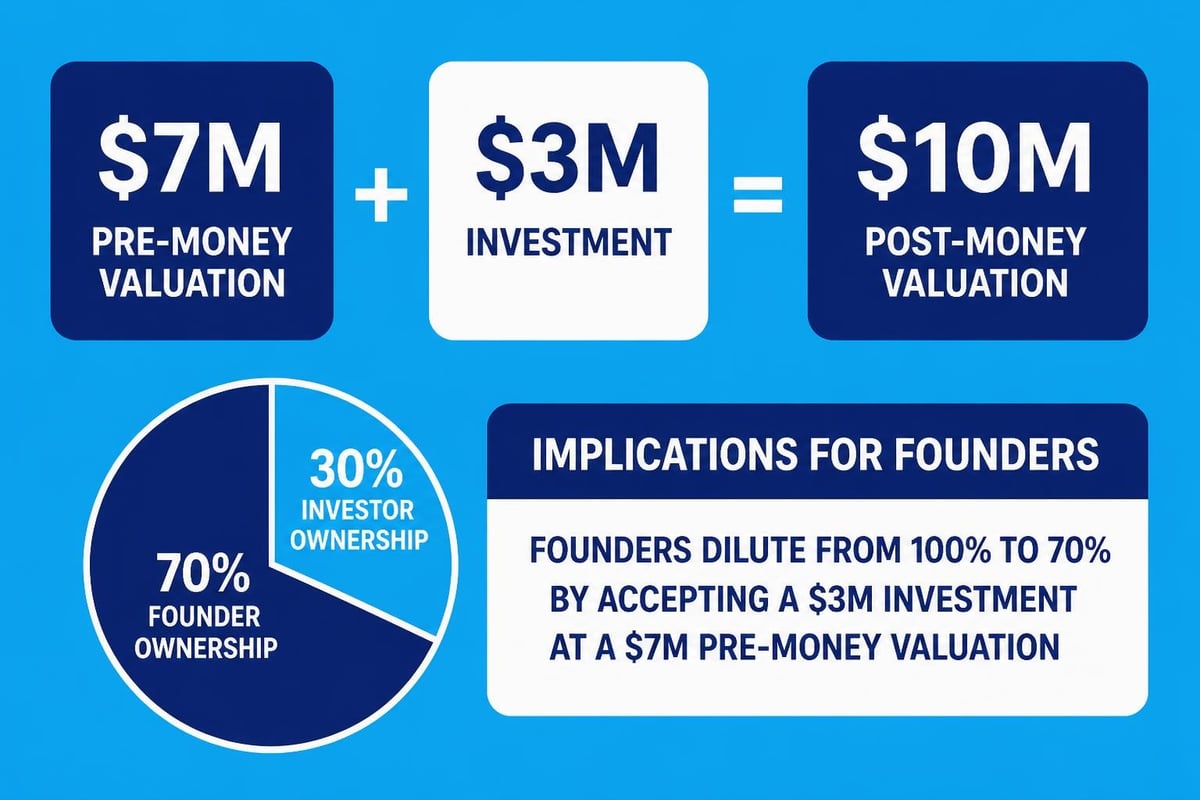
Pre-money versus post-money valuation forms the cornerstone of understanding startup worth. Pre-money valuation represents the company's value before receiving new investment, while post-money valuation includes the fresh capital injection. This distinction matters enormously during negotiations, as investors and founders must agree on what percentage of ownership each dollar of investment purchases.
Consider how valuation concepts from NYU Stern apply to real transactions. When a venture raises $2 million at a $8 million pre-money valuation, the post-money valuation becomes $10 million, giving investors 20% ownership. These percentages cascade through subsequent funding rounds, affecting dilution and ultimate exit returns for all stakeholders.
Why Traditional Methods Fall Short
Revenue multiples and discounted cash flow models struggle with pre-revenue or early-revenue companies because:
- Insufficient historical data prevents meaningful trend analysis
- High failure rates make probability-weighted outcomes difficult to calculate
- Pivot potential means the business model itself may transform
- Market timing can dramatically shift comparable company benchmarks
These limitations explain why specialized approaches have emerged for startup valuation assessment.

Primary Valuation Methodologies for Early-Stage Companies
Several frameworks have gained traction among investors and founders for determining appropriate startup valuations. Each approach emphasizes different factors and suits particular company stages or industry contexts.
The Berkus Method
Developed by veteran angel investor Dave Berkus, this approach assigns dollar values to five key success factors, with each element potentially adding up to $500,000 in value:
| Success Factor | Value Contribution | Assessment Criteria |
|---|---|---|
| Sound Idea | Up to $500K | Business concept quality and market need |
| Prototype | Up to $500K | Product development stage and functionality |
| Quality Management | Up to $500K | Team experience and execution capability |
| Strategic Relationships | Up to $500K | Partnerships, customers, or distribution |
| Product Rollout or Sales | Up to $500K | Market traction and revenue evidence |
This method works particularly well for pre-revenue companies where the pre-revenue valuation approaches need structure but sufficient flexibility to account for qualitative factors. The Berkus Method caps valuations around $2.5 million, making it most applicable to seed-stage ventures.
Scorecard Valuation Method
The Scorecard approach, developed by Bill Payne, compares the target startup against average valuations for similar companies in the same region and sector. It then adjusts this baseline using weighted factors:
- Management team strength (0-30% weighting)
- Size of opportunity (0-25% weighting)
- Product or technology (0-15% weighting)
- Competitive environment (0-10% weighting)
- Marketing and sales channels (0-10% weighting)
- Need for additional funding (0-5% weighting)
- Other factors (0-5% weighting)
This comparative methodology provides grounding in market realities while allowing customization for company-specific strengths. The UC San Diego startup toolkit offers detailed worksheets for applying this method systematically.
Risk Factor Summation
This method starts with a baseline valuation (often derived from comparable companies) and adjusts it based on twelve risk categories. Each risk factor receives a rating from very positive (-2) to very negative (+2), with each point typically representing a $250,000 valuation adjustment:
Risk Categories Include:
- Management quality and experience
- Stage of the business
- Political and legal environment
- Manufacturing complexity
- Sales and marketing channels
- Funding and capital requirements
- Competition intensity
- Technology risks
- Litigation potential
- International operations
- Reputation or brand strength
- Financial projections credibility
A company with mostly average risk factors might see minimal adjustment, while one with exceptional management but challenging market dynamics would reflect both positive and negative modifications.
The Venture Capital Method
The VC method works backward from anticipated exit value, using expected return multiples to determine current valuation. The formula considers:
- Terminal Value: Projected exit value at liquidity event
- Expected Return Multiple: Typically 10x for early-stage, 3-5x for later stages
- Current Valuation: Terminal value divided by expected multiple
- Retention Rate: Accounting for dilution from future funding rounds
This approach aligns well with how institutional investors think about portfolio returns and capital deployment, making it relevant when considering how lower middle-market PE firms evaluate potential acquisitions.
Valuation in the Context of Strategic Acquisitions
When business owners consider selling rather than raising equity capital, startup valuation takes on different dimensions. Strategic acquirers often pay premiums beyond pure financial metrics because they value synergies, market position, technology assets, or team capabilities.
Strategic Value Versus Financial Value
Financial buyers (private equity firms, financial investors) typically base valuations on projected cash flows and comparable transaction multiples. Their calculations focus on standalone business performance and potential operational improvements.
Strategic buyers consider additional factors:
- Customer base overlap and cross-selling potential
- Technology integration and product roadmap acceleration
- Geographic or market segment expansion
- Talent acquisition and capability building
- Competitive positioning and market share consolidation
These strategic acquisitions often command higher valuations because the combined entity creates more value than each standalone business. Understanding which type of buyer views your startup most favorably directly influences valuation expectations.
The Importance of Strategic Fit in Valuation
Recent market dynamics have emphasized that the highest valuation doesn't always serve founders' best interests. As TechCrunch reported regarding seed VC perspectives, inflated valuations can create problematic down rounds, misaligned investor expectations, and challenges in subsequent fundraising.
For M&A transactions, this principle intensifies. A buyer who values strategic alignment may offer terms beyond pure price that benefit sellers:
- Earnout structures tied to performance milestones
- Employment agreements preserving founder involvement
- Integration support reducing transition risk
- Cultural compatibility ensuring team retention
- Operational resources accelerating growth post-acquisition
In typical scenarios where business owners explore exit options, prioritizing strategic fit before diving deep into valuation discussions can identify buyers whose synergy calculations justify premium pricing. This approach contrasts with the traditional M&A process where financial terms often dominate initial conversations, potentially filtering out the best-aligned counterparties.
Market Conditions and Valuation Dynamics
Startup valuation doesn't occur in a vacuum. Broader capital market conditions significantly influence what investors will pay and what structures they demand. The shift from the ultra-low interest rate environment of 2010-2021 to higher rates in 2022-2026 demonstrates this impact clearly.
Capital Availability and Pricing
When capital is abundant and cheap, investors compete for quality deals, driving valuations upward. Conversely, when funding becomes more expensive, investors demand stronger unit economics, clearer paths to profitability, and more reasonable entry valuations to hit target IRR thresholds.
Current Market Characteristics (2026):
- Greater scrutiny of burn rates and runway
- Preference for companies with demonstrated revenue
- Higher bars for Series A and B rounds
- Increased use of structured instruments (convertible notes, SAFEs with caps and discounts)
- More emphasis on sustainable growth versus growth-at-all-costs
These conditions affect both equity fundraising and M&A valuations, as acquirers similarly reassess what multiples make strategic and financial sense.
Industry-Specific Considerations
Valuation norms vary dramatically across sectors. Software companies with recurring revenue models typically command 5-15x revenue multiples, while hardware companies might see 1-3x revenue multiples due to inventory requirements and margin profiles.
| Industry Sector | Typical Valuation Multiple | Key Value Drivers |
|---|---|---|
| SaaS/Software | 5-15x ARR | Recurring revenue, retention, gross margins |
| E-commerce | 1-3x Revenue | GMV, take rate, customer acquisition costs |
| Biotech | Asset-dependent | Pipeline stage, patent protection, trial results |
| Hardware | 1-3x Revenue | Gross margin, supply chain, IP portfolio |
| Marketplaces | 3-8x Revenue | Network effects, liquidity, unit economics |
Understanding how your startup fits within sector norms provides realistic framing for valuation discussions. For companies in sectors like biotechnology and pharmaceuticals, specialized expertise becomes essential given the binary outcomes around regulatory approvals.

Practical Application for Business Owners
For entrepreneurs and business owners, understanding startup valuation translates into better decision-making throughout the company lifecycle. Whether raising capital or considering an exit, several principles guide effective valuation strategy.
Building Valuation From the Ground Up
Rather than hoping for a certain number, work systematically to strengthen the factors that drive valuation:
Financial Foundation:
- Implement clean accounting and financial reporting systems
- Track key metrics (CAC, LTV, churn, gross margin) rigorously
- Build financial models with realistic assumptions
- Document revenue recognition and accounting policies
Market Position:
- Demonstrate differentiation and competitive moats
- Show evidence of product-market fit through customer retention
- Build case studies proving value delivery
- Quantify market size and penetration opportunity
Team and Operations:
- Recruit experienced leaders with relevant expertise
- Document processes and reduce key-person dependencies
- Establish advisory boards or strategic relationships
- Protect intellectual property through appropriate mechanisms
These elements appear across all valuation methodologies and signal maturity to potential investors or acquirers.
Preparing for Valuation Discussions
Whether you're using the comprehensive valuation guide and calculator or working with advisors, preparation determines negotiating position:
- Gather comparable data: Research recent transactions in your sector, geography, and stage
- Model multiple scenarios: Calculate valuations under conservative, moderate, and optimistic assumptions
- Understand your leverage: Assess alternatives (continue bootstrapping, raise equity, seek acquisition)
- Identify value drivers: Know which specific factors most influence your company's worth
- Set walk-away thresholds: Determine minimum acceptable terms before entering negotiations
This preparation proves particularly valuable when exploring confidential acquisition opportunities where understanding your position relative to potential counterparties shapes strategy.
Valuation Tools and Resources
Professional valuation typically involves specialized expertise, but founders benefit from understanding the analytical tools and frameworks that advisors employ. The MIT OpenCourseWare materials on startup valuation provide academic grounding in these concepts.
When to Seek Professional Valuation
While founders can estimate valuations for planning purposes, certain situations demand professional 409A valuations or fairness opinions:
- Issuing stock options to employees (requires 409A valuation)
- Executing significant M&A transactions
- Resolving shareholder disputes or buyouts
- Estate planning or tax reporting requirements
- Complying with financial reporting standards for investors
Professional valuation providers include:
- Specialized valuation firms (Carta, Aranca, Stout)
- Accounting firms with valuation practices
- Investment banks for larger transactions
- Business appraisers with ASA or ABV credentials
The cost typically ranges from $3,000-15,000 for 409A valuations and significantly more for complex M&A fairness opinions.
Data Room Preparation and Due Diligence
Regardless of calculated valuation, actual transaction value depends heavily on buyer confidence in the company's assets, liabilities, and representations. Thorough preparation for due diligence protects valuations during negotiation.
Essential data room contents:
- Audited or reviewed financial statements (3+ years)
- Customer contracts and revenue documentation
- Intellectual property registrations and licenses
- Employment agreements and benefit plans
- Material contracts with suppliers or partners
- Capitalization table and prior investment documents
- Compliance records (regulatory, tax, corporate)
- Litigation history or threatened claims
For M&A processes, secure virtual data rooms provide controlled access to confidential information. Platforms like the Aligned IQ VDR offer competitively priced solutions specifically designed for lower middle-market transactions, with complimentary access for matched sellers on the Aligned IQ M&A platform.
Negotiating Structure Beyond Pure Valuation
Sophisticated founders recognize that deal structure often matters more than headline valuation figures. A $10 million acquisition with favorable terms may deliver better founder outcomes than a $12 million deal with problematic provisions.
Key Structural Elements
Earnouts and Performance Incentives:
Tying portions of purchase price to post-closing performance bridges valuation gaps while aligning buyer and seller interests. Typical earnout periods run 12-36 months and represent 10-40% of total consideration.
Cash Versus Equity Consideration:
All-cash deals provide immediate liquidity but forgo upside participation. Equity rollovers allow sellers to benefit from future value creation but introduce risk and illiquidity.
Employment and Non-Compete Terms:
Transition services agreements, employment contracts, and non-compete provisions affect both seller obligations and total economic value received.
Representation and Warranty Insurance:
Shifting indemnification risk to insurance policies can accelerate escrow releases and reduce seller exposure.
| Deal Structure Element | Seller Advantage | Buyer Advantage |
|---|---|---|
| Higher cash portion | Immediate liquidity, certainty | Simpler integration, clean break |
| Equity rollover | Upside participation | Seller skin in game, alignment |
| Shorter earnout period | Faster full realization | Lower risk, clearer metrics |
| Longer employment term | Income security, influence | Knowledge transfer, continuity |
| Lower escrow percentage | More cash at close | Greater indemnification reserve |
Evaluating deals holistically across these dimensions produces better outcomes than fixating solely on enterprise value multiples.
The Role of Advisors and Intermediaries
Experienced M&A advisors, investment bankers, and business brokers provide valuable services beyond simple valuation calculations. They facilitate introductions to qualified buyers, structure transactions to optimize tax treatment, negotiate on behalf of clients, and coordinate due diligence processes.
For business owners contemplating exit strategies, working with advisors who understand both financial valuation and strategic fit considerations ensures comprehensive evaluation of opportunities. Similarly, service providers specializing in M&A transactions can guide both buyers and sellers through complex valuation negotiations.
Matching Valuation Expectations with Strategic Priorities
Perhaps the most challenging aspect of startup valuation involves reconciling seller price expectations with buyer valuation perspectives. This gap causes more deal failures than any other single factor.
Bridging the Valuation Gap
Seller Perspectives:
- Emotional attachment inflates perceived value
- Sweat equity and opportunity costs feel under-compensated
- Optimistic growth projections justify higher multiples
- Comparison to outlier transactions sets unrealistic benchmarks
Buyer Perspectives:
- Risk discounts for execution uncertainty
- Integration costs reduce net value creation
- Alternative uses of capital establish opportunity costs
- Conservative projections protect against overpayment
Productive negotiations acknowledge these different vantage points while finding creative structures that address both parties' core priorities. When buyers prioritize strategic capabilities over current financials, they may justify premium valuations that purely financial buyers cannot.
Priority-Based Matching
Rather than broadcasting businesses broadly or approaching acquisition discussions with fixed price expectations, a more effective approach involves identifying counterparties whose strategic priorities align with what the business offers. This priority-based methodology recognizes that valuation follows from strategic fit rather than preceding it.
In typical scenarios, sellers who understand buyer acquisition strategies can position their companies as solutions to specific strategic challenges. This reframing elevates discussions above pure financial multiples and creates space for value-based pricing that reflects synergies and capabilities.
The confidential nature of such exploratory discussions protects seller optionality while allowing both parties to assess fit before committing extensive resources to formal processes. This approach differs markedly from traditional sell-side M&A processes where public marketing campaigns and simultaneous negotiations with multiple parties can create pressure and reduce flexibility.
Startup valuation remains both a critical business skill and an ongoing learning process, blending financial analysis with strategic judgment and market awareness. Understanding the various methodologies, from Berkus to VC method, equips founders and business owners to engage productively in fundraising or M&A discussions while maintaining realistic expectations grounded in market dynamics. Whether you're exploring strategic buyer opportunities or evaluating your own company's worth as a potential seller, prioritizing strategic fit before diving into valuation details often produces superior outcomes for all stakeholders. Aligned IQ transforms this principle into practice through a confidential platform that matches buyers and sellers based on transaction priorities, deal parameters, and industry expertise, ensuring both parties find the right counterparty before extensive valuation negotiations begin.
No responses yet