

A quick business valuation is a rough estimate of what your company could sell for, usually built by multiplying a normalized earnings figure by a market multiple. It can be done in an afternoon, and it gives an owner a realistic price range before any formal appraisal or conversation with a buyer.
The estimate is a starting point, not a final price. Its value depends on the quality of the earnings figure you use, the multiple you choose, and how honestly you adjust for risk. This guide walks through each step, from gathering numbers to deciding when a rough range is no longer enough.
What Is a Quick Business Valuation?
A quick business valuation is a fast, formula-based estimate of company value that relies on a few financial inputs rather than a full appraisal. It trades precision for speed.
Most quick methods take one earnings or revenue figure and apply a multiple drawn from comparable sales. A formal valuation, by contrast, may examine several years of financials, forecast cash flows, test assumptions and produce a written opinion of value. Both have a place. A quick estimate helps you decide whether selling is worth pursuing, how much you might net, and what to fix first.
Owners typically use a fast estimate in three situations:
- Early exit planning, when a sale is one to five years away
- Evaluating an unsolicited offer
- Setting expectations before speaking with advisors or buyers
For buyers, the same logic works in reverse. A quick estimate screens opportunities before time is spent on diligence.
How Do You Value the Worth of a Small Business?
You value a small business by applying one or more of three standard approaches and comparing the results. SCORE describes them as market comparisons, income-based valuation of future earnings, and asset-based valuation of assets less liabilities.
Each approach answers a slightly different question:
- Market approach: What have similar businesses sold for? This is the basis of most quick estimates.
- Income approach: What are the expected future earnings worth in today's dollars? This suits businesses with stable, predictable profit.
- Asset approach: What would the business be worth if its assets were sold and its debts paid? This is most relevant for asset-heavy companies or distressed situations.
For a fast estimate, the market approach does most of the work. The income and asset approaches act as cross-checks. If a multiple-based figure lands far above the asset value and far below what the cash flow would justify, something in your inputs deserves a second look.
For a deeper look at how owners approach this at smaller scale, see Aligned IQ's guide to small business valuation.
Which Earnings Figure Should You Start With?
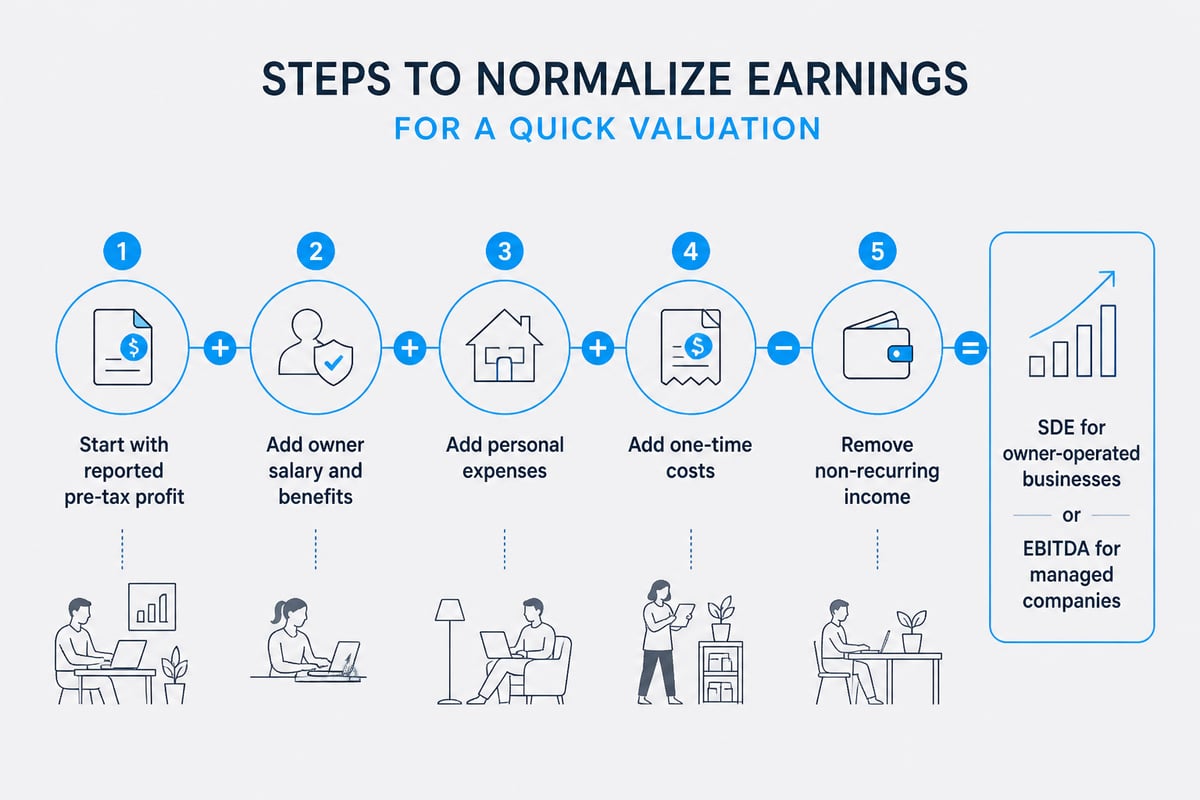
Start with seller's discretionary earnings (SDE) for owner-operated businesses and EBITDA for larger companies with professional management. Using the wrong measure is one of the most common reasons an estimate drifts from reality.
SDE is pre-tax profit plus the owner's salary and benefits, plus one-time or personal expenses. It shows the total financial benefit available to a single working owner. EBITDA is earnings before interest, taxes, depreciation and amortization, and it assumes management is paid a market salary. Buyers in the lower middle market often expect EBITDA once a business has a management layer. Aligned IQ has a useful walkthrough of EBITDA business valuation if you need the mechanics.
Once you choose the measure, normalize it. Common add-backs include:
- Owner compensation above or below market rate
- Personal vehicles, travel or family payroll run through the business
- One-time legal fees, moving costs or equipment repairs
- Non-recurring revenue or losses
Document every adjustment. Buyers will test each one, and an add-back you cannot support will be removed from the price.
What Multiple Should You Apply?
The multiple depends mainly on company size, industry and risk, and published market data gives a useful reference point. According to the BizBuySell 2025 Year in Review, the average cash-flow multiple for small-business sales rose 1% to 2.61x in 2025, while the average revenue multiple rose 2% to 0.69x.
Size changes the picture considerably. The BizBuySell Insight Report shows average multiples of 3.73x cash flow and 0.97x revenue for businesses selling above $1 million, compared with 2.30x and 0.62x for businesses below $1 million.
| Business size | Average cash-flow multiple | Average revenue multiple |
|---|---|---|
| Sale price below $1 million | 2.30x | 0.62x |
| Sale price above $1 million | 3.73x | 0.97x |
Source: BizBuySell Insight Report.
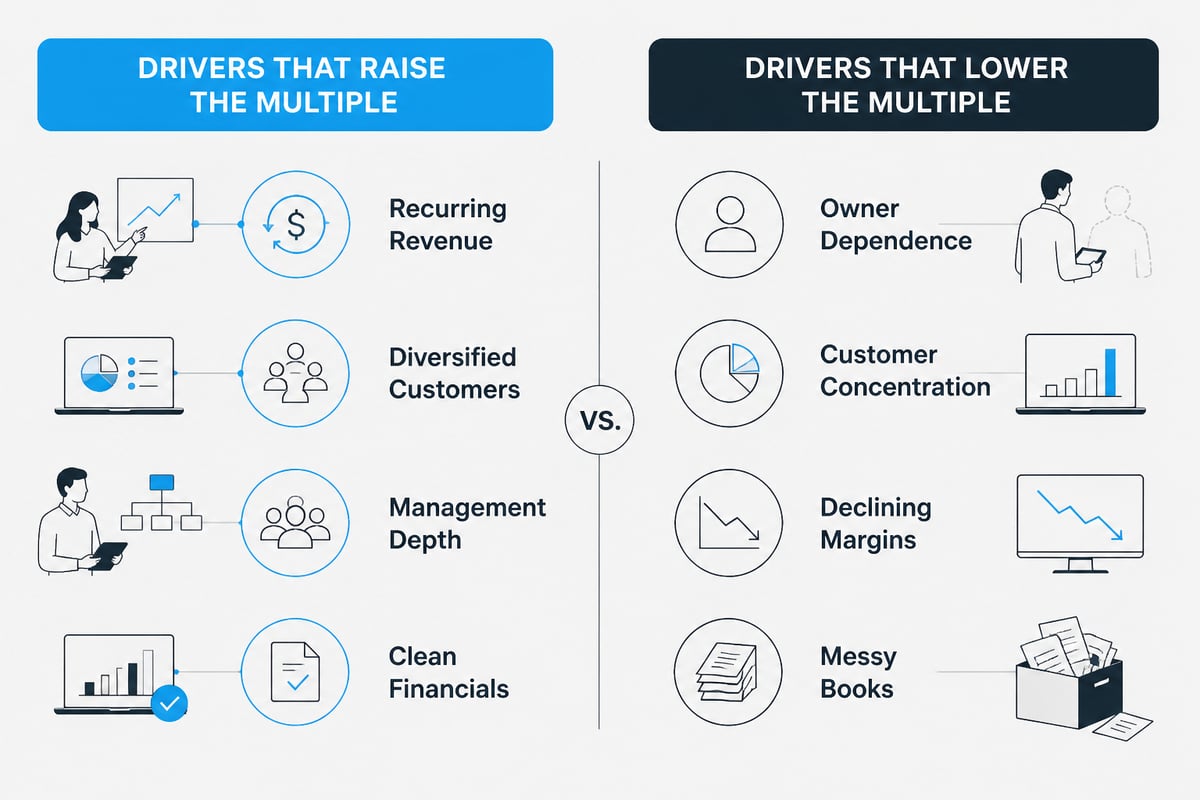
These are averages across many industries, so treat them as a band rather than a target. A company with recurring contracts, strong margins and a deep customer base should sit toward the upper end. One with heavy owner dependence or concentrated customers belongs at the lower end.
Is a Business Worth 5 Times Profit?
A business is worth five times profit only in specific circumstances, because most small businesses sell for less. The BizBuySell figures above put the average small-business cash-flow multiple at roughly 2.3x to 3.7x depending on size, so five times is an above-average outcome.
Higher multiples tend to appear when several of these conditions are present:
- Earnings above roughly $1 million, which widens the pool of institutional buyers
- Recurring or contracted revenue
- A management team that runs operations without the owner
- Documented growth over several years
- A strategic buyer who can capture synergies
Lower middle-market companies with strong fundamentals can reach or exceed that range, particularly in industries buyers are actively consolidating. A neighborhood service business with the owner at the center of every job usually cannot. The honest answer is that the multiple is an output of risk and growth, not a fixed rule of thumb.
How Do You Run a Quick Business Valuation Step by Step?
You run a quick business valuation by gathering three years of financials, normalizing earnings, choosing a multiple range and calculating a low, middle and high value. The process fits in a few hours if your books are current.
- Collect the numbers. Pull profit and loss statements, tax returns and a balance sheet for the last three years.
- Calculate SDE or EBITDA for each year and list every add-back with supporting evidence.
- Pick a weighting. Many owners use the most recent twelve months, while others average the last two or three years when results are volatile.
- Select a multiple range. Use market data for your size and industry, then adjust for the risk factors below.
- Calculate three values. Multiply earnings by the low, middle and high multiples.
- Cross-check. Compare the result with a revenue multiple and with net asset value.
- Subtract debt and add excess cash to estimate what you would take home before taxes and fees.
Hypothetical example: a business with normalized SDE of $400,000 and a multiple range of 2.3x to 3.0x would indicate a value between $920,000 and $1.2 million. The low end assumes a buyer sees meaningful risk, and the high end assumes a clean, well-documented company. The range itself is useful information, because the gap shows how much value you may be able to recover through preparation.

What Factors Move Your Valuation Up or Down?
Risk, transferability and growth move a valuation more than any other factors, because they determine how confident a buyer feels about future earnings. A multiple is essentially a price for that confidence.
Factors that typically raise value:
- Recurring revenue and long customer relationships
- Diversified customers, with no single account making up a large share of sales
- Documented processes and a capable second layer of management
- Clean, reviewed or audited financials
- Proprietary assets such as contracts, intellectual property or brand
Factors that typically lower value:
- Heavy reliance on the owner for sales or operations
- Customer or supplier concentration
- Declining margins or inconsistent earnings
- Informal bookkeeping and commingled personal expenses
- Pending litigation, unresolved tax issues or key-employee flight risk
The most controllable of these is owner dependence. Buyers pay less for a business that cannot operate without its founder, so building a team and writing down how the company runs is among the highest-return preparation steps available. Aligned IQ has also published two articles that address common misconceptions in this area: business valuation mythology, part I and part II.
How Much Is My Website or Online Business Worth?
A website or online business is typically valued on a multiple of annual profit, with the multiple set by revenue stability, traffic sources and how much work the owner performs. The same normalization rules apply as for any other company.
Online businesses add a few specific considerations. Revenue that depends on a single traffic channel, such as one search algorithm or one advertising account, carries more risk than revenue spread across channels. Subscription or repeat-purchase models tend to earn higher multiples than one-time transactions. Buyers also look closely at the last twelve months, so recent trends carry heavy weight. If profit is rising and the owner's hours are falling, the estimate improves. If profit is declining, expect the range to narrow toward the low end.
When Is a Quick Estimate Not Enough?
A quick estimate is not enough once you are ready to price a sale, negotiate with a serious buyer, or support a number for tax, legal or financing purposes. At that point you need a defensible opinion of value.
Consider a formal valuation when:
- You plan to list or approach buyers within the next twelve months
- A partner buyout, divorce, estate matter or gift is involved
- Your business has unusual assets, multiple entities or complex ownership
- Two methods produce results that differ widely
Cost is a reasonable concern. Costs vary with the complexity of the business, and a credentialed appraiser delivers a written opinion of value that a formula cannot. A quick business valuation is the right first pass, and a professional report is the right second one.
How Does Valuation Connect to Finding the Right Buyer?
Valuation connects to buyer selection because the same company can be worth different amounts to different buyers. A strategic acquirer with overlapping customers may pay more than a financial buyer, and a buyer who shares your goals for employees and legacy may be easier to close with.
Traditional sale processes often begin with a broad marketing push, which can expose a business to employees, customers and competitors before fit has been confirmed. Aligned IQ M&A takes a different path. It is a proprietary B2B web platform where buyers and sellers meet privately, and its match-making process puts strategic fit first, based on transaction priorities, deal size, and industry experience and expertise. Sellers explore potential deals in a confidential, secure setting rather than a public listing. Buyers, in turn, gain a stage to present themselves as an attractive exit option to owners who may not yet be actively marketing a company. For owners weighing a sale, Aligned IQ’s sell-side M&A advisory for business owners supports preparation through the platform, with exit planning and valuation support in one place.
Once a match is made, documents need a secure home. Aligned IQ VDR is a separate product from Aligned IQ M&A: a virtual data room for sharing deal documents, complimentary for Aligned IQ M&A sellers after a match is completed. It is also available to other buyers, sellers, intermediaries and M&A service providers at competitive pricing, which you can review on the Aligned IQ VDR pricing page. A well-organized data room also supports the valuation itself, because buyers can verify your add-backs and financials quickly.
How Do You Make Your Estimate Hold Up With Buyers?
Your estimate holds up when every input is documented, every adjustment is explained and your range is realistic rather than optimistic. Buyers discount what they cannot verify.
A short checklist helps:
- Reconcile your normalized earnings to tax returns and bank statements
- Keep a schedule of add-backs with invoices or payroll records
- Prepare a one-page summary of customers, contracts and retention
- Note any pending changes, such as lease renewals or key departures
- Present a range with the reasoning behind each end
Owners who plan ahead also benefit from understanding timing. If speed matters, Aligned IQ explains the tradeoffs in its guide on how to sell a business quickly. A faster process generally reduces leverage, so a strong valuation range and prepared documents are the best protection against a discounted outcome.
FAQ
What is the fastest way to estimate what my business is worth?
Multiply your normalized annual earnings (SDE for owner-operated companies, EBITDA for managed ones) by a multiple suited to your size and industry. Calculate a low, middle and high case so you have a range rather than a single number.
Can I value a business that is not yet profitable?
Yes, though earnings multiples will not work. Revenue multiples, asset values, recurring revenue and strategic value to a specific buyer are the more common reference points, and the resulting estimate will carry a wider range.
How accurate is an online valuation calculator?
A calculator gives a reasonable first approximation when you enter clean, normalized inputs. It cannot judge customer concentration, owner dependence or growth quality, so treat the output as a screening number and confirm it with a professional before pricing a sale.
Your next step is to calculate normalized earnings for the last three years and run a low, middle and high estimate using the multiples above. When you are ready to see how a private, strategy-first approach compares with a traditional sale process, Take a Tour of Aligned IQ M&A and review the sell-side M&A advisory for business owners to learn how preparation and matching work together.
No responses yet