

EBITDA business valuation estimates what a company is worth by multiplying its earnings before interest, taxes, depreciation, and amortization by a market-based multiple, then adjusting the result for debt and cash. For owners considering a sale, it is the most common starting point for a price conversation, but the number it produces is only as reliable as the earnings and the multiple behind it.
This guide explains how the method works, how to normalize earnings, where multiples come from, and what to do with the result before you approach a buyer.
What Is EBITDA and Why Does It Matter in Valuation?
EBITDA is a measure of operating profit that removes financing choices, tax situations, and non-cash accounting charges so that one company can be compared with another. That comparability is why it matters. Two businesses with identical operations can report very different net income because of how they are financed or how they depreciate equipment. EBITDA sets those differences aside and shows what the operations themselves produce. For a step-by-step look at applying this to your own company, see our guide to EBITDA company valuation in 2026.
Buyers care about this for a practical reason. They intend to finance the acquisition their own way, face their own tax position, and reset the asset base through purchase accounting. A metric that ignores those variables gives them a cleaner view of the cash-generating capacity they are actually buying.
EBITDA is not cash flow, and it has limits. It ignores capital expenditures, working capital needs, and the cost of maintaining equipment. A business that must replace expensive machinery every few years will look better on EBITDA than it does in the bank account. Sophisticated buyers adjust for this, and sellers should expect the question.
How Do You Calculate EBITDA and EBITDA Margin?
You calculate EBITDA by starting with net income and adding back interest, taxes, depreciation, and amortization. An equivalent route starts with operating income and adds back depreciation and amortization.
The two standard formulas:
- From net income: EBITDA = Net income + Interest + Taxes + Depreciation + Amortization
- From operating income: EBITDA = Operating income (EBIT) + Depreciation + Amortization
The EBITDA margin shows how much of each revenue dollar becomes EBITDA. The formula is EBITDA divided by total revenue, expressed as a percentage. A company with $400,000 in EBITDA on $2,000,000 in revenue has a 20 percent margin. Margin matters because buyers use it to judge efficiency against peers and to test whether earnings are sustainable. A margin well above the industry norm invites scrutiny, while a margin below it can point to a clear improvement opportunity that a buyer might pay to capture.
What Is the Formula for an EBITDA Business Valuation?
The core formula is simple: enterprise value equals adjusted EBITDA multiplied by an EBITDA multiple. Everything difficult about the method sits inside those two inputs.
Suppose a company has $750,000 in adjusted EBITDA and comparable businesses sell at 5.0 times EBITDA. The implied enterprise value is $3,750,000. That figure represents the value of the operating business before considering how it is financed.
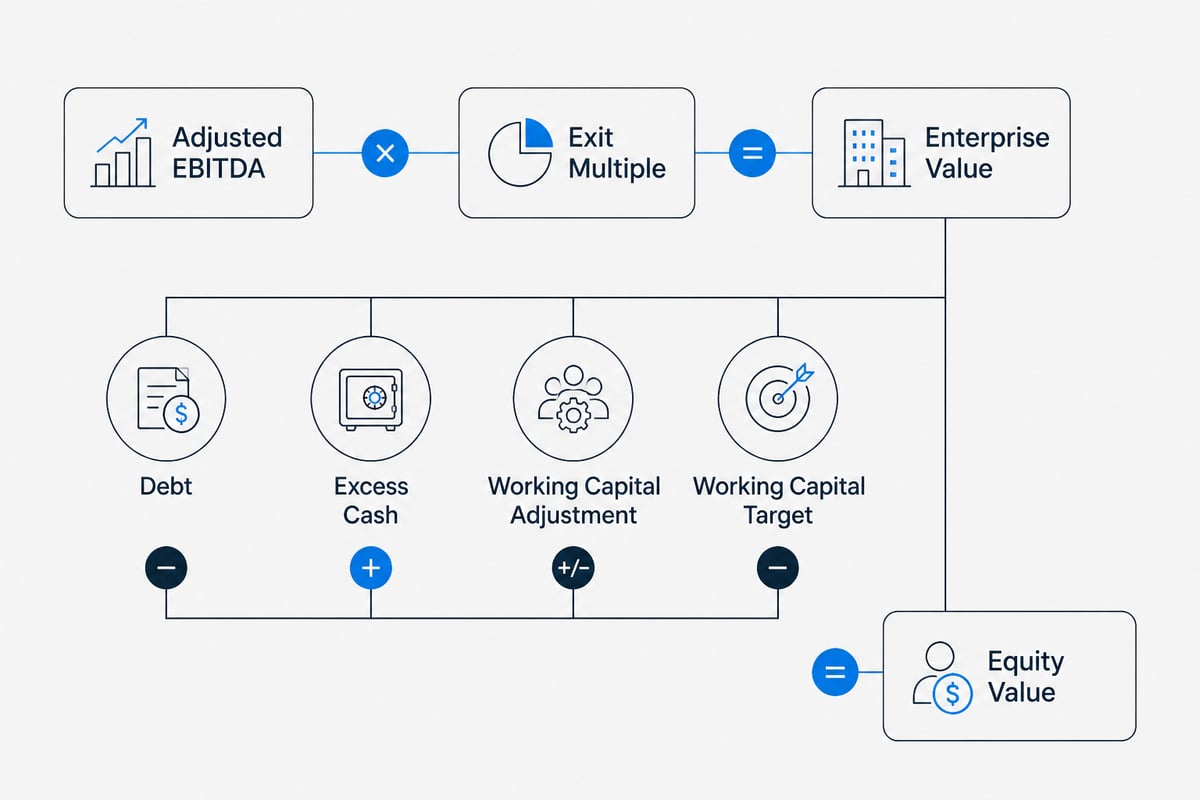
To reach what the owner actually receives, move from enterprise value to equity value:
- Start with enterprise value (adjusted EBITDA multiplied by the multiple).
- Subtract interest-bearing debt and debt-like items, such as unpaid taxes or capital leases.
- Add excess cash that the business does not need to operate.
- Adjust for any normal working capital target the buyer requires at closing.
The result is equity value, the amount available to owners before transaction costs and taxes. Owners frequently quote enterprise value as "the price" and are surprised when the check at closing looks smaller. Walking through this bridge early removes that surprise.
How Do You Normalize EBITDA Before Applying a Multiple?
Normalizing EBITDA means adjusting reported earnings to reflect what a new owner would realistically earn, and it is usually where the most value is won or lost. Reported books reflect the owner's personal choices. A buyer wants earnings stripped of those choices.
Common adjustments, called add-backs, include:
- Owner compensation above or below market. If the owner draws $400,000 but a replacement manager would cost $180,000, the difference is added back. If the owner works for free, an expense is deducted.
- Personal expenses run through the business, such as vehicles, travel, or family payroll for roles that do not exist in practice.
- One-time costs, including litigation settlements, a failed software rollout, or relocation expenses.
- Non-recurring revenue, which is subtracted, such as a one-off contract or insurance recovery.
- Related-party rent or services priced above or below market.
Every add-back needs documentation. Buyers test each one, and an unsupported adjustment lowers credibility on the ones that are legitimate. Organizing invoices, payroll records, and contracts early makes the process faster, and a secure data room is where that evidence eventually lives. Aligned IQ VDR is the virtual data room built for this stage of a deal, and it is complimentary for Aligned IQ M&A sellers after a match is completed. Other buyers, sellers, intermediaries, and M&A service providers can use it at competitive pricing.
For a deeper look at how owners and advisors approach this process, Aligned IQ explains EBITDA and valuation in more detail.
Where Do EBITDA Multiples Come From?
EBITDA multiples come from observed transactions and trading data for comparable companies, adjusted for the specific risk and growth profile of the business being valued. The multiple is a price tag for risk: the more predictable and growing the earnings, the higher the multiple a buyer will pay.
Sector differences are large. According to NYU Stern’s January 2026 U.S. sector data, advertising firms with positive EBITDA trade at an EV/EBITDA of 12.00x, aerospace and defense firms at 21.58x, and food-processing firms at 10.01x. That dataset covers public companies, so privately held businesses often transact at lower multiples because of size, liquidity, and concentration risk. Treat it as a map of relative sector valuation, not a price quote for your company.
| Sector (NYU Stern, January 2026) | EV/EBITDA, positive-EBITDA firms | EV/EBITDA, all firms |
|---|---|---|
| Advertising | 12.00x | 15.12x |
| Aerospace and defense | 21.58x | 33.42x |
| Food processing | 10.01x | 9.63x |
Within any sector, several factors move a private company's multiple up or down:
- Size. Larger EBITDA generally commands higher multiples.
- Customer concentration. Reliance on a few customers lowers the multiple.
- Recurring revenue. Contracted or subscription income raises it.
- Management depth. A business that runs without the owner is worth more than one that cannot.
- Growth trajectory and margin trend. Improving results support a premium.

How Does EBITDA Fit With Other Valuation Methods?
EBITDA multiples are one application of the market approach, and a sound valuation checks them against the other recognized approaches. The IRS identifies three generally accepted business valuation approaches: asset-based, market, and income. The U.S. Small Business Administration describes them in plain terms in its guidance on closing or selling a business: the income approach considers projected revenue and risk, the market approach compares similar businesses that recently sold, and the asset approach subtracts liabilities from asset value.
The IRS also notes that a valuation should select a benefit stream, such as pre-tax or after-tax income or cash flow, and use multiples or rates consistent with that stream. This is a practical point for owners. A multiple derived from EBITDA must be applied to EBITDA, not to net income or seller's discretionary earnings, or the result will be wrong by a wide margin.
That distinction matters for smaller companies. SCORE’s overview of valuing a small business explains that EBITDA is commonly used for larger businesses, while seller's discretionary earnings is often used for owner-operated small businesses. If you are the primary operator and your compensation is bundled into profit, discretionary earnings may be the more natural fit, and the two measures should never be mixed.
For closely held companies, the IRS says in Publication 561 that fair market value considers factors including net worth, prospective earning power, industry outlook, competitive position, management, and asset value including goodwill. A multiple alone captures only part of that list.
How Much Is a Business Worth With $1,000,000 in Sales?
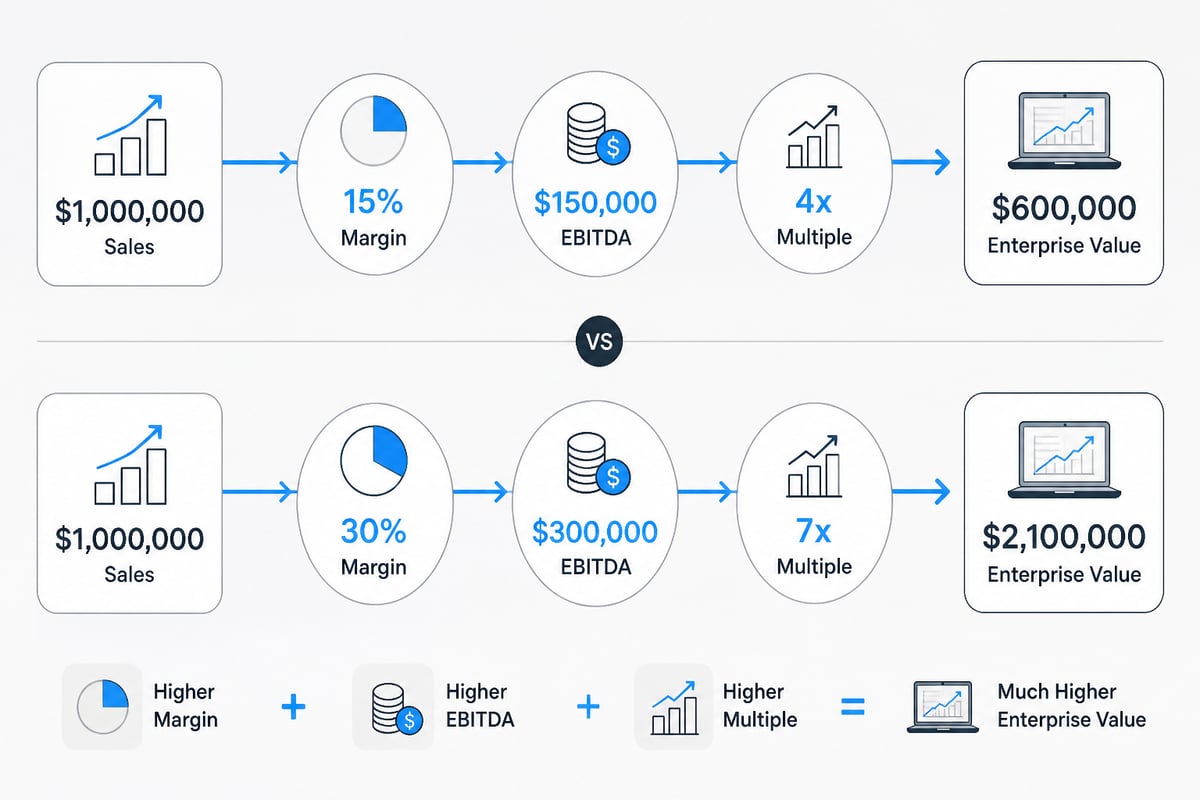
A business with $1,000,000 in sales has no fixed value, because value depends on profit, not revenue. The same sales figure can describe a company worth a few hundred thousand dollars or several million.
Consider a typical scenario. A services company with $1,000,000 in revenue and a 15 percent adjusted EBITDA margin earns $150,000. At a multiple of 3.0x to 4.0x, the indicated enterprise value is $450,000 to $600,000. A comparable company with a 30 percent margin, recurring contracts, and a capable manager might earn $300,000 and attract a higher multiple, pushing value well beyond twice that figure.
This is why revenue multiples can mislead. They ignore how efficiently sales convert to profit. Margin, customer quality, and owner dependence do the real work in setting price, and a buyer will look at all three before agreeing to a number.
What Are the Limits of an EBITDA Business Valuation?
An EBITDA business valuation is a starting point for negotiation, and it understates or overstates value in several predictable situations. Knowing these cases helps you anticipate a buyer's objections.
- Capital-intensive businesses. Heavy ongoing equipment spending means EBITDA overstates distributable cash.
- Unprofitable or early-stage companies. Negative or near-zero EBITDA makes a multiple meaningless.
- Highly seasonal or cyclical earnings. A single peak year can inflate the figure. Buyers commonly review several years of results.
- Asset-heavy holdings. Real estate or inventory may carry value that earnings do not reflect.
- Concentrated key-person risk. A company that depends on the owner's relationships will be discounted regardless of the headline number.
A defensible valuation reconciles EBITDA with at least one other approach and explains the gap. Buyers respect a seller who has already asked the hard questions about their own numbers.
How Should Owners Prepare Before Seeking a Buyer?
Owners should prepare by improving the quality of earnings, documenting every adjustment, and learning what a realistic range looks like before any buyer sees the numbers. Preparation protects price and shortens negotiations.
A sensible sequence:
- Gather several years of financial statements and reconcile them to tax returns.
- Build a list of add-backs with supporting records for each.
- Identify risk factors such as customer concentration or owner dependence, and begin reducing them.
- Estimate a value range using a multiple range rather than a single number.
- Decide what you want from the transaction, including price, timing, role after closing, and the kind of buyer you prefer.
The fifth step is where the process most often goes wrong. In a traditional sale, owners frequently expose financials to a wide field of unknown parties before knowing whether any of them are a strategic fit, which raises confidentiality risk with employees, customers, and competitors. Aligned IQ M&A takes a different path. It is a private web platform where buyers and sellers meet to explore potential deals, and it prioritizes strategic fit before either side goes deep into the process. Matches are based on transaction priorities, deal size, and industry experience and expertise, so goals are agreed first. For owners, that means a lower-risk, confidential, and secure way to test interest, and for buyers it offers a proprietary stage to present themselves as an attractive exit option.
Owners who want guidance on timing can also read Aligned IQ's perspective on when to sell for maximum value, and those comparing approaches may find its overview of calculating business valuation useful. For owners who want support through the full preparation process, Aligned IQ offers sell-side M&A advisory for business owners through its platform, with exit planning and valuation support in one place.
Presentation also affects first impressions. Sellers who assemble clean, professional materials, including a clear website, tend to inspire more confidence. Companies that sell to large corporate customers can also strengthen their position by documenting supplier credentials.
FAQ
Why is EBITDA important in valuing a business?
EBITDA isolates operating performance from financing, tax, and accounting choices, which lets buyers compare companies on equal terms. It gives a clean view of the earnings power a new owner would acquire, which is why it anchors most price discussions for established private companies.
Is a higher EBITDA multiple always better for a seller?
A higher multiple raises price, but it should be earned by the business, not assumed. Buyers pay premiums for recurring revenue, strong management, diversified customers, and growth, and they discount for the opposite. Improving those factors before a sale is often more productive than negotiating the multiple itself.
Can I use an EBITDA multiple if my company is small and owner-operated?
You can, but seller's discretionary earnings is often the better measure when the owner is the main operator and compensation is built into profit. Whichever measure you choose, the multiple must match it, since applying an EBITDA multiple to discretionary earnings produces an inflated and unreliable value.
Your next step is to take a Take a Tour of the platform and see how a private, strategy-first process compares with a traditional sale, starting by calculating your normalized EBITDA and a realistic multiple range. Aligned IQ M&A pairs sellers with buyers whose goals fit theirs, and once a match is completed, sellers receive Aligned IQ VDR at no cost to share deal documents securely. If you are planning an exit and want to learn how sell-side M&A advisory for business owners works, contact Aligned IQ to arrange a tour and begin the conversation.
No responses yet