

Business valuation companies are independent firms that estimate what a private company is worth, and for most lower middle-market owners the right choice depends on the purpose of the valuation: a sale, a tax filing, a legal dispute, or exit planning. Accounting firms, boutique appraisers, investment banks, and credentialed independent analysts all offer this work, but their methods and deliverables differ. This guide explains the main provider types, how they arrive at a number, what a valuation costs, and how to use the result when you are preparing to sell or looking to buy.
What Types of Business Valuation Are There?
There are three generally accepted approaches to valuing a business: asset-based, market, and income. The IRS Internal Revenue Manual identifies these same three and directs appraisers to consider all of them before selecting the approaches and methods best suited to the assignment.
- Asset-based approach: Totals the fair market value of assets and subtracts liabilities. It suits holding companies, asset-heavy operators, and businesses nearing liquidation.
- Market approach: Compares the company to similar businesses that have sold or are publicly traded, usually through revenue or earnings multiples. It reflects what buyers actually pay.
- Income approach: Projects future cash flows and discounts them to present value, or capitalizes a normalized level of earnings. It suits profitable, stable companies with predictable results.
A credible report rarely relies on one method alone. The conclusion typically reconciles two or three, with the appraiser explaining why each was weighted as it was.
Valuations also differ by standard of value. Fair market value is the usual standard for tax and estate work. Investment value, which reflects what a specific buyer would pay given its synergies, is more relevant to negotiations. Knowing which standard your provider is applying keeps you from comparing numbers that were never meant to match.
Which Kinds of Business Valuation Companies Serve Lower Middle-Market Owners?
Lower middle-market owners generally choose among four kinds of providers, and each fits a different objective. Understanding the differences prevents paying for a formal appraisal when a market-based opinion would do, or the reverse.
| Provider type | Typical deliverable | Best suited to |
|---|---|---|
| CPA or accounting firm valuation group | Formal appraisal or calculation of value | Tax, estate, gifting, buy-sell agreements |
| Independent valuation boutique | Full appraisal report, often defensible in court | Disputes, partner buyouts, regulatory needs |
| Investment bank or M&A advisor | Broker opinion of value or pricing analysis | Preparing for a sale and setting an asking range |
| Online or software-based tools | Automated estimate | Early, directional benchmarking |
Credentials matter when a report must withstand scrutiny. Designations such as ABV, ASA, and CVA signal formal training in valuation standards, and a provider that follows recognized professional standards is easier to defend in front of a buyer's diligence team or a tax authority. Aligned IQ's overview of certified business valuation explains what those credentials represent in an M&A context, and its page on business valuation firms describes what to expect from different types of providers.
How Do Business Valuation Companies Determine Value?
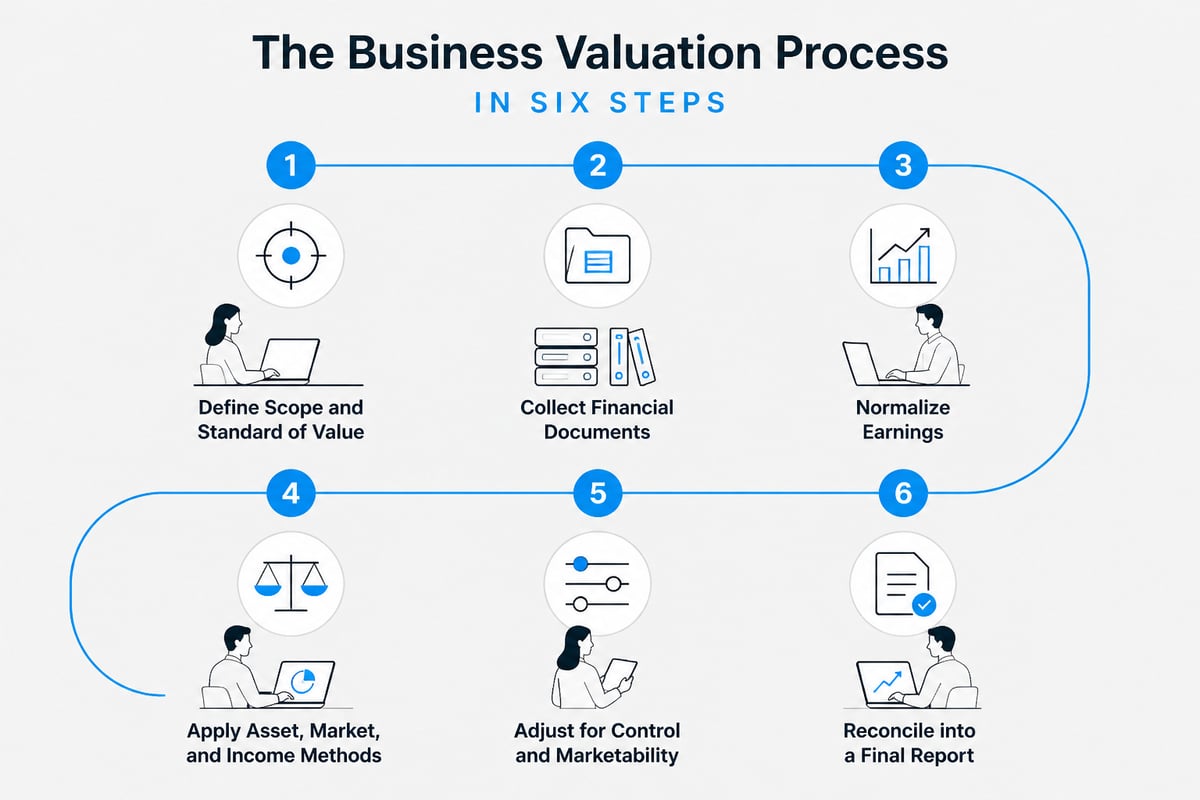
Valuation companies determine value by normalizing financial results, selecting suitable methods, and adjusting the preliminary figure for risk, control, and marketability. The process is more judgment-driven than most owners expect.
The work generally follows these steps:
- Scope and standard of value. The provider confirms the purpose, the valuation date, and whether the interest is controlling or minority.
- Document collection. Typically several years of financial statements and tax returns, customer and contract data, and an asset list.
- Normalization. Owner compensation, one-time expenses, and personal costs run through the business are adjusted to show true earning power.
- Method selection and calculation. Asset, market, and income approaches are applied as appropriate.
- Discounts and premiums. Adjustments reflect control, minority status, and marketability.
- Reconciliation and report. The appraiser weighs the indications and documents the reasoning.
Context shapes the result. IRS guidance says the analysis should consider the business's history, the economic and industry outlook, and relevant market evidence. The IRS also says marketability, including contractual or legal restrictions and prevailing market conditions, should be considered when appropriate in reaching a final value conclusion. For a privately held company, that marketability factor can move the conclusion meaningfully.
How Much Is a Business Worth With $1,000,000 in Sales?
A business with $1,000,000 in sales has no fixed worth, because value depends on profit and risk rather than revenue alone. Lower middle-market buyers price companies primarily on earnings, most often seller's discretionary earnings or EBITDA, then apply a multiple that reflects industry, growth, customer concentration, and owner dependence.
Two companies with identical sales can differ by a wide margin. A business producing strong, recurring, well-documented profit with a management team in place commands a higher multiple than one where the owner holds every key relationship. Aligned IQ's discussion of how simply increasing profit may not increase business value illustrates why raw earnings growth does not always translate into a higher price.
For owners of smaller companies, a small business valuation will usually be built on discretionary earnings. For firms with more sophisticated structures and management depth, EBITDA-based methods tend to dominate.
What Does a Business Valuation Cost, and Can You Get One for Free?
Formal valuations from independent providers cost materially more for a full, defensible appraisal than for a limited calculation, and fees vary widely with the scope of the engagement. Cost scales with company size, complexity, the number of entities, the purpose of the report, and whether the provider must be prepared to testify. Aligned IQ's guide to business valuation cost breaks down the factors that drive fees.
Free options exist, with limits. Online calculators and some advisors will produce a rough estimate at no charge, which is useful for early benchmarking. They are not appraisals, and a buyer, lender, or tax authority is unlikely to rely on them. A sensible approach is to start with a free estimate to gauge a range, then commission a formal report only when the purpose requires one.
Which Provider Fits Your Purpose?
The best provider is the one whose deliverable matches how the number will be used. A mismatch is costly in either direction: an overbuilt appraisal wastes budget, and an underbuilt opinion can collapse under diligence.
- Preparing for a sale: An M&A-focused provider or advisor who understands current buyer pricing will give a more practical range than a purely technical appraiser.
- Tax, gifting, or estate planning: A credentialed appraiser producing a report that follows recognized standards is the safer choice.
- Shareholder disputes or divorce: A boutique with litigation experience and a defensible methodology is appropriate.
- Buyer-side pricing: Acquirers often commission their own analysis to test a seller's asking price and model synergies.
Ask each candidate how many lower middle-market engagements they complete annually, which standard of value they will apply, what the final deliverable looks like, and whether they have worked in your industry. A specialist with direct experience in a niche, such as valuation of consulting firms, will typically understand the revenue quality and key-person issues that drive price in that sector.

How Should Sellers Prepare Before Engaging a Valuation Provider?
Sellers get a better valuation, and a better sale, when the business is organized before the appraiser arrives. Preparation reduces fees because less time is spent reconstructing records, and it reduces the risk of surprises in diligence later.
Priorities to address first:
- Clean financials. Reconcile statements, document add-backs, and separate personal expenses from operating ones.
- Reduced owner dependence. Document processes and delegate key relationships so earnings are not tied to one person. Aligned IQ's piece on how the right systems drive business value covers this directly.
- Customer and revenue analysis. Know concentration, retention, and contract terms before a buyer asks.
- Legal and compliance housekeeping. Resolve open contracts, licenses, and entity questions.
Owners who treat valuation as the beginning of exit planning, rather than a one-time number, tend to see value gaps early enough to close them. A broader view of timing and positioning is available in Aligned IQ's resource for business owners considering a sale.
How Does a Valuation Fit Into the Sale Process?
A valuation sets the pricing anchor, but in a traditional sale it is only one step in a long and exposed process. Understanding where it fits helps owners avoid common sequencing mistakes.
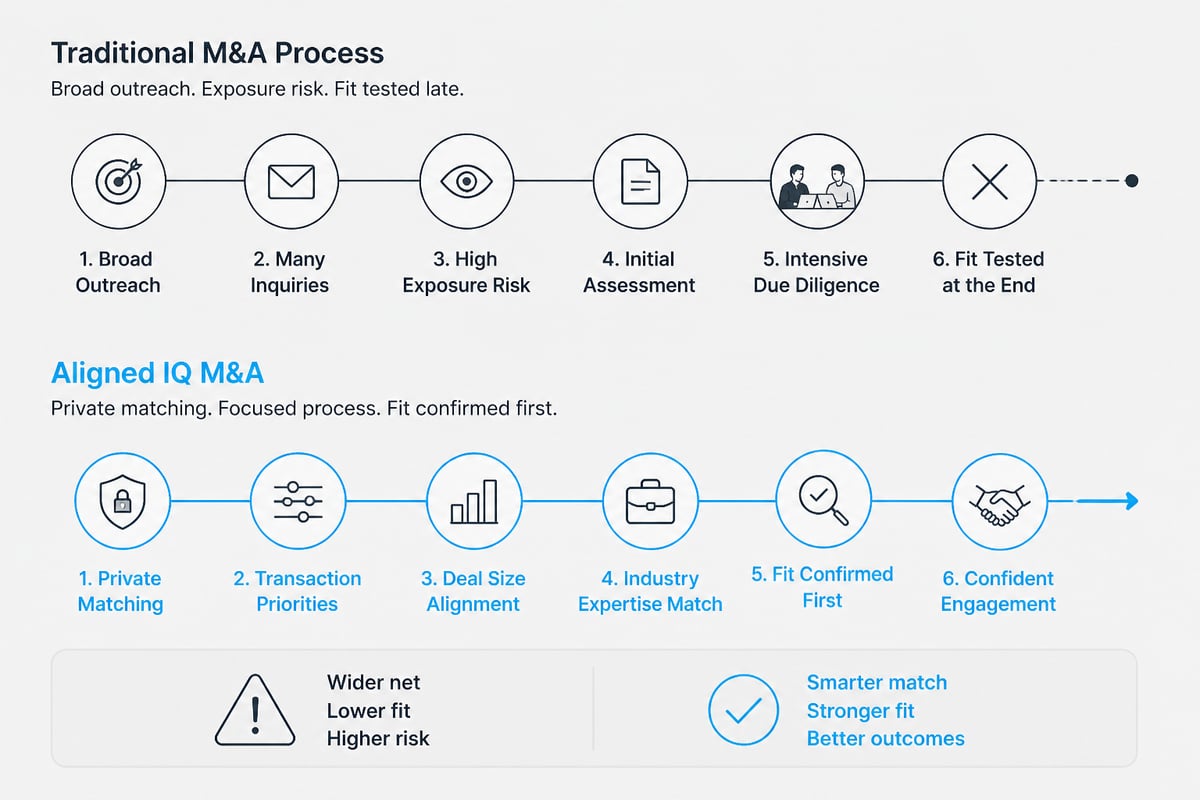
In the traditional M&A process, an owner often hires a broker or banker, circulates a teaser and confidential information memorandum to a wide pool of prospects, and fields inquiries from parties who may not be a strategic fit. Each additional recipient increases the chance that employees, customers, or competitors learn the company is for sale. Valuation expectations are frequently tested in this setting before the owner has confirmed that any particular buyer shares their goals.
Aligned IQ M&A reverses that order. It is a B2B web platform where potential buyers and sellers meet privately, and its match-making process puts strategic fit first by pairing users on transaction priorities, deal size, and industry experience and expertise. Because discussions begin from agreed goals, valuation conversations happen with counterparties who have already been screened for alignment, and the confidential, controlled setup carries lower exposure risk than broad outreach. Aligned IQ's strategy-before-the-deal model also keeps exit planning and valuation support in one place, so owners are not stitching together separate tools and advisors.
What Should Buyers Look for in a Seller's Valuation?
Corporate and private equity buyers should treat a seller's valuation as a starting point and test it against their own analysis. The questions that matter most are whether earnings were normalized fairly, whether the method fits the business model, and how heavily discounts and premiums were applied.
Buyers typically verify:
- The add-backs claimed, and whether each can be documented
- The comparable transactions used, and whether they are truly similar in size and sector
- Customer concentration, contract renewals, and working capital needs
- Which synergies the seller's number includes or excludes
On Aligned IQ M&A, buyers have a stage to present themselves as an attractive exit option for owners, and access to a proprietary pool of sellers matched to their stated acquisition criteria. That gives buyers a way to reach owners who are open to a conversation without competing in a broadly marketed auction, and to engage with them on strategic fit before price becomes the only topic.
How Do You Share Valuation Documents Securely During Diligence?
Valuation reports, financial statements, and customer data should be shared through a secure virtual data room rather than by email attachment. A data room controls who can view each file, logs activity, and keeps the diligence record organized for both sides.
It helps to keep the two Aligned IQ offerings distinct:
- Aligned IQ M&A is the matching platform. It connects buyers and sellers privately on strategic fit, deal size, and industry expertise.
- Aligned IQ VDR is the virtual data room for sharing deal documents. It is complimentary for Aligned IQ M&A sellers once a match is completed.
The VDR is also available to other lower middle-market buyers, sellers, M&A advisors, and investment bankers at competitive rates, so advisors running deals outside the matching platform can still use it. Details are on the Aligned IQ VDR pricing page. Organizing valuation workpapers, tax returns, and contracts in one permissioned space shortens diligence and signals preparedness to the other side.
FAQ
Which are the Big 4 valuation firms?
The Big 4 are Deloitte, PwC, EY, and KPMG, the four largest global accounting and professional services networks, each with a valuation practice. They primarily serve large corporations, and lower middle-market owners often find that boutique appraisers, regional accounting firms, or M&A-focused advisors offer a better fit on cost and sector experience.
What are business valuation companies' most common deliverables?
The most common deliverables are a full appraisal report, a calculation of value, and a broker or advisor opinion of value. A full appraisal is the most rigorous and defensible, a calculation is more limited in scope, and an opinion of value is designed to support pricing decisions ahead of a sale rather than a legal or tax filing.
How long does a business valuation take?
Engagement timelines depend on the provider and the scope, and typically run longer when financial records are incomplete. Timelines extend when records need cleanup, when multiple entities are involved, or when the report must meet litigation standards.
Take a tour of Aligned IQ M&A to see how private, strategy-first matching works, then gather your last three years of financials so your valuation provider has what it needs on day one. If you want to see how matching, exit planning, and a secure data room fit together for your own transition, contact Aligned IQ to arrange a walkthrough with the team.
No responses yet