

Determining the value of a business means estimating what a buyer would reasonably pay for its future earnings, assets and risk profile, and it is done by applying one or more recognized methods to normalized financial results. For an owner planning an exit, the practical answer is a range rather than a single figure, supported by clean financials, comparable sales and an honest view of how transferable the company is.
This guide walks through that process in the order an owner would actually follow it.
What Does a Business Valuation Actually Measure?
A business valuation measures the price a willing buyer and a willing seller would likely agree on, based on expected future benefits and the risk of receiving them. It is an estimate of market value, not an accounting figure and not a reflection of what the owner has invested over the years.
That distinction matters because three different numbers are often confused:
- Book value: assets minus liabilities as recorded on the balance sheet.
- Fair value for reporting: a measurement standard used in financial statements. Fair value is a measurement standard used in financial reporting, and it differs from a sale-price estimate.
- Transaction value: what a specific buyer pays, shaped by deal structure, timing and negotiation.
Owners preparing for a sale care most about the third. The first two are inputs, not the answer. For a broader primer on why this step comes first, see understanding business value before a sale.
What Are the Common Valuation Methods?
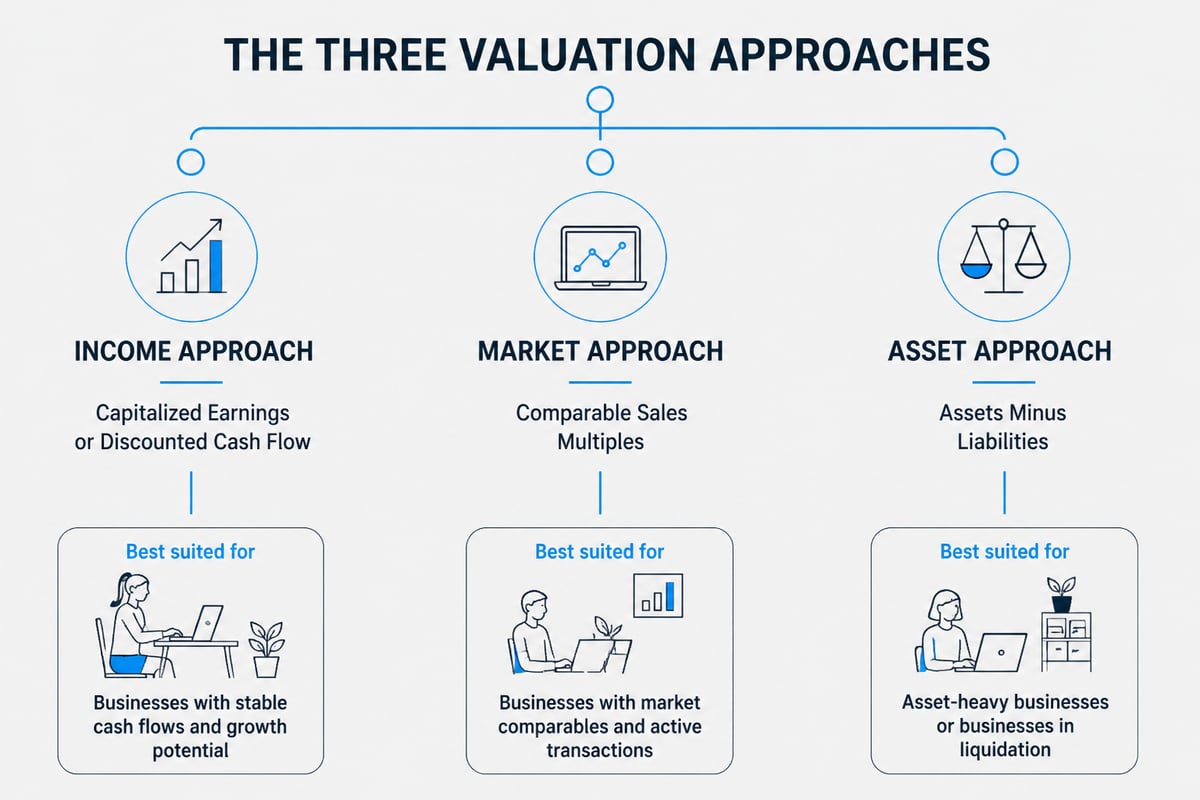
The three common valuation approaches are the income approach, the market approach and the asset approach. The U.S. Small Business Administration describes them as income (projected revenue adjusted for risk), market (comparison with similar recent sales) and assets (assets less liabilities).
Each answers a slightly different question.
Income approach
This method asks what the business will earn and how risky those earnings are. Two techniques dominate:
- Capitalization of earnings: a normalized annual earnings figure is divided by a rate that reflects risk. It suits stable companies with predictable results.
- Discounted cash flow: projected cash flows for several years are discounted back to today. It suits businesses with changing growth or margins, but it is only as reliable as its assumptions.
Market approach
This method compares your company with similar businesses that have sold. In practice it produces a multiple, such as a multiple of seller's discretionary earnings or EBITDA, applied to your own results. Our overview of using comparables to estimate the value of your business explains how to select and adjust them.
Asset approach
This method totals the fair market value of assets and subtracts liabilities. It is most relevant to asset-heavy companies or those earning little, where the business is worth more broken up than operated. The SBA also notes that a valuation should account for tangible property and real estate as well as intangibles such as brand presence, intellectual property, customer information and projected future revenue.
How Do You Choose the Right Method for Your Company?
Choose the method that matches how your business creates value and what a buyer will focus on, and in most cases use two methods to cross-check each other. A profitable service company is typically anchored by the market and income approaches, while an equipment-heavy manufacturer with thin earnings leans more on assets.
A practical decision guide:
| Business profile | Primary method | Cross-check |
|---|---|---|
| Stable, profitable, owner-light | Earnings multiple (market) | Capitalized earnings |
| High-growth or uneven results | Discounted cash flow | Comparable sales |
| Asset-heavy, low earnings | Asset approach | Liquidation estimate |
| Real estate or equipment dominant | Asset approach | Income approach |
Where the methods disagree sharply, the gap itself is useful information. It usually points to a risk, such as customer concentration, or to an opportunity, such as hidden earnings power, worth investigating before going to market.
How Do You Normalize Earnings Before Applying a Multiple?
Normalizing earnings means adjusting reported profit to show what a new owner would actually earn, and it is the step that most changes the final number. Valuation multiples are applied to adjusted earnings, not to the figure on the tax return.
Typical adjustments include:
- Owner compensation: replace the owner's actual pay with a market salary for the role.
- Personal or discretionary expenses: add back vehicles, travel or family payroll that a buyer would not need to continue.
- One-time items: remove unusual legal costs, settlements or a one-off windfall.
- Related-party arrangements: reset above-market or below-market rent or fees to market terms.
- Non-cash items: account for depreciation and amortization consistently.
Every add-back should be documented with invoices or statements, because buyers will test each one. Aggressive, unsupported adjustments erode credibility faster than a lower, defensible number.
An important related point: higher profit does not automatically raise value if its quality is weak. We cover this in why increasing profit alone may not increase business value.
Is a Business Worth 5 Times Profit?
A business is not automatically worth five times profit, because the right multiple depends on size, industry, growth, risk and how much the owner contributes to daily operations. Small, owner-dependent companies often trade at lower multiples of discretionary earnings, while larger, systemized businesses with recurring revenue can command more.
Treat any rule of thumb as a starting reference, then test it against real transaction data. BizBuySell’s insight report data tables publish sale prices, revenue and cash-flow multiples, and days on market by geography and industry, which makes them a practical benchmark. For a sense of scale, BizBuySell's 2025 review reported a rising number of small-business transactions and a median sale price in the mid-six figures.
Industry specifics matter too. Restaurants, for example, trade very differently from software or distribution companies, and industry-specific transaction analysis shows how wide that gap can be.
How Much Is a Business Worth With $300,000 in Profit or $1,000,000 in Sales?
Annual profit of $300,000 or sales of $1,000,000 does not produce one fixed value, but each can be turned into an illustrative range once you apply a multiple suited to the business.
Illustrative arithmetic: $300,000 in normalized earnings with a multiple between 2.0 and 3.5 gives a range of roughly $600,000 to $1,050,000. A well-systemized company with recurring revenue would sit toward the high end, while one dependent on the owner would sit toward the low end. These figures illustrate arithmetic only, not a prediction for any real company.
Sales alone tell you much less. With $1,000,000 in revenue, value hinges on margin. A business keeping 5 percent as profit is worth far less than one keeping 25 percent, which is why buyers anchor on earnings and treat revenue multiples as a rough cross-check. Our pages on valuing a business based on revenue describe when that shortcut is reasonable and when it misleads.

Which Non-Financial Factors Move the Number?
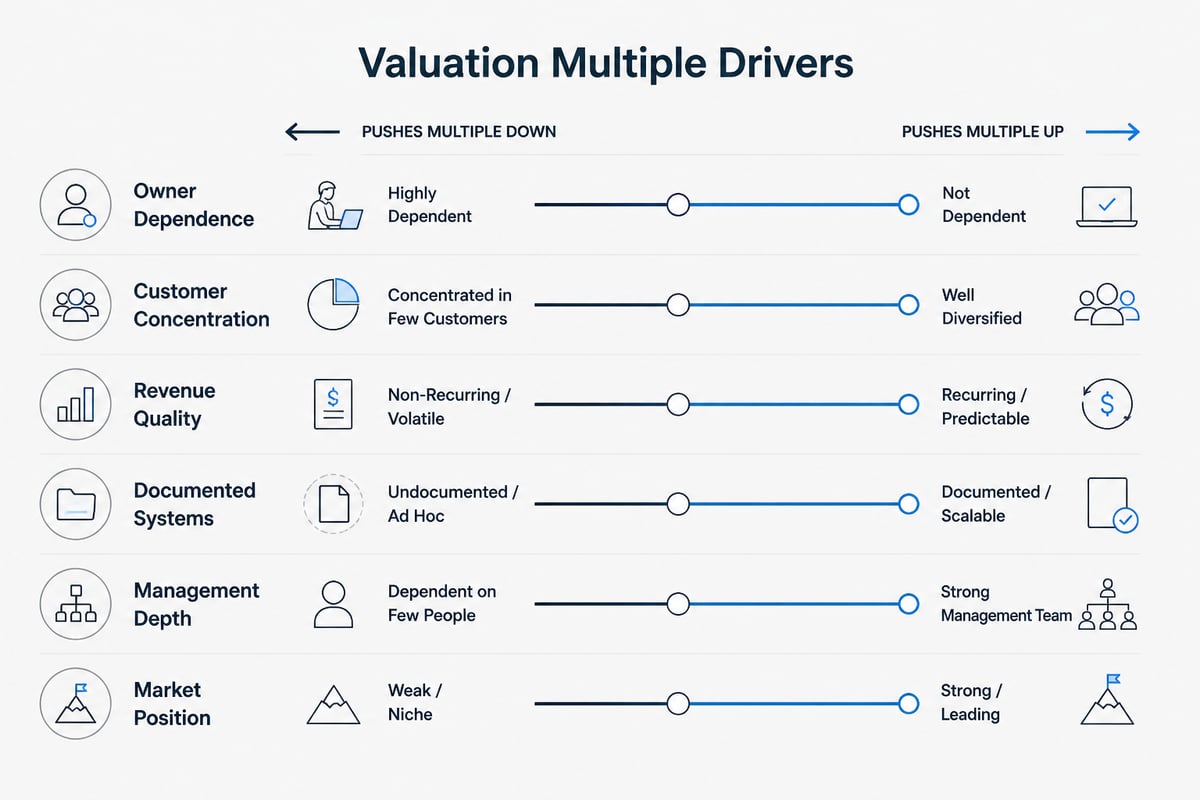
Non-financial factors move the multiple more than most owners expect, because they change how much risk a buyer carries. Two companies with identical earnings can be priced very differently.
The factors buyers weigh most heavily:
- Owner dependence: can the business run without you? Read more on unlocking transferable value.
- Customer concentration: a single client representing a large share of revenue raises risk.
- Revenue quality: recurring and contracted income is worth more than one-off sales. See improving revenue quality.
- Documented systems: repeatable processes make a handover credible.
- Management depth: a capable second layer reduces transition risk.
- Market position: growth outlook, competition and barriers to entry.
Value and marketability are linked but not identical. A strong company can still sit unsold if it is hard to present or transfer, a relationship explored in business value and business marketability.
How Do You Build and Test a Defensible Value Range?
Build a defensible range by running at least two methods on normalized earnings, then stress-testing the result against market data and buyer logic. The goal is a low, midpoint and high figure you can explain line by line. For a fast first pass, our guide to quick business valuation walks through the same steps in less time.
A workable sequence:
- Assemble three to five years of financials and reconcile them to tax returns.
- Normalize earnings with documented add-backs.
- Select a primary and a secondary method using the table above.
- Gather comparables from transaction databases and closed deals in your industry.
- Adjust for risk and transferability, moving toward the low or high end of the multiple range.
- Run scenarios: conservative, expected and optimistic cases.
- Reconcile the methods into a single range and note the assumptions behind it.
Owners who want an outside view can review professional valuation options, since a formal opinion can be worth the cost for disputes, estate matters or lender requirements.
How Does a Confidential, Strategy-First Process Change the Outcome?
A valuation only becomes a price when the right counterparty agrees to it, so the way a company reaches buyers affects realized value as much as the estimate itself. In the traditional sell-side process, a business is often marketed broadly, which can raise confidentiality concerns for employees, customers and suppliers. The mechanics are outlined in the traditional sell-side M&A process.
Aligned IQ M&A is a private, match-making web platform that takes a different path. Strategic fit is established first, so buyers and sellers agree on goals before either side commits to deep diligence. Matches are based on transaction priorities, deal size, and industry experience and expertise, and buyers use the platform to present themselves as attractive exit options. Because discussions stay private, owners can explore interest with lower risk to confidentiality than a broad marketing campaign. Buyers, in turn, gain access to a semi-proprietary pool of sellers rather than a widely circulated listing.
Valuation support and exit planning sit in the same place, so an owner can refine the number while learning who might pay for it. For an owner still deciding how many parties to approach, how many potential buyers to approach is a useful companion read.
How Should You Prepare Documents to Support Your Valuation?
Prepare an organized set of financial, legal and operational documents, because buyers will test every claim behind your value range. Well-presented records shorten diligence and reduce the chance of a late price reduction.
Core items include:
- Three to five years of financial statements and tax returns
- A schedule of normalizing adjustments with support
- Customer, contract and revenue breakdowns
- Organizational chart and key employee information
- Lease, loan and equipment schedules
- Intellectual property and licensing records
Sharing these securely is part of protecting confidentiality. The Aligned IQ Virtual Dataroom is a separate product from the Aligned IQ M&A matching platform. It is a secure online data room for sharing deal documents, and it is complimentary for Aligned IQ M&A sellers after a match is completed.
What Mistakes Distort a Valuation?
The most common mistakes are valuing the business on hope rather than evidence, using stale or poorly matched comparables, and ignoring risk. Each can leave an owner with an expectation the market will not meet.
- Using revenue as the only measure without regard to margins
- Overstating add-backs that a buyer cannot verify
- Ignoring owner dependence when comparing to systemized peers
- Neglecting capital needs: past decisions about equipment and investment shape value, as discussed in the cumulative impact of past capex decisions
- Treating one number as final instead of a range that moves with terms and timing
- Skipping financing realities: the SBA's guidance on valuing a business before acquisition notes that buyers may need financing, which affects what they can pay
Valuation is also not static. Improving systems, revenue quality and risk controls can lift the range over time, and the role of risk management in long-term value shows how.
FAQ
What is the simplest way to estimate what my business is worth?
Take normalized annual earnings and multiply by a market-based multiple for your industry and size, then cross-check with a second method. Treat the result as a range, and refine it with comparable sales before relying on it.
How long does a business valuation take?
A preliminary estimate can be assembled quickly if your financials are organized, while a formal appraisal takes longer because of data gathering and analysis. Timelines vary by company complexity and by the provider you engage.
Should I get a professional valuation before selling?
A professional valuation is worth considering when the stakes are high, the business is complex, or an independent opinion is needed for lenders, partners or legal reasons. Many owners start with their own estimate and then validate it with an advisor before going to market.
Your next step is to gather three years of financials and calculate normalized earnings, so you have a number to test against market data. From there, Aligned IQ can help you connect that valuation to a confidential, strategy-first search for the right buyer, with the Virtual Dataroom ready for deal documents once a match is made. To see how the platform works in practice, Take a Tour of Aligned IQ and ask your questions.
No responses yet