

To value my business, start with a normalized earnings figure, apply a multiple drawn from comparable sales, and cross-check the result with an income-based and an asset-based view. Most private companies sell for a multiple of owner earnings or EBITDA, and the right multiple depends on size, industry, growth, and how well the company runs without its owner. This guide explains each method, shows how the math works, and describes how to turn an estimate into a defensible price.
What Does It Mean to Value Your Business?
Valuing a business means estimating the price a willing buyer would pay a willing seller for the company's future earnings and assets. The result is an opinion of value, not a fixed fact, and it changes with the purpose of the valuation, the buyer's strategy, and market conditions.
Three terms are worth separating early:
- Value is what the business is worth based on its fundamentals.
- Price is what a specific buyer agrees to pay after negotiation.
- Proceeds is what the owner keeps after debt, fees, and taxes.
Owners who confuse these three often set expectations that no buyer can meet. A realistic valuation gives you a range, and the final number inside that range depends on deal structure and buyer fit. For a plain-language primer on why this step comes first, see this Aligned IQ article on understanding business value before a sale.
What Are the Common Valuation Methods?
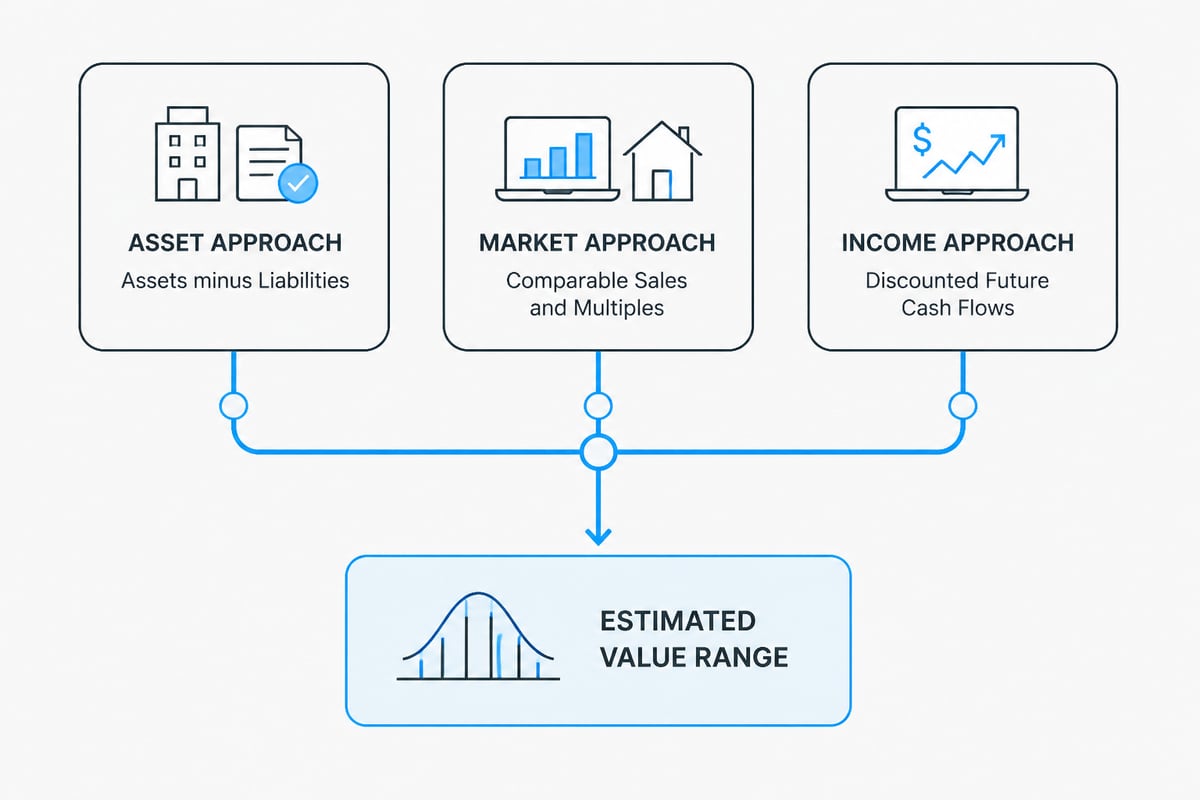
The three common valuation methods are the asset approach, the market approach, and the income approach. The Internal Revenue Service identifies these as the generally accepted approaches and says all three should be considered when developing a valuation conclusion.
| Approach | What it measures | Best suited to |
|---|---|---|
| Asset | Fair value of assets minus liabilities | Asset-heavy firms, holding companies, distressed sales |
| Market | Prices paid for comparable businesses | Most small and lower middle-market companies |
| Income | Present value of expected future cash flows | Stable or growing companies with forecastable earnings |
No single approach is correct in every case. Appraisers typically run two or three and then weigh the results based on how reliable the inputs are. A company with strong, steady cash flow leans on the income and market approaches, while a capital-intensive manufacturer may give the asset approach more weight.
The Market Approach
The market approach prices your company by reference to what buyers have paid for similar ones. It is the most intuitive method and the one buyers tend to use as a starting point in negotiation. The challenge is finding comparables that truly resemble your company in size, margin profile, and customer mix. Aligned IQ explains the mechanics in its guide to using comparables to estimate the value of your business.
The Income Approach
The income approach, usually a discounted cash flow (DCF) analysis, projects future cash flows and discounts them to present value using a rate that reflects risk. Higher perceived risk means a higher discount rate and a lower value. DCF is sensitive to its assumptions, so a small change in growth or the discount rate can move the result materially. That is why it works best alongside a market check rather than alone.
The Asset Approach
The asset approach adds up the fair market value of everything the company owns and subtracts what it owes. For service and software businesses, where most value sits in goodwill and relationships, it produces a floor rather than a realistic price. For equipment-rich or real estate-heavy companies, it can be the most relevant lens.
Which Earnings Number Should You Use: SDE or EBITDA?
Use seller's discretionary earnings (SDE) for owner-operated businesses and EBITDA for companies large enough to have a management team beyond the owner. Both start from net income and add back items that a new owner would not incur or that do not reflect ongoing operations.
SDE adds back the owner's salary and benefits, one-time expenses, and personal costs run through the company. It answers the question, "How much total cash would one working owner earn?"
EBITDA adds back interest, taxes, depreciation, and amortization, and then adjusts for non-recurring items. It assumes the owner is replaced by paid management at a market salary, which makes it the standard for larger deals and private equity buyers.
Normalizing is the step where many valuations are won or lost. Typical adjustments include:
- Owner compensation above or below market rate
- Personal vehicles, travel, or family payroll
- One-time legal, moving, or repair costs
- Non-recurring revenue or windfalls
- Related-party rent set above or below market
Each adjustment must be documented, because a buyer will test every one during due diligence.
Is a Business Worth 5 Times Profit?
A business is rarely worth exactly 5 times profit, because multiples vary widely by size, industry, and risk. Small owner-operated companies often sell for a lower multiple of owner earnings than larger, more transferable companies with recurring revenue, which can command higher multiples.
A 5x multiple is well above typical small-business multiples and usually requires strong characteristics: durable contracts, diversified customers, documented systems, and a management team that does not depend on the owner.
The formula itself is simple:
Estimated value = normalized earnings × multiple
If the earnings figure is wrong, the multiple cannot rescue the result. A modest improvement in normalized earnings, or a one-turn improvement in the multiple, can change value by far more than owners expect.
How Much Is a Business Worth That Makes $300,000 a Year?
A business with $300,000 in normalized owner earnings could be valued at a multiple of that figure, with the exact multiple depending on whether $300,000 is SDE or EBITDA, how stable it is, and how dependent it is on the owner.
Here is a typical scenario, offered as an illustration rather than a real transaction:
| Profile | Likely multiple | Implied value |
|---|---|---|
| Owner does most of the work, few contracts | Lower multiple | Lower value |
| Some staff depth, moderate recurring revenue | Middle multiple | Middle value |
| Strong management, recurring revenue, documented systems | Higher multiple | Higher value |
The same $300,000 can produce very different prices. Buyers pay for earnings they believe will continue after the owner leaves. That is why profit alone is a weak predictor, a point Aligned IQ explores in its article on why increasing profit may not increase business value.
How Much Is My Website or Online Business Worth?
An online business is typically valued like any other company: normalized earnings multiplied by a multiple, adjusted for traffic quality, customer concentration, and platform risk. A content site or e-commerce store with diversified traffic sources and steady profit will earn a higher multiple than one dependent on a single search ranking or ad account.
Check these factors before pricing a website:
- Share of revenue from the top traffic source or platform
- Months of consistent profit history, with clean bookkeeping
- Owner hours required per week
- Customer or subscriber retention
- Documented processes for content, fulfillment, or support
Revenue-based shortcuts can mislead, since two sites with the same revenue may have very different margins. Aligned IQ's guide on how to value a business based on revenue in 2026 explains when a revenue multiple is a useful cross-check and when it is not.
What Factors Move Your Multiple Up or Down?
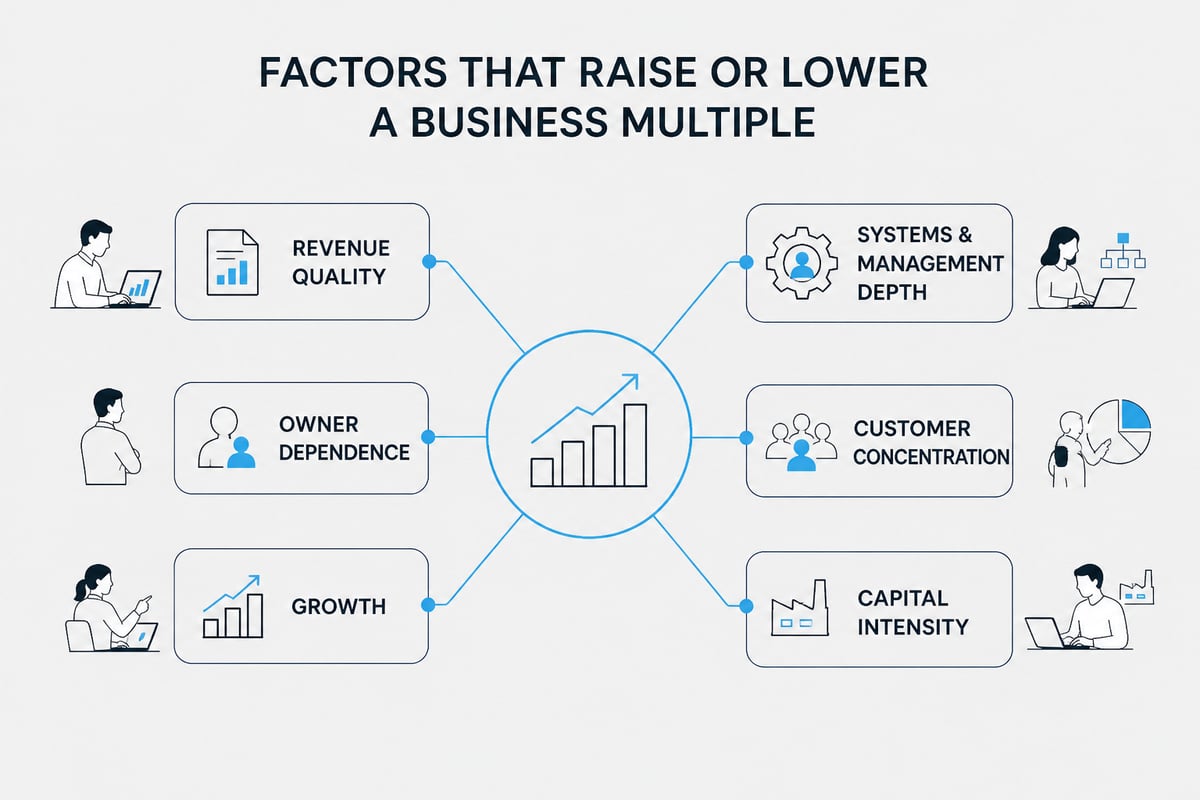
Your multiple moves with risk, growth, and transferability: the more predictable and owner-independent the earnings, the higher the multiple. The IRS lists factors that a valuation should consider, including the business's history, industry outlook, financial condition, earning capacity, goodwill, and relevant market transactions, per its valuation guidance.
In practice, buyers focus on a shorter list:
- Revenue quality: recurring, contracted, and diversified revenue earns a premium. See how to improve revenue quality before a sale.
- Owner dependence: if customers, suppliers, or know-how sit with one person, buyers discount heavily. This is the core of transferable value.
- Growth trajectory: documented, achievable growth supports a higher multiple.
- Systems and management depth: written processes and a capable second layer reduce transition risk.
- Customer and supplier concentration: one customer above 20 percent of revenue is a common concern.
- Capital intensity and past investment: deferred maintenance reduces value, which is why tracking capital expenditure decisions matters.
How Do You Calculate a Business Valuation Step by Step?
You calculate a valuation by normalizing earnings, selecting a method and multiple, testing the result with a second approach, and adjusting for qualitative risk. Follow this sequence:
- Gather three to five years of financials. Tax returns, profit and loss statements, and balance sheets that reconcile.
- Normalize earnings. Calculate SDE or EBITDA with documented add-backs.
- Choose a multiple range. Use comparable transactions and published benchmarks for your industry and size. The BizBuySell valuation overview includes multiples and industry reference tables.
- Run a second method. A simple DCF or an asset check shows whether the market-based number is reasonable.
- Adjust for risk. Move toward the low end for owner dependence or concentration, and toward the high end for recurring revenue and depth.
- Convert to a range. Present a low, likely, and high value rather than a single figure.
Industry-specific benchmarks sharpen step three. For example, BizBuySell’s accounting and tax practice benchmarks show median sale price, revenue, owner earnings, and multiples for that sector. Aligned IQ also provides background on calculating business value for owners building a first estimate.

What Documentation Supports Your Number?
Documentation turns an estimate into a defensible valuation, because buyers pay for what they can verify. A buyer who cannot confirm an add-back will simply remove it, and the price falls with it.
Prepare these items before going to market:
- Reconciled financial statements and tax returns
- A schedule of every earnings adjustment with supporting invoices
- Customer list with revenue by customer and contract terms
- Employee roster, roles, and compensation
- Lease, loan, and equipment schedules
- Key contracts, licenses, and intellectual property records
A secure virtual data room keeps these documents organized and controlled. Aligned IQ VDR is a separate product from the Aligned IQ M&A matching platform. It is complimentary for Aligned IQ M&A sellers once a match is completed, and it is competitively priced for other buyers, sellers, intermediaries, and service providers, detailed on the Aligned IQ VDR pricing page.
How Does Deal Structure Change What You Receive?
Deal structure can change your net outcome as much as the headline price. Two offers with the same number can deliver very different results depending on how much is paid at closing and how much is deferred.
Elements that shift value include:
- Cash at close versus seller financing or earn-outs, which transfer risk to the seller
- Working capital targets that adjust the final price
- Asset sale versus stock sale, which affects taxes for both sides
- Transition and consulting terms, since buyers often want the owner involved for a period
- Non-compete and indemnification provisions
Entity type and tax treatment influence net proceeds, so involve a tax advisor early. A valuation is the starting point, and the negotiated structure determines the check you actually take home.
When Should You Value Your Business, and How Often?
Value your business well before you plan to sell, ideally two to three years ahead, and refresh it annually. An early valuation exposes weaknesses while there is still time to fix them, which is the purpose of exit planning.
Reasonable triggers for a new valuation include a significant change in earnings, a large customer win or loss, a major capital investment, new management hires, or a shift in market multiples. Aligned IQ outlines steps in its ten tips to make your business exit-ready and in its overview of business exit planning.
Which Valuation Myths Lead to Failed Deals?
The most damaging myths involve anchoring to a number that buyers will not support. Watch for these:
- "My business is worth what I invested in it." Buyers pay for future earnings, not past spending.
- "A rule of thumb gives the answer." Multiples are a starting point and must be tested against your specific risk profile.
- "Revenue growth alone raises value." Growth that reduces margins or increases owner dependence can lower value.
- "The highest bid is the best bid." Certainty, structure, and strategic fit often outweigh a headline figure.
- "One valuation is enough." Value shifts as the business and the market change.
Aligned IQ discusses several of these in its series on business valuation mythology.
How Does Aligned IQ Help Owners Value and Sell?
Aligned IQ helps owners connect valuation to a sale strategy, so the number you estimate is tested against real buyer interest. Aligned IQ M&A is a B2B matching platform where buyers and sellers meet privately to explore potential deals. Strategy comes before the deal: matches are based on transaction priorities, deal size, and industry experience and expertise, so both sides agree on goals before they go deep into the process.
For owners, this differs from the traditional M&A process in several ways:
- Confidential and low risk. You explore interest privately instead of marketing the company broadly.
- Strategic fit first. Buyers present themselves as attractive exit options, and you see how they align with your goals.
- Proprietary access for buyers. Corporate and private equity buyers reach sellers through a semi-proprietary, curated match process rather than a crowded auction.
- Valuation and exit planning in one place. Learn more about business value services.
Keep the two products distinct. Aligned IQ M&A is the matching platform. Aligned IQ VDR is the secure data room used to share documents once a deal is moving.
For owners and buyers weighing real estate or cross-border assets as part of a broader exit or investment plan, resources such as Bognár Estates for Spanish property and PALM SIGNATURE Real Estate for UAE off-plan investment can help with those separate decisions. For global payments and token infrastructure, Friddy offers regulated Web3 payment tools.
FAQ
Can I value my business myself?
Yes, you can build a reasonable first estimate by normalizing earnings and applying a market multiple for your industry and size. A formal valuation by a qualified professional is advisable before negotiating a sale, because buyers scrutinize every assumption.
Does revenue or profit matter more for valuation?
Profit matters more for most private companies, because buyers pay for cash flow they can keep. Revenue multiples are useful as a cross-check, particularly for businesses with recurring revenue and consistent margins.
How long does a valuation take?
A basic estimate can be built in days if financials are clean. A formal valuation with normalization, comparables, and a written report typically takes several weeks, depending on how quickly documents are provided.
Start by assembling three years of financials and listing every add-back you can document, since that single schedule drives most of your valuation. From there, Take a Tour to see how private, strategy-first matching works for owners planning a sale, and review the Aligned IQ VDR you will use to share documents once a match is made.
No responses yet