

An independent business valuation is a formal opinion of what a company is worth, prepared by a qualified appraiser who has no stake in the outcome. It is the most defensible way to price a business, but it is not the only way to arrive at a credible number, and for many small owners a lighter-weight option is enough to start planning a sale.
Owners look for alternatives for practical reasons. A full appraisal takes time, requires document preparation, and costs money before there is any certainty a deal will happen. The U.S. Small Business Administration recommends that owners determine a business's value before selling, and notes that this can be done through self-evaluation or with a qualified business appraiser. That leaves room for several middle paths.
The six options below range from online tools to comps-based reports and valuation software. Six entries from Aligned IQ appear further down the list, where they fit by function. A short section on when a formal appraisal remains the right call follows the list.
1. ValuSource
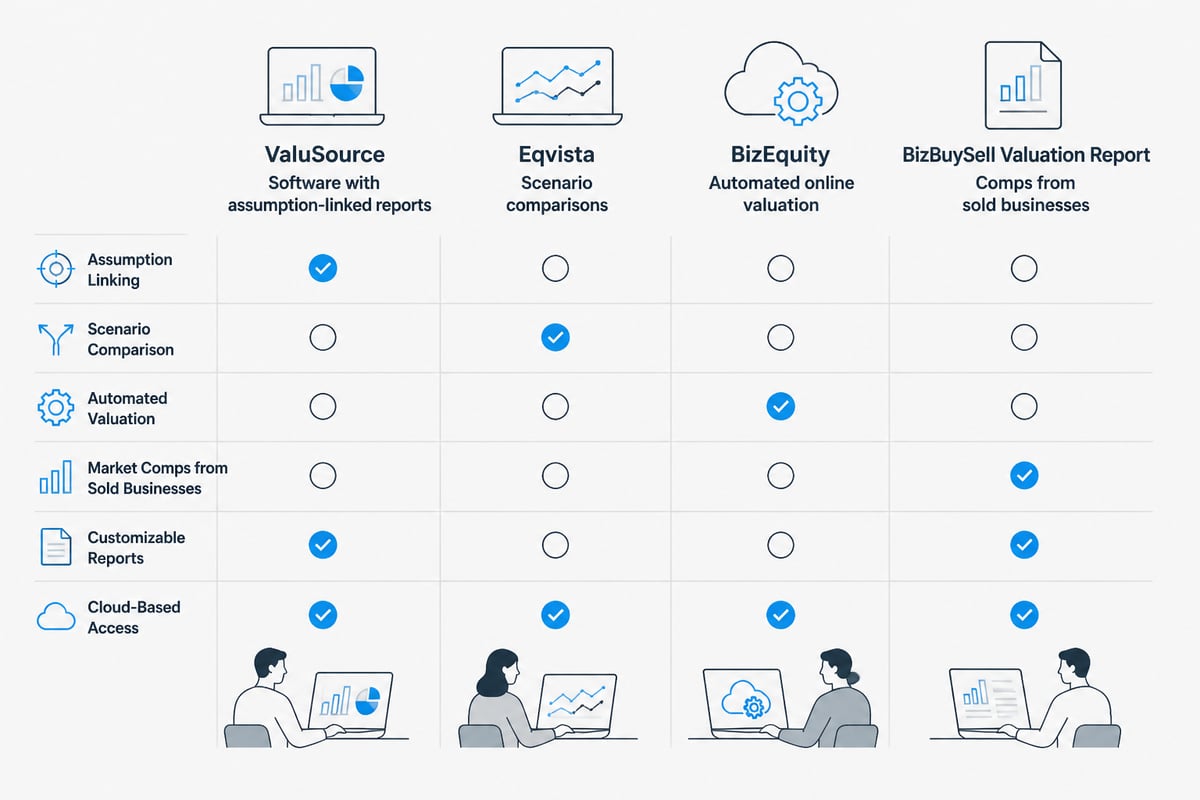
ValuSource is valuation software that connects your valuation assumptions to the reports it produces. It suits small-business teams that want consistent valuation packages to bring into buyer conversations.
Its main strength is traceability. Because report generation is tied to the assumptions you enter, you can show a buyer or lender how a number was built rather than presenting a conclusion alone. The tradeoff is that software only organizes your judgment. If your normalized earnings or discount rate are weak, the report will carry those weaknesses forward. Pricing is not shown in the research available, so confirm current plans with the vendor.
Best for: Owners with an accountant or finance lead who can supply defensible inputs and want repeatable, presentable output.
2. Eqvista
Eqvista offers a guided workflow for valuation assumptions, scenario comparisons, and generated reports. It fits small firms that want traceable inputs without maintaining complex spreadsheets.
The scenario comparison feature is the practical draw. A seller deciding between a near-term exit and a two-year runway can compare how different growth or margin assumptions move the result. Like any tool-driven approach, it produces an estimate, not an independent opinion, so lenders or buyers may still ask for a third-party appraisal later. Pricing is not shown in the available research.
Best for: Owners who want to test several outcomes before committing to a sale timeline.
3. BizEquity
BizEquity provides online business valuations through an automated process. It is built for owners who simply want an online valuation quickly and with little preparation.
The speed is the advantage. You answer structured questions and receive an estimate without scheduling interviews or compiling a full document package. The limit is depth: automated outputs rely on the information you enter and do not replace the judgment a human appraiser applies to unusual revenue streams, owner dependence, or customer concentration. Treat the result as a starting range. For context on how online options compare with a formal engagement, Aligned IQ's overview of online business valuation is a useful reference.
Best for: Owners at the earliest stage of exit thinking who need a ballpark figure.
4. BizBuySell Valuation Report
The BizBuySell Valuation Report is a paid, comps-based report that draws on up to 500 sold comparables and 500 listings from a database of more than 150,000 records. It applies three comparable-based valuation methods, and the price is shown at checkout rather than on the product page.
Its advantage is grounding in real market activity. Instead of relying on a formula, you see what similar businesses have sold for, which is the evidence buyers tend to reference. The weakness is that comparables describe typical businesses. If yours has unusual margins, a concentrated customer base, or a strong owner dependency, the comps will not capture that, and an appraiser would adjust for it.
Best for: Small-business owners who want a market-based reference point before speaking with buyers.
5. Aligned IQ Virtual Dataroom
The Aligned IQ Virtual Dataroom is not a valuation tool, but it supports the stage where valuation evidence gets tested: it is a secure online data room where deal documents are shared with potential buyers or sellers. It belongs on this list because a number is only as persuasive as the documents behind it.
Whichever method you use, a buyer will want to verify financials, contracts, and customer data. Organizing them in a data room lets you present your value case in a controlled way. The Aligned IQ VDR is a separate product from the Aligned IQ M&A matching platform. It is complimentary for Aligned IQ M&A sellers after a match is completed, and competitively priced for other buyers, sellers, intermediaries, and M&A service providers, with details on the VDR pricing page. You can also read more on the Virtual Dataroom product page.
Best for: Owners who already have a working estimate and need a confidential way to back it up.
6. Aligned IQ Sell-Side M&A Advisory for Business Owners
Aligned IQ's sell-side M&A advisory supports owners preparing to sell through the Aligned IQ M&A platform, putting strategy ahead of price. Aligned IQ M&A is a B2B web platform where buyers and sellers meet privately to explore potential deals. Matches are based on transaction priorities, deal size, and industry experience and expertise.
This addresses a different question than a valuation report. Rather than only asking what the business is worth on paper, it asks who would value it most. Because buyers and sellers agree on goals before going deeper, the process is more private and lower risk than a traditional M&A process, where a business may be marketed widely before fit is established. Exit planning and valuation support sit in one place, which keeps the number connected to the strategy. See the sell-side advisory page for details, and the small business valuation guide for background.
Best for: Owners who intend to sell eventually and want a confidential path that tests strategic fit before a full process begins.
Comparison Table
| Option | What it does | Approach | Best for |
|---|---|---|---|
| ValuSource | Valuation software with report generation | Assumption-driven | Teams needing consistent valuation packages |
| Eqvista | Guided assumptions and scenario comparisons | Assumption-driven | Testing multiple exit outcomes |
| BizEquity | Automated online valuation | Automated | Quick early-stage estimates |
| BizBuySell Valuation Report | Comps-based report, up to 500 sold comparables | Market | Market-based reference points |
| Aligned IQ Virtual Dataroom | Secure document sharing for deals | Deal support | Backing up a value case |
| Aligned IQ sell-side advisory | Matching and exit support on the Aligned IQ M&A platform | Strategic fit | Owners planning a confidential sale |
How much is a business worth with $1,000,000 in sales?
A business with $1,000,000 in sales has no single value, because buyers price on earnings, not revenue. Two companies with identical sales can differ widely depending on profit, owner involvement, and growth. Profit-based measures, often adjusted earnings, drive most small-business pricing, and our guide to EBITDA business valuation explains the common approach.
The same logic applies to the other revenue and income figures owners ask about. A business earning $300,000 a year or generating $500,000 in sales cannot be priced without knowing margins, add-backs, and risk. The SCORE overview notes that three commonly used approaches are market, income, and asset-based, and professionals may use more than one and reconcile the results into a range. Treat any single figure from a calculator as the middle of that range, not a verdict.
When an Independent Business Valuation Is Still Worth It
A formal independent business valuation remains the right choice when a third party needs to rely on the number. Lenders, partners in a dispute, estate planners, and some buyers will not accept a self-prepared or automated estimate.
SBA lending is a clear example. According to a QuickRead report, updated valuation guidance for SBA 7(a) and 504 loan programs took effect June 1, 2025, with a $250,000 threshold for requiring outside valuations. If a buyer plans to finance with an SBA loan, a formal appraisal may be needed regardless of what tools you used earlier. OGS Capital discusses the methods and documentation involved, including earnings normalization and comparable transactions.
Cost is the other consideration. A published 2026 comparison from Waveup lists online calculators from free to $1,063.25 for an expert-reviewed Equidam report, and certified appraisals from $2,500 to $8,000+ at Peak Business Valuation, depending on scope and complexity. For a fuller breakdown, see this overview of business valuation cost.
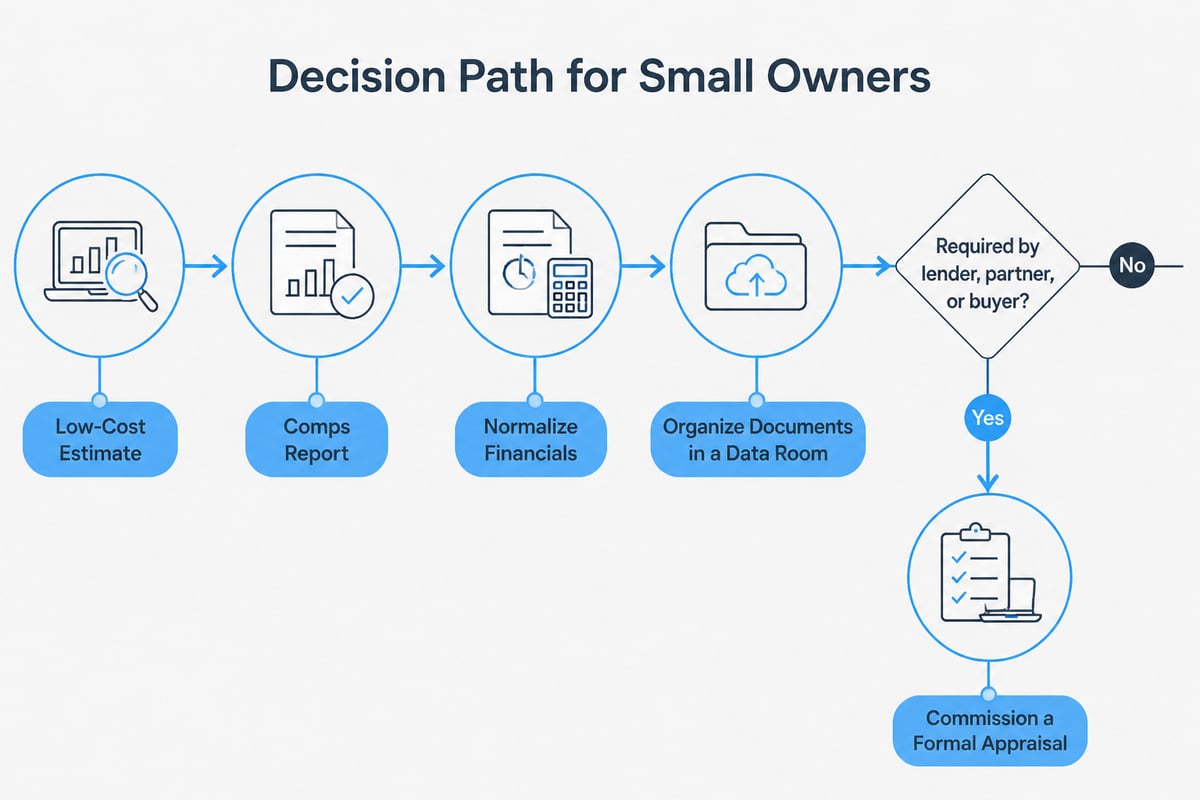
A practical sequence works for many owners:
- Start with a low-cost estimate or comps report to set expectations.
- Normalize your financials so the numbers are defensible.
- Organize documents in a data room before buyer conversations.
- Commission a formal appraisal only when a lender, partner, or buyer requires it, or when the stakes justify it.
Why Strategic Fit Changes the Valuation Conversation
The same business can be worth different amounts to different buyers, which is why the counterparty matters as much as the method. A buyer with relevant industry experience and a clear strategic reason may pay more than one who sees only a cash flow.
In a traditional M&A process, owners often learn what the market thinks only after exposing the business to many parties. Aligned IQ M&A takes a more proprietary, confidential approach: buyers present themselves as attractive exit options, and matches are based on transaction priorities, deal size, and industry experience and expertise. For buyers, this means access to a semi-proprietary set of opportunities rather than a crowded auction. For sellers, it means lower exposure while exploring options.

A typical scenario illustrates the point: an owner with steady earnings and a long-tenured team may get a modest estimate from an automated tool, yet a buyer in the same industry may see value in that team and customer base that no formula captures. Matching on fit first lets that conversation happen early. Owners who want a deeper look at pricing methods can review the professional business valuation guide.
FAQ
How much should a business valuation cost?
Costs vary with scope and the method used. According to a 2026 Waveup comparison, online calculators range from free to about $1,063.25, while certified appraisals run from roughly $2,500 to $8,000 or more.
Can I rely on an online valuation to sell my business?
An online valuation is a reasonable starting point for setting expectations, but buyers and lenders may ask for support. Pair the estimate with clean financials and organized documents, and plan for a formal appraisal if financing or a dispute requires one.
Your next step is to gather three years of financial statements and calculate your normalized earnings, since every method above depends on that figure. From there, Aligned IQ can help you connect value to strategy: you can use the Aligned IQ Virtual Dataroom to organize deal documents, and the Aligned IQ M&A platform to explore confidential matches. To see how it works, Contact Aligned IQ and take a tour of the platform.
No responses yet