

The best business valuation software free of charge today consists of online calculators from marketplaces and advisory firms that turn your earnings into a rough value range in a few minutes. They suit a first look at what your company might be worth, but they are starting points, not appraisals, and the range they return depends heavily on the numbers you enter. This guide covers six free tools, how valuation methods work, and what to do once you have a number.
What free valuation tools can and cannot tell you
Free valuation tools give you an estimated range based on a formula, usually earnings multiplied by a market multiple, and they cannot replace a full appraisal. Most ask for revenue, profit, and a few business traits, then apply a multiple drawn from past sales or industry norms.
The U.S. Small Business Administration notes that owners can conduct a self-evaluation or seek a qualified business appraiser, and advises researching valuation methods when valuing a business independently. A free calculator is a sensible form of self-evaluation. It tells you whether your expectations are in a realistic zone before you invest in anything more formal.
Expect three limits:
- Generic inputs. A calculator cannot see customer concentration, lease terms, or pending litigation.
- Earnings quality. Owner pay, one-time costs, and personal expenses change the result, and a tool only reflects what you type in.
- No buyer context. A strategic buyer may pay differently than the market average a calculator reflects.
1. Empire Flippers Business and Website Valuation Calculator
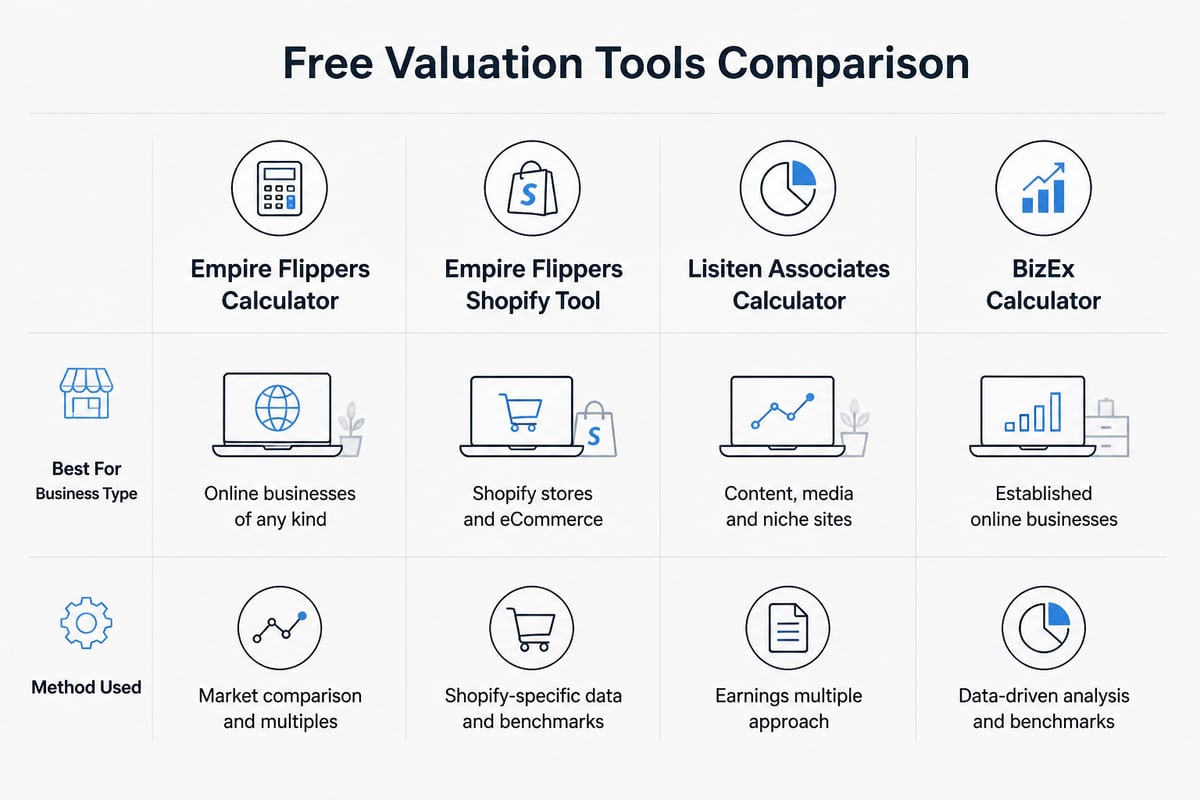
This free calculator estimates the value of an online business across 20 business models in about one to two minutes. It uses the last 12 months of net profit multiplied by a multiple that typically ranges from 1.7x to 5x or more. Empire Flippers says that range is based on 2,688 businesses sold for more than $600 million, which gives the estimate a transaction-backed foundation rather than a theoretical one.
- Cost: Free
- Method: Trailing 12-month net profit times a market multiple
- Coverage: 20 online business models, from Amazon FBA to SaaS
- Time to result: About 1 to 2 minutes
- Suits: Online and e-commerce owners who want a fast, marketplace-informed range before deciding whether to explore a sale
The company also states that its multiple can be affected by growth, traffic and earnings diversity, owner involvement, business age, and platform. Those factors are worth reviewing for any business, online or not, because buyers weigh them in similar ways.
Verdict: The most useful first stop for a digital business, with a clear formula and a sales-based multiple range.
2. Empire Flippers Shopify Valuation Tool
This is a free Shopify app that produces an automated valuation based on closed marketplace deals. It states a valuation range of approximately plus or minus 15%, which is a candid signal of how wide a free estimate should be read.
- Cost: Free
- Method: Automated valuation informed by closed marketplace deals
- Precision: A stated range of about 15% either side of the estimate
- Platform: Shopify app
- Suits: Shopify store owners who want an estimate pulled from their store data rather than typed in by hand
Because it reads from the store, it removes data-entry error, though it still cannot adjust for factors like supplier dependence or inventory write-downs.
Verdict: A low-effort option for Shopify merchants, best used alongside the general calculator above to see whether the two ranges overlap.
3. Lisiten Associates Free Business Valuation Calculator
This free online calculator from Lisiten Associates, Inc. generates a valuation report from business metrics you enter. It is promoted for decisions around a sale, a merger, and strategic planning, which makes it more suited to established, traditional companies than to web-based ones.
- Cost: Free
- Output: A valuation report generated from your entered metrics
- Stated uses: Sale, merger, and strategic planning decisions
- Suits: Owners of brick-and-mortar or service businesses who want a written first-pass report to share with a partner or advisor
A report format has a practical benefit: it gives you a document to react to, which makes a later conversation with an advisor more concrete.
Verdict: A reasonable choice for non-digital businesses that want an initial report rather than a single number.
4. BizEx Business Valuation Calculator Tool
This free tool uses the multiple of earnings method, calculating an estimate from information you enter into a valuation spreadsheet. The method is the same one most small-business buyers use for a first screen, so the logic transfers directly to real conversations.
- Cost: Free
- Method: Multiple of earnings
- Format: Valuation spreadsheet you complete
- Suits: Small-business owners who want to see the arithmetic and adjust inputs themselves
The spreadsheet format lets you test scenarios, such as how normalizing owner compensation shifts the result. That kind of sensitivity check is where a spreadsheet approach earns its place.
Verdict: Best for owners who prefer to control the inputs and understand every step of the estimate.
5. Aligned IQ M&A
Aligned IQ M&A is a B2B web platform where potential business buyers and sellers can meet privately to explore potential deals, with matches based on transaction priorities, deal size, and industry experience. It is not a calculator. It sits at the stage after a valuation estimate, when an owner starts asking who might actually buy.
- Cost: See the Take a Tour page for details
- Approach: Strategy comes before the deal, so buyers and sellers agree on goals first
- Confidentiality: Private matching, a lower-risk and more confidential route than the traditional M&A process, where a business is often marketed broadly
- Related support: Exit planning and valuation support in one place
- Suits: Owners who have a rough value range and want to explore strategic-fit buyers privately before committing to a sale process
Aligned IQ M&A is a proprietary matching environment, so buyers on it arrive having signaled their own priorities, which is different from responding to an open listing.
Verdict: A logical next step after a free estimate, for owners who want discreet buyer introductions.
6. Aligned IQ Virtual Dataroom
The Aligned IQ Virtual Dataroom is a secure online data room for sharing deal documents with potential buyers or sellers. It is separate from Aligned IQ M&A. The data room (Aligned IQ VDR) is complimentary for Aligned IQ M&A sellers after a match is completed, and it is competitively priced for other buyers, sellers, intermediaries, and M&A service providers. Current rates are on the Aligned IQ VDR pricing page.
- Function: Secure sharing of financials, contracts, and diligence documents
- Access: Complimentary for Aligned IQ M&A sellers after a match; competitively priced for others
- Suits: Owners who have moved past estimation and need a controlled place to share documents once a buyer is engaged
It is not valuation software, so treat it as the tool you will need after your valuation work, not a substitute for it.
Verdict: Useful once a deal is moving, particularly because it is included for matched sellers.
Comparison table
| Tool | Cost | Method | Best fit |
|---|---|---|---|
| Empire Flippers Calculator | Free | 12-month net profit times multiple | Online businesses |
| Empire Flippers Shopify Valuation Tool | Free | Automated, closed-deal based, about ±15% | Shopify stores |
| Lisiten Associates Calculator | Free | Report from entered metrics | Traditional businesses |
| BizEx Calculator | Free | Multiple of earnings spreadsheet | Small-business owners |
| Aligned IQ M&A | See Take a Tour page | Strategic-fit buyer matching | Owners ready to meet buyers privately |
| Aligned IQ Virtual Dataroom | Complimentary for matched M&A sellers | Secure document sharing | Owners in active deal discussions |
How do you value a small business with free tools?
Value a small business by gathering clean earnings figures, running two or three calculators, and comparing the ranges. Follow this order:
- Pull 12 months of profit and adjust for owner pay and one-time expenses.
- Run the same figures through at least two tools.
- Note the gap between the results and which inputs caused it.
- Compare the range to what a buyer would realistically pay given risks like customer concentration.
A broader overview of business valuation software options, including paid tiers, is useful if the free tools leave questions open.
What are the common valuation methods?
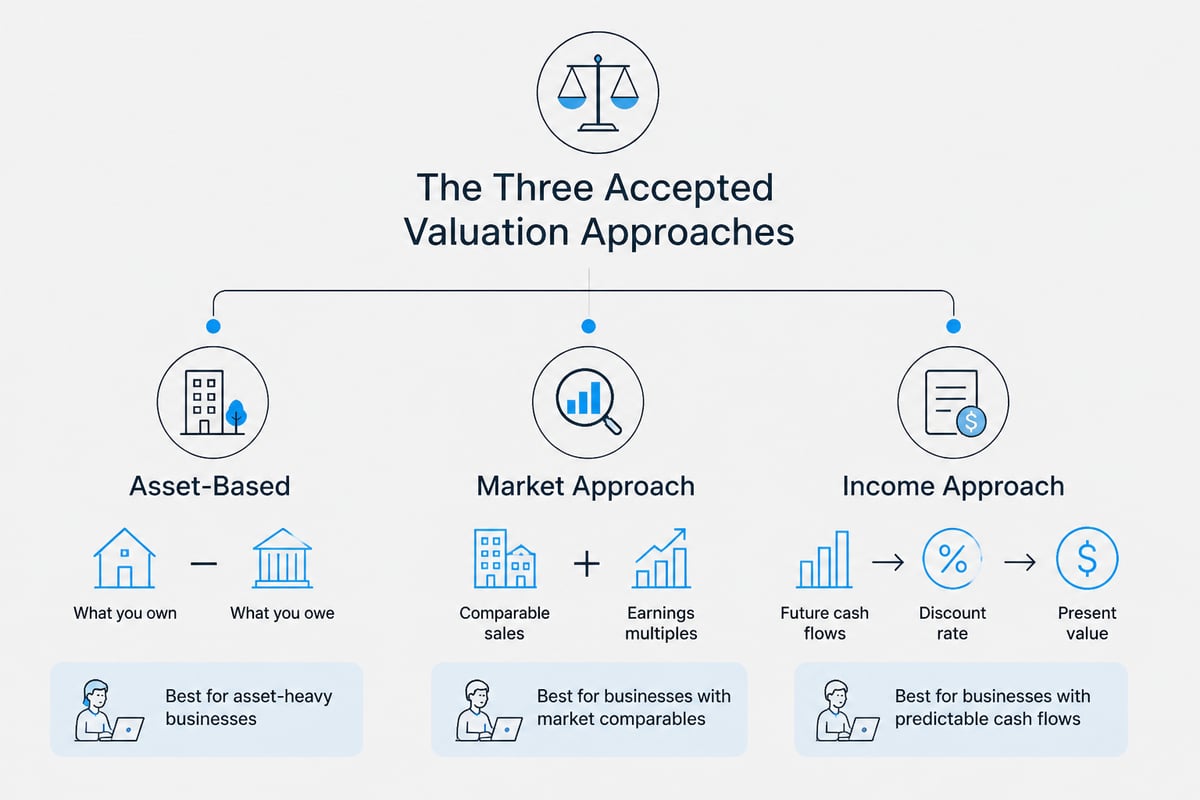
The three common valuation methods are asset-based, market, and income approaches. The Internal Revenue Service lists these as the generally accepted approaches and says an appraiser should consider all three and use professional judgment to select appropriate methods.
- Asset-based: Totals what the company owns minus what it owes. It suits asset-heavy businesses.
- Market: Compares your business to similar ones that sold. Multiple-of-earnings calculators are a simplified form of this.
- Income: Projects future earnings and discounts them to today's value. It suits stable, predictable cash flow.
Most free tools lean on the market approach. If your business has significant equipment, real estate, or uneven earnings, the asset or income lens may tell you something the calculators do not. Earnings-based methods in particular are covered in more depth in this explainer on EBITDA business valuation.
Is a business worth three times profit?
A business is sometimes worth about three times profit, but that figure is an average, not a rule. Empire Flippers reports multiples that typically range from 1.7x to 5x or more, which shows how wide the spread can be.
What moves a business toward the low or high end:
- Growth trend and earnings stability
- How much the business depends on the owner
- Customer and supplier concentration
- Business age and track record
- Industry and deal size
A multiple of three can be fair for one company and generous for another. Treat it as a reference point, then ask which factors push yours up or down.

When to move from a free estimate to a professional valuation
Move to a professional valuation when the decision carries real financial weight, such as setting an asking price, negotiating with a buyer, or addressing a partner dispute. A free tool gives you a range. A credentialed appraiser documents the reasoning, and that documentation matters when someone challenges your number.
Signs you have outgrown a calculator:
- Your results across tools differ by a wide margin
- You have unusual assets, contracts, or ownership structures
- A buyer or lender is asking for supporting analysis
- You are close to a transaction and need a defensible figure
Options and price expectations for that step are laid out in this guide to business valuation cost. A typical scenario: an owner runs two free calculators, finds the ranges overlap loosely, and then commissions a professional valuation only once serious buyer interest appears, rather than paying for one at the exploration stage.
Preparing your numbers before you use any calculator
Clean inputs matter more than which tool you pick, because every calculator multiplies what you give it. Spend an hour on preparation and the free tools become noticeably more reliable.
- Normalize owner compensation. Replace what you actually pay yourself with a market salary for the role.
- Remove one-time items. Legal settlements, unusual repairs, and one-off windfalls distort a 12-month figure.
- Separate personal expenses. Vehicles, travel, and similar costs run through the business should be identified.
- Document recurring revenue. Contracts and repeat customers support a higher multiple than one-time sales.
These adjustments are the same ones a buyer will make, so doing them first prevents surprises later. For owners earlier in the process, a quick overview of small business valuation concepts shows how these adjustments feed into the final number.
FAQ
How accurate is business valuation software free of charge?
Free valuation software is accurate enough for a first range and not accurate enough to set a final price. Empire Flippers' Shopify tool, for example, states a range of roughly plus or minus 15%, and general calculators carry wider uncertainty because they cannot see company-specific risks.
Can I use a free valuation to sell my business?
You can use a free valuation to set expectations and frame early conversations, but buyers will test it against your financial records. Expect them to adjust the figure during due diligence, so enter clean, defensible numbers from the start.
How many tools should I run before trusting a range?
Run at least two or three and compare the results. If they cluster together, you have a reasonable working range. If they diverge widely, review your inputs and consider a professional opinion.
Your next step is to run your last 12 months of adjusted profit through two of the calculators above and record the range. If you then want to see how strategic-fit matching works for an eventual exit, you can take a tour of the platform. To explore it, take a tour of Aligned IQ through Take a Tour, and review how the Aligned IQ Virtual Dataroom would hold your deal documents once a match is made.
No responses yet