

The landscape of sme mergers and acquisitions has evolved significantly in 2026, with small and medium-sized enterprises increasingly recognizing strategic transactions as viable pathways to accelerate growth, expand market share, and achieve competitive advantages. Unlike traditional M&A processes dominated by large corporations and institutional buyers, SME transactions require different approaches that prioritize strategic fit, confidentiality, and streamlined execution. Business owners exploring exit strategies or buyers seeking acquisition opportunities must navigate unique challenges specific to the lower middle market, from valuation complexities to finding the right counterparty who shares compatible vision and operational philosophy.
Understanding SME Mergers and Acquisitions in 2026
The SME transaction market represents a substantial portion of overall M&A activity, yet it operates with distinct characteristics compared to larger enterprise deals. The U.S. Small Business Administration guide outlines the differences between mergers and acquisitions, emphasizing that SMEs often face resource constraints and require more flexible deal structures.
Key differences in SME transactions include:
- Lower transaction values typically ranging from $1 million to $50 million
- Greater emphasis on owner involvement during transition periods
- Limited access to traditional investment banking resources
- Higher reliance on seller financing and earnout provisions
- More personalized negotiation processes focused on cultural alignment

The motivation behind sme mergers and acquisitions varies significantly. Sellers may pursue transactions to achieve retirement goals, capitalize on market conditions, or address succession challenges. Buyers often seek acquisitions to enter new markets, acquire talent and expertise, or achieve economies of scale.
Market Dynamics Shaping SME Transactions
Current market conditions in 2026 have created both opportunities and challenges for SME owners. Chambers and Partners analyze the 2025 M&A landscape, highlighting increased strategic acquisitions and market consolidation trends that continue to influence the SME sector.
Several factors are driving transaction activity:
- Demographic shifts with Baby Boomer business owners reaching retirement age
- Technology disruption forcing consolidation in traditional industries
- Capital availability from family offices and search funds targeting SME acquisitions
- Strategic imperatives requiring rapid capability acquisition
- Succession planning challenges with next-generation leadership gaps
| Market Driver | Impact on Sellers | Impact on Buyers |
|---|---|---|
| Demographic transition | Increased supply of businesses | More selection opportunities |
| Technology disruption | Urgency to exit or evolve | Access to innovation |
| Capital availability | Enhanced valuations | Competitive bidding |
| Strategic consolidation | Premium offers for market leaders | Acquisition integration complexity |
Strategic Planning for SME Acquisitions
Successful sme mergers and acquisitions begin long before formal negotiations commence. This practical guide to SME acquisitions emphasizes comprehensive preparation and strategic alignment as foundational elements.
Defining Acquisition Criteria
Buyers must establish clear parameters before pursuing opportunities. Transaction priorities should address both quantitative and qualitative factors that align with long-term strategic objectives.
Essential acquisition criteria include:
- Industry sector and subsector specifications
- Revenue and EBITDA range requirements
- Geographic preferences and limitations
- Cultural compatibility and management philosophy
- Growth trajectory and market positioning
- Technology infrastructure and capabilities
Traditional M&A processes often prioritize financial metrics while undervaluing strategic fit. This approach can lead to failed integrations and value destruction post-close. Modern platforms emphasize matching counterparties based on strategic alignment before diving deep into financial details.
Preparation for Business Sellers
For SME owners considering exit strategies, preparation determines transaction success and valuation outcomes. Understanding merger and acquisition exit strategy components helps owners position their businesses optimally.
A typical scenario involves an owner who begins preparation 18 to 24 months before anticipated transaction timing. This preparation phase addresses operational improvements, financial documentation, and strategic positioning that enhance attractiveness to potential buyers.
Critical preparation areas include:
- Financial record normalization and GAAP compliance
- Customer concentration reduction initiatives
- Management team development and delegation
- Recurring revenue stream establishment
- Intellectual property documentation and protection
- Operational process systematization
The confidential nature of these preparations presents challenges. Traditional intermediary engagement can signal market availability before owners are ready, potentially disrupting customer relationships, employee morale, and competitive positioning.

Valuation Methodologies for SME Transactions
Determining appropriate valuation represents one of the most contentious aspects of sme mergers and acquisitions. Unlike publicly traded companies with market-determined values, SMEs require specialized valuation approaches that consider unique characteristics and market dynamics.
Common Valuation Methods
| Valuation Method | Best Application | Typical Multiple Range |
|---|---|---|
| EBITDA Multiple | Stable, profitable businesses | 3x to 7x EBITDA |
| Revenue Multiple | High-growth, low-margin businesses | 0.5x to 3x revenue |
| Asset-Based | Capital-intensive operations | Book value +/- adjustments |
| Discounted Cash Flow | Predictable cash generation | NPV of projected flows |
The selection of appropriate methodology depends on industry norms, business stage, and growth characteristics. Technology-enabled businesses often command premium valuations compared to traditional service providers, even with similar profitability profiles.
Factors Influencing SME Valuations
Beyond mathematical calculations, numerous qualitative factors influence final transaction values. Buyers assess risk profiles and growth potential, adjusting valuations accordingly.
Market position and competitive advantages significantly impact valuations. A typical scenario might involve two businesses with identical EBITDA but vastly different valuations due to factors such as customer relationships, proprietary processes, or brand strength.
Value drivers include:
- Recurring revenue percentages and customer retention rates
- Management team depth and succession readiness
- Scalability potential and capacity utilization
- Competitive moat strength and differentiation
- Geographic diversification and market coverage
The Deal Sourcing Challenge
Identifying appropriate counterparties represents perhaps the greatest challenge in sme mergers and acquisitions. Traditional approaches through investment bankers, business brokers, or broad marketplace listings often fail to prioritize the strategic alignment essential for successful transactions.
Traditional Deal Sourcing Limitations
The conventional M&A process requires extensive networking, intermediary fees, and public marketing that compromises confidentiality. Business owners risk employee uncertainty, customer concerns, and competitive intelligence leaks when broadly marketing their businesses.
Buyers face different challenges navigating deal sourcing platforms that prioritize quantity over quality. Sifting through numerous unsuitable opportunities consumes valuable time and resources without identifying strategic fits.
Common sourcing challenges:
- Limited access to proprietary deal flow
- Misalignment between buyer capabilities and seller needs
- Confidentiality breaches during exploratory phases
- High intermediary costs reducing transaction economics
- Time consumption reviewing incompatible opportunities
Modern Match-Making Approaches
Innovative platforms have emerged that prioritize strategic fit before financial details, transforming how counterparties connect. These systems evaluate transaction priorities, industry expertise, and deal parameters to facilitate compatible matches while maintaining confidentiality.
The proprietary nature of these platforms creates advantages for both buyers and sellers. Buyers gain access to opportunities not broadly marketed, while sellers explore potential exits confidentially without public exposure risks.
For sellers specifically, the low-risk nature of preliminary exploration through confidential platforms differs substantially from traditional intermediary engagement. Owners can evaluate potential strategic partners without committing to formal sale processes or paying upfront fees.
Due Diligence and Transaction Execution
Once counterparties identify mutual interest, comprehensive due diligence becomes essential. This academic paper explores theories and evidence on mergers and acquisitions by SMEs, highlighting distinctive features that affect success rates compared to larger firm transactions.
Structuring the Due Diligence Process
Effective due diligence balances thoroughness with efficiency, particularly important for SME transactions where prolonged processes increase deal fatigue and execution risk.
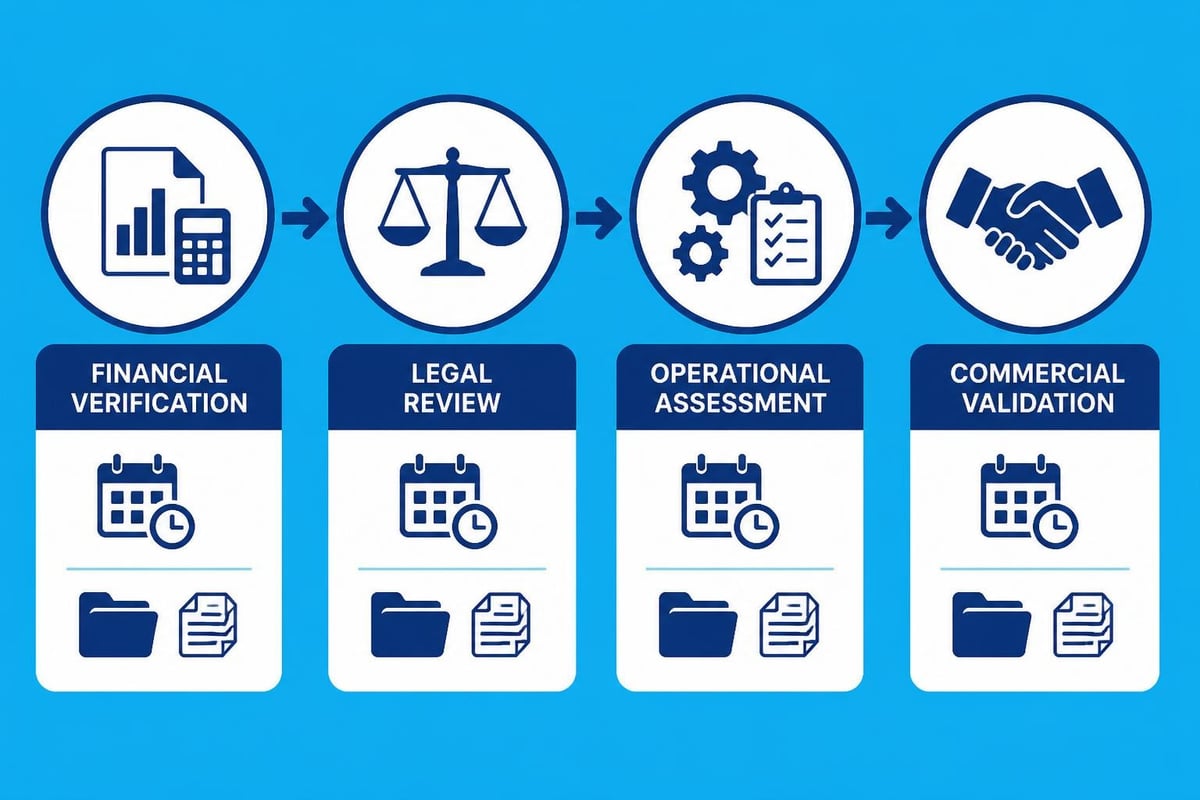
Due diligence categories include:
- Financial verification: Revenue recognition, profitability sustainability, working capital requirements
- Legal review: Contract assignments, litigation exposure, regulatory compliance
- Operational assessment: Process documentation, vendor relationships, capacity analysis
- Commercial validation: Customer concentration, market positioning, competitive dynamics
- Human resources: Key employee retention, compensation structures, benefit obligations
The confidential exchange of sensitive information requires secure infrastructure. Virtual data rooms provide controlled access to documents while maintaining audit trails and permission management.
Virtual Data Room Considerations
Traditional virtual data room providers often price services beyond SME transaction budgets, with monthly fees exceeding $1,000 for basic functionality. This creates barriers to proper information management during due diligence.
The Aligned IQ VDR addresses this challenge with competitive pricing available at https://vdr.alignediq.net/pricing, making secure document exchange accessible for lower middle-market transactions. The platform provides complimentary access for sellers who complete matches through the Aligned IQ M&A platform, while remaining competitively priced for other buyers, sellers, intermediaries, and M&A service providers.
Financing SME Acquisitions
Capital structure significantly impacts transaction feasibility and post-close success. SME Capital discusses funding solutions for acquisitions, detailing various financing options available to buyers.
Common Financing Structures
SME acquisitions typically employ multiple capital sources rather than single financing instruments. The optimal mix balances cost of capital, control considerations, and cash flow sustainability.
| Financing Source | Typical Percentage | Advantages | Considerations |
|---|---|---|---|
| Buyer equity | 10-30% | No repayment obligation | Dilutes returns |
| Bank debt | 40-60% | Lower cost of capital | Requires collateral |
| Seller financing | 10-30% | Signals seller confidence | Creates ongoing relationship |
| Earnouts | 10-25% | Bridges valuation gaps | Complexity in calculation |
Seller financing particularly characterizes sme mergers and acquisitions, reflecting both limited buyer capital and seller confidence in business sustainability. Terms typically range from three to seven years with market-rate interest.
Strategic Buyer vs. Financial Buyer Dynamics
The financing approach often differs based on buyer type. Strategic buyers with existing operations can leverage synergies and balance sheet strength for more aggressive debt structures. Financial buyers and individual acquirers require more conservative approaches.
In a typical scenario, a strategic buyer might finance an acquisition with 60% debt leveraged against combined entity assets, while an individual buyer pursues an SBA 7(a) loan covering 75% of the purchase price with seller financing comprising the remaining 25%.
Integration Planning and Execution
Post-close integration determines whether sme mergers and acquisitions deliver anticipated value or destroy wealth through execution failures. Research indicates that 50-70% of acquisitions fail to achieve projected synergies due to integration challenges.
Cultural Integration Priorities
Financial and operational integration receives substantial attention, yet cultural alignment often determines ultimate success. Misaligned values, communication styles, and decision-making processes create friction that undermines performance.
Integration success factors:
- Leadership alignment on strategic priorities and values
- Transparent communication addressing employee concerns
- Retention programs for key personnel across both organizations
- Process harmonization balancing best practices from each entity
- Customer communication maintaining service continuity
The steps to acquire a business extend beyond closing to include structured integration planning that begins during due diligence.
Measuring Integration Success
Establishing clear metrics enables objective assessment of integration progress and value creation. These measurements should address both quantitative results and qualitative indicators of organizational health.
A typical scenario involves tracking revenue retention rates, employee turnover, customer satisfaction scores, and operational efficiency metrics on monthly intervals during the first year post-close.
Leveraging Professional Advisors
While sme mergers and acquisitions often involve smaller transaction values than enterprise deals, professional guidance remains essential for optimal outcomes. The challenge involves engaging advisors cost-effectively without excessive fee structures that reduce transaction economics.
Key Advisor Categories
Different transaction phases require specialized expertise. Assembling the appropriate advisory team depends on transaction complexity, industry specifics, and internal capabilities.
- M&A Advisors and Intermediaries: Deal sourcing, valuation, negotiation support
- Legal Counsel: Purchase agreement drafting, regulatory compliance, contract review
- Accounting and Tax Advisors: Financial due diligence, tax structure optimization
- Industry Consultants: Market validation, operational assessment
- Insurance Advisors: Representations and warranties coverage, key person policies
M&A service providers increasingly participate through performance-based compensation models, aligning incentives with successful transaction completion. Platforms enabling sell-side referrals allow intermediaries to generate revenue while providing value-added services throughout the transaction process.
Controlling Advisory Costs
Professional fees can consume 5-10% of transaction value if not managed carefully. Buyers and sellers should establish clear engagement terms, define scope boundaries, and negotiate success-based compensation where appropriate.
The proprietary nature of certain platforms reduces reliance on traditional intermediaries for initial counterparty identification, allowing parties to preserve capital for essential services during due diligence and closing phases.
Regulatory and Compliance Considerations
While sme mergers and acquisitions typically avoid regulatory scrutiny affecting larger transactions, various compliance requirements still apply. Understanding these obligations prevents delays and unexpected costs during transaction execution.
Industry-Specific Regulations
Certain sectors involve licensing, permits, or regulatory approvals that must transfer or be reissued following ownership changes. Healthcare, financial services, transportation, and alcohol distribution represent examples requiring particular attention.
Common regulatory considerations:
- Business license transfers and renewals
- Professional certifications and credentials
- Environmental compliance and potential liabilities
- Employment law obligations and benefit plan transitions
- Data privacy and security requirements under current regulations
Identifying regulatory requirements early in due diligence allows adequate time for applications, approvals, and contingency planning if transfers encounter obstacles.
Tax Structure Optimization
Transaction structure significantly impacts tax consequences for both buyers and sellers. Asset purchases versus stock acquisitions create different treatment, with substantial financial implications.
Sellers generally prefer stock sales receiving capital gains treatment, while buyers favor asset purchases enabling stepped-up basis and depreciation benefits. Negotiating structure requires balancing these competing interests through price adjustments or other consideration.
Risk Mitigation Strategies
Every transaction involves inherent risks that thoughtful planning and contractual protections can mitigate. Understanding common risk categories enables appropriate safeguards during negotiation and closing documentation.
Representations and Warranties
Purchase agreements include detailed representations covering financial accuracy, legal compliance, operational capabilities, and other business aspects. These representations allocate risk between parties and establish recourse for material inaccuracies.
Standard representations address:
- Financial statement accuracy and GAAP compliance
- Tax return completeness and obligation settlement
- Legal entity good standing and authorization
- Contract validity and performance obligations
- Intellectual property ownership and infringement
Sellers should carefully review representations, ensuring accuracy while avoiding overly broad commitments. Buyers must conduct sufficient due diligence to validate critical representations before close.
Indemnification and Escrow
Indemnification provisions establish remedies for representation breaches or undisclosed liabilities emerging post-close. Escrow arrangements provide security for these potential claims by withholding portions of purchase price for specified periods.
A typical scenario involves 10-15% of purchase price held in escrow for 12-18 months, with claims processed through defined procedures balancing prompt resolution against frivolous assertions.
Alternative Transaction Structures
Traditional full acquisitions represent one approach to sme mergers and acquisitions, yet alternative structures sometimes better serve strategic objectives while managing risk and capital requirements.
Partial Acquisitions and Joint Ventures
Acquiring minority stakes or forming joint ventures allows parties to collaborate while limiting capital commitments and integration complexity. These structures work well when testing market opportunities or combining complementary capabilities.
Partial acquisition benefits:
- Reduced capital requirements for buyers
- Continued owner involvement maintaining business continuity
- Flexibility for future full acquisition or exit
- Shared risk in uncertain market conditions
The challenge involves governance structures and decision rights that balance control with collaboration. Clear operating agreements prevent conflicts while enabling effective joint management.
Earnouts and Performance-Based Consideration
Earnout provisions bridge valuation gaps when buyers and sellers hold different perspectives on future performance. These mechanisms tie portions of purchase price to achieving specified financial or operational milestones post-close.
Successful earnouts require precise definitions of measurement criteria, accounting treatment, and buyer obligations to support performance. Ambiguous terms create disputes that damage relationships and generate legal costs exceeding earnout values.
Successfully navigating sme mergers and acquisitions requires strategic planning, careful counterparty selection, and thorough execution across all transaction phases. The emphasis on strategic fit, confidential exploration, and efficient processes distinguishes successful SME transactions from those that fail to deliver anticipated value. Aligned IQ transforms the M&A process by prioritizing strategic alignment through proprietary match-making based on transaction priorities, deal size, and industry expertise, enabling buyers and sellers to explore opportunities confidentially before committing to traditional intermediary processes. Take a tour to discover how our platform and complimentary virtual data room for matched sellers can support your M&A objectives.
No responses yet