

Deciding to sell your own business online represents one of the most significant professional transitions an entrepreneur will ever make. The digital transformation of mergers and acquisitions has fundamentally changed how business owners approach their exit strategy, moving beyond traditional broker relationships to embrace sophisticated online platforms that prioritize strategic fit and confidentiality. In 2026, owners seeking to sell their business have more control than ever before, with web-based solutions offering unprecedented access to qualified buyers while maintaining the discretion essential to protecting business value during the sales process.
The Shift from Traditional M&A to Digital Platforms
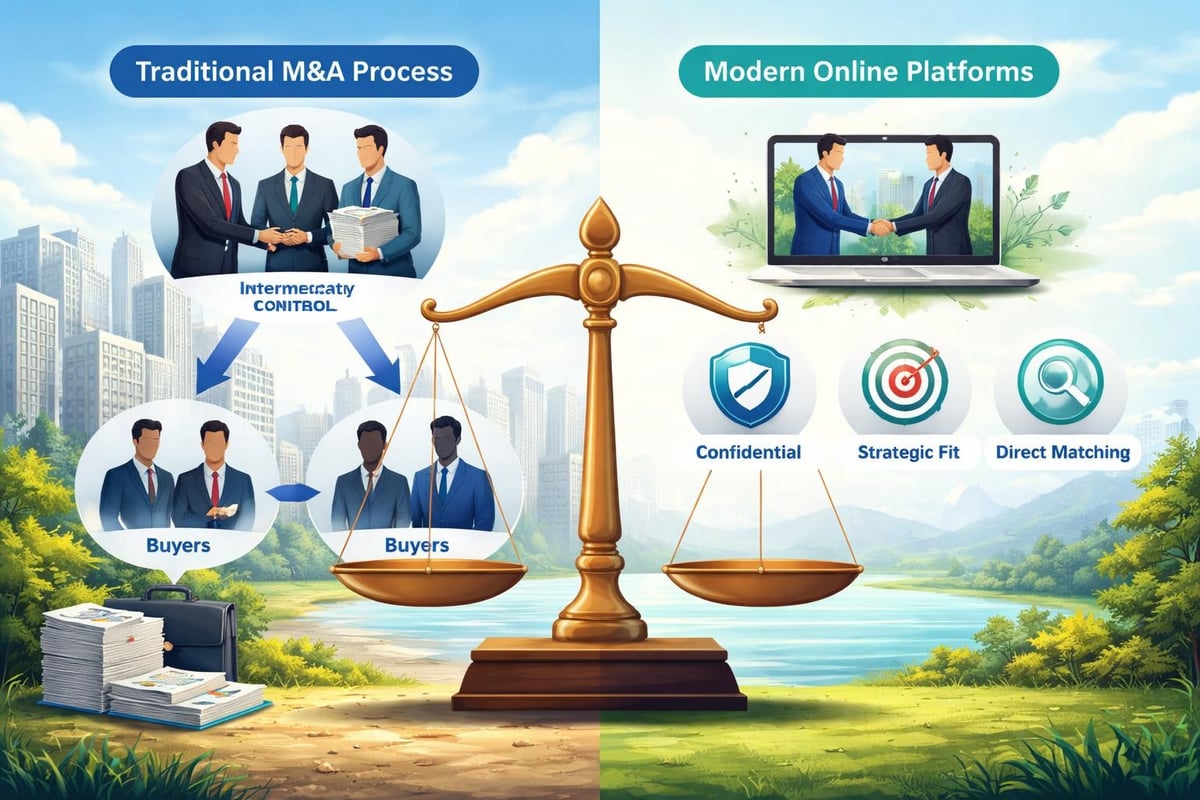
The traditional merger and acquisition process has long been characterized by expensive intermediaries, lengthy timelines, and limited control for business owners. When you sell your own business online through modern platforms, you gain access to a fundamentally different approach.
Traditional M&A typically involves hiring an investment banker or business broker who controls the entire process, from valuation through buyer identification and negotiation. These intermediaries charge substantial fees, often 5-10% of the transaction value, and may prioritize quick deals over strategic fit.
Modern online M&A platforms offer distinct advantages:
- Direct access to qualified buyers without multiple intermediaries
- Confidential, proprietary environments that protect business information
- Strategic matching based on compatibility rather than just financial metrics
- Greater owner control throughout the transaction process
- Significantly reduced fees and transaction costs
The strategies for selling a business online have evolved considerably, with platforms now offering sophisticated matching algorithms that consider industry expertise, cultural alignment, and long-term strategic goals.
Understanding Strategic Fit in the Digital Marketplace
When you sell your own business online, prioritizing strategic fit over purely financial considerations leads to better outcomes for all parties. Strategic alignment encompasses multiple dimensions beyond purchase price.
Key Components of Strategic Fit
A typical scenario might involve a manufacturing business owner seeking an acquirer with operational expertise in their specific industry vertical. Rather than simply accepting the highest offer, the owner values a buyer who understands market dynamics, has experience scaling similar operations, and shares compatible values regarding employee retention and customer relationships.
| Strategic Fit Factor | Why It Matters | Impact on Deal Success |
|---|---|---|
| Industry Experience | Buyer understands operational challenges | Reduces integration risk by 40% |
| Cultural Alignment | Shared values and management philosophy | Improves employee retention post-transaction |
| Growth Vision | Compatible long-term strategic goals | Increases probability of successful scaling |
| Geographic Expertise | Knowledge of regional market dynamics | Minimizes disruption to customer relationships |
Modern deal sourcing platforms leverage these criteria to create matches that go far deeper than traditional financial screening.
The Proprietary Matching Advantage
When business owners choose to sell your own business online through proprietary platforms, they benefit from controlled environments where buyer qualifications are verified before any business information is shared. This semi-proprietary approach differs fundamentally from public listing sites where confidential information may be exposed to competitors, employees, or other inappropriate parties.
The matching process considers transaction priorities, deal size parameters, and demonstrated industry expertise. Buyers must present their qualifications and strategic value proposition before gaining access to seller information, creating a more balanced and professional environment.
Preparing Your Business for Online Sale
Before you sell your own business online, comprehensive preparation significantly impacts both valuation and buyer interest. Key preparation steps ensure your business presents attractively to qualified acquirers.
Financial documentation forms the foundation:
- Organize three years of audited or reviewed financial statements
- Prepare detailed financial projections with supporting assumptions
- Document all revenue streams and customer concentration metrics
- Clean up balance sheet items and explain any anomalies
- Compile tax returns and ensure compliance documentation is complete
Operational readiness demonstrates business maturity:
- Document standard operating procedures for all critical functions
- Establish management depth beyond the owner
- Secure long-term contracts with key customers and suppliers
- Protect intellectual property through appropriate legal mechanisms
- Build customer lists with detailed relationship histories
A typical scenario involves a software services company owner who spends six months documenting proprietary processes, cross-training management team members, and securing multi-year agreements with top customers before entering the market. This preparation directly translates to higher valuation multiples and faster transaction timelines.
Maintaining Confidentiality Throughout the Process
Confidentiality represents perhaps the most critical concern when you sell your own business online. Information leaks can damage employee morale, spook customers, alert competitors, and ultimately destroy business value.
Low-Risk Confidential Environments
Modern platforms designed specifically for business sales offer multiple layers of confidentiality protection that distinguish them from traditional M&A processes:
Anonymous initial profiles allow sellers to share industry sector, revenue range, and geographic location without revealing company identity. Only after mutual interest is established and non-disclosure agreements are executed does detailed information become accessible.
Controlled information release enables sellers to share increasingly detailed data as buyer qualifications are verified and serious intent is demonstrated. This staged approach minimizes exposure while facilitating necessary due diligence.
Secure communication channels within proprietary platforms ensure all discussions, document exchanges, and negotiations occur in encrypted, monitored environments rather than through unsecured email or public forums.

Virtual Data Rooms: The Essential Infrastructure
When you sell your own business online, a secure virtual data room (VDR) becomes indispensable infrastructure for managing due diligence efficiently while maintaining control over sensitive information.
VDR Capabilities and Selection Criteria
| Feature Category | Essential Capabilities | Business Impact |
|---|---|---|
| Security | 256-bit encryption, two-factor authentication, detailed audit logs | Protects confidential information from unauthorized access |
| User Management | Granular permission controls, document-level restrictions | Allows staged information release to multiple parties |
| Collaboration | Q&A modules, comment threads, version control | Streamlines communication and reduces email chaos |
| Analytics | User activity tracking, document view reports | Provides insights into buyer engagement and interest |
The Aligned IQ VDR offers competitively priced solutions specifically designed for lower middle-market transactions. For sellers who complete matches through the Aligned IQ M&A platform, the VDR is complimentary, eliminating a significant transaction cost. Other buyers, sellers, and M&A advisors can access the same enterprise-grade security and functionality at competitive pricing that makes sophisticated deal infrastructure accessible to smaller transactions.
Key VDR advantages when selling online:
- Centralized document repository eliminates version control issues
- Detailed analytics reveal which buyers are conducting serious due diligence
- Automated reporting reduces administrative burden on business owners
- Professional presentation enhances perceived business sophistication
- Seamless collaboration between multiple advisors and stakeholders
Understanding data room costs helps business owners budget appropriately and recognize the value of complimentary VDR access through integrated platforms.
Buyer Qualification and Engagement
Not all buyers represent appropriate fits when you sell your own business online. Effective qualification processes separate serious, qualified acquirers from time-wasters and information gatherers.
Multi-Dimensional Buyer Assessment
A typical scenario involves a distribution business owner receiving initial interest from five potential buyers through an online platform. Rather than engaging with all inquiries equally, the owner uses platform tools to assess:
Financial capacity: Has the buyer demonstrated access to sufficient capital through verified funding sources, existing portfolio companies, or institutional backing?
Industry expertise: Does the buyer have direct experience in the sector, adjacent markets, or relevant operational capabilities?
Strategic rationale: Can the buyer articulate a clear value creation thesis that goes beyond financial engineering?
Transaction history: Has the buyer successfully completed similar acquisitions, and what happened to those businesses post-transaction?
Sophisticated platforms enable buyers to showcase themselves as attractive exit options by building comprehensive profiles that demonstrate their qualifications, investment criteria, and track record. This transparency benefits sellers by facilitating informed decisions about which buyers merit deeper engagement.
Valuation Strategies for Online Transactions
Establishing realistic valuation expectations proves crucial when you sell your own business online. Realistic valuation balances maximum price with deal certainty and strategic fit.
Common valuation methodologies include:
- Multiple of earnings: EBITDA multiples ranging from 3x to 8x for lower middle-market companies
- Revenue multiples: Particularly relevant for high-growth or SaaS businesses
- Discounted cash flow: Forward-looking approach based on projected performance
- Asset-based valuation: Appropriate for asset-heavy businesses or distressed situations
Industry-specific factors significantly impact multiples. A software company with recurring revenue might command 4-6x revenue multiples, while a traditional manufacturing business might trade at 4-6x EBITDA.
| Business Characteristic | Valuation Impact | Typical Multiple Adjustment |
|---|---|---|
| Recurring revenue model | Highly positive | +1.0 to 2.0x multiplier |
| Owner dependency | Highly negative | -30% to 50% reduction |
| Market leadership position | Positive | +0.5 to 1.5x multiplier |
| Customer concentration | Negative if high | -20% to 40% reduction |
| Documented processes | Positive | +10% to 25% premium |
Smart sellers engage professional valuation advisors before listing to establish defensible expectations and identify value-enhancement opportunities. When you sell your own business online through platforms that emphasize strategic fit, you may achieve premium valuations from buyers who recognize unique synergies.

The Role of M&A Service Providers
When you sell your own business online, strategic engagement with specialized service providers enhances outcomes while the platform infrastructure reduces overall intermediary costs.
Complementary Professional Services
Transaction attorneys ensure legal compliance, draft purchase agreements, and protect seller interests through appropriate representations and warranties. Their expertise becomes particularly valuable in complex deal structures or cross-border transactions.
Accounting and tax advisors optimize transaction structure to minimize tax liability, ensure financial statement accuracy, and advise on post-closing financial matters. Proper tax planning can save sellers 20-30% of after-tax proceeds.
Quality of earnings specialists provide independent validation of financial performance, identifying potential adjustments that impact valuation and reducing post-closing disputes.
Industry-specific consultants may be valuable for businesses in regulated industries or those requiring specialized operational due diligence.
On modern platforms, M&A service providers can showcase their expertise, receive referrals for sell-side engagements, and often work on more collaborative terms than traditional M&A processes permit. This ecosystem approach creates value for all participants while maintaining owner control over the process.
Navigating Due Diligence Efficiently
Due diligence represents the most intensive phase when you sell your own business online. Proper preparation and systematic organization dramatically accelerate this process.
Organize information into standard categories:
- Corporate documents (formation papers, bylaws, shareholder agreements)
- Financial records (statements, tax returns, AR/AP aging, budgets)
- Operational materials (contracts, leases, equipment lists, insurance policies)
- Human resources (organization charts, employment agreements, benefit plans)
- Legal and compliance (litigation history, permits, licenses, regulatory filings)
- Sales and marketing (customer contracts, pipeline reports, marketing materials)
- Technology and IP (patents, trademarks, software licenses, vendor agreements)
A typical scenario involves a business owner who proactively uploads all due diligence materials to the virtual data room before serious buyer engagement begins. This preparation enables the owner to respond immediately to information requests rather than scrambling during active negotiations, creating positive momentum and demonstrating organizational sophistication.
Due diligence best practices:
- Anticipate standard buyer questions and prepare responses in advance
- Designate a single point of contact for information requests
- Track all requests and responses in organized logs
- Set reasonable timelines for responses while maintaining business operations
- Use VDR analytics to identify areas of buyer focus or concern
The secure infrastructure provided by platforms like Aligned IQ’s virtual data room ensures this intensive information exchange occurs efficiently while maintaining appropriate confidentiality controls.
Deal Structure and Negotiation Considerations
When you sell your own business online, understanding common deal structures helps you evaluate offers comprehensively rather than focusing solely on headline purchase price.
Common Transaction Structures
| Structure Type | Seller Advantages | Buyer Advantages | Typical Use Cases |
|---|---|---|---|
| All-cash at closing | Immediate liquidity, clean exit | Requires significant capital | Strong businesses, motivated sellers |
| Earn-out provisions | Higher total consideration possible | Risk mitigation on performance | Growth businesses, uncertain projections |
| Seller financing | Achieves higher valuation, tax deferral | Reduces cash requirement | Asset-rich businesses, buyer capital constraints |
| Equity rollover | Participation in upside, tax deferral | Seller commitment signal | Platform investments, growth equity |
A typical scenario might involve a manufacturing business receiving three offers: an all-cash offer at 5.0x EBITDA, a structured deal at 5.5x with 20% earn-out, and a private equity offer at 5.2x with 15% equity rollover. The "best" offer depends on the owner's liquidity needs, risk tolerance, and confidence in future performance.
Critical negotiation points beyond price:
- Working capital requirements and adjustment mechanisms
- Representations, warranties, and indemnification provisions
- Non-compete and employment agreements for seller
- Treatment of existing management team and employees
- Transition support expectations and duration
Online platforms facilitate these complex negotiations by providing structured communication channels, document sharing capabilities, and often templated agreements that accelerate discussions while ensuring critical terms are addressed.
Leveraging Platform Features for Competitive Advantage
When you sell your own business online through sophisticated platforms, understanding and utilizing available features creates significant advantages over traditional processes.
Profile optimization allows sellers to present their businesses professionally while maintaining anonymity. High-quality profiles that articulate unique value propositions, competitive advantages, and growth opportunities attract more qualified buyer interest.
Strategic matching algorithms work best when sellers provide detailed, accurate information about their transaction priorities, desired buyer characteristics, and deal preferences. Platforms like Aligned IQ M&A use this information to identify buyers whose acquisition criteria align closely with seller expectations.
Communication tools within proprietary platforms create documented records of all discussions, reducing misunderstandings and providing reference materials during negotiation. These tools also facilitate multi-party conversations when advisors, partners, or other stakeholders need to participate.
Analytics and reporting help sellers understand buyer engagement levels, identify which information generates the most interest, and track pipeline progression toward definitive agreements.
The semi-proprietary nature of leading platforms ensures that only qualified, verified buyers gain access to detailed business information, fundamentally reducing risk compared to public listing sites where anyone might view sensitive data.
Timeline Expectations and Process Management
Understanding realistic timelines helps business owners manage expectations when they sell your own business online. While online platforms accelerate certain phases, comprehensive transactions still require substantial time investment.
Typical timeline phases:
- Preparation and platform onboarding (4-8 weeks): Financial documentation, profile creation, advisor engagement
- Initial matching and buyer qualification (2-4 weeks): Platform algorithms identify potential matches, initial conversations occur
- Detailed discussions and LOI negotiation (4-8 weeks): Serious buyers conduct preliminary diligence, terms are negotiated
- Due diligence (6-12 weeks): Comprehensive investigation of all business aspects
- Definitive agreement and closing (4-8 weeks): Final documentation, regulatory approvals, closing conditions satisfaction
Total timeline from preparation through closing typically ranges from 6-12 months for middle-market transactions. Smaller, simpler businesses may close faster, while complex businesses with regulatory requirements or multiple stakeholders may require longer periods.
Process management best practices:
- Maintain regular business operations and performance during the sale process
- Set clear milestones and deadlines with buyers to maintain momentum
- Communicate regularly with advisors and platform representatives
- Prepare contingency plans if initial buyer discussions don't progress
- Avoid over-optimizing the business artificially, which buyers will discount
Online platforms provide project management tools and milestone tracking that help sellers maintain organization throughout this complex, multi-month process.
Understanding the Modern M&A Ecosystem
The digital transformation of M&A has created an ecosystem that extends far beyond simple buyer-seller matching. When you sell your own business online in 2026, you're accessing a comprehensive infrastructure designed to facilitate every transaction phase.
Ecosystem participants include:
- Business sellers seeking optimal exits with strategic buyers
- Qualified buyers ranging from individual acquirers to private equity firms
- M&A service providers offering specialized expertise in specific transaction aspects
- Platform operators providing technology infrastructure and facilitation services
- Financing sources including banks, mezzanine lenders, and equity investors
This ecosystem approach transforms M&A from a adversarial negotiation into a collaborative process where all parties work toward mutually beneficial outcomes. By prioritizing strategic fit before diving into detailed financial discussions, modern platforms reduce wasted effort and improve ultimate deal satisfaction.
Private equity platforms particularly benefit from this ecosystem approach, as they can efficiently source deals that meet specific investment criteria while presenting themselves as attractive partners to business owners considering exit options.
Measuring Success Beyond Purchase Price
While valuation obviously matters when you sell your own business online, sophisticated sellers measure success across multiple dimensions that impact long-term satisfaction with the transaction.
Comprehensive success metrics:
- Strategic fit quality: Does the buyer share your vision for the business and commitment to stakeholders?
- Transaction certainty: How likely is the deal to close without renegotiation or withdrawal?
- Timeline efficiency: Was the process managed professionally with minimal business disruption?
- Post-closing outcomes: What happened to employees, customers, and the business legacy after transition?
- Personal satisfaction: Did the process align with your values and exit objectives?
A typical scenario involves a founder who receives a slightly lower offer from a strategic buyer with deep industry expertise versus a higher offer from a financial buyer with limited sector knowledge. Choosing the strategic buyer based on cultural fit and growth vision may produce greater long-term satisfaction despite the lower purchase price.
Factors that enhance deal satisfaction:
- Transparent communication throughout the process
- Alignment on post-closing role and transition expectations
- Demonstrated buyer commitment to preserving company culture
- Clear plans for employee retention and development
- Shared vision for customer relationships and service quality
Modern platforms that emphasize strategic matching and collaborative processes tend to produce higher satisfaction scores across these dimensions compared to traditional M&A approaches focused primarily on financial metrics.
Successfully navigating the process to sell your own business online requires understanding modern platforms, prioritizing strategic fit, and leveraging secure infrastructure throughout the transaction lifecycle. The shift from traditional intermediary-driven M&A to collaborative digital platforms empowers business owners with greater control, enhanced confidentiality, and access to qualified buyers who align with their long-term vision. Aligned IQ transforms this vision into reality through proprietary matching technology that prioritizes strategic fit, complimentary virtual data room access for matched sellers, and a comprehensive ecosystem supporting successful middle-market transactions. Take a tour today to discover how our platform can help you find the perfect buyer for your business while maintaining the confidentiality and control essential to protecting everything you've built.
No responses yet