

Determining the right asking price for your business represents one of the most critical decisions in the entire exit process. Price it too high, and you risk scaring away qualified buyers who could have been perfect strategic fits. Set it too low, and you leave substantial value on the table after years of building your company. The question "how do I price my business for sale" doesn't have a single answer because every business has unique characteristics, market positions, and growth trajectories that influence valuation. Understanding the methodologies, market dynamics, and strategic considerations that drive pricing decisions empowers you to approach the sale with confidence and realistic expectations.
Understanding the Fundamentals of Business Valuation
When asking how do I price my business for sale, you must first understand that business valuation combines both science and art. The science involves applying established financial methodologies to quantifiable data. The art requires interpreting qualitative factors like customer relationships, brand strength, and competitive positioning.
Core Valuation Methodologies
Most business valuations rely on three primary approaches that serve different purposes and business types:
- Asset-Based Valuation: Calculates net asset value by subtracting liabilities from assets
- Income-Based Valuation: Focuses on the business's ability to generate future cash flows
- Market-Based Valuation: Compares your business to similar companies that recently sold
The income-based approach typically dominates lower middle-market transactions because buyers primarily purchase future earnings potential. Valuation using multiples provides a standardized way to compare businesses across similar industries by applying industry-specific multipliers to revenue or EBITDA (Earnings Before Interest, Taxes, Depreciation, and Amortization).
A typical scenario involves a manufacturing business with $2.5 million in annual EBITDA seeking valuation. If comparable businesses in that sector trade at 4-6x EBITDA multiples, the baseline valuation range would fall between $10 million and $15 million before adjustments for specific strengths or weaknesses.

Revenue Multiples Versus Profit Multiples
The debate between using revenue or profit multiples depends heavily on your industry and growth stage. Profit versus revenue multiples each tell different stories about business value.
Revenue multiples work best for:
- High-growth technology companies
- Businesses with subscription models
- Companies in emerging markets
- Situations where profitability is temporarily suppressed for growth
Profit multiples suit:
- Established businesses with consistent margins
- Service-based companies
- Traditional manufacturing operations
- Businesses with predictable cash flows
The price-to-sales ratio gained prominence in tech valuations but requires careful interpretation. A SaaS business might command 3-8x revenue multiples based on growth rate and retention metrics, while a traditional retail operation might only achieve 0.3-0.6x revenue.
Advanced Pricing Strategies for Maximum Value
Once you understand baseline methodologies for how do I price my business for sale, implementing strategic approaches can significantly impact final outcomes.
The Comparable Transactions Method
Comparable transactions analysis examines recent sales of similar businesses to establish market-based pricing benchmarks. This method proves particularly valuable when sufficient transaction data exists in your industry.
| Factor | Impact on Comparability | Adjustment Required |
|---|---|---|
| Industry Sector | High | Minimal if exact match |
| Revenue Size | High | Scaling adjustments needed |
| Geographic Location | Medium | Regional market differences |
| Growth Rate | High | Premium/discount application |
| Customer Concentration | Medium | Risk-based adjustments |
The challenge with comparable analysis lies in accessing reliable transaction data. Many lower middle-market deals remain private, making it difficult to verify pricing details. This information asymmetry is where platforms specializing in deal sourcing create value by connecting buyers and sellers with better market intelligence.
Discounted Cash Flow Analysis
The First Chicago method combines discounted cash flow projections with market multiples to create a comprehensive valuation framework. This approach requires:
- Developing detailed financial projections for the next 3-5 years
- Selecting appropriate discount rates that reflect investment risk
- Calculating terminal value using conservative exit multiples
- Discounting all future cash flows to present value
- Comparing DCF results with market-based multiples for validation
The method acknowledges that buyer perceptions of risk and opportunity directly impact pricing decisions. A business with predictable cash flows commands higher multiples than one with volatile performance, even if average earnings match.
Strategic Value Considerations
When contemplating how do I price my business for sale, recognize that strategic buyers often pay premiums beyond pure financial metrics. These premiums reflect synergies and competitive advantages that make your business worth more to specific acquirers.
Premium drivers include:
- Proprietary technology or intellectual property
- Exclusive customer relationships or contracts
- Geographic expansion opportunities
- Talent acquisition and team capabilities
- Market share consolidation benefits
In a typical scenario, a regional logistics company might receive a 20-30% premium from a national competitor seeking to enter that market compared to a financial buyer focused solely on cash flow returns. Understanding your potential buyer universe helps position pricing expectations appropriately.

Common Pricing Mistakes and How to Avoid Them
Even experienced business owners make critical errors when determining how do I price my business for sale. Recognizing these pitfalls helps you navigate the process more effectively.
Overvaluation Based on Emotional Attachment
The mistake: Owners price businesses based on personal investment, effort, and emotional attachment rather than market realities.
The solution: Engage independent third-party advisors who provide objective assessments. Professional appraisers help determine accurate pricing by removing emotional bias from the equation.
Ignoring Market Timing and Economic Conditions
Market conditions in 2026 significantly impact valuation multiples across all industries. Interest rates, credit availability, and economic growth projections influence what buyers can afford and what returns they require.
Consider these timing factors:
- Credit market conditions affecting buyer financing options
- Industry consolidation trends creating competitive bidding
- Regulatory changes impacting sector attractiveness
- Technology disruptions threatening or enhancing business models
- Macroeconomic cycles influencing investor risk appetite
Failing to Prepare Financial Documentation
Buyers discount prices when financial records are incomplete, inconsistent, or unreliable. Quality of earnings reports, normalized EBITDA calculations, and comprehensive financial statements directly impact credibility and pricing.
The traditional M&A process often involves extensive due diligence where information gaps create negotiation leverage for buyers. Modern platforms like Aligned IQ M&A address this challenge by prioritizing strategic fit before deep financial dives, creating more collaborative transactions. Once matches occur through the platform's proprietary matching process, sellers gain access to Aligned IQ VDR, a complimentary virtual data room that facilitates secure document sharing and maintains confidentiality throughout negotiations.
Alternative Pricing Approaches Worth Considering
Beyond traditional methodologies, several alternative strategies for how do I price my business for sale merit consideration depending on your specific situation and objectives.
The No-Asking-Price Strategy
Some advisors recommend avoiding published asking prices entirely, instead letting the market determine value through a competitive bidding process. This approach works best when:
- Your business has unique characteristics without clear comparables
- Multiple buyer types (strategic, financial, international) might compete
- You have time to run a thorough process
- Market conditions favor sellers
The strategy requires identifying and qualifying serious buyers, presenting comprehensive information packages, and managing a structured bidding process. The risk lies in potentially deterring buyers who want pricing guidance before investing time in evaluation.
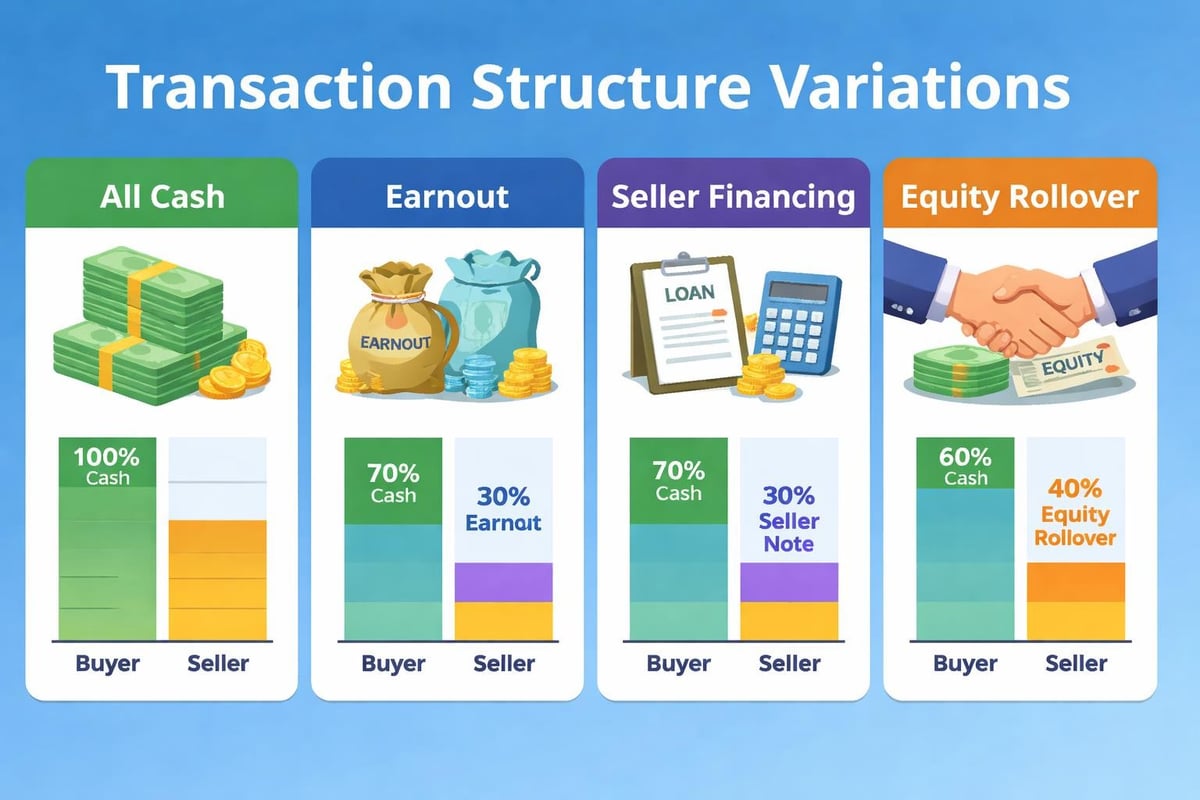
Earnouts and Seller Financing Structures
Price doesn't always equal upfront cash. Sophisticated deal structures can bridge valuation gaps between buyer and seller expectations:
| Structure Component | Seller Benefit | Buyer Benefit |
|---|---|---|
| Cash at Closing | Immediate liquidity | Lower initial investment |
| Earnout (1-3 years) | Higher total price | Risk mitigation on projections |
| Seller Note | Interest income | Improved financing terms |
| Equity Rollover | Upside participation | Seller skin in the game |
When asking how do I price my business for sale with creative structures, recognize that the headline price differs from present value of payments. A $12 million deal with 50% cash, 30% earnout, and 20% seller note has substantially different economics than $12 million all cash.
Asset Sale Versus Stock Sale Implications
The transaction structure significantly impacts effective pricing. Asset sales typically favor buyers through tax benefits, while stock sales benefit sellers by potentially qualifying for capital gains treatment.
Asset Sale Pricing Considerations:
- Buyers allocate purchase price to assets for depreciation
- Sellers face potential ordinary income on some assets
- Liabilities generally remain with seller unless assumed
- Price adjustments often needed to offset tax differences
Stock Sale Pricing Considerations:
- Sellers receive capital gains treatment (more favorable)
- Buyers inherit tax basis and potential liabilities
- Simplified transaction structure in many cases
- Price typically higher to compensate buyer for lost step-up
Industry-Specific Valuation Nuances
Different industries require different approaches when determining how do I price my business for sale. Understanding sector-specific drivers ensures realistic pricing expectations.
Technology and SaaS Businesses
Software companies command premium valuations based on:
- Annual Recurring Revenue (ARR) growth rates
- Customer retention metrics (logo retention, net revenue retention)
- Gross margin profiles typically exceeding 70-80%
- Sales efficiency ratios like CAC payback period
- Product differentiation and competitive moats
A typical scenario involves a SaaS business with $5 million ARR growing 40% annually potentially commanding 6-10x revenue multiples, while a slower-growth competitor at 15% might only achieve 3-5x revenue.
Manufacturing and Distribution
Industrial businesses focus on different metrics:
- EBITDA multiples ranging from 3-7x depending on niche
- Asset intensity and working capital requirements
- Customer diversification and contract duration
- Operational efficiency and margin sustainability
- Supply chain resilience and vendor relationships
Service-Based Businesses
Professional services, agencies, and consulting firms face unique valuation challenges:
- Key person dependency that may not transfer
- Client concentration creating revenue risk
- Limited tangible assets supporting valuations
- Recurring revenue models commanding premiums
- Intellectual property and proprietary methodologies
Various pricing methodologies apply differently across these sectors, making industry expertise essential for accurate valuations.
Leveraging Technology and Platforms in the Pricing Process
Modern M&A technology has transformed how business owners approach the question of how do I price my business for sale by providing better data, wider buyer access, and more efficient processes.
The Role of M&A Platforms
Traditional M&A processes often limited seller exposure to buyers through single intermediaries or narrow networks. Contemporary private equity platforms and specialized M&A marketplaces expand reach while maintaining confidentiality.
Aligned IQ M&A differentiates itself through a proprietary matching process that prioritizes strategic fit before diving into detailed financial negotiations. This approach benefits sellers by:
- Maintaining confidentiality through controlled, private introductions
- Qualifying buyers based on transaction priorities and industry expertise
- Reducing time waste on mismatched prospects
- Creating competitive tension among strategically aligned buyers
- Providing secure documentation sharing through complimentary VDR access
The platform's focus on alignment first, valuation second creates more collaborative transactions where pricing discussions occur after both parties confirm strategic compatibility.
Virtual Data Rooms and Pricing Transparency
Once serious discussions begin, secure information sharing becomes critical. The Aligned IQ VDR offers competitively priced virtual data room services that facilitate due diligence while protecting sensitive information.
For sellers matched through Aligned IQ M&A, the VDR comes complimentary, reducing transaction costs while maintaining security. Other market participants including buyers, intermediaries, and M&A service providers access the same enterprise-grade security at competitive rates, making professional-quality deal management accessible across the lower middle market.
Understanding data room costs helps you budget appropriately for the transaction process while recognizing that modern platforms have dramatically reduced barriers to professional-quality deal execution.
Working with Advisors and Valuation Professionals
Most business owners benefit from professional guidance when determining how do I price my business for sale, but understanding when and how to engage experts maximizes value.
Types of Valuation Professionals
Different advisors serve different purposes in the pricing process:
| Advisor Type | Primary Function | Typical Cost | Best Used When |
|---|---|---|---|
| Business Broker | Marketing and transaction management | 8-12% commission | Sub-$5M businesses |
| M&A Advisor | Strategic positioning and deal execution | 5-10% commission | $5M-$50M businesses |
| Investment Banker | Comprehensive sell-side representation | Retainer + success fee | $50M+ businesses |
| Business Appraiser | Formal valuation opinion | $5K-$25K flat fee | Tax, legal, litigation purposes |
| CPA/Tax Advisor | Structure and tax optimization | Hourly or project | All transactions |
The Value of Independent Opinions
Even when working with transaction advisors, independent business appraisals provide valuable benchmarks. These formal opinions use standardized methodologies and often prove useful for:
- Establishing baseline expectations before marketing
- Supporting negotiations with documentation
- Resolving disputes between partners or family members
- Meeting regulatory or legal requirements
- Providing comparative data points against broker opinions
Managing Conflicts of Interest
Transaction advisors often face inherent conflicts because their compensation ties to deal completion. While most professionals maintain ethical standards, recognize these dynamics when evaluating pricing advice:
- Advisors might encourage accepting lower offers to secure fees
- Urgency to close may override patience for optimal pricing
- Exclusive agreements might limit market exposure
- Commission structures could influence strategic recommendations
Platforms like Aligned IQ M&A that focus on strategic matching rather than transaction commissions create different incentive structures, potentially aligning better with seller interests around pricing optimization and fit quality.
Preparing Your Business for Optimal Valuation
The final consideration in how do I price my business for sale involves recognizing that pricing reflects not just current performance but buyer perceptions of future potential and risk.
Value Enhancement Strategies
Strategic improvements implemented 12-24 months before sale can significantly impact pricing:
- Diversify customer concentration to reduce revenue risk
- Document systems and processes to decrease key person dependency
- Clean up financial statements to show true normalized earnings
- Resolve legal or compliance issues that create uncertainty
- Strengthen management team to enable smooth ownership transition
Timing Considerations for Maximum Price
Market timing, business cycles, and preparation all influence optimal pricing. Consider selling when:
- Your business shows consistent growth trajectory
- Industry multiples reach cyclical peaks
- Strong management team can operate independently
- Financial performance demonstrates sustainability
- Competitive position appears secure for the foreseeable future
Realistic Expectations and Market Feedback
Initial pricing represents a hypothesis that market feedback validates or disproves. Successful sellers remain flexible, adjusting expectations based on:
- Buyer interest levels and engagement quality
- Specific objections or concerns raised during discussions
- Competitive intelligence about similar transactions
- Changes in market conditions or business performance
- Strategic fit quality with interested parties
The collaborative approach fostered by platforms prioritizing strategic alignment before valuation creates environments where pricing discussions occur with fuller context and mutual understanding of value drivers beyond pure multiples.
Pricing your business for sale requires balancing financial methodologies with market realities, strategic considerations, and honest assessment of your company's strengths and weaknesses. The most successful exits occur when sellers combine rigorous valuation analysis with flexible negotiation strategies and access to qualified, strategically aligned buyers. Aligned IQ transforms this process by prioritizing fit before price, connecting business owners with buyers who value what makes your company unique, and providing complimentary secure data room access to matched sellers. Take a Tour to discover how our proprietary matching platform can help you find the perfect counterparty and achieve your M&A goals with confidence.
No responses yet