
Understanding the true value of a business is fundamental to any successful merger or acquisition. Whether you're a business owner preparing for an eventual exit or a strategic buyer evaluating acquisition opportunities, a professional business valuation provides the objective financial foundation necessary for informed decision-making. In 2026, with evolving accounting standards, regulatory requirements, and market dynamics, the importance of rigorous valuation methodology has never been more critical for middle-market transactions.
Why Professional Business Valuation Matters in M&A Transactions
A professional business valuation serves multiple strategic purposes beyond simply determining a price tag. For sellers, a credible valuation establishes realistic expectations, strengthens negotiating positions, and provides documentation for tax reporting purposes. For buyers, independent valuations reduce overpayment risk and support due diligence findings with quantitative analysis.
The stakes are particularly high in the lower middle market, where information asymmetry between buyers and sellers can derail otherwise promising deals. According to the International Valuation Standards (IVS), professional valuations must adhere to consistent methodology and transparent assumptions to ensure credibility across jurisdictions and transaction types.
The Cost of Inadequate Valuation
Skipping professional business valuation or relying on informal estimates creates significant risks:
- Deal failure due to unrealistic price expectations on either side
- Post-transaction disputes when earn-outs or performance targets are based on flawed assumptions
- Tax exposure from IRS challenges to estate, gift, or transaction valuations
- Litigation vulnerability in shareholder disputes or divorce proceedings
- Strategic misalignment when acquisition decisions rest on incomplete financial analysis
Many business owners exploring new business acquisition strategies discover that the valuation gap between buyer and seller perspectives often stems from methodological differences rather than true disagreement about business fundamentals.
Core Valuation Approaches and Methodologies
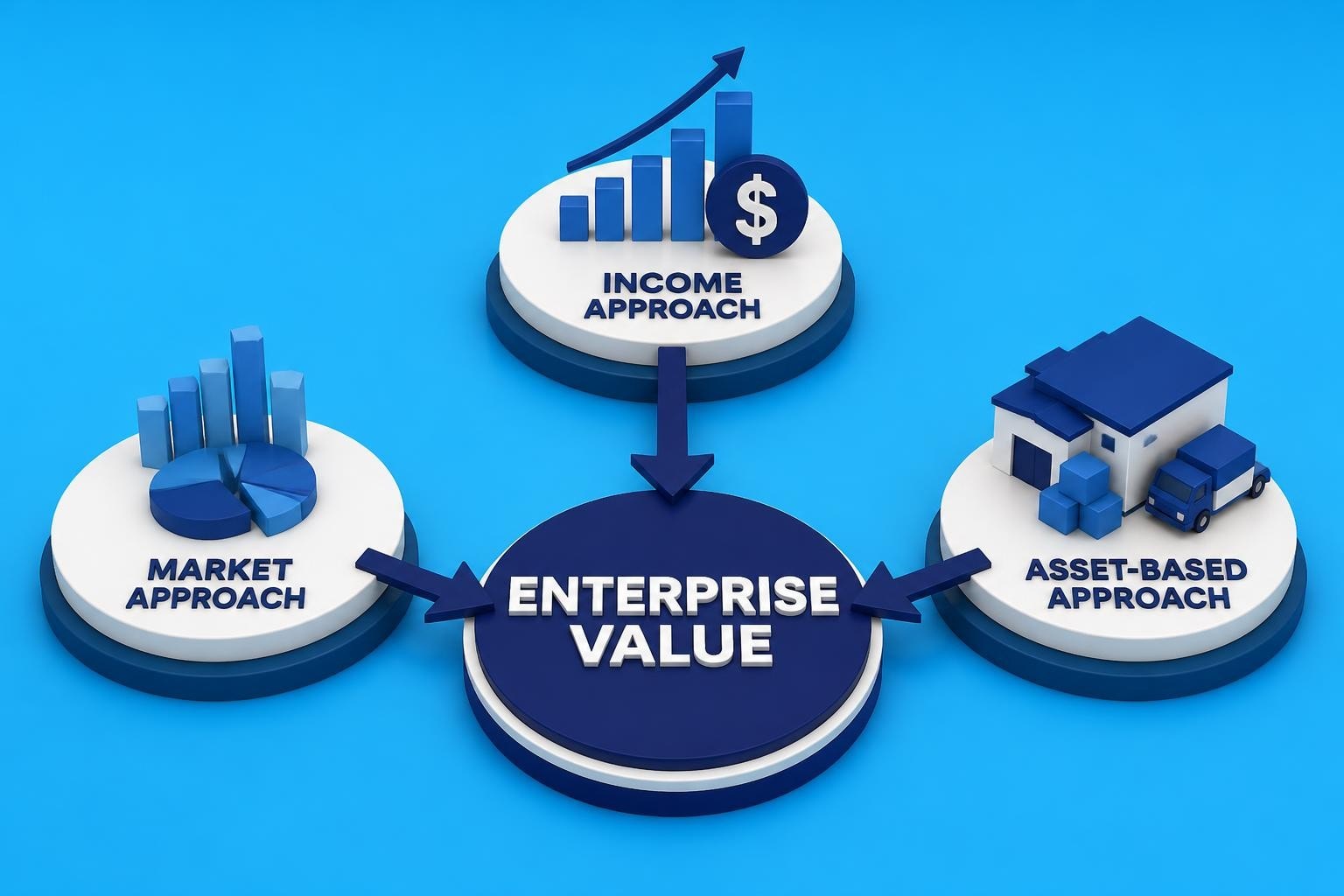
Professional business valuation typically employs three fundamental approaches, each offering distinct perspectives on enterprise value. Credentialed valuators seldom rely on a single method, instead triangulating conclusions across multiple approaches to ensure robust, defensible results.
Income Approach: Discounted Cash Flow and Capitalization
The income approach values a business based on its expected future economic benefits, either through discounted cash flow (DCF) analysis or capitalization of earnings methods.
Discounted Cash Flow Analysis projects free cash flows over a discrete forecast period, then applies a discount rate reflecting the risk-adjusted required return on investment. The terminal value captures cash flows beyond the projection period. This method works best for businesses with predictable cash flows and reasonable visibility into future performance.
| DCF Component | Key Considerations | Common Challenges |
|---|---|---|
| Revenue projections | Historical growth, market trends, competitive position | Overly optimistic forecasts |
| Operating margins | Cost structure, economies of scale, pricing power | Sustainability of current margins |
| Discount rate (WACC) | Cost of equity, cost of debt, capital structure | Estimating private company risk premium |
| Terminal value | Perpetuity growth rate, exit multiple | Disproportionate impact on total value |
Capitalization of Earnings applies a capitalization rate to a normalized measure of economic income (typically EBITDA or seller's discretionary earnings for small businesses). This simpler approach assumes stable, predictable earnings in perpetuity, making it suitable for mature businesses in stable industries.
The IRS guidance materials provide foundational principles for income approach valuations, particularly for closely held business interests where market data is limited.

Market Approach: Comparable Transactions and Guideline Companies
The market approach determines value by reference to actual transaction prices or public company trading multiples for comparable businesses. This approach relies on the economic principle that rational investors pay similar prices for similar assets.
Guideline Public Company Method analyzes trading multiples (such as EV/EBITDA, EV/Revenue, or P/E ratios) for publicly traded companies with similar characteristics. Adjustments account for size differences, liquidity discounts, and other factors distinguishing private middle-market businesses from public comparables.
Guideline Transaction Method examines actual sale prices in completed M&A transactions involving comparable private companies. This method provides direct market evidence but requires access to reliable transaction databases and careful screening for truly comparable deals.
For buyers using deal sourcing platforms to identify acquisition targets, understanding market multiples within specific industry verticals helps quickly assess whether asking prices align with recent market activity.
Asset-Based Approach: Balance Sheet Fundamentals
The asset-based approach values a business by adjusting the balance sheet to reflect fair market value of assets minus liabilities. This methodology is most relevant for:
- Asset-heavy businesses where tangible assets drive value (manufacturing, real estate, distribution)
- Distressed situations where liquidation value establishes a floor
- Holding companies with investment portfolios
- Early-stage businesses lacking positive earnings or cash flow
While less commonly used as the primary method for operating businesses, the asset approach provides an important reality check, particularly when income or market approaches yield results below adjusted net asset value.
Professional Standards and Regulatory Framework
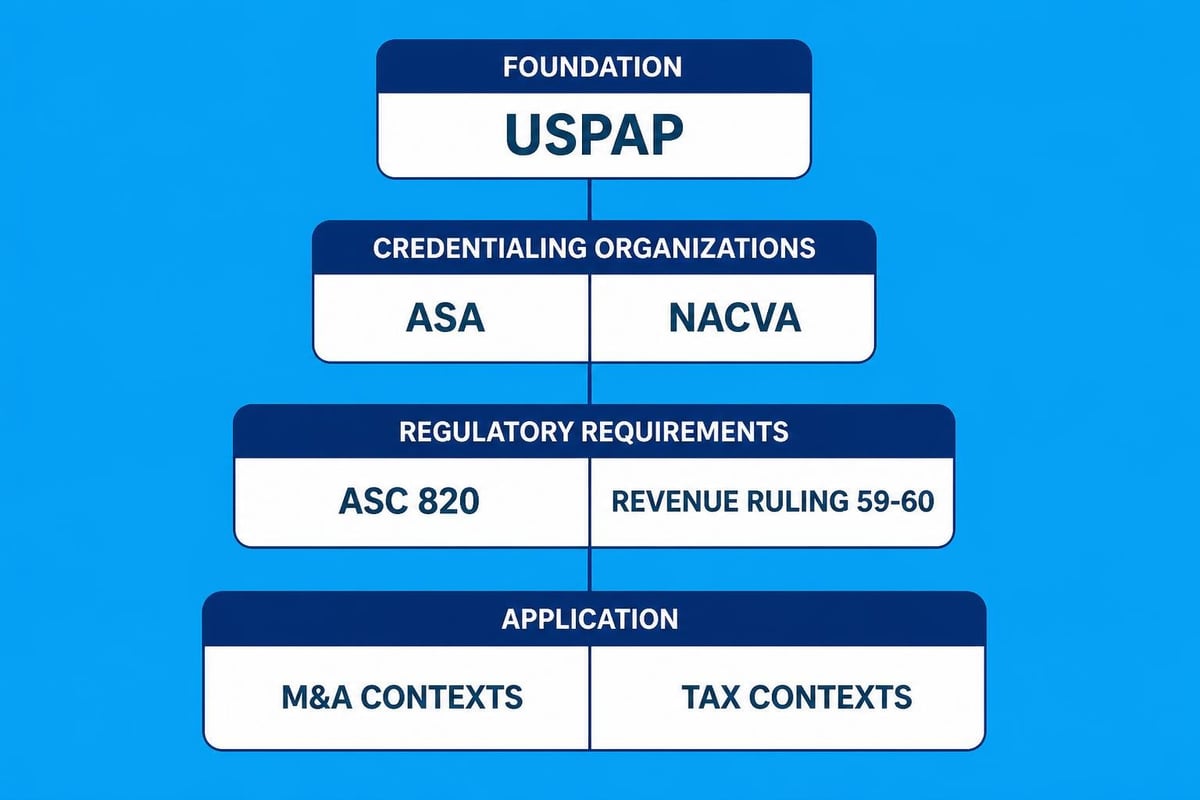
Professional business valuation operates within a structured framework of standards, regulations, and best practices designed to ensure consistency, transparency, and credibility.
Valuation Standards and Credentialing Bodies
Multiple organizations establish standards and credential professional valuators:
- American Society of Appraisers (ASA) offers the Accredited Senior Appraiser (ASA) designation
- National Association of Certified Valuators and Analysts (NACVA) grants the Certified Valuation Analyst (CVA) credential
- AICPA provides the Accredited in Business Valuation (ABV) credential for CPAs
- The Appraisal Foundation establishes Uniform Standards of Professional Appraisal Practice (USPAP)
The American Society of Appraisers education resources outline rigorous training and continuing education requirements that maintain professional competency as methodologies and markets evolve.
Financial Reporting and Tax Compliance Requirements
When valuations serve specific regulatory purposes, additional standards apply:
- ASC 820 (Fair Value Measurement) governs financial reporting valuations under US GAAP
- Revenue Ruling 59-60 establishes IRS expectations for estate and gift tax valuations
- IRS Section 409A requires independent valuations for stock option pricing in private companies
- IRC Section 1042 ESOP transactions require qualified independent appraisals
The AICPA practice aid for estate and gift tax valuations provides detailed guidance on documentation, report content, and defensibility criteria for tax-related professional business valuation engagements.
Valuation Adjustments and Normalization
Raw financial statements rarely present an accurate picture of sustainable earning power. Professional business valuation requires careful normalization to adjust for non-recurring items, discretionary expenses, and other factors that distort true economic performance.
Common Normalizing Adjustments
Owner Compensation: Closely held businesses often pay owner-operators above or below market rates. Valuators adjust to market-rate compensation for the functions actually performed, revealing true economic profit available to a prospective buyer.
Discretionary Expenses: Personal expenses run through the business, above-market rent paid to related parties, excessive travel and entertainment, and family member compensation for minimal work all require adjustment.
Non-Recurring Items: One-time legal settlements, insurance recoveries, gain or loss on asset sales, and unusual bad debt write-offs should be excluded when projecting normalized future performance.
Working Capital: Professional business valuation considers whether current working capital levels are adequate, excessive, or deficient relative to operational needs. Buyers typically expect normalized working capital at closing.
Premiums and Discounts
Beyond normalizing historical performance, valuators apply premiums or discounts reflecting specific characteristics of the subject interest:
| Adjustment Type | Typical Range | Application |
|---|---|---|
| Control premium | 20-40% | Minority interest to controlling interest |
| Discount for lack of control (DLOC) | 15-35% | Controlling to minority interest |
| Discount for lack of marketability (DLOM) | 20-45% | Reflects illiquidity of private company stock |
| Key person discount | 10-25% | Business dependent on specific individual |
Determining appropriate discount levels requires judgment based on company-specific factors, industry characteristics, and empirical studies. The Deloitte guidance on fair value measurement under ASC 820 provides technical considerations for applying these adjustments in financial reporting contexts.
The Role of Professional Business Valuation in M&A Success
Professional business valuation serves distinct but complementary functions throughout the M&A lifecycle, from initial consideration through post-close integration and performance measurement.
Pre-Transaction Strategic Planning
Business owners exploring exit options benefit from valuation analysis years before entering active negotiations. Early-stage valuation identifies value drivers, highlights areas requiring improvement, and establishes realistic price expectations that inform strategic planning.
For sellers considering platforms like Aligned IQ M&A, which prioritizes strategic fit before extensive financial disclosure, understanding value ranges helps determine whether timing is appropriate or if additional value-building initiatives would improve exit outcomes.
Buyers developing acquisition criteria similarly use valuation frameworks to establish target return thresholds, maximum price parameters, and deal structure preferences that guide sourcing efforts.
Due Diligence and Negotiation
During active negotiations, independent professional business valuation provides objective support for pricing discussions. Quality of earnings analysis, a specialized form of financial due diligence, validates normalized EBITDA and identifies risks that might justify price adjustments or earn-out structures.
PwC’s transaction valuation practice emphasizes that valuation bridges financial due diligence and deal structuring, informing decisions about cash versus stock consideration, earn-outs, working capital pegs, and representations and warranties.
Post-Acquisition Purchase Price Allocation
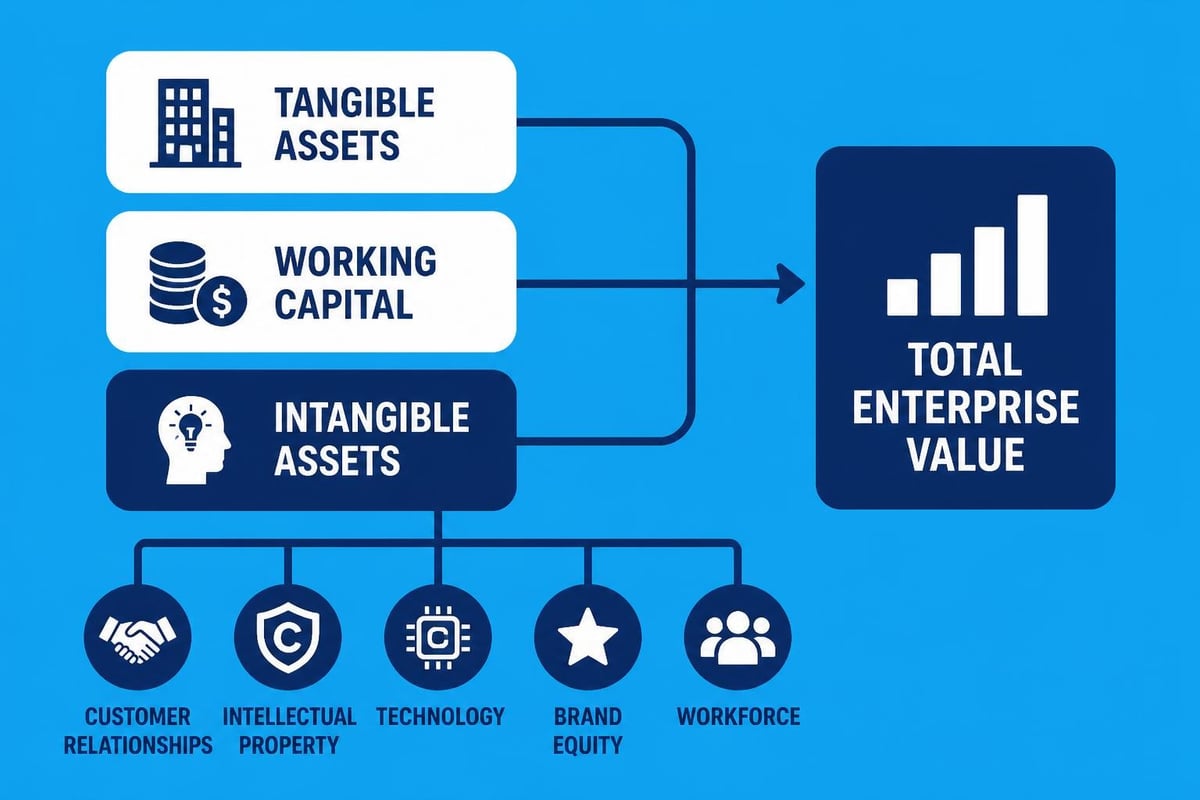
After closing, buyers must allocate purchase price across acquired assets for financial reporting and tax purposes. Professional business valuation quantifies intangible assets including customer relationships, trade names, technology, and workforce in place. This purchase price allocation (PPA) impacts future amortization expense, goodwill balances, and potentially impairment testing.
Beyond Traditional Financial Metrics
While discounted cash flow and comparable transaction analysis remain foundational, professional business valuation increasingly incorporates non-financial value drivers that traditional methodologies may underweight.
Customer-Based Valuation Approaches
Customer lifetime value (CLV) analysis offers powerful insights, particularly for subscription businesses, SaaS companies, and professional services firms where recurring revenue streams drive value. Harvard Business Review’s framework for customer-based valuation demonstrates how detailed customer cohort analysis can provide forward-looking value indicators that complement backward-looking financial metrics.
Key customer concentration represents both a risk and an opportunity. While dependence on a few large customers typically warrants a discount, long-term contracts with creditworthy counterparties may justify premium valuations. Valuators assess customer diversification, retention rates, contract terms, and relationship strength.
Intangible Asset Valuation
Modern businesses increasingly derive value from intangible assets:
- Intellectual property: Patents, trademarks, copyrights, trade secrets
- Technology platforms: Proprietary software, databases, algorithms
- Brand equity: Customer recognition, reputation, market position
- Human capital: Skilled workforce, management depth, organizational culture
- Network effects: Platform businesses where value increases with user base
Professional business valuation employs specialized methods for intangible assets, including relief from royalty, multi-period excess earnings, and with-and-without analysis to isolate contributory value.
Selecting the Right Valuation Professional
The quality of professional business valuation depends heavily on selecting qualified professionals with relevant credentials, industry expertise, and appropriate independence.
Credentials and Experience
Look for professionals holding recognized credentials (ASA, CVA, ABV, CFA) with specific experience in your industry and transaction size. A valuator who primarily works with Fortune 500 companies may lack relevant perspective on lower middle-market dynamics, while someone focused exclusively on small businesses may not understand buyer perspectives from strategic acquirers and financial sponsors.
Independence and Objectivity
For litigation, tax reporting, or financial statement purposes, independence is often legally required. Even when not mandated, objective third-party valuation typically carries more weight in negotiations than analysis performed by transaction advisors with success fees tied to deal completion.
Scope Definition and Fee Structure
Valuation engagement types vary significantly:
- Full formal valuation report: Comprehensive documentation meeting all professional standards (typical for tax, litigation, ESOP transactions)
- Summary valuation report: Abbreviated documentation focusing on conclusions (common for internal planning, preliminary negotiations)
- Calculation of value: Limited-scope engagement following specified methodology without full investigation
Fee structures typically range from $5,000 to $50,000+ for lower middle-market businesses, depending on complexity, purpose, and report type. Hourly rates for credentialed professionals generally range from $250 to $600 per hour in 2026.
Data Security and Confidentiality in the Valuation Process
Professional business valuation requires sharing sensitive financial and operational information. Protecting this data throughout the engagement is critical, particularly when valuation supports potential M&A discussions.
Confidential Information Exchange
Valuators typically execute non-disclosure agreements before receiving detailed information. Best practices include:
- Secure file transfer protocols rather than email attachments
- Limited data retention policies with destruction after engagement completion
- Access controls limiting which team members see specific information
- Redacted reporting when circulation extends beyond immediate parties
For businesses using secure platforms like Aligned IQ VDR, which offers competitively priced virtual data rooms, extending access to valuation professionals during due diligence provides controlled information sharing with complete audit trails.
Strategic Versus Tactical Information Sharing
Sellers concerned about competitive intelligence reaching strategic buyers often hesitate to share detailed operational data early in the process. The Aligned IQ M&A platform addresses this by prioritizing strategic fit assessment before extensive financial disclosure, allowing sellers to evaluate cultural alignment and strategic rationale before sharing sensitive valuation inputs.
Integration with M&A Advisory Services
Professional business valuation rarely stands alone. Most successful transactions involve coordinated engagement across multiple service providers, each contributing specialized expertise.
The M&A Service Provider Ecosystem
Complete transaction support typically includes:
- Business valuation professionals providing objective value opinions
- M&A advisors and investment bankers managing the sale process and negotiations
- Quality of earnings providers validating financial performance during due diligence
- Tax advisors structuring transactions to optimize after-tax proceeds
- Legal counsel documenting agreements and managing regulatory compliance
- Lenders or capital providers financing acquisition consideration
M&A service providers increasingly recognize the value of platforms that facilitate secure, confidential collaboration while maintaining appropriate boundaries between advisory roles.
When to Engage Valuation Professionals
Timing considerations for valuation engagement:
- 12-24 months before anticipated exit: Strategic planning valuation identifies value enhancement opportunities
- Upon serious buyer interest: Supports pricing discussions with objective analysis
- During due diligence: Quality of earnings and working capital analysis validate assumptions
- Post-LOI, pre-closing: Purchase price allocation planning and tax structure optimization
- Post-close: Final PPA for financial reporting and tax compliance
Many business owners benefit from periodic valuations (every 2-3 years) tracking value creation and informing strategic decisions long before any exit consideration.
Common Valuation Challenges in Lower Middle Market Transactions
Professional business valuation in the lower middle market faces unique challenges that distinguish it from large corporate transactions or small business appraisals.
Limited Comparable Data
Public company comparables may be too large, with economies of scale, geographic reach, and product diversification that don't translate to middle-market private companies. Completed transaction data is often proprietary, incomplete, or lacks sufficient detail about adjustments and deal structures. Valuators must exercise judgment in selecting and adjusting comparable data to reflect truly similar circumstances.
Financial Statement Quality
Unlike public companies with audited financial statements prepared under rigorous accounting standards, middle-market businesses often rely on compiled or reviewed statements prepared primarily for tax minimization rather than economic transparency. Valuators spend significant time reconstructing true economic performance from tax-focused reporting.
Owner-Operator Dynamics
The typical scenario involves founders who have built businesses over decades, performing multiple functions without clear separation between operational roles and ownership prerogatives. Determining market-rate replacement costs for owner functions requires industry knowledge and judgment beyond mechanical application of compensation surveys.
Growth Trajectory Uncertainty
Middle-market businesses often face inflection points where historical performance provides limited guidance for future prospects. Recent technology investments, customer concentration changes, competitive threats, or market expansion initiatives create forecast uncertainty that challenges traditional valuation methodologies.
Professional business valuation provides the objective financial foundation essential for successful M&A transactions, combining rigorous methodology with judgment informed by market knowledge and industry expertise. Whether you're a business owner planning an eventual exit or a buyer evaluating acquisition opportunities, understanding valuation fundamentals helps align expectations and supports informed decision-making. When you're ready to explore strategic partnerships that prioritize fit and alignment, take a tour of how Aligned IQ M&A connects buyers and sellers through a confidential platform focused on strategic compatibility, complemented by secure collaboration tools like the Aligned IQ VDR that facilitate professional due diligence while protecting sensitive information.
No responses yet