

The landscape of business transactions has evolved dramatically over the past decade, and working with a mergers and acquisitions firm has become increasingly complex. Business owners seeking exit opportunities and buyers searching for the right acquisition targets now face a market where strategic fit matters more than ever. Traditional approaches often prioritize financial metrics while overlooking the critical alignment factors that determine long-term success. Modern platforms are transforming how parties connect, emphasizing compatibility and shared vision before diving into extensive due diligence processes.
Understanding the Role of a Mergers and Acquisitions Firm
A mergers and acquisitions firm traditionally serves as an intermediary between buyers and sellers, facilitating transactions that range from small business acquisitions to enterprise-level deals. These firms provide expertise in valuation, negotiation, due diligence coordination, and deal structuring. Investment bankers, M&A advisors, and business brokers all fall under this umbrella, each serving specific market segments.
The value proposition extends beyond simple matchmaking. A skilled mergers and acquisitions firm brings market intelligence, industry connections, and transactional expertise that most business owners lack. They understand best practices for middle-market M&A transactions, including proper timing, valuation methodologies, and negotiation strategies.
Market Segmentation and Specialization
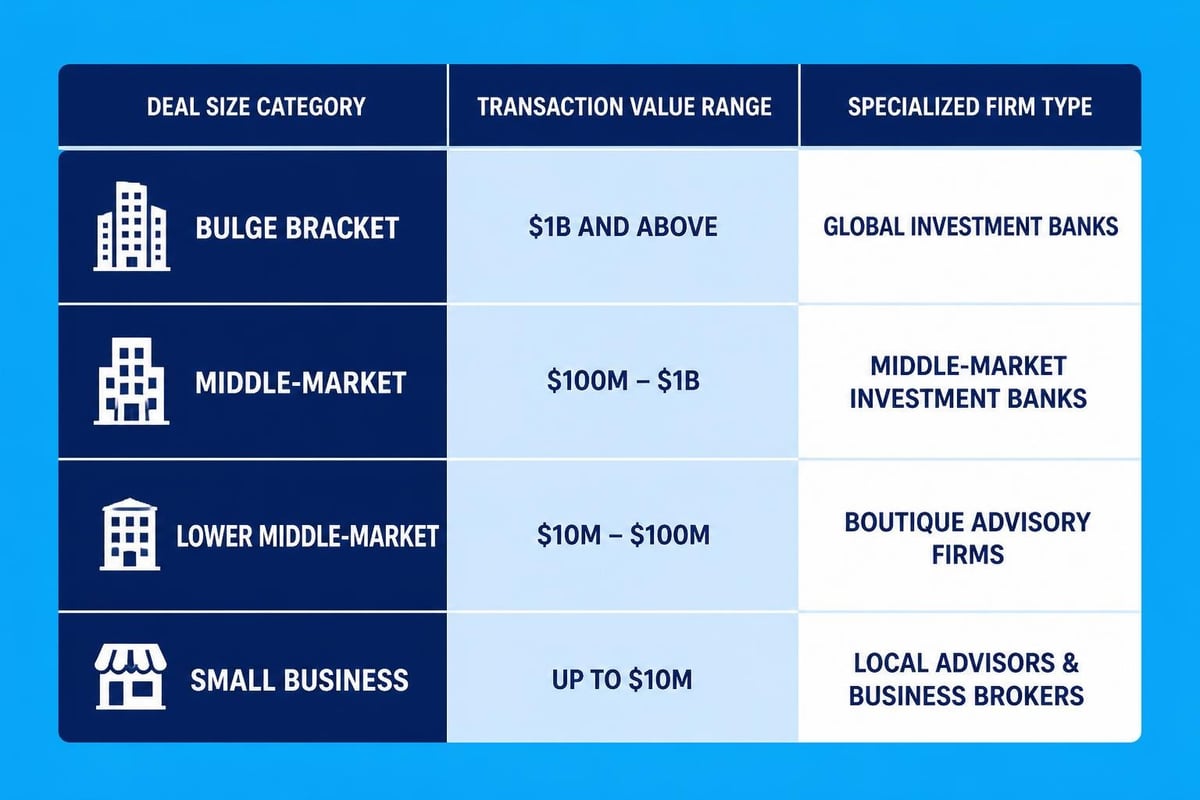
Different firms specialize in various deal sizes and industries:
- Bulge bracket firms handle transactions exceeding $500 million
- Middle-market specialists focus on deals between $50 million and $500 million
- Lower middle-market advisors work with transactions from $5 million to $50 million
- Small business brokers facilitate deals under $5 million
This segmentation matters because the approach, fee structures, and processes differ significantly across categories. Understanding where your transaction fits helps identify the right resources and set appropriate expectations.
The Traditional M&A Process and Its Limitations
Working with a conventional mergers and acquisitions firm typically follows a linear path. The seller engages an advisor, who prepares marketing materials, identifies potential buyers, manages communications, coordinates due diligence, and negotiates terms. This process can take anywhere from six months to two years.
Key stages include:
- Business valuation and preparation
- Confidential Information Memorandum creation
- Buyer identification and outreach
- Initial discussions and Letter of Intent negotiation
- Due diligence execution
- Final negotiations and closing
The challenge with the traditional sell-side M&A process lies in its inefficiencies. Sellers often lack control over who sees their information, and buyers waste time pursuing opportunities that ultimately prove incompatible. The focus on financial metrics before strategic alignment leads to deals collapsing late in the process, after significant time and expense.
Communication Challenges in Conventional Approaches
Communication best practices during mergers and acquisitions emphasize transparency and stakeholder management. However, traditional processes often suffer from information asymmetry, where parties guard details until late stages. This creates mistrust and increases transaction risk.
A typical scenario might involve a manufacturing business owner receiving unsolicited approaches from private equity firms. Without proper vetting mechanisms, the owner struggles to determine which buyers genuinely align with their vision for the company's future and employees.
The Strategic Fit Paradigm
Strategic alignment determines whether a transaction creates lasting value or becomes a costly mistake. Financial compatibility matters, but cultural fit, operational synergies, growth vision, and management philosophy prove equally critical. A mergers and acquisitions firm that prioritizes these factors from the outset saves all parties substantial time and resources.
Modern approaches incorporate multiple alignment dimensions:
| Alignment Factor | Traditional Weight | Strategic-First Weight |
|---|---|---|
| Financial Metrics | 70% | 30% |
| Cultural Compatibility | 10% | 25% |
| Operational Synergies | 15% | 25% |
| Growth Vision | 5% | 20% |
This rebalancing reflects research showing that most failed acquisitions stem from cultural and strategic misalignment rather than financial miscalculation. M&A integration best practices emphasize early alignment assessment.
Industry-Specific Considerations
Different sectors demand specialized knowledge. A mergers and acquisitions firm handling financial services mergers and acquisitions must understand regulatory complexities, while those working in construction and engineering M&A need familiarity with project-based revenue models and bonding requirements.
Sector-specific expertise includes:
- Regulatory compliance requirements
- Industry-specific valuation multiples
- Market cycle understanding
- Competitive landscape knowledge
- Operational best practices
Platform-Based M&A Solutions
Technology has revolutionized how buyers and sellers connect. Platform-based approaches allow business owners to maintain control while exploring opportunities confidentially. Unlike engaging a traditional mergers and acquisitions firm where control shifts to advisors, modern platforms empower principals to drive their own processes.

Match-Making Technology
Sophisticated matching algorithms consider multiple variables simultaneously. Transaction size, industry experience, geographic preferences, growth plans, and operational priorities all factor into compatibility scoring. This approach mirrors how private equity platforms identify platform acquisitions and subsequent tuck-in acquisition strategies.
A typical scenario involves a software company owner seeking an exit within two years. Rather than broadly marketing the business, the platform matches them with buyers who specifically seek software assets in their vertical, understand SaaS metrics, and share similar growth philosophies.
Benefits for Business Buyers
Buyers face their own challenges in traditional processes. Sourcing quality deal flow, differentiating themselves from competitors, and demonstrating their value proposition to sellers all require significant effort. Platform approaches provide buyers with tools to showcase their capabilities, track record, and strategic vision.
Key buyer advantages include:
- Proprietary access to pre-qualified opportunities
- Ability to demonstrate track record and expertise
- Direct communication with decision-makers
- Reduced competition through strategic matching
- Lower acquisition costs through efficient processes
Lower middle-market PE firms particularly benefit from platforms that help them compete against larger funds by highlighting their operational expertise and industry focus.
Virtual Data Rooms in Modern M&A
Once parties establish mutual interest, secure information sharing becomes critical. Working with a mergers and acquisitions firm traditionally meant paying substantial fees for virtual data room (VDR) services. These costs can range from $10,000 to $100,000 depending on deal size and complexity.
Modern VDR solutions offer competitive pricing that makes them accessible across transaction sizes. Best data room providers balance security, usability, and cost-effectiveness.
VDR Features and Functionality
A comprehensive VDR solution provides:
- Bank-level encryption for document security
- Granular permission controls for user access management
- Activity tracking to monitor document views and downloads
- Q&A modules for organized due diligence queries
- Integration capabilities with other M&A tools
| Feature | Basic VDR | Enterprise VDR | Modern Platform VDR |
|---|---|---|---|
| Security Level | Standard SSL | Advanced encryption | Bank-level encryption |
| User Management | Limited | Advanced | Granular controls |
| Activity Tracking | Basic logs | Detailed reports | Real-time analytics |
| Q&A Module | No | Yes | Yes |
| Pricing | Per-page fees | Fixed high cost | Competitive/Complimentary |
Complimentary VDR Access
Some platforms now bundle VDR access with their matching services, eliminating this cost center for sellers who complete matches through the platform. This approach differs from traditional mergers and acquisitions firm models where every service component carries separate fees.
Competitive VDR pricing at platforms like Aligned IQ VDR (details available at vdr.alignediq.net/pricing) makes secure due diligence accessible to all transaction participants, whether they connect through the platform or engage independently.
Service Provider Opportunities
M&A advisors, attorneys, accountants, and other professionals play crucial roles in successful transactions. Forward-thinking platforms create opportunities for service providers to participate in the ecosystem rather than compete against it.
Service provider benefits include:
- Referral fee opportunities for sell-side introductions
- Platform to showcase expertise and credentials
- Access to qualified buyer and seller networks
- Collaborative rather than adversarial relationships
- Ongoing engagement throughout transaction lifecycle
A typical scenario might involve an M&A advisor with a client not yet ready to sell. Rather than losing the relationship, the advisor can introduce the owner to a platform where they explore options confidentially while the advisor remains engaged for eventual transaction support.

Due Diligence and Deal Execution
Even with perfect strategic alignment, thorough due diligence remains essential. A competent mergers and acquisitions firm coordinates this process across multiple workstreams: financial, legal, operational, commercial, and cultural.
Financial Due Diligence Components
Key financial areas include:
- Historical financial statement analysis
- Adjusted EBITDA calculations and normalization
- Working capital requirements assessment
- Revenue quality and customer concentration review
- Tax compliance and exposure evaluation
Understanding metrics like adjusted EBITDA helps both parties establish fair valuation baselines. Normalized earnings remove one-time expenses and owner-specific costs that won't continue post-transaction.
Operational and Commercial Assessment
Beyond financials, buyers must understand operational capabilities, market position, competitive advantages, and growth constraints. This evaluation determines whether projected synergies are achievable and realistic.
Research into predicting mergers and acquisitions using temporal dynamic networks shows that industry positioning and network effects significantly impact transaction success. Companies with strong industry connections and strategic partnerships typically command premium valuations.
Confidentiality and Risk Management
Business owners rightfully worry about confidentiality when exploring exit options. Premature disclosure can damage customer relationships, employee morale, vendor partnerships, and competitive positioning. A professional mergers and acquisitions firm implements strict confidentiality protocols.
Multi-Layered Confidentiality Protection
Effective confidentiality measures include:
- Anonymous initial profiles without identifying information
- Staged disclosure tied to buyer qualification and commitment
- Robust non-disclosure agreements before sensitive data sharing
- Secure communication channels and document repositories
- Limited circulation of detailed business information
Platform-based approaches enhance confidentiality by allowing sellers to control information flow. Rather than broadcasting availability to the market, sellers share details only with strategically matched, pre-qualified buyers who demonstrate serious interest.
Transaction Structure and Valuation
How a mergers and acquisitions firm structures a deal significantly impacts both parties' outcomes. Asset purchases, stock purchases, mergers, earnouts, seller financing, and equity rollovers each carry different tax implications, risk profiles, and strategic considerations.
Common Transaction Structures
| Structure Type | Buyer Preference | Seller Preference | Tax Efficiency |
|---|---|---|---|
| Asset Purchase | High | Low | Buyer favorable |
| Stock Purchase | Medium | High | Seller favorable |
| Merger | Medium | Medium | Situation dependent |
| Earnout Component | High | Low | Risk-sharing mechanism |
Valuation methodologies vary by industry, company size, growth profile, and market conditions. Comparable company analysis, precedent transactions, discounted cash flow models, and asset-based approaches all provide different perspectives on value.
Industry-Specific M&A Dynamics
Sector expertise separates effective advisors from generalists. A mergers and acquisitions firm specializing in education and training M&A understands accreditation issues, student retention metrics, and regulatory compliance that don't apply to other industries.
Sector-specific value drivers include:
- Technology: Recurring revenue, customer acquisition costs, churn rates
- Manufacturing: Equipment condition, supply chain stability, production capacity
- Healthcare: Regulatory compliance, reimbursement rates, patient demographics
- Professional services: Client concentration, key person dependencies, contract structures
Understanding these nuances helps parties establish realistic valuations and identify genuine synergy opportunities.
The Buyer Showcase Advantage
Traditional processes favor sellers by design. A mergers and acquisitions firm represents seller interests, marketing their business to potential buyers. This asymmetry leaves buyers struggling to differentiate themselves beyond price.
Modern platforms create opportunities for buyers to proactively showcase their value propositions. Track records, industry expertise, operational resources, growth capital, and cultural values all become visible to potential sellers before initial contact.
Building Buyer Credibility
Effective buyer profiles highlight:
- Previous acquisition experience and outcomes
- Industry-specific operational expertise
- Financial capacity and capital sources
- Strategic vision and growth plans
- Cultural values and management philosophy
- Post-acquisition support resources
This transparency helps sellers evaluate buyers beyond financial offers. A typical scenario might involve choosing between a slightly higher offer from a financial buyer versus a strategic buyer offering operational synergies and long-term growth support.
Integration Planning and Post-Closing Success
The work doesn't end at closing. Research shows that integration planning and execution determines whether acquisitions create or destroy value. A quality mergers and acquisitions firm guides parties through integration planning during due diligence.
Critical Integration Elements
- Leadership and organizational structure decisions
- Systems and technology consolidation plans
- Customer communication strategies
- Employee retention and cultural integration
- Operational process harmonization
Early planning prevents common pitfalls: talent departures, customer losses, operational disruptions, and cultural clashes. Successful acquirers begin integration planning during due diligence rather than waiting until post-closing.
Regulatory and Compliance Considerations
Larger transactions face regulatory scrutiny from antitrust authorities, industry-specific regulators, and securities commissions. A sophisticated mergers and acquisitions firm navigates these requirements efficiently, preventing delays and complications.
Common regulatory touchpoints include:
- Hart-Scott-Rodino filing requirements for deals exceeding threshold values
- Industry-specific license transfers and approvals
- Securities law compliance for certain transaction structures
- Environmental compliance assessments and liability transfers
- Employment law considerations for workforce transitions
Studies of international M&A networks reveal that regulatory environments significantly influence cross-border transaction patterns and structures.
Technology-Enabled M&A Efficiency
Advanced analytics, machine learning, and network analysis increasingly support M&A decision-making. Research into graph-based deep learning for M&A prediction demonstrates how technology can identify promising acquisition targets and predict transaction success.
A forward-thinking mergers and acquisitions firm leverages these tools to:
- Identify strategic targets matching specific criteria
- Assess market dynamics and competitive positioning
- Model integration scenarios and synergy potential
- Predict cultural compatibility based on organizational data
- Optimize transaction timing based on market conditions
Data-Driven Matching
Platform technology enables matching sophistication impossible through manual processes. Multiple variables analyzed simultaneously create compatibility scores that traditional approaches cannot replicate. This precision reduces wasted time pursuing incompatible opportunities.
Fee Structures and Economics
Understanding costs helps parties budget appropriately. Traditional mergers and acquisitions firm fees typically include:
Retainer fees ranging from $25,000 to $200,000 depending on firm tier and deal complexity, plus success fees calculated as percentages of transaction value using Lehman formula variations or similar structures.
Platform-based models often eliminate or reduce upfront costs, charging only upon successful transactions. This alignment of interests benefits both buyers and sellers by removing barriers to exploration.
Total Cost Comparison
| Cost Component | Traditional Firm | Platform Approach |
|---|---|---|
| Upfront Retainer | $50,000-$150,000 | $0-minimal |
| Success Fee | 5-10% of value | Competitive rates |
| Legal Fees | $75,000-$250,000 | $75,000-$250,000 |
| Accounting/Tax | $25,000-$75,000 | $25,000-$75,000 |
| VDR Costs | $15,000-$50,000 | Complimentary/competitive |
| Total Estimated | $200,000-$600,000 | Significantly reduced |
These economics particularly matter for lower middle-market transactions where traditional fee structures consume substantial portions of proceeds.
Finding the Right Partners
Selecting the right mergers and acquisitions firm or platform requires careful evaluation. Track record, industry expertise, cultural fit, fee structure transparency, and process approach all warrant consideration.
Critical evaluation criteria include:
- Demonstrated success in relevant transaction sizes
- Industry-specific knowledge and relationships
- Client references from recent similar deals
- Clear process explanation and timeline expectations
- Transparent fee structures without hidden costs
- Communication style and responsiveness
- Technology platform capabilities and security
Business owners benefit from exploring multiple options before committing. The right partnership significantly impacts both transaction success and owner satisfaction throughout the process.
Successfully navigating mergers and acquisitions requires the right combination of expertise, technology, and strategic alignment. Whether you're a business owner exploring future exit options, a buyer seeking proprietary deal flow, or an M&A service provider looking to expand your practice, modern platforms offer collaborative alternatives to traditional processes. Aligned IQ transforms M&A into a strategic-fit-first process, connecting buyers and sellers through sophisticated matching technology while providing complimentary VDR access to matched parties and competitive pricing for all other users. Take a tour to discover how our platform can help you achieve your M&A goals with greater efficiency, confidentiality, and success.
No responses yet