

The landscape of mergers and acquisitions continues to evolve rapidly, with lower middle-market companies increasingly recognizing the value of strategic transactions. Successful merger and acquisition strategies require careful planning, precise execution, and a deep understanding of how to identify the right counterparty. Business owners considering exit options and buyers seeking growth opportunities must navigate a complex process that extends far beyond simple financial calculations. The most effective approaches prioritize strategic alignment from the outset, ensuring that both parties share compatible visions, operational philosophies, and long-term objectives before investing significant time and resources into due diligence.
Understanding Core Merger and Acquisition Strategies
Modern merger and acquisition strategies encompass several distinct approaches, each designed to achieve specific business objectives. The choice of strategy depends on your company's growth goals, market position, and available resources.
Horizontal Integration Strategies
Horizontal mergers involve acquiring companies operating in the same industry and at the same production stage. This approach offers immediate market share expansion, economies of scale, and competitive advantage through consolidation.
Benefits include:
- Reduced competition in the marketplace
- Increased pricing power through market dominance
- Combined operational efficiencies and cost synergies
- Enhanced distribution networks and customer bases
- Accelerated revenue growth without building from scratch
In a typical scenario, a regional manufacturing company might acquire a competitor in an adjacent territory to expand geographic reach while maintaining industry expertise. This strategy works particularly well when strategic fit exists between the organizations' cultures, processes, and customer service approaches.
Vertical Integration Approaches
Vertical integration involves acquiring companies either upstream (suppliers) or downstream (distributors) in your supply chain. This strategy provides greater control over production processes, reduces dependency on external vendors, and can significantly improve profit margins.
| Vertical Integration Type | Primary Advantage | Risk Factor |
|---|---|---|
| Forward Integration | Direct customer access | Market knowledge requirements |
| Backward Integration | Supply chain control | Operational complexity |
| Balanced Integration | End-to-end optimization | Capital intensity |
Companies pursuing vertical strategies often discover that controlling more of the value chain reduces vulnerability to supply disruptions and price fluctuations.

Conglomerate Diversification
Conglomerate merger and acquisition strategies involve acquiring businesses in completely different industries. While this approach carries higher complexity, it offers powerful diversification benefits and risk mitigation across economic cycles.
This strategy proves valuable when:
- Core markets face saturation or decline
- Seasonal business patterns require stabilization
- Investment opportunities exceed internal growth capacity
- Portfolio diversification reduces overall business risk
According to Deloitte’s analysis of contemporary M&A strategies, companies increasingly pursue transformative deals that reshape their business models and competitive positions.
Transaction Types and Deal Structures
Understanding the various transaction structures available helps companies select the optimal approach for their specific circumstances. Each structure offers distinct advantages regarding tax implications, liability transfer, and operational continuity.
Asset Purchases Versus Stock Acquisitions
Asset purchases allow buyers to acquire specific company assets while avoiding unwanted liabilities. Sellers typically prefer stock sales for favorable tax treatment, creating natural negotiation tension.
Stock acquisitions transfer ownership of the entire entity, including all assets, liabilities, contracts, and legal obligations. This streamlined approach often works best when continuity matters for customer relationships and ongoing contracts.
A third option, merger transactions, combines two entities into a single surviving company. This structure works well for deals emphasizing partnership and mutual benefit rather than outright acquisition.
Equity Deals and Partial Acquisitions
Equity deals provide flexibility for businesses not ready for complete ownership transfer. Minority stake investments, majority control positions, and earnout structures all fall within this category.
These arrangements offer:
- Gradual transition for sellers uncertain about immediate exit
- Reduced upfront capital requirements for buyers
- Shared risk during integration periods
- Performance incentives through earnout provisions
- Ongoing seller involvement leveraging institutional knowledge
The lower middle market particularly benefits from these flexible structures, as they accommodate the unique needs of privately-held businesses where owner expertise remains critical to operations.
Strategic Priorities in Modern M&A
The traditional M&A process often emphasized financial metrics and deal terms before adequately assessing strategic compatibility. This approach contributed to disappointing integration outcomes and value destruction.
Prioritizing Strategic Alignment
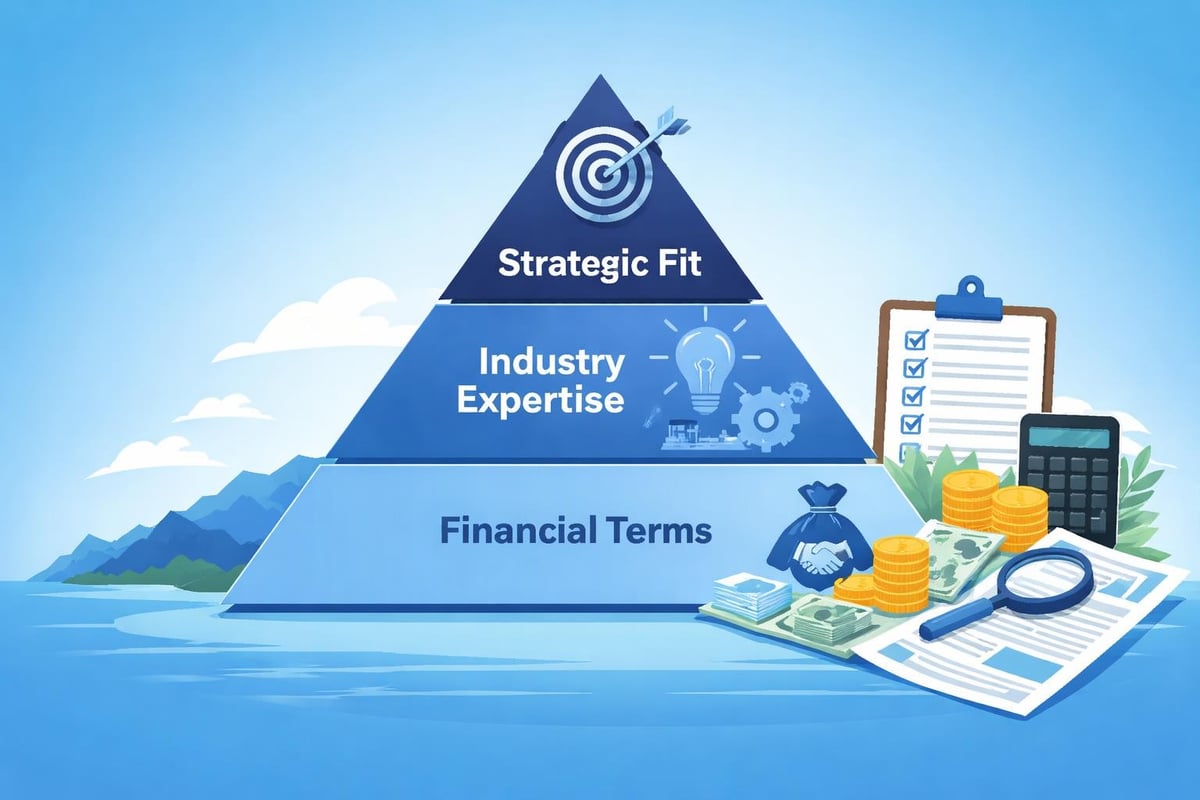
Leading merger and acquisition strategies now begin with strategic fit assessment. This shift recognizes that financial engineering cannot overcome fundamental incompatibilities in business philosophy, organizational culture, or operational approaches.
Key alignment factors include:
- Management philosophy and decision-making styles
- Customer service standards and quality commitments
- Employee treatment and workplace culture
- Technology infrastructure and digital capabilities
- Growth expectations and investment timelines
Companies that prioritize these factors early avoid costly mistakes and increase the probability of successful integration. Unlike the traditional M&A process where sellers broadcast availability broadly, forward-thinking business owners now seek private, confidential connections with compatible buyers who appreciate their company's unique value proposition.
Industry Expertise and Experience
Buyers with deep industry knowledge bring immediate credibility and understanding to acquisition conversations. Research on M&A strategies for midsize businesses emphasizes that relevant experience significantly influences deal success rates.
Industry expertise provides:
- Accurate valuation based on market-specific factors
- Realistic integration planning grounded in operational understanding
- Credible growth strategies leveraging sector trends
- Established relationships with customers, suppliers, and industry stakeholders
Sellers naturally prefer counterparties who understand their business challenges and opportunities without extensive explanation or education.
Deal Size Considerations and Market Segments
The lower middle market-typically defined as companies with enterprise values between $10 million and $250 million-represents a distinct M&A segment with unique characteristics and requirements.
Lower Middle Market Dynamics
This market segment often involves founder-owned businesses where personal legacy considerations matter as much as financial outcomes. Transaction complexity increases when emotional factors intersect with business logic.
| Market Segment | Enterprise Value | Key Characteristics | Strategic Considerations |
|---|---|---|---|
| Small Business | < $10M | Owner-operator focused | Lifestyle and legacy priorities |
| Lower Middle | $10M – $250M | Professional management emerging | Balance of growth and continuity |
| Middle Market | $250M – $1B | Institutional involvement | Sophisticated processes required |
The five types of merger and acquisition strategies apply across all market segments, but implementation approaches differ based on company size and sophistication.
Matching Deal Size to Capabilities
Buyers must honestly assess their capacity to complete and integrate acquisitions within specific size ranges. Overstretching financial or operational capabilities leads to distressed outcomes.
Similarly, sellers benefit from targeting buyers whose transaction experience aligns with their company's scale and complexity. A buyer focused on $100 million acquisitions may lack patience for a $15 million deal's unique requirements.
Due Diligence and Information Management
Comprehensive due diligence protects both parties from unpleasant surprises while building the foundation for successful integration. However, the process creates significant challenges around confidentiality, information organization, and secure data sharing.
Virtual Data Room Solutions
Modern transactions rely heavily on virtual data rooms (VDRs) for secure document sharing and due diligence management. These platforms provide controlled access to sensitive financial records, legal documents, customer contracts, and operational data.
When evaluating top data room providers, consider these essential features:
- Granular permission controls by user and document
- Comprehensive audit trails tracking all access and downloads
- Advanced search functionality across large document collections
- Secure Q&A modules for managing due diligence inquiries
- Mobile access for busy executives reviewing materials remotely
The Aligned IQ VDR offers competitively priced virtual data room services with transparent pricing that makes secure due diligence accessible for lower middle-market transactions. Unlike traditional providers charging premium rates, this solution remains cost-effective while delivering enterprise-grade security.
For companies exploring the Aligned IQ M&A platform, a complimentary free virtual data room becomes available after completing a match, reducing transaction costs for sellers and facilitating smoother information exchange.
Confidentiality and Privacy Protection
Lower middle-market business owners face legitimate concerns about maintaining confidentiality during M&A exploration. News of a potential sale can disrupt employee morale, concern key customers, and alert competitors.
The most effective merger and acquisition strategies therefore include:
- Controlled disclosure limiting information access to serious, qualified buyers
- Non-disclosure agreements signed before sharing sensitive materials
- Anonymous initial discussions protecting seller identity during early exploration
- Private matchmaking platforms avoiding public deal listings
- Secure communication channels preventing information leakage
The proprietary nature of platforms designed specifically for private M&A conversations offers significant advantages over traditional processes where intermediaries broadly market opportunities to numerous potential buyers.
Valuation Approaches for M&A Transactions
Determining fair value represents one of the most challenging aspects of merger and acquisition strategies. Multiple methodologies exist, each offering different perspectives on company worth.
Common Valuation Methods
Market-based approaches compare the target company to similar businesses recently sold, applying relevant multiples to revenue, EBITDA, or other financial metrics. This method works best when comparable transactions exist with transparent terms.
Income-based approaches calculate present value of projected future cash flows. Discounted cash flow analysis requires reliable financial forecasts and appropriate discount rates reflecting business risk.
Asset-based approaches value companies based on net asset value, particularly relevant for asset-intensive businesses or liquidation scenarios.
Understanding valuation for mergers and acquisitions helps both buyers and sellers establish realistic expectations and negotiate more effectively. The gap between seller expectations and buyer offers often stems from different valuation approaches rather than bad faith.
Negotiating Value Gaps
When valuation differences persist despite good-faith analysis, creative deal structures can bridge the gap:
- Earnouts tying portions of purchase price to future performance
- Seller financing demonstrating seller confidence in company trajectory
- Equity rollovers allowing sellers to participate in future growth
- Consulting agreements compensating sellers for transition assistance
These mechanisms align interests and share risk between buyers and sellers while facilitating transactions that might otherwise fail.
Integration Planning and Execution
Even perfectly structured deals fail without thoughtful integration planning. The period immediately following transaction close determines whether anticipated synergies materialize or evaporate.
Pre-Close Integration Preparation
Successful merger and acquisition strategies emphasize integration planning well before deal closure. Waiting until after closing wastes valuable momentum and increases integration risk.
Critical pre-close activities include:
- Establishing integration management teams with clear leadership
- Identifying quick wins demonstrating immediate value
- Developing detailed communication plans for all stakeholder groups
- Mapping systems, processes, and technology integration requirements
- Planning cultural integration activities building unified teams
Day One Readiness ensures basic operational continuity from the moment of closing. Employees need to know their roles, customers require assurance about service continuity, and vendors must understand payment processes.
Post-Close Integration Priorities
The first 100 days after closing set the tone for long-term integration success. Leadership visibility, clear communication, and decisive action all matter tremendously during this critical window.
Priority areas include:
- Cultural integration through joint activities and shared goals
- Systems consolidation eliminating redundant technology costs
- Customer retention maintaining service quality during transition
- Talent retention securing key employees through incentives and engagement
- Financial integration establishing unified reporting and controls
Companies often underestimate the time and resources required for successful integration. Allocating dedicated integration teams and budget ensures the process receives appropriate attention.
Technology's Role in Modern M&A
Digital transformation has fundamentally changed how companies approach merger and acquisition strategies. Technology now influences every phase from initial partner identification through post-close integration.
Digital Platforms for M&A Matchmaking
Traditional M&A processes relied heavily on intermediaries, broad marketing, and extensive networking to identify potential transaction partners. This approach created inefficiencies, confidentiality concerns, and mismatched connections.
Modern platforms now facilitate private, targeted connections between buyers and sellers based on specific criteria including:
- Transaction size preferences and available capital
- Industry expertise and operational experience
- Geographic focus and expansion priorities
- Strategic objectives and growth plans
- Cultural values and business philosophies
The semi-proprietary nature of these platforms protects seller confidentiality while providing qualified buyers access to opportunities matching their acquisition criteria. Unlike public deal listings, private matchmaking preserves optionality for sellers not committed to immediate sale.
Analytics and Market Intelligence
Data analytics increasingly inform merger and acquisition strategies through:
- Market trend analysis identifying consolidation opportunities
- Competitive intelligence revealing potential acquisition targets
- Valuation benchmarking using comparable transaction databases
- Integration prediction models forecasting success probability
- Performance tracking monitoring post-acquisition value creation
Companies leveraging these analytical capabilities make more informed decisions and achieve better outcomes than those relying solely on intuition and traditional methods.
Service Provider Ecosystem and Advisor Roles
Complex M&A transactions require specialized expertise across legal, financial, operational, and strategic domains. Building the right advisor team significantly influences transaction success.
Key M&A Service Providers
Investment bankers and M&A advisors provide valuation guidance, buyer identification, negotiation support, and transaction structuring expertise. They prove particularly valuable for sellers lacking M&A experience.
Legal counsel specializing in M&A protects clients from contractual risks, ensures regulatory compliance, and negotiates favorable terms. Both buyer and seller need independent legal representation.
Accounting and tax advisors structure transactions to optimize tax outcomes and identify financial risks during due diligence. Their expertise often saves multiples of their fees through tax-efficient structuring.
Operational consultants assess integration requirements, identify synergy opportunities, and support post-close execution. They bridge strategic planning and practical implementation.
Engaging and Compensating Advisors
M&A service providers typically work on retained fee structures, success fees contingent on closing, or hybrid arrangements combining both elements. Understanding how M&A strategies apply to small businesses helps companies select appropriately scaled advisor support.
The Aligned IQ M&A platform offers service providers opportunities to earn referral fees for sell-side engagements while showcasing their professional capabilities to platform users. This model aligns advisor incentives with successful client outcomes while expanding their market reach.
Risk Management Throughout the M&A Process
Every acquisition carries inherent risks ranging from valuation errors to integration failures. Sophisticated merger and acquisition strategies incorporate comprehensive risk assessment and mitigation approaches.
Common M&A Risk Categories
| Risk Type | Description | Mitigation Approach |
|---|---|---|
| Financial | Hidden liabilities, revenue decline | Thorough due diligence, representations and warranties |
| Operational | Integration complexity, system incompatibility | Detailed integration planning, phased approach |
| Cultural | Leadership conflicts, employee turnover | Cultural assessment, retention programs |
| Market | Industry disruption, competitive response | Strategic analysis, contingency planning |
| Legal | Regulatory issues, contract violations | Comprehensive legal review, regulatory clearance |
Quality of earnings analysis provides deeper financial understanding than standard accounting statements, identifying non-recurring items, aggressive accounting practices, and revenue sustainability concerns.
Protecting Against Downside Scenarios
Representations and warranties insurance has become increasingly common in lower middle-market transactions, transferring certain risks from sellers to insurance carriers. This innovation facilitates cleaner exits for sellers while protecting buyers against unknown liabilities.
Escrow arrangements hold portions of purchase price for specified periods, providing security against post-close adjustments or breached representations. Typical escrows range from 10% to 20% of purchase price held for 12 to 24 months.
Effective merger and acquisition strategies combine thorough preparation, strategic alignment, and disciplined execution across every transaction phase. Success requires matching the right buyers with the right sellers based on compatible objectives, adequate resources, and shared vision for the combined entity's future. Aligned IQ transforms traditional M&A processes by prioritizing strategic fit from initial connection through deal completion, offering both a proprietary matchmaking platform for confidential buyer-seller connections and competitively priced virtual data room solutions that streamline secure due diligence. Take a tour today to discover how our platform helps buyers, sellers, and service providers achieve their M&A goals through better-matched partnerships and streamlined transaction processes.
No responses yet