

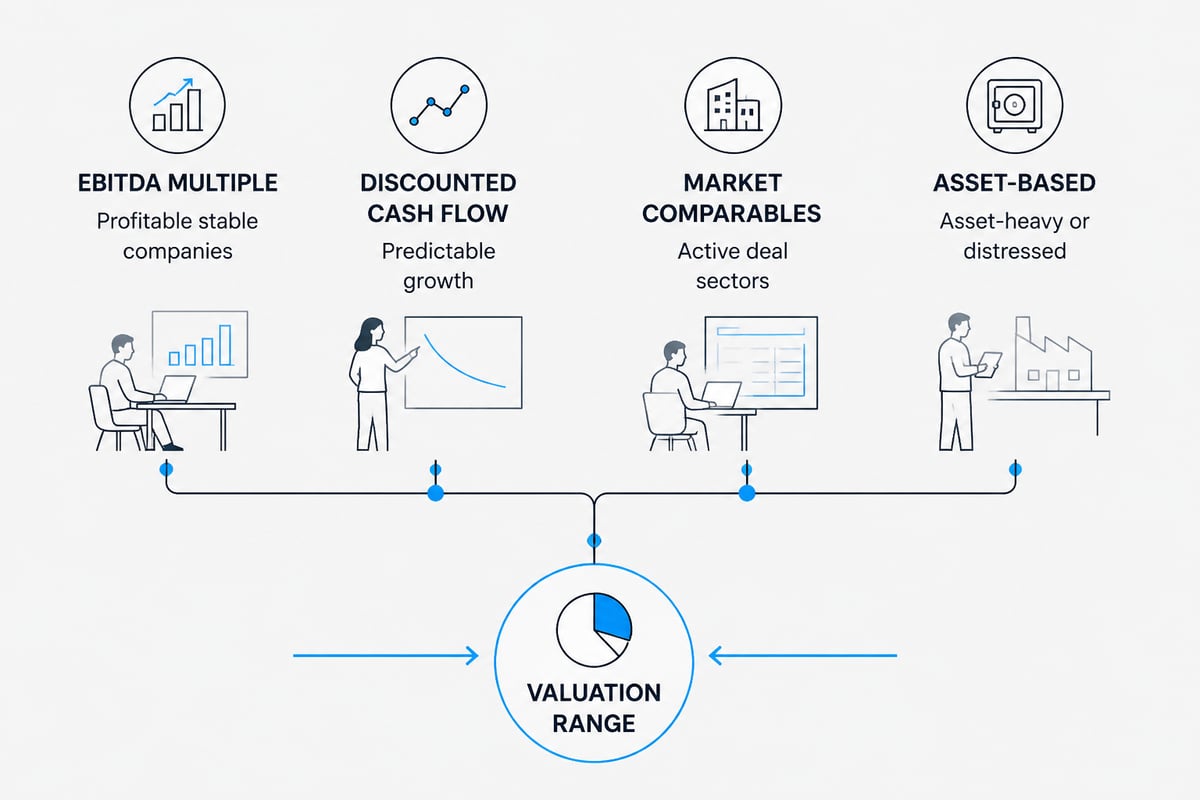
To calculate business valuation for an M&A deal, start with normalized earnings (usually EBITDA), apply a multiple drawn from comparable transactions, and cross-check the result with a discounted cash flow model and an asset-based floor. No single formula produces the price; the defensible number is the range where several methods overlap.
That range matters to both sides of the table. Sellers who understand it set realistic expectations and protect their negotiating position. Buyers who understand it avoid overpaying for earnings that will not repeat. This guide walks through the inputs, the four core methods, the adjustments that move the number, and how strategic fit shapes the final price. Deal activity gives the work real stakes: Bain estimated global M&A deal value at US$4.8 trillion for 2025, a sharp increase from 2024 and the second-highest annual total on record.
What Is the Purpose of Valuation in an M&A Deal?
The purpose of valuation in an M&A deal is to establish a supportable price range that both a buyer and a seller can defend, so negotiation starts from evidence rather than opinion.
For a seller, a valuation anchors the asking price, reveals which operational weaknesses are costing value, and supports exit planning well before a sale process begins. For a buyer, it tests whether the purchase price can be recovered through the target's cash flows and whether the deal meets return thresholds. Lenders, investors and advisors also rely on it to size financing and structure terms.
A valuation also differs from a price. Value is an estimate of what a business is worth under stated assumptions. Price is what a specific buyer agrees to pay, and it reflects synergies, competition and timing. Keeping the two separate prevents the common error of treating a calculator output as a final offer.
What You Need Before You Start
Reliable valuation depends on clean inputs, so gather these before running any model:
- Three to five years of financial statements: income statements, balance sheets and cash flow statements, ideally reviewed or audited.
- Tax returns: these help reconcile reported income with the books.
- A current year-to-date and trailing twelve-month view: buyers weight recent performance heavily.
- Customer and revenue detail: concentration, retention, contract terms and recurring versus one-time revenue.
- Owner compensation and personal expenses run through the business: needed for normalization.
- A forward budget or forecast: necessary for discounted cash flow work.
- A list of assets and liabilities: including equipment, real estate, debt and any off-balance-sheet obligations.
If you want a starting benchmark before assembling all of this, an online business valuation can give owners an initial range to refine later.
Step 1: Normalize Earnings to Find What a Buyer Will Actually Pay For
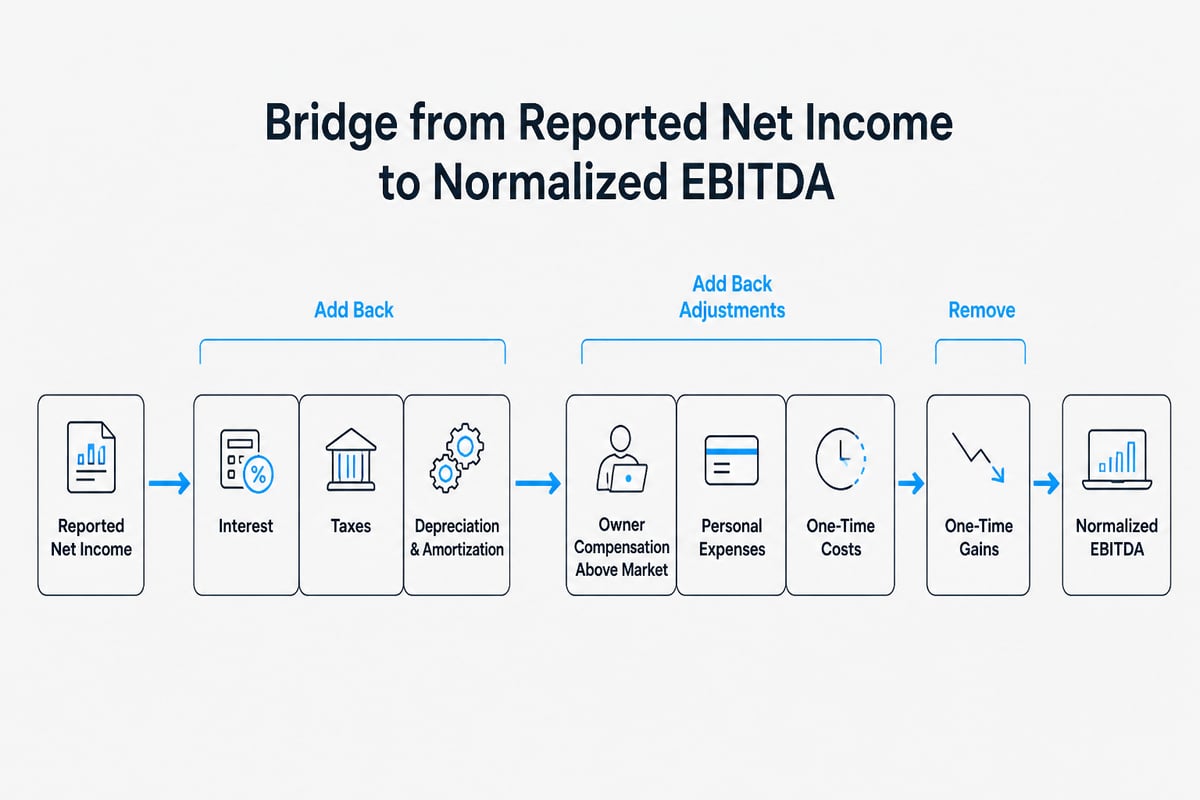
The first step is to restate reported profit as normalized EBITDA, which strips out costs and income a new owner would not inherit.
Reported net income rarely reflects the true earning power of a private company. Owners often pay themselves above or below market, run personal expenses through the business, or book one-time items that distort a single year. Common adjustments include:
- Add back owner compensation above a market-rate replacement salary, and subtract the shortfall if the owner is underpaid.
- Add back personal expenses, such as vehicles, travel or family payroll for roles that do not exist in practice.
- Remove one-time costs, such as a lawsuit settlement, a major relocation or an unusual repair.
- Remove one-time gains, such as an asset sale or a pandemic-era subsidy.
- Adjust related-party rent or services to market rates.
Document every adjustment with supporting records. Buyers and their advisors will test each one in due diligence, and an unsupported add-back weakens credibility on the others. Sellers sometimes assume that higher profit alone raises value, but increasing profit does not always increase the value of a business if the earnings are not durable or transferable.
Step 2: Apply an Earnings Multiple (EBITDA or SDE)
The most common way to calculate business valuation in lower middle-market deals is to multiply normalized earnings by a multiple supported by similar transactions.
Enterprise value equals normalized EBITDA multiplied by a market multiple. For very small businesses where the owner works in the operation, buyers often use seller's discretionary earnings (SDE) instead, which adds one owner's total compensation back to earnings.
Hypothetical example: a company with $2,000,000 in normalized EBITDA and an applicable multiple of 5.0x would have an indicated enterprise value of $10,000,000. The same company at 6.0x would indicate $12,000,000. The multiple is where most of the debate happens.
What multiplier should you use?
Choose a multiplier by looking at what comparable businesses have sold for, then adjust for the target's size, growth, margins and risk. Published benchmarks give useful context. Capstone Partners reported that average middle-market M&A valuations have risen in recent years, according to its Middle Market M&A Valuations Index. That figure reflects larger middle-market transactions. Smaller private companies generally trade at lower multiples, so applying a headline average to a business with $1 million to $5 million in EBITDA overstates value.
Factors that push a multiple higher or lower:
| Factor | Supports a higher multiple | Supports a lower multiple |
|---|---|---|
| Revenue quality | Recurring contracts, high retention | One-time or project-based sales |
| Customer base | Diversified, no client above 10% | One or two clients drive most revenue |
| Owner dependence | Management team runs operations | Owner holds key relationships |
| Growth | Consistent, documented growth | Flat or declining trend |
| Margins | Stable or expanding | Compressing or volatile |
| Size | Larger EBITDA base | Smaller, less diversified base |
For a deeper look at how this method works in practice, see this overview of EBITDA business valuation.
Step 3: Cross-Check With a Discounted Cash Flow Model
A discounted cash flow (DCF) model values a business by projecting its future free cash flows and discounting them to present value at a rate that reflects risk.
The method suits companies with predictable growth or a clear forecast, and buyers use it to test whether an earnings-multiple price can be justified by future cash generation. The core inputs are:
- Projected free cash flow for a explicit forecast period, commonly five years.
- Discount rate, often a weighted average cost of capital (WACC), which blends the cost of debt and equity. Small private companies carry higher discount rates than large public ones because of size and liquidity risk.
- Terminal value, which captures the business's value beyond the forecast period, typically through a perpetual growth rate or an exit multiple.
Free cash flow equals operating profit after tax, plus depreciation and amortization, minus capital expenditures and increases in working capital. Each line deserves scrutiny, because small changes in the discount rate or terminal growth assumption can swing the result by a wide margin. Run at least three scenarios (base, upside and downside) and present the DCF as a range, not a single figure.
Step 4: Benchmark Against Market Comparables
The market approach calculates value by studying what buyers paid for similar companies, which makes it the method closest to how deals actually price.
Gather transaction data on businesses of similar size, industry and geography. Sources include private deal databases, advisor networks and published industry reports. Compare multiples of revenue, EBITDA or SDE, then adjust for differences in growth, margin and risk. Good comparables are scarce for private companies, so treat the result as a reference band, not a precise answer.
The market approach also exposes a limit in buyer pools. A single buyer's offer reflects that buyer's synergies and alternatives, so approaching several qualified counterparties tends to reveal true market value. Owners weighing this decision can read about how many potential buyers to approach during a sale.

Step 5: Establish a Floor With the Asset-Based Method
The asset-based valuation model calculates a company's worth as total assets minus total liabilities, adjusted to fair market value.
You can run it two ways. Under a going-concern basis, assets and liabilities are restated to fair market value, including equipment, inventory, real estate and identifiable intangibles. Under a liquidation basis, you estimate what remains if assets were sold quickly and debts paid.
This approach fits asset-heavy businesses, holding companies and distressed situations. For most profitable operating companies it produces a number below the earnings-based value, because it ignores goodwill (the premium a buyer pays for reputation, customer relationships and future earning power). Use it as a floor. If an earnings-based value falls below the asset value, the business may be worth more broken up than operated.
Step 6: Adjust for Risk, Transferability and Deal Structure
After the math, a final layer of adjustments reflects how easily the business can change hands and how risky its earnings are.
Buyers discount for characteristics that threaten continuity after closing. Typical drivers include:
- Owner dependence: if customers, suppliers or key know-how sit with the founder, buyers price in the risk of transition. Documented processes and a capable second layer of management reduce that discount. This is why putting the right systems in place can raise value.
- Customer concentration: a single large account creates fragility.
- Working capital: deals usually include a target level of working capital, and shortfalls reduce proceeds dollar for dollar.
- Debt and debt-like items: enterprise value converts to equity value after subtracting debt and similar obligations.
- Deal structure: earn-outs, seller notes and rollover equity change the effective price. A higher headline number with deferred, contingent payments can be worth less than a lower, cash-heavy offer.
Strategic fit matters here too. A buyer that gains cost savings, new customers or a capability it would otherwise build can justify paying more than a financial buyer, because synergies increase what the business is worth to them specifically.
How Strategic Fit Changes the Number
Strategic fit changes valuation because the same company is worth different amounts to buyers with different goals, so the best price usually comes from the best-matched counterparty.
In a traditional M&A process, sellers often hand financials to many parties before knowing whether goals align, which increases confidentiality risk and wastes time on poor matches. A more focused approach prioritizes alignment on transaction priorities, deal size and industry experience first, then moves into detailed numbers.
That is the logic behind Aligned IQ M&A, the private matchmaking platform where buyers and sellers meet to explore potential deals. Strategy comes before the deal, so both sides agree on goals first, and valuation support and exit planning sit in the same place. For sellers, a typical scenario is an owner who wants to understand a realistic range privately before any buyer sees company data, which lowers risk and protects confidentiality compared with a broad outreach process. For buyers, the platform offers a semi-proprietary stage to present themselves as an attractive exit option and to source and evaluate businesses that fit their criteria, such as through the Buyer-side acquisition platform.
Document sharing is a separate product. Aligned IQ VDR is a virtual data room for sharing deal documents securely, and it is complimentary for Aligned IQ M&A sellers once a match is completed.
How Do You Assess How Much a Business Is Worth?
You assess how much a business is worth by blending methods: normalize earnings, apply a market-supported multiple, test it against a DCF, and confirm it against asset value.
A practical sequence looks like this:
- Normalize EBITDA or SDE and document each adjustment.
- Select a multiple range from comparable transactions and adjust for size and risk.
- Build a three-scenario DCF to test the earnings-based range.
- Calculate asset value as a floor.
- Adjust for debt, working capital, owner dependence and structure.
- Present a range, then refine as buyers respond.
If the stakes justify it, a professional business valuation provides an independent opinion that carries weight with buyers, lenders and advisors. For a closer look at the arithmetic, this page on calculating business valuation is a useful companion, and a methods overview compares the asset, market, DCF and EBITDA-multiple approaches for small and mid-market companies.
Common Mistakes When Valuing a Business for Sale
Most valuation errors come from inputs and assumptions rather than arithmetic.
- Using a headline multiple on a small company. Averages from larger deals overstate value for smaller firms.
- Unsupported add-backs. Aggressive normalization invites distrust and re-pricing during diligence.
- Ignoring owner dependence. A business that cannot operate without its founder is worth less to most buyers.
- Relying on one method. A single approach hides weaknesses that a second or third method would expose.
- Confusing value with price. Buyer-specific synergies and competitive tension move the final number.
- Overlooking working capital and debt. Enterprise value is not the same as cash at closing.
- Valuing too late. Owners who calculate value shortly before a sale have little time to fix issues that depress it. Reading about common valuation myths early can prevent costly assumptions.
FAQ
What is the asset-based valuation model?
The asset-based valuation model values a company as the fair market value of its assets minus its liabilities. It works best for asset-heavy or distressed businesses and usually sets a floor, since it ignores goodwill and future earnings.
How accurate is a business valuation?
A valuation is an informed estimate, not an exact figure, and it depends on the quality of financial records and the assumptions chosen. Expect a range, and expect that real buyers will move the final price based on their own synergies, financing and risk views.
How often should a business owner update a valuation?
Updating annually is a reasonable cadence for owners planning an eventual exit, and again before any sale process begins. Regular updates show how operational changes, such as reduced owner dependence or stronger recurring revenue, affect value over time.
Your next step is to gather three years of financials and calculate normalized EBITDA, because every method above starts there. Once you have a defensible range, Aligned IQ M&A can help you test it against strategically aligned counterparties in a private, low-risk setting, with exit planning and valuation support in one place. Take a Tour of the platform to see how matching works, or contact Aligned IQ to discuss your goals and get started.
No responses yet