

Understanding EBITDA valuation is essential for anyone involved in mergers and acquisitions, whether you're a business owner preparing for an eventual exit, a strategic buyer searching for acquisition targets, or an M&A advisor facilitating transactions. This valuation methodology has become the industry standard for middle-market deals because it provides a normalized view of operating performance that transcends differences in capital structure, tax jurisdictions, and depreciation policies. When buyers and sellers evaluate potential deals, EBITDA-based multiples offer a common language that facilitates negotiation and helps both parties assess whether a transaction makes strategic and financial sense. For owners exploring their exit options and buyers showcasing themselves as attractive partners, mastering ebitda valuation fundamentals ensures more productive conversations and better-aligned expectations from the first meeting through closing.
What Is EBITDA Valuation and Why It Matters
EBITDA valuation refers to the process of estimating a company's enterprise value using its Earnings Before Interest, Taxes, Depreciation, and Amortization as the primary metric. The most common approach applies an industry-specific multiple to the target company's EBITDA to arrive at an enterprise value (EV). This methodology has gained widespread acceptance because EBITDA approximates cash flow from operations before financing decisions and accounting conventions.
The formula is straightforward: Enterprise Value = EBITDA × Multiple. The multiple itself varies dramatically based on industry, company size, growth rate, competitive positioning, and prevailing market conditions. Market-based multiples and the EV/EBITDA approach have become central to valuation practice because they reflect what actual buyers are willing to pay in real transactions.
Why Buyers and Sellers Prefer EBITDA Metrics
Several factors explain EBITDA's dominance in M&A valuations:
- Capital structure neutrality: EBITDA excludes interest expense, allowing comparison of companies with different debt levels
- Tax normalization: By removing taxes, EBITDA enables apples-to-apples comparisons across different jurisdictions
- Asset-base independence: Depreciation and amortization reflect historical investment decisions and accounting choices rather than current operating performance
- Cash flow proxy: EBITDA approximates operating cash generation before working capital changes
For business owners considering an eventual sale, understanding how potential acquirers will evaluate your company through an EBITDA lens helps you optimize operations and financial reporting well before initiating a formal process. Strategic buyers often prioritize businesses that demonstrate consistent EBITDA growth and margins that meet or exceed industry benchmarks.
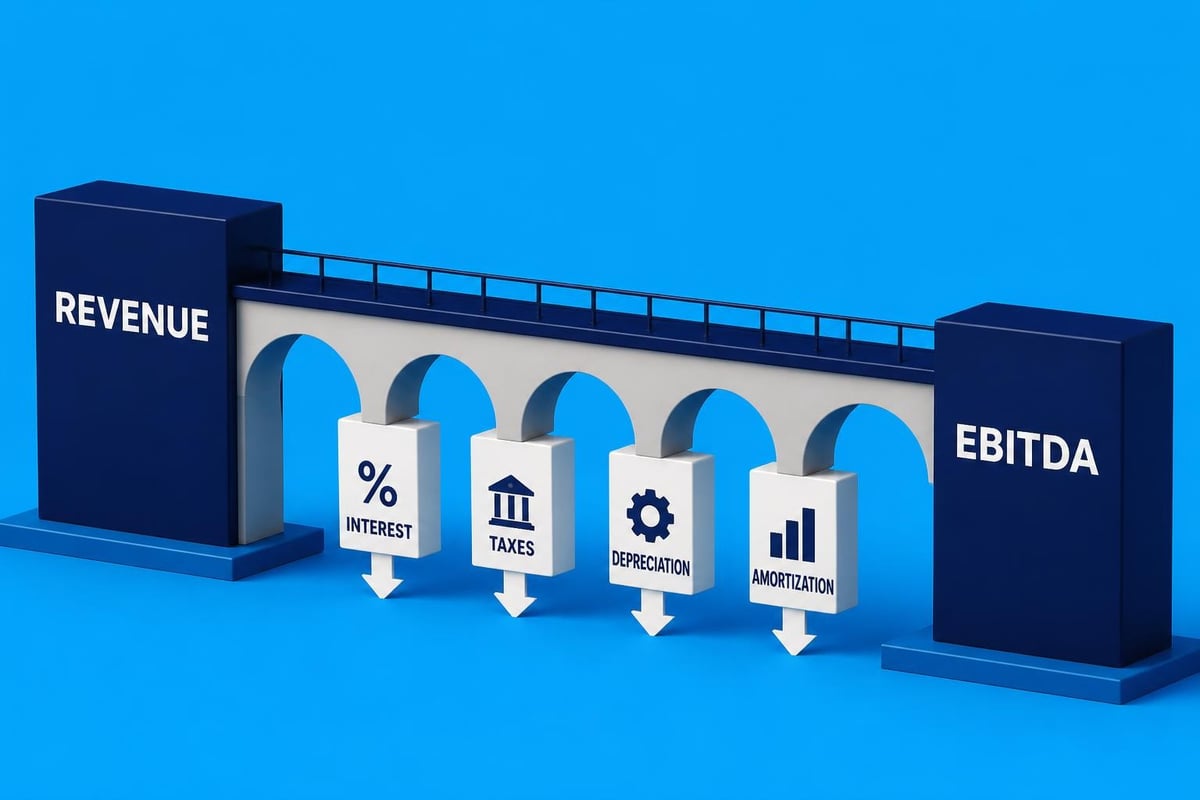
Calculating EBITDA and Enterprise Value Multiples
Before applying multiples, you need an accurate EBITDA figure. Start with net income from your income statement, then add back interest expense, income tax expense, depreciation, and amortization. Many practitioners also calculate "Adjusted EBITDA" by normalizing for one-time expenses, owner compensation above market rates, and other non-recurring items.
The step-by-step calculation process and worked examples demonstrate how to move from reported financials to a normalized EBITDA that reflects sustainable operating performance. This adjustment process is particularly important in owner-operated businesses where personal expenses may flow through the company or where compensation structures don't reflect market rates.
Building Your Valuation Model
A comprehensive ebitda valuation model follows these steps:
- Calculate trailing twelve months (TTM) EBITDA from the most recent financial statements
- Normalize EBITDA by adjusting for non-recurring items and owner discretionary expenses
- Research comparable transactions to identify relevant EV/EBITDA multiples in your industry
- Select appropriate multiples based on your company's size, growth, and competitive position
- Apply the multiple to normalized EBITDA to estimate enterprise value
- Adjust for net debt by subtracting interest-bearing debt and adding cash to arrive at equity value
The quality of your comparable transaction data significantly impacts valuation accuracy. Aswath Damodaran’s industry datasets provide regularly updated EV/EBITDA multiples by sector, offering a reliable starting point for benchmarking.
| EBITDA Component | Typical Adjustments | Impact on Valuation |
|---|---|---|
| Owner Compensation | Normalize to market rate | Increases EBITDA if owner overpaid |
| One-Time Legal Fees | Add back non-recurring costs | Increases normalized EBITDA |
| Related Party Rent | Adjust to fair market value | May increase or decrease EBITDA |
| Stock-Based Compensation | Often excluded in middle market | Increases EBITDA |
Industry-Specific Multiples and Benchmarking
EBITDA multiples vary dramatically across industries, reflecting differences in growth prospects, capital intensity, competitive dynamics, and risk profiles. Software-as-a-service companies frequently command multiples of 10-15×, while traditional manufacturing businesses might trade at 4-6× EBITDA. Understanding where your business falls within the industry spectrum is crucial for setting realistic expectations.
Professional services firms typically see lower multiples (3-5×) due to revenue concentration and key-person dependencies. Healthcare and specialized industrial businesses often achieve premium valuations when they demonstrate recurring revenue streams and defensible market positions. Sector-specific M&A research and benchmark multiples reveal how transaction dynamics shift based on industry trends and consolidation activity.
Factors That Drive Multiple Expansion
Beyond industry classification, several company-specific factors influence where your business falls within the valuation range:
- Revenue growth rate: Companies growing 20%+ annually often command premium multiples
- Customer concentration: Diversified customer bases reduce risk and support higher valuations
- Recurring revenue: Subscription models and long-term contracts justify higher multiples
- Market position: Leading players in fragmented markets attract strategic premiums
- Management depth: Professional management teams independent of owners increase value
In a typical scenario, a distribution company with $5 million in normalized EBITDA might receive offers ranging from 4× ($20 million) to 6× ($30 million) depending on these qualitative factors. A business with 80% revenue from one customer would likely fall at the low end, while a company with 200+ customers and recurring contracts might achieve the high end or better.
Limitations and Criticisms of EBITDA Valuation
Despite its widespread use, ebitda valuation has significant limitations that sophisticated buyers and sellers must acknowledge. EBITDA ignores capital expenditure requirements, which can be substantial in asset-intensive industries. A company requiring constant equipment replacement to maintain operations generates less true cash flow than EBITDA suggests.
Working capital needs also disappear from EBITDA-based valuations. High-growth companies often consume cash to fund inventory and receivables, reducing the cash available to owners despite strong EBITDA. The critical perspective on EBITDA’s limitations highlights why some analysts prefer Economic Value Added (EVA) or free cash flow metrics that capture these dynamics.
When EBITDA Multiples Mislead
Certain business characteristics make EBITDA an unreliable valuation foundation:
- Heavy capital expenditure requirements that exceed depreciation
- Significant working capital swings tied to seasonal or growth patterns
- Long-term contracts with deferred revenue recognition
- Pension obligations or other off-balance-sheet liabilities
The practical tutorial on EV/EBITDA calculations emphasizes supplementing multiples analysis with discounted cash flow models and asset-based approaches for businesses with these characteristics. Smart buyers always look beyond the EBITDA multiple to understand the complete financial picture.

Enhancing Your EBITDA Before a Transaction
Business owners planning an eventual exit should focus on optimizing EBITDA at least 24-36 months before engaging potential buyers. This preparation significantly impacts both the multiple you command and the absolute EBITDA figure to which it applies. Working with a business valuation specialist early in the process helps identify the highest-impact improvements.
Cost structure optimization often yields immediate results. Analyzing vendor contracts, eliminating redundant software subscriptions, and renegotiating insurance policies can add tens or hundreds of thousands to EBITDA without operational disruption. Revenue enhancement strategies take longer but can fundamentally transform your valuation. Adding recurring revenue streams, reducing customer concentration, and expanding into adjacent markets all support higher multiples.
Pre-Transaction EBITDA Optimization Checklist
| Focus Area | Action Items | Timeline |
|---|---|---|
| Revenue Quality | Shift to subscription models; diversify customer base | 24-36 months |
| Cost Structure | Renegotiate vendor contracts; eliminate discretionary spending | 6-12 months |
| Financial Reporting | Implement accrual accounting; document add-backs | 12-18 months |
| Systems & Processes | Document procedures; reduce key-person dependencies | 18-24 months |
Clean financial reporting becomes increasingly important as you approach a transaction. Buyers scrutinize EBITDA calculations intensely during due diligence, challenging every adjustment and add-back. Companies with clear documentation, consistent accounting policies, and audited or reviewed financials face fewer purchase price adjustments and smoother closing processes.
Strategic Fit and Valuation in Modern M&A
While EBITDA multiples provide a quantitative framework, strategic fit increasingly drives premium valuations in today's M&A market. Buyers pay above-market multiples when an acquisition delivers capabilities they cannot build internally, accelerates growth plans, or creates meaningful synergies. The traditional M&A process often obscures strategic fit behind confidentiality agreements and intermediary-managed processes.
Platforms that prioritize strategic alignment before diving into financial details help both parties assess whether a premium valuation makes sense. When buyers can showcase their industry expertise, operational capabilities, and cultural fit early in the process, sellers gain confidence that a partner can execute on synergies that justify higher multiples. This transparency benefits all parties by focusing energy on matches with genuine value-creation potential.
How Strategic Buyers Justify Premium Multiples
Strategic acquirers can often pay multiples significantly above financial sponsor benchmarks because they capture synergies that create additional value. Common sources of strategic premium include:
- Revenue synergies: Cross-selling opportunities and market expansion
- Cost synergies: Eliminating redundant functions and leveraging scale
- Technology acquisition: Buying capabilities faster than internal development
- Market position: Consolidating fragmented industries to create market leaders
The investor-facing primer on EV/EBITDA explains how public market investors evaluate these factors, principles that equally apply in private company transactions. Sellers who understand a buyer's strategic rationale can structure transactions that unlock maximum value for both parties.

The Role of Due Diligence in Validating EBITDA
No matter how attractive the initial EBITDA multiple appears, sophisticated buyers conduct exhaustive due diligence to validate the numbers and identify risks that might justify purchase price adjustments. Financial due diligence focuses intensely on EBITDA quality, scrutinizing revenue recognition policies, customer retention rates, supplier dependencies, and the sustainability of margins.
Quality of earnings (QofE) reports prepared by independent accounting firms dissect EBITDA adjustments, identifying which add-backs truly represent non-recurring expenses versus ongoing costs that sellers inappropriately excluded. These reports often become the basis for negotiating final purchase price and working capital targets. Sellers who anticipate this scrutiny and maintain conservative EBITDA calculations face fewer surprises and smoother negotiations.
Virtual data rooms streamline the due diligence process by organizing financial records, customer contracts, employee agreements, and operational documentation in a secure, accessible environment. The confidential nature of M&A demands robust security protocols that protect sensitive information while allowing buyers to conduct thorough analysis. Aligned IQ VDR provides lower middle-market participants with enterprise-grade security at competitive pricing, making professional-quality due diligence accessible to businesses of all sizes.
Documents Buyers Examine When Validating EBITDA
- Three years of financial statements (monthly detail preferred)
- Tax returns for the same period
- General ledger detail for all EBITDA adjustments
- Customer contracts and concentration analysis
- Vendor agreements and pricing terms
- Employee compensation details and benefit costs
- Capital expenditure history and future requirements
Negotiating Purchase Price Beyond the Multiple
While the EBITDA multiple establishes a baseline enterprise value, final purchase price reflects numerous other factors negotiated between parties. Earnouts tie a portion of consideration to future performance, allowing sellers to capture upside if the business exceeds projections. These structures help bridge valuation gaps when buyers and sellers have different growth expectations.
Working capital adjustments ensure sellers deliver adequate current assets to operate the business post-closing. The working capital "peg" typically equals normalized levels based on historical operating patterns. Excess cash generally flows to sellers, while debt is usually subtracted from the enterprise value to arrive at equity value. Understanding these mechanics prevents surprise deductions at closing.
In a typical scenario, a manufacturing business might be valued at $25 million (5× EBITDA of $5 million). The seller carries $3 million in debt and maintains $1 million in working capital. The preliminary equity value would be $23 million ($25M enterprise value less $3M debt plus $1M working capital if it exceeds the peg). Additional adjustments for excess cash, deferred revenue, or contingent liabilities would further modify the final number.
Common Purchase Price Adjustments
| Adjustment Type | Impact on Seller Proceeds | Typical Resolution |
|---|---|---|
| Debt Payoff | Reduces equity value dollar-for-dollar | Paid at closing from proceeds |
| Excess Cash | Increases equity value dollar-for-dollar | Retained by seller |
| Working Capital Shortfall | Reduces equity value | Indemnity or escrow holdback |
| Earnout Payments | Deferred consideration | Performance targets over 1-3 years |
Matching Buyers and Sellers in the Modern Market
The traditional M&A process often forces business owners to choose between complete confidentiality and broad market exposure. Listing with an intermediary who shops your business widely risks damaging relationships with employees, customers, and suppliers if word leaks. Yet limiting outreach to a small group of known contacts may mean missing the perfect strategic buyer who would pay a premium multiple.
Modern M&A platforms address this challenge by enabling confidential, proprietary connections based on strategic fit criteria before either party discloses sensitive financial details. Business owners seeking to eventually sell can explore potential matches based on industry expertise, transaction size parameters, and strategic priorities without immediately entering a formal sale process. This low-risk approach lets sellers evaluate their options while maintaining complete confidentiality.
For buyers, these platforms provide a stage to showcase operational capabilities, industry experience, and cultural attributes that make them attractive partners for business owners. Rather than competing in broad auctions focused purely on price, strategic acquirers can demonstrate why their specific expertise and resources justify premium valuations through synergy realization. This collaborative approach to M&A transforms the process from adversarial negotiation to partnership formation.
Benefits of Strategic-Fit-First Match-Making
The proprietary nature of these platforms creates advantages for all participants:
- Sellers: Explore exit options confidentially without market exposure or formal auction pressure
- Buyers: Differentiate based on strategic value rather than competing purely on price
- Service Providers: Connect clients with qualified counterparties and showcase professional expertise
After initial matches establish mutual interest based on strategic alignment, parties can move into detailed financial discussions with confidence that the relationship has genuine value-creation potential. The secure, confidential environment protects both sides while enabling productive conversations about EBITDA, multiples, synergies, and transaction structure.
Preparing Financial Documentation for Buyer Review
Once a seller decides to share detailed financials with a matched buyer, the quality and organization of documentation significantly impacts valuation discussions. Buyers expect to see three years of historical financials with sufficient detail to validate EBITDA calculations and understand trends. Monthly income statements reveal seasonality and margin patterns that annual summaries obscure.
EBITDA reconciliation schedules should clearly document every adjustment, with supporting evidence for each add-back. Owner compensation above market rates requires benchmarking data. One-time legal fees need invoices and explanation. Related-party transactions demand arms-length pricing justification. The more transparent and well-documented your adjustments, the less buyers will discount your normalized EBITDA.
Customer concentration analysis proves particularly important because it directly impacts the multiple buyers will pay. A schedule showing revenue by customer for three years, with retention rates and contract terms, helps buyers assess risk and justify their valuation. Similarly, vendor concentration analysis and key employee documentation demonstrate operational resilience.
Essential Financial Schedules for Due Diligence
- Monthly income statements (36-month history)
- Revenue by customer with retention analysis
- EBITDA reconciliation with supporting documentation
- Capital expenditure history and future requirements
- Working capital analysis showing seasonal peaks and normalized levels
- Debt schedule with maturity dates and covenant compliance
- Tax return reconciliation to financial statements
EBITDA valuation remains the dominant methodology for middle-market M&A transactions because it provides a standardized framework that facilitates productive discussions between buyers and sellers with different perspectives and priorities. Understanding how to calculate, benchmark, and optimize your EBITDA positions you for better outcomes whether you're preparing for an eventual exit or evaluating acquisition opportunities. Aligned IQ transforms traditional M&A by prioritizing strategic fit before financial details, enabling confidential matches based on transaction priorities, deal size, and industry expertise that help all parties find the perfect counterparty to meet their goals. Take a tour to discover how our platform creates collaborative partnerships that maximize value for buyers, sellers, and M&A service providers.
No responses yet