

Diversification in mergers and acquisitions represents one of the most strategic approaches companies use to expand their market presence, reduce risk exposure, and unlock new revenue streams. As businesses navigate an increasingly competitive landscape in 2026, the decision to pursue diversification through M&A requires careful consideration of strategic fit, financial capabilities, and long-term growth objectives. Understanding the fundamentals of this approach enables business owners, buyers, and M&A professionals to make informed decisions that align with their organizational goals while mitigating the inherent risks associated with expansion.
Understanding Diversification Through M&A
Diversification in mergers and acquisitions occurs when a company acquires or merges with another business operating in a different industry, market segment, or geographic region. This strategy differs fundamentally from horizontal or vertical integration, where companies combine with competitors or supply chain partners.
The primary motivations behind diversification strategies include revenue stream expansion, market volatility reduction, and competitive positioning enhancement. Companies pursuing this path typically seek to balance their portfolio by entering industries with different economic cycles or customer bases.
Types of Diversification Strategies
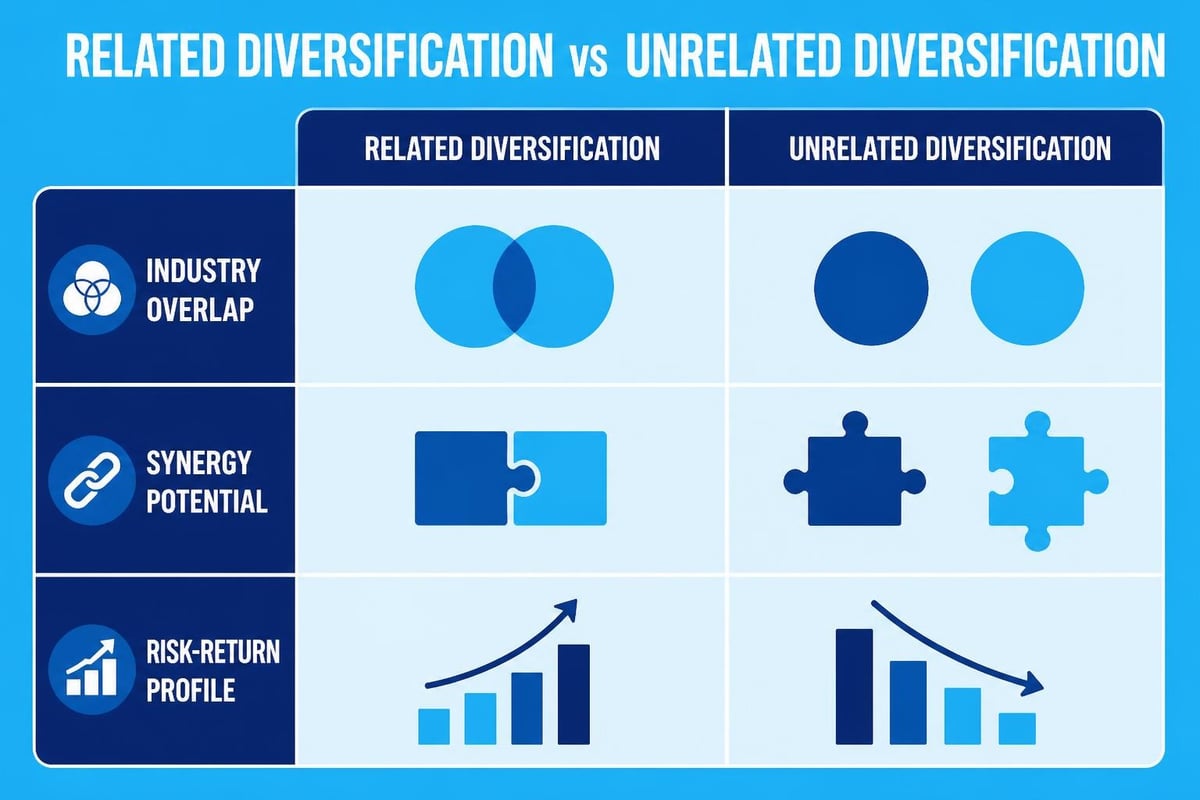
Related diversification involves acquiring companies that share some commonalities with the existing business, such as similar technologies, distribution channels, or customer segments. A typical scenario might involve a manufacturing company acquiring a complementary products business that serves the same customer base but offers different solutions.
Unrelated diversification pursues opportunities in completely different industries with minimal operational overlap. Corporate diversification strategy encompasses various approaches including conglomerate formation, where companies build portfolios across multiple unrelated sectors.
The choice between related and unrelated diversification significantly impacts integration complexity, synergy realization, and ultimate success probability. Research indicates that related diversification typically delivers higher success rates due to transferable competencies and market knowledge.
Strategic Rationale for Diversification in Mergers and Acquisitions
Business leaders pursue diversification in mergers and acquisitions for several compelling reasons. Risk mitigation stands as the foremost driver, particularly for companies heavily dependent on cyclical industries or concentrated customer bases.
Risk Reduction and Portfolio Balance
Diversifying across multiple industries or markets creates a buffer against sector-specific downturns. When one business unit experiences declining performance, others may maintain stability or growth, smoothing overall corporate performance.
| Diversification Benefit | Impact on Business | Risk Mitigation Level |
|---|---|---|
| Revenue Stream Expansion | Multiple income sources reduce dependency | High |
| Market Cycle Protection | Different industries peak at different times | Medium-High |
| Geographic Expansion | Reduces regional economic exposure | Medium |
| Customer Base Broadening | Decreases client concentration risk | High |
Historical evidence demonstrates that diversification via acquisition can create substantial economic value when executed strategically. The key lies in identifying opportunities where the acquiring company brings genuine capabilities that enhance the target's performance.
Growth Acceleration and Market Access
Diversification enables rapid entry into markets that would require years to penetrate organically. This acceleration proves particularly valuable when market timing is critical or when established competitors create high barriers to entry.
Companies leveraging deal sourcing platforms gain access to pre-qualified opportunities across diverse industries, streamlining the identification process for potential diversification targets. These platforms facilitate connections between buyers seeking expansion and sellers evaluating exit options.
Challenges and Risks in Diversification Strategies
While diversification in mergers and acquisitions offers substantial benefits, it introduces significant challenges that require careful management. Understanding these obstacles helps acquirers prepare appropriate mitigation strategies.
Integration Complexity
Combining businesses from different industries creates operational, cultural, and strategic alignment challenges. Management teams must navigate unfamiliar business models, industry dynamics, and competitive landscapes.
- Cultural misalignment between organizations with different industry norms
- Operational incompatibility requiring separate management structures
- Knowledge gaps limiting synergy realization
- Resource allocation conflicts between legacy and acquired businesses
The integration burden intensifies when diversifying into unrelated industries. Companies may struggle to transfer best practices or realize operational synergies when business models fundamentally differ.
Management Attention and Resource Dilution
Diversification stretches management capabilities across multiple domains. Executives must develop expertise in unfamiliar markets while maintaining performance in core operations. This division of focus can undermine competitive positioning in both legacy and acquired businesses.
Platform acquisition strategies employed by private equity firms demonstrate how specialized management teams can effectively oversee diversified portfolios by bringing industry-specific expertise to each platform company.

Evaluating Diversification Opportunities
Successful diversification in mergers and acquisitions begins with rigorous opportunity evaluation. Buyers must assess potential targets across multiple dimensions to ensure strategic alignment and value creation potential.
Strategic Fit Assessment
Strategic fit evaluation examines how well a potential acquisition aligns with corporate objectives, capabilities, and market positioning. This assessment should address:
- Complementary capabilities that enhance competitive advantages
- Market positioning that strengthens overall portfolio appeal
- Cultural compatibility supporting smooth integration
- Financial performance matching investment criteria
- Growth trajectory aligning with expansion timelines
Platforms prioritizing strategic fit, such as those using match-making processes based on transaction priorities and industry expertise, help buyers identify opportunities with higher success probabilities. The traditional M&A process often emphasizes financial metrics over strategic alignment, potentially overlooking critical compatibility factors.
Financial Due Diligence in Diverse Industries
Financial analysis becomes more complex when evaluating targets in unfamiliar industries. Buyers must understand industry-specific metrics, valuation multiples, and performance benchmarks.
Understanding metrics like adjusted EBITDA proves essential when comparing opportunities across different sectors with varying accounting treatments and normalization requirements. Each industry has unique addback conventions and profitability measures that influence valuation.
| Industry Sector | Key Valuation Metrics | Typical Multiple Range |
|---|---|---|
| Technology/SaaS | ARR, MRR, CAC, LTV | 4-8x Revenue |
| Manufacturing | EBITDA, Capacity Utilization | 5-9x EBITDA |
| Professional Services | Revenue per Employee, Client Retention | 0.8-2x Revenue |
| Healthcare | Patient Volume, Reimbursement Rates | 6-11x EBITDA |
Market Trends Shaping Diversification Strategies
The M&A landscape continues evolving, with several trends influencing how companies approach diversification in mergers and acquisitions in 2026.
Technology-Enabled Market Entry
Digital transformation accelerates across industries, creating opportunities for technology companies to diversify into traditional sectors. Conversely, established businesses acquire technology capabilities to modernize operations and enhance customer experiences.
Financial services mergers and acquisitions illustrate how fintech innovation drives diversification as traditional banks acquire digital payment platforms, lending technologies, and wealth management applications.
Private Equity's Role in Diversification
Private equity platforms employ sophisticated diversification strategies through platform-and-add-on structures. These firms build diversified businesses within targeted sectors by combining multiple complementary acquisitions.
Research on acquisition behaviors throughout firm lifecycles reveals patterns where both young and mature firms actively pursue acquisitions, with middle-aged companies showing less activity. This U-shaped pattern influences market dynamics and competition for diversification targets.

Regulatory Considerations and Historical Context
Diversification in mergers and acquisitions has been influenced by regulatory environments throughout corporate history. Understanding these dynamics provides context for current market conditions.
Antitrust Enforcement Impact
Historical studies examining whether tough antitrust enforcement caused corporate diversification in the 1960s demonstrate how regulatory policy shapes M&A strategies. When companies faced restrictions on horizontal growth within their industries, many pursued conglomerate structures through unrelated diversification.
Today's regulatory landscape remains complex, with antitrust authorities scrutinizing large transactions for competitive impacts. However, diversification into unrelated industries typically faces fewer regulatory hurdles than horizontal consolidation within concentrated markets.
Tax and Legal Structures
Different diversification approaches carry distinct tax implications and legal requirements. Understanding these factors enables more effective deal structuring and post-acquisition operations.
Companies must consider:
- Tax consolidation opportunities across diversified entities
- Liability isolation through appropriate corporate structures
- Intellectual property protection across different business units
- Regulatory compliance requirements for each industry
Execution Best Practices for Diversification Deals
Successfully executing diversification in mergers and acquisitions requires disciplined processes and experienced management. Several best practices increase the likelihood of value creation.
Building Cross-Functional Integration Teams
Diversification deals benefit from integration teams combining expertise from both organizations. These teams should include members who understand the acquiring company's processes and others who bring deep knowledge of the target's industry.
A typical scenario involves a manufacturing company acquiring a software business. The integration team would need manufacturing operations experts, software development leaders, and change management specialists to bridge the operational and cultural gaps between these fundamentally different business models.
Maintaining Operational Independence When Appropriate
Not all acquisitions require full integration. Diversified portfolios often perform better when businesses maintain operational autonomy while benefiting from financial resources and strategic guidance.
Tuck-in acquisition strategies contrast with arm's-length diversification approaches. Tuck-ins fully integrate acquired companies into existing operations, while diversification often preserves separate business units with distinct management teams.
Technology Infrastructure for Diversified Organizations
Managing diversified portfolios requires robust technology infrastructure supporting data consolidation, performance monitoring, and secure collaboration across business units.
Virtual Data Rooms for Multi-Business Management
Diversified companies conducting ongoing M&A activity require secure environments for due diligence, integration planning, and ongoing information management. Virtual data rooms provide centralized platforms for managing sensitive business information across multiple entities.
Aligned IQ VDR offers lower middle-market buyers, sellers, and M&A advisors secure virtual data room capabilities with competitive pricing available at https://vdr.alignediq.net/pricing. This infrastructure supports both initial acquisitions and ongoing portfolio management for companies pursuing diversification strategies. The platform is complimentary for sellers on the Aligned IQ M&A platform after completing a match, reducing transaction costs during the critical due diligence phase.
Confidential Deal Exploration
Diversification strategies often involve exploring multiple opportunities simultaneously across different sectors. Maintaining confidentiality throughout this process protects competitive positioning and prevents market disruption.
The proprietary nature of platforms designed for private deal exploration enables business owners and buyers to evaluate strategic fit before committing significant resources to formal processes. This low-risk approach differs substantially from traditional M&A processes where extensive public marketing may expose strategic intentions.
Measuring Diversification Success
Evaluating whether diversification in mergers and acquisitions delivers intended value requires establishing clear metrics and monitoring performance over extended periods.
Performance Metrics for Diversified Portfolios
Companies should track both financial and strategic indicators:
- Portfolio revenue contribution from each business unit
- Cross-selling effectiveness between divisions
- Risk correlation across business segments
- Management efficiency measured by overhead ratios
- Market valuation compared to focused competitors
Studies examining diversification’s role in enterprise strategy provide frameworks for measuring success across different organizational contexts and industries.
Long-Term Value Creation Assessment
Short-term financial performance may not reflect diversification's full value. Benefits like risk reduction and strategic optionality materialize over years rather than quarters.
Investors and management teams should evaluate:
- Business cycle resilience during economic downturns
- Strategic flexibility for future market opportunities
- Talent attraction and retention across diversified platforms
- Innovation acceleration through cross-pollination between units
Strategic Considerations for Different Buyer Types
Diversification in mergers and acquisitions serves different purposes depending on buyer characteristics and capabilities.
Corporate Strategic Buyers
Large corporations pursue diversification to enter adjacent markets, acquire new capabilities, or reduce dependence on mature business lines. These buyers typically seek related diversification where operational synergies justify premium valuations.
Strategic buyers benefit from comprehensive strategies for merger and acquisition that align with long-term corporate vision and competitive positioning objectives.
Financial Buyers and Private Equity
Lower middle-market PE firms employ diversification within their portfolio companies to build more valuable platforms. These firms combine operational expertise with financial engineering to create value through strategic add-on acquisitions.
Financial buyers often maintain clearer boundaries between portfolio companies than corporate acquirers, treating each as a separate investment rather than integrating them into unified operations.
First-Time Acquirers and Independent Sponsors
Individuals and small teams pursuing acquisition entrepreneurship may use diversification to build holding company structures. This approach allows them to acquire multiple smaller businesses across different industries, reducing concentration risk while building management capabilities.
Diversification in mergers and acquisitions offers powerful opportunities for growth, risk mitigation, and value creation when executed with strategic discipline and operational excellence. Whether you're a business owner exploring exit options or a buyer seeking expansion opportunities, finding the right strategic fit is paramount to success. Aligned IQ transforms the M&A process by prioritizing strategic alignment before delving into complex negotiations, connecting buyers and sellers through a confidential platform based on transaction priorities, deal size, and industry expertise. Take a tour today to discover how our proprietary match-making process can help you find the perfect counterparty for your diversification or exit strategy.
No responses yet