

In 2025, the buy build strategy is reshaping how ambitious companies accelerate growth and dominate fragmented markets. With its rising popularity in private equity and corporate growth, this approach offers a proven path to exponential value creation and rapid market expansion. Businesses are achieving competitive advantages by leveraging buy build tactics to outpace organic growth. Ready to unlock step-by-step, actionable strategies? This guide covers the fundamentals, smart execution, integration best practices, risk management, and the latest trends—everything you need to succeed with buy build strategies in 2025.
Understanding Buy and Build: Fundamentals and 2025 Market Dynamics
The buy build approach is transforming how companies pursue growth in today’s competitive landscape. Unlike traditional mergers and acquisitions, buy build means creating a larger, more valuable business by acquiring a series of smaller companies and integrating them under one platform. For a deeper dive into this approach, review this Buy and build strategy guide for a comprehensive overview.

Buy build strategies shine in fragmented markets, where many small operators compete and no single player dominates. In these environments, rolling up smaller businesses into a unified group can quickly build scale and market presence. This is especially powerful in industries like healthcare, IT services, and specialty manufacturing, where regional businesses can be combined to create a national or even global footprint.
Private equity firms and strategic investors are the main drivers behind buy build activity. They target platform companies—businesses with robust infrastructure and management—to serve as the foundation for subsequent bolt-on acquisitions. The buy build method offers several advantages over organic growth:
| Benefit | Buy Build Approach | Traditional M&A/Organic Growth |
|---|---|---|
| Speed of Expansion | Rapid | Gradual |
| Synergy Potential | High (cost/revenue) | Moderate |
| Market Reach | New geographies/customers | Limited |
| Valuation Uplift (Arbitrage) | Strong | Weak |
In 2025, buy build strategies are evolving alongside market dynamics. Increased competition means companies must move fast to secure the best targets. Digital transformation is enabling smarter sourcing and integration, while regulatory changes are shaping how deals are structured and executed. According to Connection Capital, buy build is one of the most used strategies for value creation in private equity. For example, a platform company in logistics might acquire several regional firms, centralize operations, and double its market share within a few years.
Why is buy build expected to outperform organic strategies in the current economic climate? The answer lies in its ability to rapidly unlock synergies, access new customer segments, and achieve multiple arbitrage as the combined entity commands higher valuation multiples. As the market continues to shift, those who embrace a disciplined buy build approach are poised to capture outsized returns and establish lasting competitive advantages.
Step-by-Step Buy and Build Guide: Smart Execution in 2025
Ready to unlock the full potential of your buy build strategy in 2025? This step-by-step guide breaks down every phase, from setting your vision to integrating new acquisitions. Whether you’re a private equity investor or a corporate executive, mastering each step is key to outpacing competitors and building exponential value.
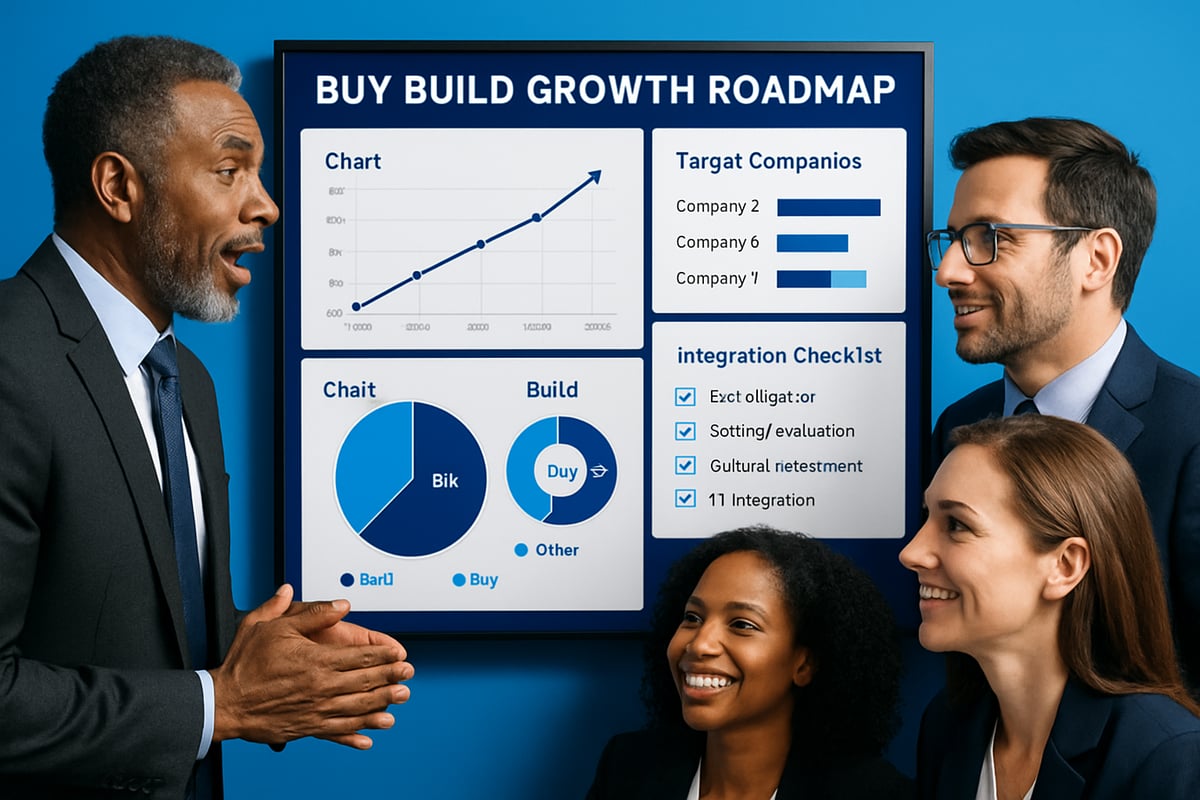
Step 1: Defining Your Strategic Objectives
Every successful buy build journey starts with crystal-clear objectives. What are you aiming to achieve? It could be doubling your market share, expanding geographically, or diversifying your product portfolio.
Begin by mapping out your growth goals over a defined time horizon—say, a three-year plan for market dominance. Align your buy build ambitions closely with your company’s long-term vision. This ensures you’re not acquiring for the sake of activity, but rather for measurable, strategic progress.
Set clear metrics to track, such as revenue growth, EBITDA improvement, or boosting valuation multiples. For example, you might establish a target to double market share within three years by acquiring complementary businesses.
Tip: Clear objectives help you avoid value-destroying deals and keep your buy build strategy focused and disciplined.
Step 2: Selecting the Right Platform Company
The foundation of any buy build strategy is the platform company. This entity should have robust systems, scalable operations, and an experienced management team ready for growth. Industry positioning and deep sector expertise are crucial—without them, bolt-on acquisitions may struggle to integrate.
Assess whether your platform is truly “integration ready.” Are the systems adaptable? Is leadership capable of handling rapid expansion? Private equity firms frequently start with a strong platform before pursuing bolt-ons, as highlighted in Platform acquisition essentials.
A poor platform choice is a leading cause of failed buy build attempts. Prioritize companies with a proven track record, scalable infrastructure, and a culture that welcomes change. This careful selection sets the stage for seamless future acquisitions and long-term value creation.
Step 3: Sourcing and Evaluating Acquisition Targets
Once your platform is in place, it’s time to identify the right targets to fuel your buy build growth. Use a blend of industry research, networking, and proprietary deal sourcing to build a robust pipeline. In 2025, technology and data analytics are game-changers, enabling you to spot off-market opportunities others might miss.
When evaluating potential acquisitions, look beyond the numbers. Examine financial health, customer base, geographic reach, and—most importantly—cultural fit. The best buy build targets will complement your existing strengths and fill strategic gaps.
Fragmented sectors often provide the richest acquisition pipelines. Leverage digital platforms and analytics to streamline your screening process, ensuring your buy build engine runs efficiently and effectively.
Step 4: Due Diligence and Valuation
Thorough due diligence is the backbone of a resilient buy build approach. Go beyond financials to assess legal, operational, and cultural factors. Identify hidden liabilities, operational inefficiencies, or compliance risks that could derail integration.
Synergy assessment is critical. Examine how the acquisition will contribute to your buy build goals—will it deliver cost savings, open new markets, or strengthen your value proposition? Use a mix of EBITDA multiples, discounted cash flow, and market comparables to arrive at a fair valuation.
Remember, smaller companies often trade at lower EBITDA multiples, enabling immediate value uplift—a phenomenon known as multiple arbitrage. Diligent evaluation at this stage ensures your buy build deals deliver real, lasting value.
Step 5: Financing the Buy and Build Strategy
Securing flexible financing is vital for your buy build ambitions. Evaluate all options, including equity, senior debt, mezzanine, and alternative funding sources. In 2025, the use of private debt and co-investments is rising, giving dealmakers more tools to structure buy build transactions.
Structure your deals to balance risk and preserve cash flow for future bolt-on acquisitions. For instance, combining senior debt with equity can optimize your capital stack, keeping your buy build strategy nimble and ready for new opportunities.
Smart financing not only supports initial acquisitions but also ensures your buy build engine can maintain momentum, even in a dynamic market landscape.
Step 6: Integration Planning and Execution
Integration makes or breaks any buy build strategy. Early, detailed planning is essential for operational efficiency, cultural alignment, and synergy capture. Develop a clear roadmap for aligning systems, processes, and leadership teams before closing any deal.
Avoid common pitfalls like duplicated roles, fragmented leadership, and unclear decision-making. For example, centralizing procurement across all entities can drive major cost synergies and reinforce your buy build value proposition.
Integration failures are the top reason buy build strategies underperform. Assign cross-functional integration teams, set clear KPIs, and maintain open communication to ensure each acquisition strengthens—not weakens—your buy build platform.
Maximizing Value: Synergies, Cost Savings, and Multiple Arbitrage
Unlocking the full potential of a buy build strategy means moving beyond just acquiring companies. The real magic happens when you actively create value through synergies, cost savings, and multiple arbitrage. In 2025, these levers are more critical than ever, as competition intensifies and investors demand measurable results.

Realizing Synergies: Revenue and Cost Opportunities
Synergy is the secret sauce that transforms a buy build approach from a collection of deals into a true growth engine. There are two main types: revenue synergies and cost synergies.
Revenue synergies come from cross-selling, entering new markets, and leveraging combined customer bases. Cost synergies result from process standardization, centralizing procurement, and merging support functions. For example, after a buy build acquisition, integrating sales teams can open up new revenue streams as each company’s products reach fresh customers.
According to industry research, synergy realization directly improves margins and shortens the payback period. But capturing these benefits isn’t automatic. It requires intentional planning, clear accountability, and ongoing measurement. Many companies find that targeted synergy programs are essential for delivering on the promise of buy build.
For a deeper dive into maximizing synergies and overcoming common challenges, explore Building a stronger buy-and-build.
Cost Optimization and Efficiency Gains
Cost optimization is often where a buy build strategy delivers its most immediate value. By eliminating redundancies across HR, IT, and finance, leaders can significantly reduce overhead.
- Consolidate back-office functions to streamline operations.
- Negotiate better supplier terms with increased purchasing power.
- Standardize technology platforms for lower maintenance costs.
Consider this: after a buy build transaction, merging IT departments and centralizing payroll can cut duplicate expenses while improving service quality. These efficiency gains not only bolster the bottom line but also free up resources for reinvestment or further acquisitions.
The key is to approach cost savings systematically. Quick wins are possible, but sustainable improvements require ongoing review and a willingness to rethink legacy structures.
Multiple Arbitrage: Boosting Valuation through Scale
Multiple arbitrage is a core driver behind the buy build appeal. It’s the process of acquiring smaller firms at lower valuation multiples and then, through integration and growth, commanding higher multiples for the combined entity.
Let’s break it down with a simple table:
| Scenario | Purchase Multiple | Sale Multiple | Value Uplift |
|---|---|---|---|
| Individual Small Firms | 5x EBITDA | – | – |
| Combined Entity (Post-Buy Build) | – | 8x EBITDA | Significant |
For example, if you acquire companies at 5x EBITDA and later sell the integrated business at 8x, you generate substantial uplift—assuming effective integration and growth. This concept is especially appealing in fragmented sectors, where small players often trade at a discount.
However, multiple arbitrage only materializes when the buy build strategy results in a stronger, more scalable business. Without real operational improvements, premium valuations remain out of reach.
Case Study: Buy and Build Success Story
Let’s look at a real-world buy build example. A mid-market industrial services firm launched a buy build strategy in 2021, acquiring five regional competitors over two years.
Key steps:
- Defined clear synergy and cost-saving targets up front.
- Selected targets with complementary customer bases.
- Centralized procurement and unified sales under one platform.
Results: The company doubled market share, improved EBITDA margins by 20%, and sold at a much higher multiple than standalone firms. Lesson learned? Disciplined integration and a relentless focus on synergy capture made all the difference in this buy build journey.
Integration Mastery: Overcoming Challenges and Ensuring Success
Achieving true success with a buy build strategy requires more than just closing deals. The real value emerges during integration, where companies must blend people, systems, and cultures into a seamless, high-performing organization. This section unpacks integration best practices, revealing how to avoid common pitfalls and unlock the full potential of your buy build efforts.

Building a Robust Integration Framework
A structured integration framework is the backbone of any successful buy build initiative. Start by mapping out timelines, assigning clear roles, and setting measurable KPIs before closing any deal. Staging acquisitions is crucial to prevent resource overload and ensure each integration phase gets the attention it deserves.
Form cross-functional integration teams, bringing together experts from finance, operations, IT, and HR. These teams should collaborate on both pre-acquisition planning and post-deal execution. Early planning helps identify potential roadblocks, enabling you to mitigate risks proactively. For an in-depth look at how risk management supports integration success, see Risk management in M&A and integration.
Remember, integration planning should begin well before signing the dotted line. By embedding buy build principles into every stage, you’ll set the stage for a smoother transition and faster value creation.
Cultural Alignment and Change Management
Cultural alignment is often the silent driver behind buy build success or failure. Assess cultural compatibility during due diligence, not after the deal closes. Develop clear strategies for blending teams, integrating leadership, and communicating shared values.
Retaining key talent from acquired companies is another priority. Empowering legacy leaders and acknowledging their expertise can ease transitions and reduce resistance. Culture, much like operations, needs active management throughout the buy build process to maximize synergy and minimize friction.
Technology and Systems Integration
Seamless technology integration is critical for buy build scalability. Begin by centralizing IT platforms, consolidating data, and harmonizing systems such as ERP, CRM, and financial reporting.
Migrating all entities onto a unified digital infrastructure streamlines workflows and enables real-time performance tracking. This foundation not only supports current operations but also makes future acquisitions easier to integrate. In a buy build approach, robust systems are the engine that drives sustainable growth.
Communication and Stakeholder Engagement
Transparent, consistent communication is the glue that holds a buy build integration together. Develop clear plans to keep employees, customers, and investors informed throughout every stage.
Hold regular updates and Q&A sessions to address concerns, manage expectations, and celebrate milestones. Proactive communication reduces uncertainty and builds trust, making it easier to rally everyone behind the buy build vision. Remember, people support what they help create.
Measuring and Tracking Post-Acquisition Performance
Measuring integration success is essential for buy build strategies. Set clear KPIs for synergy realization, revenue growth, and cost savings before integration begins. Use dashboard reporting to track milestones, highlight achievements, and identify areas for improvement.
Schedule regular performance reviews, allowing for course corrections as needed. Companies that consistently monitor integration metrics outperform those that don’t. Continuous improvement is the heartbeat of a resilient buy build strategy, ensuring long-term success and value creation.
Risk Management and Pitfalls to Avoid in Buy and Build
Successfully executing a buy build strategy in 2025 requires more than just ambition and capital. Effective risk management is the backbone of sustainable growth, helping companies sidestep common pitfalls and maximize returns. Let’s break down the biggest risks and how savvy leaders can avoid them.
Common Pitfalls in Buy Build
Many buy build strategies stumble because of predictable mistakes. Overpaying for acquisition targets is a frequent misstep, especially in competitive markets. Integration failures also derail value creation when systems, teams, and processes don’t harmonize.
Cultural clashes are another silent killer, often overlooked during due diligence. Companies that rush through acquisitions or underestimate cultural fit risk losing key talent and customer trust.
For example, several buy build initiatives have fallen short simply because they failed to plan integration or skipped thorough diligence. According to industry data, a significant number of buy build strategies miss their ROI targets due to poor execution discipline.
To steer clear of these pitfalls:
- Set strict valuation criteria
- Prioritize integration planning from day one
- Invest time in cultural assessment
Navigating Regulatory and Compliance Risks
Operating across borders introduces a new layer of risk to any buy build approach. Regulatory shifts, tax laws, and local market requirements can complicate even the most well-structured deals.
Multi-jurisdictional compliance demands a robust understanding of each region’s legal landscape. Regulatory missteps can lead to costly delays or fines, eroding the value of your buy build investment.
With global M&A activity surging, it’s essential to stay updated on compliance trends. For a broader perspective on these risks in 2025, see the Global M&A trends in private capital: 2025 outlook.
Financial Risk Mitigation Strategies
Financial risks loom large in any buy build journey. Over-leveraging can strain cash flow, especially if synergy gains take longer to realize. Stress testing your financial models against various scenarios is critical.
Scenario planning helps you anticipate potential shocks, such as interest rate hikes or market downturns. Smart leaders diversify funding sources and avoid over-reliance on a single lender.
Mitigating financial risk in buy build also means setting realistic synergy targets and timelines. Conservative estimates protect against disappointment and build stakeholder confidence.
Lessons Learned: Embedding Risk Management
The most successful buy build strategies treat risk management as a continuous discipline. Embedding risk controls at every stage, from deal sourcing to post-merger integration, is essential.
Learning from past failures is just as important as celebrating wins. Review every acquisition for lessons, and refine your risk protocols accordingly.
By making risk management a core part of your buy build strategy, you position your company for resilient, long-term growth.
The Future of Buy and Build: Trends and Innovations for 2025 and Beyond
The landscape for buy build strategies is evolving faster than ever as we enter 2025. New technologies, shifting investor priorities, and global market forces are transforming how companies discover, evaluate, and integrate acquisitions. Understanding these trends is essential for anyone looking to stay ahead in the buy build arena.
Technology-Driven Deal Sourcing and Execution
Technology is dramatically reshaping the buy build process. Artificial intelligence and advanced data analytics now help companies identify promising acquisition targets with greater accuracy and speed. Automated deal-matching platforms scan thousands of opportunities, aligning them with strategic objectives.
In 2025, digital tools are not just for sourcing; they also streamline due diligence and integration planning. For example, AI can flag compliance risks or operational inefficiencies before a deal closes. According to the Private Equity 2025 Outlook: AI, Liquidity, SWFs, and Credit Trends, AI is set to become a core driver of deal success in the coming years.
Firms that harness these innovations position themselves for faster, smarter buy build execution.
Evolving Private Equity and Corporate Strategies
Private equity and corporate investors are refining their buy build strategies to capture more value in 2025. There’s a notable shift toward sector specialization, where firms focus on industries they know best. This expertise enables smarter acquisitions and more effective post-deal integration.
Co-investment models and flexible deal structures are also gaining traction, allowing investors to share risk and tap into larger opportunities. According to 2025 private equity trends, buy build transactions are rising year over year as firms seek operational improvements beyond traditional cost-cutting.
As competition intensifies, a tailored, strategic approach is vital for buy build success.
ESG and Responsible Buy and Build
Environmental, social, and governance (ESG) factors are becoming central to buy build decision-making. Investors increasingly assess targets for sustainability practices, ethical leadership, and community impact. Companies with strong ESG credentials often receive higher valuations and integrate more smoothly post-acquisition.
Buy build strategies in 2025 will frequently include ESG due diligence and ongoing measurement. For example, acquiring a company with a proven record in renewable energy or diversity can accelerate both financial returns and brand value.
Integrating ESG into buy build planning isn’t just about compliance—it’s about building a resilient, future-ready business.
Globalization and Cross-Border Buy and Build
Global expansion is a major theme in buy build strategies for 2025. Companies are targeting cross-border acquisitions to tap into new markets and diversify revenue streams. However, these deals bring unique challenges, from regulatory hurdles to cultural integration.
Emerging markets present compelling opportunities, but require advanced risk management and local expertise. Successful global buy build execution demands careful planning, robust compliance, and a deep understanding of both local and international dynamics.
As firms look beyond borders, mastering cross-border buy build will separate the leaders from the laggards.
If you’re thinking about how to actually put these buy and build strategies into action for your business—or if you want a sense check on your own approach—there’s nothing like a real conversation with someone who’s seen it all. We’ve covered everything from picking the right platform company to planning smooth integrations and managing risk, but every deal has its unique twists. If you want tailored insights or just want to bounce around ideas about your M&A ambitions for 2025, I’d love to help. Let’s connect and talk through your goals—Talk to an Expert!
No responses yet