

Searching for "business appraisers near me" typically signals a critical moment in your company's journey. Whether you're preparing for a sale, seeking financing, resolving shareholder disputes, or planning estate transitions, the right business appraiser provides the credible valuation foundation that M&A transactions, legal proceedings, and financial decisions require. Understanding how to identify qualified professionals, what to expect from the appraisal process, and how valuations integrate with modern deal-making platforms ensures you make informed decisions during pivotal business moments.
Understanding Business Appraisers and Their Role in M&A
Business appraisers serve as independent professionals who determine the economic value of companies, business interests, and intangible assets using recognized methodologies and professional standards. Their work creates defensible, documented valuations that satisfy regulatory requirements, support transaction negotiations, and provide clarity during complex business decisions.
The credibility of a business appraisal depends heavily on the appraiser's credentials, adherence to professional standards, and methodology transparency. When evaluating business appraisers near me, understanding these foundational elements helps distinguish qualified experts from generalists who lack specialized training.
Professional Credentials That Matter
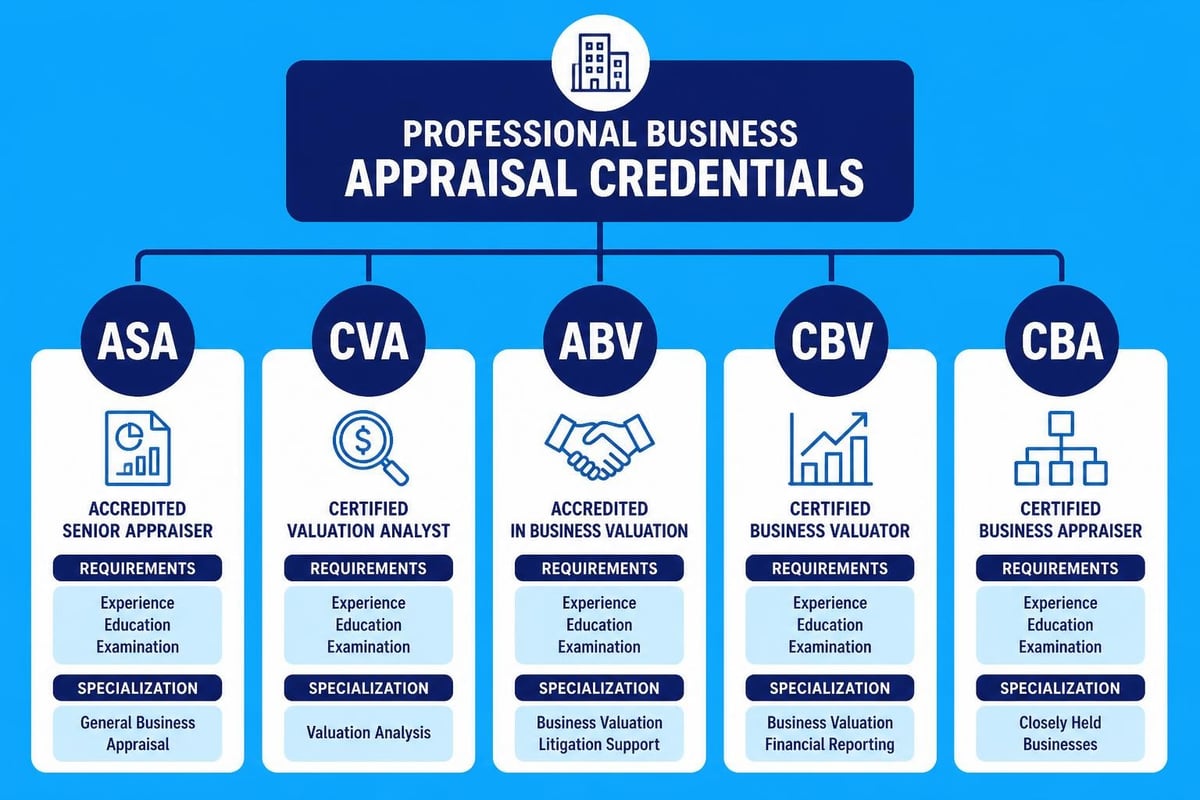
Not all business appraisers maintain equivalent qualifications. Several recognized credentialing bodies establish competency standards:
- Accredited Senior Appraiser (ASA) from the American Society of Appraisers
- Certified Valuation Analyst (CVA) from the National Association of Certified Valuators and Analysts
- Accredited in Business Valuation (ABV) from the AICPA’s ABV credential program
- Chartered Business Valuator (CBV) for Canadian transactions from the CBV Institute
- Certified Business Appraiser (CBA) from the Institute of Business Appraisers
Each credential requires specific education, examination, and continuing education commitments. The comparison of business valuation credentials illustrates the differences in training requirements, experience mandates, and professional oversight across certifying organizations.
Standards Governing Business Valuations
Professional appraisers follow established frameworks that ensure consistency and reliability. The Uniform Standards of Professional Appraisal Practice (USPAP) provides the most widely recognized standards in the United States, covering ethics, competency, and reporting requirements for all appraisal disciplines including business valuation.
Additionally, specialized business valuation standards provide industry-specific guidance. The ASA Business Valuation Standards detail requirements specific to valuing operating businesses and business interests, while International Valuation Standards address cross-border transactions and global consistency.
Why You Need a Business Appraisal
Multiple scenarios require professional business valuations, each with distinct requirements and stakeholder expectations.
Transaction Planning and Execution
Buyers and sellers benefit from independent valuations that establish realistic price expectations and negotiation parameters. For sellers contemplating exit strategies, appraisals provide market-based valuations that inform timing decisions and identify value drivers requiring enhancement before marketing.
On platforms like Aligned IQ M&A, where strategic fit precedes detailed due diligence, having a current business appraisal helps sellers understand their baseline value and communicate effectively with matched buyers. This approach differs from traditional M&A processes where sellers often enter negotiations without comprehensive self-knowledge about their company's market value.
| Transaction Purpose | Appraisal Type | Typical Standards |
|---|---|---|
| Sale preparation | Fair market value | USPAP, ASA BV Standards |
| Shareholder buyout | Fair value | State-specific statutes, USPAP |
| Estate planning | Fair market value | IRS requirements, USPAP |
| ESOP transactions | Adequate consideration | DOL regulations, USPAP |
| Litigation support | Multiple standards | Case-specific, USPAP |
Tax Compliance and Planning
The IRS requires credible appraisals for numerous tax situations. IRS valuation guidance specifies when professional appraisals become mandatory, particularly for estate and gift tax filings, charitable contributions of business interests, and certain corporate reorganizations.
Key tax situations requiring business appraisals:
- Estate tax returns involving business ownership
- Gift tax filings for transferred business interests
- Charitable donations exceeding $5,000
- Corporate restructurings and reorganizations
- S-corporation compliance verification
Financing and Capitalization Events
Lenders and investors frequently require independent valuations before committing capital. SBA loans, traditional bank financing, and private equity investments typically mandate third-party appraisals as part of underwriting processes.
How to Find Qualified Business Appraisers Near Me
Geographic proximity matters less than it once did, but local appraisers often bring regional market knowledge and industry connections that enhance valuation accuracy. The search process should balance geographic convenience with credential verification and relevant experience.
Directory Resources and Referral Sources
Professional organizations maintain searchable directories of credentialed members:
- American Society of Appraisers "Find an Appraiser" directory
- NACVA member search tools
- AICPA practitioner databases
- State CPA society referral services
- CBV Institute directory for Canadian valuations
Industry-specific referral sources also provide qualified leads. M&A advisors, business attorneys, and CPAs who serve middle-market clients typically maintain relationships with reputable business appraisers and can provide informed recommendations based on transaction complexity and industry specialization.
Vetting Potential Appraisers
Once you've identified business appraisers near me through directories or referrals, systematic evaluation ensures you select the best fit for your specific needs.
Essential qualification questions:
- What professional credentials do you hold, and when were they earned?
- How many years have you performed business valuations?
- What percentage of your practice focuses on companies in my industry?
- How many valuations have you completed in the past 24 months?
- Do you carry errors and omissions insurance?
- Have you testified as an expert witness in valuation matters?
Experience with comparable businesses carries particular weight. An appraiser who regularly values manufacturing companies brings different insights than one specializing in professional services firms. Industry-specific knowledge affects multiple valuation components, from selecting comparable transactions to assessing competitive positioning.

The Business Appraisal Process
Understanding what appraisers analyze and how they work helps business owners prepare effectively and set realistic timeline expectations.
Information Gathering and Due Diligence
Professional valuations require comprehensive financial and operational data. Appraisers typically request three to five years of:
- Financial statements (preferably audited or reviewed)
- Tax returns (corporate and partnership)
- Detailed asset listings and depreciation schedules
- Customer concentration analyses
- Employee and management organizational charts
- Contracts, leases, and material agreements
- Industry research and competitive intelligence
The quality and completeness of provided information directly impacts valuation accuracy and timeline. Business owners who maintain organized financial records and contemporaneous documentation streamline the appraisal process considerably.
Valuation Methodologies
Professional appraisers employ multiple approaches, typically combining methods to triangulate value conclusions. The practical guidance on private company valuation from NYU Stern demonstrates how academic frameworks translate into practitioner methodologies.
Three primary valuation approaches:
- Income Approach – Capitalizes or discounts projected cash flows based on risk-adjusted rates
- Market Approach – Compares the subject company to similar businesses through transaction multiples
- Asset Approach – Values underlying assets minus liabilities, adjusted to fair market value
Most comprehensive appraisals weight multiple methods, with the specific combination depending on business characteristics, data availability, and valuation purpose. Service businesses with minimal tangible assets typically emphasize income and market approaches, while asset-intensive manufacturers may incorporate all three methods with heavier asset-approach weighting.
Timeline and Cost Expectations
Business appraisal timelines vary based on company complexity, data availability, and engagement scope. A typical scenario for a middle-market company involves:
| Phase | Duration | Key Activities |
|---|---|---|
| Engagement and planning | 3-5 days | Agreement execution, data request issuance |
| Information gathering | 1-2 weeks | Document collection, management interviews |
| Analysis and valuation | 2-3 weeks | Financial normalization, methodology application |
| Report drafting | 1-2 weeks | Documentation, quality review |
| Total timeline | 6-8 weeks | From engagement to final report delivery |
Cost structures reflect complexity, credentials, and report depth. Limited-scope calculations for internal planning purposes might range from $5,000 to $15,000, while comprehensive appraisals supporting litigation or regulatory filings typically cost $15,000 to $50,000 or more for complex businesses.
Preparing Your Business for Appraisal
Proactive preparation accelerates the appraisal process and often yields more favorable valuations by highlighting value drivers and addressing potential concerns before they surface during analysis.
Financial Statement Normalization
Appraisers normalize financial statements to remove non-recurring items, owner-specific expenses, and accounting irregularities that distort true economic performance. Business owners can facilitate this process by identifying:
- Owner compensation exceeding market rates
- Discretionary expenses (luxury vehicles, non-business travel, family member salaries)
- Non-recurring professional fees (one-time legal settlements, appraisal costs)
- Extraordinary gains or losses
- Related-party transactions requiring adjustment
Providing this context upfront demonstrates financial sophistication and builds appraiser confidence in management's business acumen.
Operational Documentation
Beyond financials, operational metrics provide crucial context for value conclusions. Comprehensive documentation addressing these areas strengthens valuations:
- Customer diversification and retention metrics
- Revenue recurring percentages and contract backlog
- Proprietary processes, intellectual property, and competitive advantages
- Management depth and succession planning
- Growth initiatives and capital expenditure plans
Businesses preparing for eventual sale benefit from maintaining this documentation continuously rather than scrambling during transaction processes. On platforms like Aligned IQ M&A, where strategic fit precedes detailed financial due diligence, having appraisal-ready documentation positions sellers for efficient matched-buyer conversations once strategic alignment is confirmed.

Integrating Appraisals into Your M&A Strategy
Business appraisals represent one component of comprehensive transaction preparation. Understanding how valuations connect to broader M&A processes maximizes their strategic value.
Using Appraisals to Inform Deal Structure
Valuation conclusions guide more than asking price. They inform earnout structures, seller financing terms, and negotiation parameters. A typical scenario might involve a business appraised at $8 million with sellers initially targeting $10 million based on emotional attachment and growth projections. The independent appraisal provides objective grounding for realistic expectations while identifying specific initiatives that could justify premium pricing.
Earnout provisions bridge valuation gaps by tying future payments to performance milestones. When appraisals identify specific growth drivers or risk factors, these insights directly inform earnout structuring and risk allocation between buyers and sellers.
Confidential Deal Exploration
Traditional M&A processes often require disclosing valuation expectations early, creating negotiation disadvantages. Modern platforms transform this dynamic. Aligned IQ M&A allows business owners to explore strategic matches confidentially before exposing detailed financial information or valuation conclusions. This approach preserves optionality while identifying counterparties whose strategic priorities align with seller objectives.
The platform's matching algorithm considers transaction priorities, deal size parameters, and industry experience without requiring premature disclosure of proprietary financial data or appraisal results. Only after mutual strategic interest is established do parties progress to detailed financial discussions where professional appraisals become central negotiation tools.
Appraisals and Virtual Data Rooms
Once business appraisers near me complete their work and valuations support proceeding with transactions, secure information sharing becomes paramount. Virtual data rooms (VDRs) provide the infrastructure for controlled document disclosure during due diligence.
Organizing Appraisal Documentation
Professional appraisals generate substantial supporting documentation beyond final reports:
- Detailed financial statement analyses
- Comparable transaction databases
- Industry research compilations
- Management interview notes
- Asset valuation support
- Methodology work papers
Organizing this material within VDR folder structures allows buyers to verify appraisal assumptions and conduct independent analysis. Best practices for virtual data room organization emphasize logical hierarchies that parallel buyer due diligence workflows.
Recommended VDR folder structure for appraisal materials:
- Financial Information → Valuation Reports → [Appraiser folders]
- Financial Information → Supporting Schedules → Normalization Adjustments
- Financial Information → Tax Returns → [Years with appraisal reliance]
- Operational Information → Industry Analysis → Market Research
Cost-Effective VDR Solutions
Traditional virtual data room providers often charge premium rates that burden middle-market transactions. Aligned IQ VDR offers competitively priced alternatives designed specifically for lower middle-market buyers, sellers, M&A advisors, investment bankers, and other transaction professionals.
For sellers who complete matches through Aligned IQ M&A, the VDR becomes complimentary, eliminating this cost component from transaction budgets. This integration between the matching platform and document management infrastructure streamlines the entire process from strategic fit identification through closing documentation.
When Geographic Proximity Matters Less
Technology has fundamentally altered the business appraisers near me equation. While local appraisers once held decisive advantages through market knowledge and site visit logistics, modern communication tools and data accessibility have reduced geographic constraints significantly.
Remote Appraisal Capabilities
Virtual site tours, video conferencing for management interviews, and digital document sharing enable qualified appraisers to serve clients effectively regardless of physical location. The key consideration shifts from proximity to credential verification and relevant industry experience.
A credentialed appraiser with extensive manufacturing industry experience located 1,000 miles away often delivers superior valuations compared to a local generalist lacking specialized knowledge. This principle applies particularly to niche industries where concentrated expertise trumps regional presence.
Balancing Local Market Knowledge with Specialization
Certain situations still benefit from local appraiser knowledge. Real estate-intensive businesses, companies with significant location-specific competitive advantages, or transactions involving state-specific regulatory considerations may justify prioritizing business appraisers near me with demonstrated regional expertise.
The optimal approach often combines specialized credentials with regional familiarity. When searching for qualified professionals, consider expanding geographic parameters while tightening industry experience requirements. Many professional appraisers maintain national practices serving specialized niches, delivering superior outcomes compared to geographically convenient alternatives.
Strategic Fit Versus Valuation in Modern M&A
Traditional M&A processes emphasize financial metrics and valuation multiples as primary decision drivers. This approach often overlooks strategic compatibility factors that ultimately determine post-acquisition success.
Prioritizing Strategic Alignment
Lower middle-market private equity firms and strategic acquirers increasingly recognize that cultural fit, operational synergies, and strategic vision alignment matter as much as purchase price. A typical scenario involves two buyers offering comparable valuations, with dramatically different post-acquisition integration approaches and cultural philosophies.
Sellers who prioritize strategic fit often achieve better outcomes through smoother transitions, preserved company cultures, and sustained employee retention. Aligned IQ M&A's matching methodology reflects this reality by emphasizing strategic compatibility before progressing to detailed financial negotiations where appraisals become central.
Valuation as Baseline, Not Ceiling
Professional appraisals establish market value baselines, but strategic buyers often justify premiums for specific capabilities, customer relationships, or market positioning. Understanding this dynamic helps sellers position their businesses effectively beyond pure financial metrics.
Bolt-on acquisition strategies exemplify how strategic value exceeds standalone appraisal conclusions. Platform companies pursuing add-on acquisitions frequently pay premiums for businesses that accelerate geographic expansion, add complementary capabilities, or consolidate fragmented markets. Independent appraisals still provide negotiation anchors, but final prices reflect strategic premiums that pure financial analysis doesn't capture.
Appraisal Red Flags and Quality Indicators
Not all business appraisals deliver equivalent credibility or utility. Recognizing quality indicators and warning signs helps business owners evaluate completed work and select qualified professionals initially.
Warning Signs of Substandard Work
Red flags suggesting inadequate appraisals:
- Reliance on single valuation methodology without explanation
- Absence of comparable transaction analysis
- Limited or no financial statement normalization
- Generic industry analysis lacking company-specific application
- Missing or inadequate discounted cash flow assumptions
- Credential inflation or misrepresentation
- Guaranteed valuation conclusions before analysis
Professional appraisers provide reasoned conclusions supported by transparent methodologies and documented assumptions. Any guarantee of specific valuation outcomes before completing analysis indicates bias that undermines credibility.
Quality Markers Worth Seeking
Conversely, high-quality appraisals demonstrate specific characteristics that enhance utility and defensibility:
- Multiple valuation approaches with reconciliation rationale
- Detailed comparable transaction selection criteria
- Industry-specific risk factor analysis
- Sensitivity analysis showing valuation ranges under varying assumptions
- Clear limiting condition disclosures
- Comprehensive certification and appraiser qualification statements
The best appraisals educate readers about methodology choices and assumption rationales, transforming technical documents into strategic planning tools rather than mere compliance requirements.
M&A Service Provider Ecosystem
Business appraisers function within broader M&A service provider networks that include attorneys, accountants, investment bankers, and specialized advisors. Understanding these relationships helps business owners assemble effective advisory teams.
Collaborative Professional Networks
Successful transactions require coordinated expertise across multiple disciplines. A typical scenario involves business appraisers working alongside:
- M&A attorneys structuring transaction documents
- CPAs managing tax efficiency and due diligence
- Investment bankers or M&A advisors managing process and negotiations
- Industry consultants validating operational assumptions
- Wealth advisors coordinating post-sale planning
These professionals often maintain referral relationships built through repeated collaboration. When selecting business appraisers near me, understanding their professional network provides insight into their experience level and industry standing.
Service Provider Marketplaces
Modern platforms connect business owners with vetted service providers, streamlining advisor selection. Aligned IQ’s service provider network allows M&A professionals to showcase expertise, receive sell-side referrals, and connect with active buyers and sellers. This ecosystem approach benefits business owners through pre-vetted advisor access while creating revenue opportunities for qualified service providers.
For business appraisers, participation in these networks provides deal flow while signaling commitment to middle-market M&A specialization. Sellers benefit from integrated access to complementary expertise without managing multiple vendor relationships independently.
Post-Appraisal Strategic Decisions
Receiving a business appraisal creates a decision point. The valuation informs but shouldn't dictate subsequent actions without considering broader strategic context and personal objectives.
Interpreting Results Against Expectations
Appraisals sometimes deliver unexpected conclusions. When valuations fall below expectations, business owners face several strategic options:
- Pursue value enhancement initiatives before marketing
- Adjust exit timeline expectations
- Reconsider transaction structure (partial sales, recapitalizations)
- Maintain ownership and revisit periodically
Conversely, valuations exceeding expectations create opportunities to accelerate exit planning, consider partial liquidity events, or use valuation strength as negotiation leverage.
Value Enhancement Before Sale
The period between receiving appraisals and marketing businesses presents critical value-building opportunities. Common initiatives include:
| Enhancement Area | Typical Actions | Timeline Impact |
|---|---|---|
| Customer concentration | Diversification initiatives, new customer acquisition | 12-24 months |
| Financial reporting | System upgrades, audit preparation | 6-12 months |
| Management depth | Key hire recruitment, succession planning | 12-18 months |
| Revenue quality | Contract conversions, recurring revenue models | 6-18 months |
| Operating leverage | Process standardization, efficiency gains | 6-12 months |
Strategic owners use appraisal findings to guide these investments, addressing specific value detractors identified during analysis. This proactive approach often generates returns exceeding the investment through improved sale multiples and broader buyer appeal.
Finding qualified business appraisers near me represents a crucial step in M&A preparation, providing the objective valuation foundation that informs pricing expectations, deal structure, and negotiation strategy. By prioritizing credentials, verifying industry expertise, and understanding how appraisals integrate with broader transaction processes, business owners position themselves for successful outcomes. Whether you're exploring strategic options or actively pursuing a sale, Aligned IQ transforms M&A into a collaborative process by prioritizing strategic fit before detailed financial negotiations, helping you find the perfect counterparty to meet your transaction goals while providing complimentary VDR access for matched sellers.
No responses yet