

Understanding the true value of a business is critical for any transaction, from mergers and acquisitions to succession planning and strategic partnerships. Business appraisal services provide the rigorous, independent analysis needed to establish fair market value, ensuring that both buyers and sellers enter negotiations with confidence and clarity. Whether you're a business owner preparing for an exit, a buyer evaluating acquisition targets, or an M&A advisor supporting clients through complex transactions, professional valuation expertise serves as the cornerstone of informed decision-making in today's competitive marketplace.
What Business Appraisal Services Deliver
Business appraisal services encompass far more than a simple price estimate. These professional engagements apply systematic methodologies to analyze financial performance, market position, intangible assets, and future earning potential. A comprehensive appraisal examines historical financial statements, industry benchmarks, competitive dynamics, and economic conditions to arrive at a defensible conclusion of value.
Professional appraisers follow established standards and frameworks that govern their work. The AICPA professional standards for valuation services outline procedures, reporting requirements, and ethical obligations that credentialed practitioners must observe. Similarly, USPAP standards from The Appraisal Foundation provide authoritative guidance applicable to business valuation and intangible asset appraisals.
The deliverable from business appraisal services typically takes the form of a formal valuation report that documents assumptions, data sources, methodologies applied, and the final value conclusion. This report serves multiple stakeholders throughout the M&A lifecycle and beyond.
Core Components of Professional Valuations
Every credible business appraisal incorporates several essential elements:
- Financial analysis reviewing normalized earnings, revenue trends, and working capital requirements
- Industry research examining market conditions, growth rates, and sector-specific risk factors
- Methodology application using income, market, and asset-based approaches as appropriate
- Quality of earnings assessment adjusting for one-time events and owner discretionary expenses
- Risk evaluation considering business concentration, customer dependencies, and operational vulnerabilities
- Report documentation providing transparent support for all conclusions reached

The depth and scope of business appraisal services vary based on the engagement purpose. A full appraisal represents the most comprehensive option, delivering maximum credibility for litigation, tax reporting, or major transactions. Alternatively, limited appraisals or calculation engagements may suffice for internal planning or preliminary M&A discussions when cost efficiency matters more than exhaustive documentation.
Valuation Methodologies Professionals Apply
Business appraisal services rely on three fundamental approaches, each offering unique insights into value. Professional appraisers typically employ multiple methods and reconcile the results to arrive at a final conclusion.
Income Approach Methods
The income approach focuses on a business's capacity to generate future economic benefits. This forward-looking perspective resonates particularly well with buyers evaluating acquisition opportunities based on anticipated returns.
Discounted Cash Flow (DCF) represents the most theoretically sound income method. Appraisers project future cash flows over a discrete period, then apply a discount rate reflecting the investment's risk profile. The CFA Institute materials on equity valuation provide authoritative frameworks for DCF modeling and discount rate estimation that many business appraisal services reference.
Capitalization of earnings offers a simpler alternative for stable, mature businesses. This method divides normalized earnings by a capitalization rate derived from market data and risk assessment. For many lower middle-market transactions, capitalization provides adequate precision with less forecasting complexity than DCF analysis.
Market Approach Techniques
The market approach determines value by reference to actual transactions involving comparable businesses. This method grounds valuations in real-world evidence of what buyers actually pay.
Guideline public company analysis examines pricing multiples from publicly traded firms in similar industries. Revenue multiples, EBITDA multiples, and other metrics establish valuation benchmarks, adjusted for size, growth, and risk differences between public companies and private business targets.
Guideline transaction analysis reviews actual M&A deals involving similar businesses. The IBBA industry research and Market Pulse data track transaction multiples across Main Street and lower-middle-market deals, providing valuable comparables for business appraisal services working in these segments.
| Valuation Approach | Primary Focus | Best Application | Key Limitation |
|---|---|---|---|
| Income (DCF) | Future cash generation | Growth businesses, strategic buyers | Forecast uncertainty |
| Income (Capitalization) | Normalized current earnings | Stable, mature operations | Assumes no growth |
| Market (Guideline Companies) | Public company multiples | Established industries | Size/liquidity differences |
| Market (Transactions) | Actual deal comparables | All private businesses | Limited transaction data |
| Asset-Based | Net asset value | Asset-intensive, distressed | Ignores earning power |
Asset-Based Approaches
The asset approach calculates value by adjusting the business's balance sheet to fair market value. All assets receive appraisal, from real estate and equipment to inventory and intangible assets like customer relationships or intellectual property.
This approach proves particularly relevant for asset-intensive businesses, holding companies, or distressed situations where earning power has diminished. However, it often understates value for service businesses and other operations where intangible assets and assembled workforce create value beyond recorded book values.
When to Engage Business Appraisal Services
Timing and context significantly influence how business appraisal services contribute to successful outcomes. Understanding when professional valuation adds the most value helps owners and buyers allocate resources effectively.
Pre-Transaction Planning
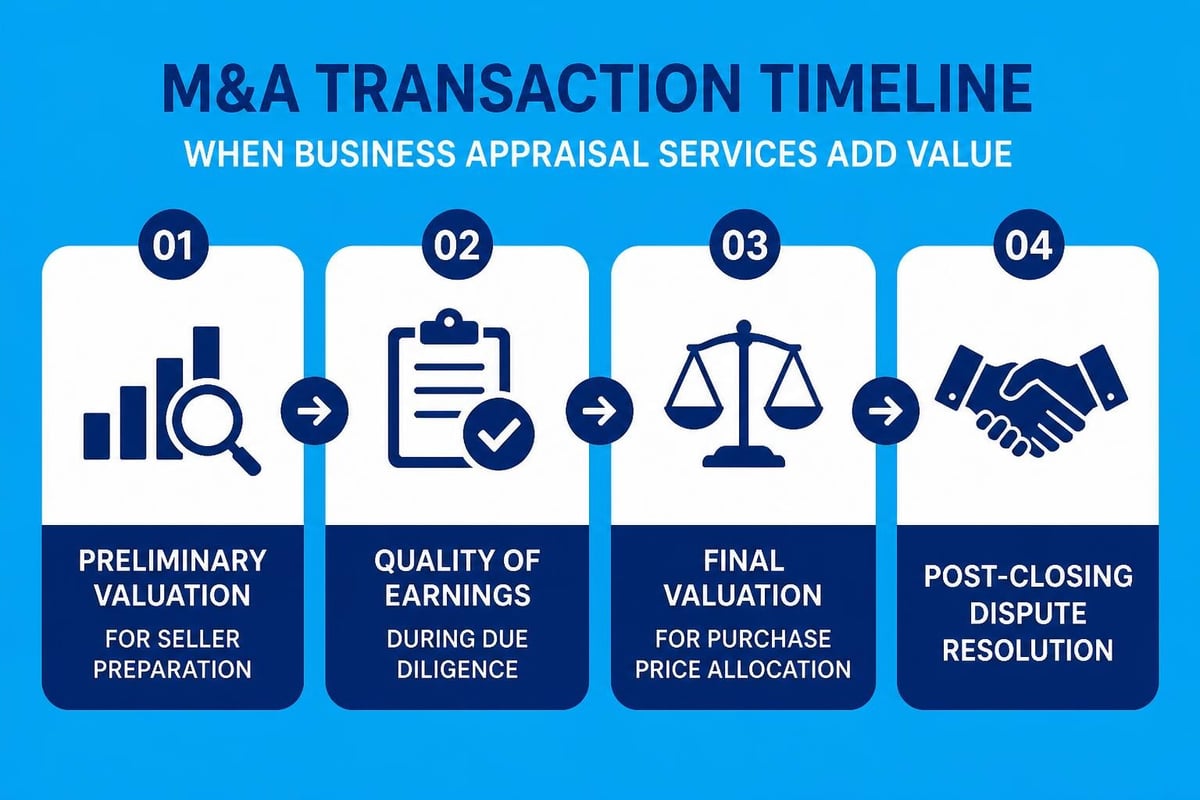
Business owners contemplating an eventual exit benefit enormously from early-stage valuation. A baseline appraisal conducted 12-24 months before marketing reveals value drivers, identifies improvement opportunities, and establishes realistic price expectations. The SBA resources for business owners discuss how valuations support exit planning and business preparation.
This advance knowledge allows owners to enhance value systematically rather than discovering shortfalls during due diligence. In a typical scenario, an owner learns that customer concentration significantly discounts their business value, then implements diversification strategies before engaging buyers.
For business sellers exploring options through platforms prioritizing strategic fit, having current valuation data strengthens the matching process. Understanding your business's financial profile helps identify buyers whose acquisition criteria and valuation methodologies align with your expectations, reducing wasted time on mismatched opportunities.
Active Transaction Support
During active M&A processes, business appraisal services provide negotiation anchors and third-party validation. Sellers use professional valuations to justify asking prices and counter lowball offers with credible evidence. Buyers rely on independent appraisals to assess whether proposed terms reflect fair value or incorporate unwarranted premiums.
Quality of earnings studies frequently complement formal valuations during this phase. These focused financial analyses normalize historical performance, highlighting sustainable earnings versus one-time events. This clarity helps both parties understand the true economic foundation supporting valuation conclusions.
Post-Transaction Applications
Business appraisal services continue delivering value after deal closure. Purchase price allocation requires valuing acquired assets and intangibles for tax reporting and financial statement preparation. Fair value measurements under ASC 820 or IFRS 13 demand rigorous appraisal support for goodwill impairment testing and financial reporting compliance.
Earnout disputes, working capital adjustments, and other post-closing matters frequently reference valuation opinions. Having credible appraisal documentation from transaction inception prevents costly disagreements and supports efficient resolution when disputes arise.
Selecting Qualified Valuation Professionals
The quality of business appraisal services depends entirely on practitioner competence and independence. Not all valuation providers offer equivalent expertise, credentials, or adherence to professional standards.
Professional Credentials and Standards
Several organizations credential business valuation professionals and establish practice standards. The NACVA Professional Standards guide Certified Valuation Analysts (CVAs) and provide comprehensive frameworks covering engagement procedures, reporting formats, and quality control. The NACVA Body of Knowledge represents a practitioner-oriented reference covering methodologies and technical issues in depth.
Other widely recognized credentials include the Accredited in Business Valuation (ABV) designation from the AICPA, the Accredited Senior Appraiser (ASA) from the American Society of Appraisers, and the Chartered Business Valuator (CBV) from the CBV Institute. Each credential requires demonstrated experience, examination success, and ongoing continuing education.
When evaluating valuation professionals, consider:
- Relevant credentials from recognized certifying bodies
- Industry experience in your specific sector
- Transaction familiarity with deals of similar size and complexity
- Independence from parties with financial interests in valuation outcomes
- Professional liability coverage protecting against errors and omissions
- Engagement clarity regarding scope, deliverables, and timelines
Engagement Types and Cost Considerations
Business appraisal services span a spectrum of engagement types, each with different scope, rigor, and cost profiles. Understanding these options helps match the engagement to your specific needs and budget.
Full appraisal reports provide comprehensive documentation suitable for litigation, tax reporting, or major transactions where maximum credibility matters. These engagements involve extensive data gathering, multiple methodology application, and detailed reporting that can extend 50-100+ pages. Costs typically range from $10,000 to $50,000+ for middle-market businesses, depending on complexity.
Limited appraisals restrict scope by limiting procedures, methodologies, or documentation detail. These engagements still comply with professional standards but acknowledge scope limitations explicitly in the report. They suit internal planning, preliminary M&A discussions, or situations where full appraisal rigor exceeds practical requirements. Costs generally fall in the $5,000-$15,000 range.
Calculation engagements represent the most streamlined option, applying agreed-upon procedures to calculate value without the appraiser expressing a conclusion of value. These work well for preliminary estimates or when parties agree on methodology and simply need competent application. Costs often start around $3,000-$8,000 for straightforward businesses.
For business owners and buyers working within lower middle-market segments, cost-effective valuation options matter. Business valuation software platforms now provide preliminary estimates and data-driven benchmarks that can inform early-stage discussions before engaging formal business appraisal services.
Valuation Trends Reshaping Business Appraisal Services
The valuation profession continues evolving in response to market dynamics, regulatory developments, and technological advances. Understanding these trends helps stakeholders anticipate how business appraisal services will develop through 2026 and beyond.
Data Availability and Market Intelligence
Access to transaction data has expanded dramatically, improving the reliability of market approach valuations. Industry databases now track thousands of private company transactions annually, providing robust comparable sets for business appraisal services. PwC valuation insights discuss how enhanced data availability and analytical capabilities are elevating valuation quality across the profession.
This data richness particularly benefits small business valuation where historical data gaps previously limited market approach reliability. Main Street businesses now receive more credible comparative benchmarking than was possible even five years ago.
Technology Integration
Valuation technology continues advancing beyond simple spreadsheet modeling. Cloud-based platforms integrate financial data import, automated adjustments, industry benchmarking, and report generation into streamlined workflows. These tools enhance efficiency without replacing professional judgment in areas requiring expertise and interpretation.
Artificial intelligence and machine learning applications are emerging in comparables screening, risk assessment, and forecast validation. While technology augments business appraisal services, human expertise remains essential for understanding qualitative factors, management quality, competitive positioning, and strategic value that algorithms cannot fully capture.
Specialized Industry Knowledge
Generic valuation expertise no longer suffices for many engagements. Business appraisal services increasingly differentiate through deep industry specialization, understanding sector-specific metrics, regulatory considerations, and competitive dynamics that materially affect value.
In a typical scenario, valuing a manufacturing business requires understanding capacity utilization, capital intensity, supply chain dependencies, and equipment obsolescence factors that differ fundamentally from valuing a software-as-a-service business focused on recurring revenue, customer acquisition costs, churn rates, and scalability economics.
This specialization extends to niche sectors from agribusiness M&A to chemicals and materials transactions, where industry-specific knowledge dramatically improves valuation accuracy and credibility.
Integrating Valuation into Strategic M&A Processes
Business appraisal services deliver maximum value when integrated thoughtfully into broader M&A strategies rather than treated as isolated compliance exercises. For both buyers and sellers, valuation should inform rather than dictate transaction decisions.
Valuation's Role for Business Sellers
For business owners preparing to exit, professional valuation establishes the financial foundation for transaction planning and positioning. Understanding value drivers helps owners enhance business attractiveness systematically before marketing begins.
However, valuation represents only one input into selecting the right buyer. Strategic fit, cultural alignment, employee treatment, legacy preservation, and deal structure all influence outcomes beyond simple price maximization. The most successful exits balance financial objectives with qualitative priorities that formal valuations cannot capture.
Confidential, low-risk exploration of potential buyers allows owners to assess strategic fit before committing to the traditional sell-side M&A process. This approach enables owners to understand buyer priorities and valuation perspectives informally before engaging formal business appraisal services and launching broad marketing efforts.
Valuation Considerations for Buyers
Acquirers approach business appraisal services with different objectives than sellers. While sellers seek to justify maximum pricing, buyers use valuation to identify opportunities priced below intrinsic value or to validate that strategic premiums remain economically rational.
Sophisticated buyers applying disciplined acquisition strategies recognize that formal appraisals establish baseline fair market value, but strategic value may differ substantially. Synergies, market access, talent acquisition, and competitive considerations can justify premiums over standalone value for the right opportunities.

Private equity platforms and business buyers sourcing deals increasingly value proprietary deal flow and pre-qualified opportunities where strategic alignment precedes detailed financial analysis. This sequence allows valuation work to focus on validating fit rather than discovering fundamental misalignment late in diligence.
Aligning Valuation with Deal Execution
Once buyers and sellers establish mutual interest, business appraisal services support efficient deal progression. Quality of earnings studies, working capital analysis, and asset appraisals complement enterprise valuation during due diligence.
Virtual data rooms facilitate secure information exchange during this phase. The Aligned IQ VDR provides competitively priced virtual data room services that enable buyers, sellers, and their advisors to share sensitive valuation inputs and supporting documentation securely. For sellers matched through Aligned IQ M&A, the VDR is complimentary after matching, reducing transaction costs while maintaining confidentiality and security throughout due diligence.
Service Provider Opportunities
Business appraisal services professionals, M&A advisors, and other service providers play critical roles supporting successful transactions. Their expertise bridges information gaps, provides third-party validation, and helps parties navigate complex valuation and negotiation dynamics.
Professional advisors who understand both technical valuation methodologies and practical transaction dynamics deliver the most value. They translate appraisal conclusions into negotiation strategies, explain valuation drivers in business terms, and help clients assess whether formal valuations reflect reasonable estimates or contain aggressive assumptions requiring scrutiny.
Valuation Quality and Common Pitfalls
Not all business appraisal services deliver equal quality. Understanding common valuation pitfalls helps stakeholders evaluate appraisal credibility and avoid costly mistakes.
Over-Reliance on Single Methodologies
Competent appraisers apply multiple methods and reconcile results rather than defaulting to a single preferred approach. In a typical scenario, an appraiser might develop both DCF and guideline transaction analyses, then weight the results based on data quality, business characteristics, and methodology appropriateness. Single-method valuations often reflect limited expertise or predetermined conclusions rather than rigorous analysis.
Inadequate Comparable Selection
Market approach credibility depends entirely on comparable quality. Poor comparables introduce bias that undermines valuation reliability. Appraisers must adjust for size differences, growth disparities, profitability variations, and geographic factors when selecting and applying guideline companies or transactions.
Main Street businesses differ fundamentally from middle-market companies in pricing, buyer pools, and valuation multiples. Business appraisal services must calibrate methodology and data sources to the specific transaction segment they're addressing.
Forecast Optimism in Income Approaches
DCF valuations prove only as reliable as their underlying projections. Overly optimistic growth assumptions, understated capital requirements, or unrealistic margin expansion can inflate value conclusions dramatically. Professional appraisers scrutinize forecasts, benchmark assumptions against industry norms, and apply sensitivity analysis to test conclusion robustness.
Ignoring Control and Marketability Considerations
Private business interests typically warrant discounts for lack of control (minority interests) and lack of marketability (illiquid investments). The magnitude of these discounts varies based on business characteristics, shareholder rights, and market conditions, but ignoring them entirely produces unreliable valuations.
Conversely, control premiums may apply when valuing controlling interests based on minority-interest pricing data. Professional business appraisal services explicitly address these adjustments and document their rationale transparently.
Future Directions for Business Appraisal Services
Looking ahead through 2026 and beyond, several developments will continue reshaping how business appraisal services operate and deliver value.
Enhanced ESG Considerations
Environmental, social, and governance factors increasingly influence business valuations as investors and buyers integrate sustainability considerations into decision frameworks. Climate risks, social license to operate, and governance quality affect both cash flow projections and risk assessments that drive value conclusions.
Business appraisal services will increasingly incorporate ESG analysis, adjusting valuations for environmental liabilities, social risks, and governance weaknesses that weren't traditionally emphasized in valuation models.
Cross-Border Complexity
International M&A continues growing, introducing cross-border valuation complexities involving currency risks, tax treaty considerations, regulatory differences, and cultural factors. Business appraisal services supporting international transactions require specialized expertise in multi-jurisdictional issues beyond domestic valuation competencies.
Regulatory Evolution
Tax regulations, financial reporting standards, and securities laws continue evolving, affecting valuation requirements and methodologies. Professional business appraisal services must maintain current knowledge of regulatory developments and adapt practices accordingly.
Integration with Strategic Planning
Forward-thinking businesses integrate valuation into ongoing strategic planning rather than commissioning appraisals only for transactions or compliance. Regular valuation updates inform capital allocation, performance measurement, and strategic decision-making, making business appraisal services a continuous strategic input rather than an episodic transaction requirement.
| Valuation Trend | Impact on Services | Buyer/Seller Consideration |
|---|---|---|
| Enhanced data availability | More reliable market comparables | Better pricing benchmarks |
| Technology integration | Lower costs for routine work | Focus advisor time on complex issues |
| Industry specialization | Deeper sector expertise | Match appraiser to business type |
| ESG factors | Broader risk assessment | Address sustainability early |
| Regulatory complexity | Higher compliance requirements | Engage credentialed professionals |
Business appraisal services provide the financial foundation for informed M&A decision-making, but value extends beyond numbers to encompass strategic fit, operational synergies, and long-term alignment between buyers and sellers. Whether you're a business owner exploring exit options, a buyer evaluating acquisition opportunities, or an advisor supporting clients through complex transactions, Aligned IQ offers a confidential, strategic-fit-first platform where buyers and sellers connect based on transaction priorities, deal size, and industry expertise before diving into detailed valuation and negotiation. Our match-making process helps ensure all parties find the right counterparty to meet their M&A goals, supported by complimentary VDR services for matched sellers and competitively priced data room access for all transaction participants. Take a tour today to discover how Aligned IQ transforms M&A into a more collaborative, efficient process.
No responses yet