

A BizBuySell business for sale search returns thousands of listings across industries, price bands and states, from owner-operated service companies to franchises and commercial real estate. The marketplace is the largest public starting point for small business acquisitions, but a listing is only an advertisement, so the value comes from how you screen, finance and verify what you find. The ten items below combine marketplace listing types with books and platforms that help you act on them, and they are ordered for practical use rather than ranked by popularity.
One caution applies to every entry. BizBuySell shows live inventory that changes daily, so this article describes categories of listings and the tools around them rather than specific businesses that may already be under contract.
1. SBA-Eligible Listings on BizBuySell
SBA-eligible listings are marketplace postings flagged as candidates for government-backed acquisition financing, and they are the most practical place to start a BizBuySell business for sale search if you plan to borrow.
- Key specs: SBA 7(a) loans can be used to acquire a business or partial ownership, with a maximum loan amount of $5 million. Eligible borrowers must be for-profit U.S. businesses that meet SBA size requirements and can demonstrate creditworthiness and repayment ability.
- Price: Browsing is free; asking prices vary by listing.
- Best use: Buyers who need seller-friendly financing and want listings with documented cash flow, typically in the low-seven-figure range or below.
- Verdict: The most efficient filter for financed buyers, provided you confirm eligibility with a lender rather than trusting the badge.
2. Recently Listed Businesses
Recently listed businesses are postings added in the last few days, and they give you a first-mover position before other buyers have requested financials.
- Key specs: Sorted by newest date; typically include asking price, stated cash flow, revenue, location and a short broker summary.
- Price: Free to view; asking prices vary widely.
- Best use: Buyers who can respond within a day, with a proof-of-funds letter and a signed confidentiality agreement ready.
- Verdict: Valuable only if you move fast; stale listings often reflect pricing the market has already rejected.
3. Established Cash-Flow Businesses
Established cash-flow businesses are listings with multi-year operating history, and they suit buyers who value predictable earnings over growth upside.
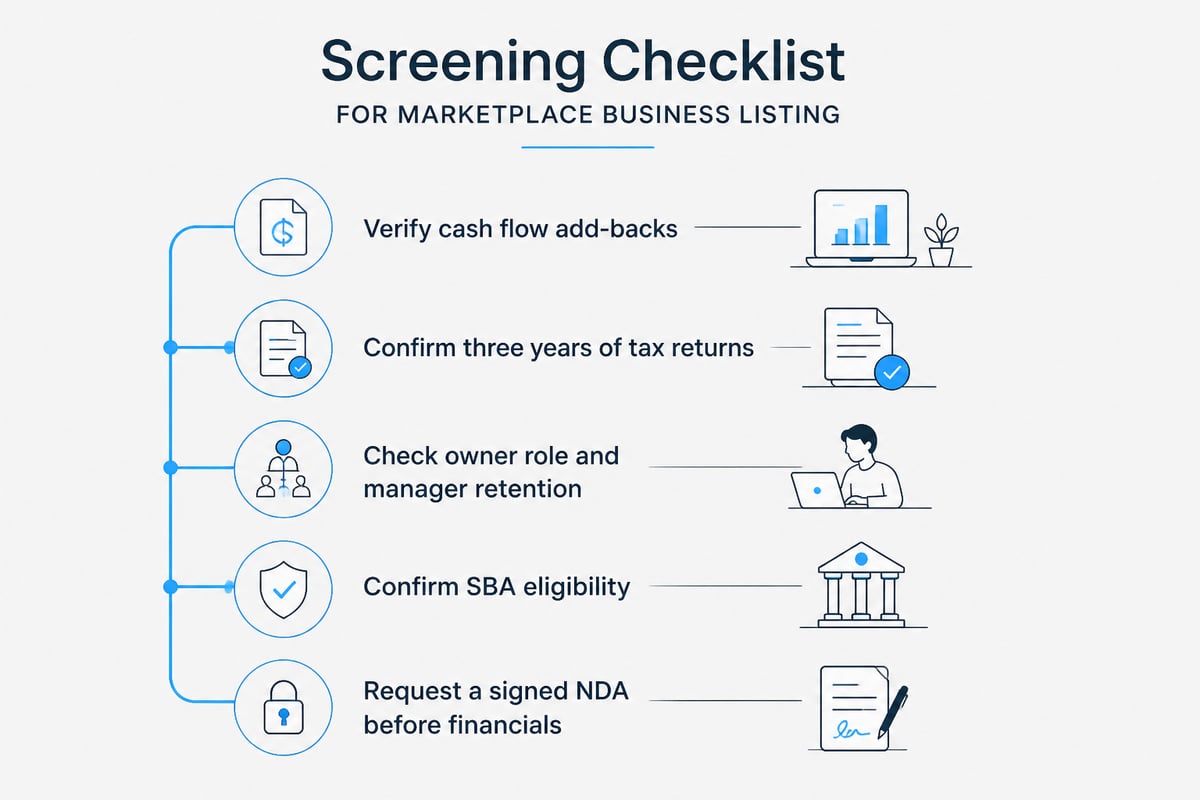
- Key specs: Look for three or more years of tax returns, stated seller's discretionary earnings, and a clear owner-role description.
- Price: Varies by industry and size.
- Best use: Acquirers screening on cash-flow multiples. BizBuySell's 2025 Chicago-area data reports a median sale price and median cash flow that give a useful local benchmark.
- Verdict: A reliable category, but verify add-backs, since seller-adjusted earnings are the number most often disputed in diligence.
4. Absentee-Owner and Semi-Absentee Businesses
Absentee-owner listings are businesses described as running with a manager in place, and they suit buyers who want to oversee rather than operate.
- Key specs: Check whether the manager is staying, what the payroll cost is, and whether earnings are stated before or after a market-rate manager salary.
- Price: Often priced at a premium to owner-operated peers.
- Best use: Corporate or private equity buyers adding a bolt-on who already have operational capacity.
- Verdict: Attractive on paper; confirm that the manager's compensation is reflected in the cash flow figure.
5. Business Real Estate Listings
Business real estate listings are properties sold for commercial use, sometimes alongside an operating company, and they suit buyers who want hard assets behind the deal.
- Key specs: Check zoning, lease terms if the property is sold separately, and whether the real estate is priced inside or outside the business.
- Price: Varies by market and property type.
- Best use: Buyers with a real-estate-backed financing structure who want collateral to support a loan.
- Verdict: Useful for asset-heavy targets such as light industrial or hospitality; separate the real estate valuation from the operating business valuation.
6. Franchise Resale and Franchise Opportunity Listings
Franchise listings include existing units for resale and new franchise opportunities, and they suit buyers who prefer a documented operating system.
- Key specs: Review franchise disclosure documents, transfer fees, territory rights and franchisor approval requirements.
- Price: Resales are priced by the seller; new franchises carry initial fees set by the franchisor.
- Best use: Buyers who want brand recognition and training in exchange for royalties and franchisor control.
- Verdict: Lower operational risk, but approval requirements can lengthen the closing timeline.
7. HBR Guide to Buying a Small Business
The HBR Guide to Buying a Small Business by Richard S. Ruback and Royce Yudkoff is a Harvard Business Review Press book covering how to find, screen, negotiate for and run a small business.
- Key specs: Authored by Richard S. Ruback and Royce Yudkoff; covers the full acquisition process from search to operation.
- Price: Not listed here; check retailers for current pricing.
- Best use: First-time buyers who need a structured overview of the acquisition process before approaching sellers.
- Verdict: A practical orientation that pairs well with a hands-on marketplace search.
8. Buy Then Build by Walker Deibel
Buy Then Build: How Acquisition Entrepreneurs Outsmart the Startup Game is a guide to acquiring and then growing an existing small business.
- Key specs: Focuses on the acquisition entrepreneur path and the comparison between buying and starting from scratch.
- Price: Not listed here; check retailers for current pricing.
- Best use: Buyers weighing an established company against a startup, who want a framework for post-close growth.
- Verdict: A good fit if your goal is to grow what you buy, not simply to own it.
9. Search Funds and Buyout Guides
Two further titles complement the list: Search Funds & Entrepreneurial Acquisitions, which covers the search-fund route to buying and leading a business, and Buyout: The Insider's Guide to Buying Your Own Company, which offers practical guidance on buying a company.
- Key specs: The first addresses search funds specifically; the second addresses navigating the buyout process.
- Price: Not listed here; check retailers for current pricing.
- Best use: Buyers considering a search-fund structure, or those who want negotiation and deal-structuring guidance.
- Verdict: Choose the search-funds book for investor-backed searches and the buyout book for general buyout mechanics.
10. Aligned IQ M&A and Aligned IQ VDR
Aligned IQ is a two-part option: Aligned IQ M&A is a private matching platform, and Aligned IQ VDR is a separate virtual data room. The two do different jobs, so they are described separately here.
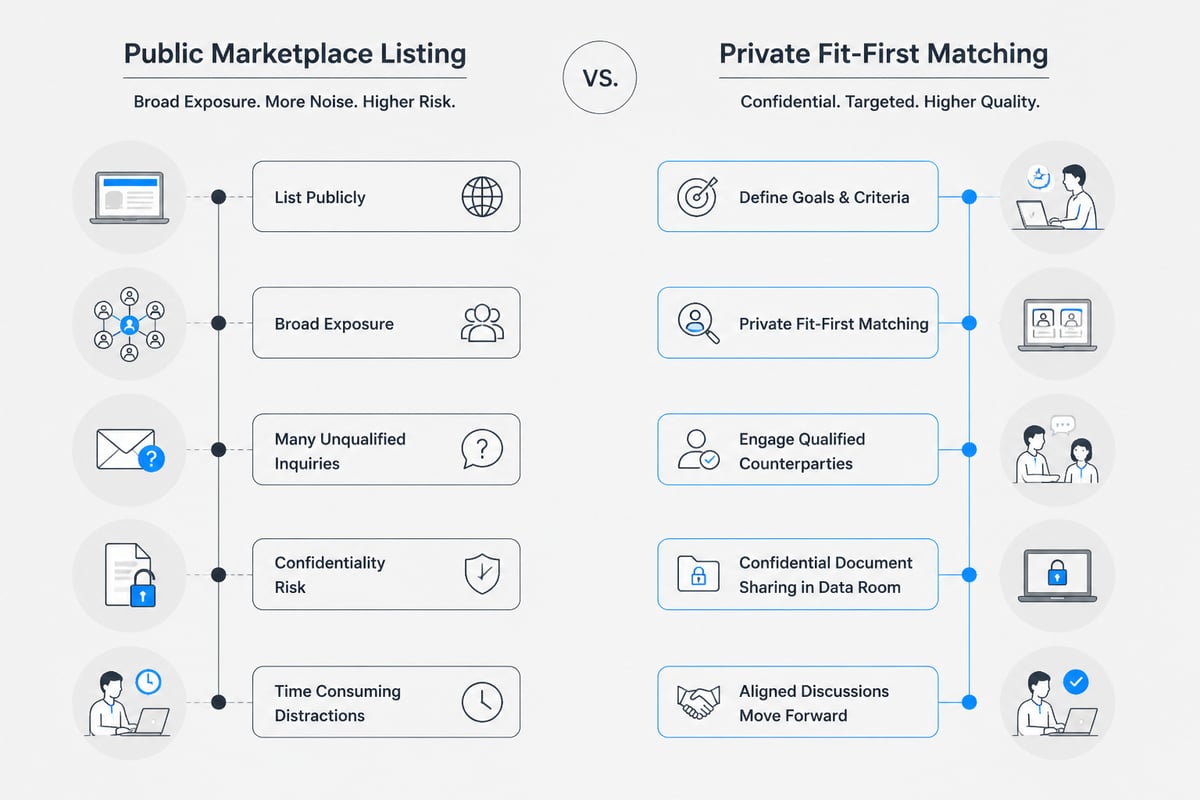
Aligned IQ M&A is a B2B web platform where prospective buyers and sellers meet privately to explore deals. It puts strategic fit first, so both sides agree on goals before the deal process begins, and matches are based on transaction priorities, deal size, and industry experience and expertise. Because it works through private matching rather than public postings, it is a semi-proprietary alternative to the traditional M&A process, with a more confidential and lower-risk path for owners who may sell eventually. Buyers can present themselves as an attractive exit option for owners. The buyer-side acquisition platform is the relevant entry point for acquirers sourcing deals.
Aligned IQ VDR is a secure virtual data room for sharing deal documents. It is complimentary for Aligned IQ M&A sellers after a match is completed, and competitively priced for other buyers, sellers, intermediaries and M&A service providers; see the Aligned IQ VDR pricing page for current rates, and the Virtual Dataroom product page for details.
- Best use: Owners planning an eventual exit who want strategy and valuation support in one place, and buyers who want access to matched, non-public opportunities.
- Verdict: A complement to public marketplaces rather than a replacement; the confidentiality and fit-first process suit sensitive sales. Take a Tour to see how matching and the data room work together.
Comparison Table
| # | Item | Type | Best use |
|---|---|---|---|
| 1 | SBA-eligible listings | Marketplace filter | Financed acquisitions |
| 2 | Recently listed businesses | Marketplace filter | Fast-moving buyers |
| 3 | Established cash-flow businesses | Listing category | Earnings-based screening |
| 4 | Absentee-owner businesses | Listing category | Bolt-on acquisitions |
| 5 | Business real estate | Listing category | Asset-backed deals |
| 6 | Franchise resales | Listing category | Systemized operations |
| 7 | HBR Guide to Buying a Small Business | Book | First-time acquirers |
| 8 | Buy Then Build | Book | Post-close growth planning |
| 9 | Search Funds and Buyout guides | Books | Search-fund and buyout structuring |
| 10 | Aligned IQ M&A and VDR | Platform and data room | Private matching and secure document sharing |
How to Read BizBuySell Data Before You Make an Offer
Reading marketplace data well means comparing asking prices with closed-sale benchmarks, not with other asking prices. BizBuySell's 2025 Chicago-area data shows that closed sales typically sell below asking price and take several months on market. A seller asking full price on a typical listing is therefore unlikely to receive it, and a realistic offer reflects both the discount and the long timeline.
Three checks apply to nearly every listing:
- Recast the earnings. Rebuild cash flow from tax returns and bank statements rather than relying on broker summaries.
- Test the owner dependency. Ask which customer relationships, licenses or processes depend on the current owner.
- Confirm the financing path early. Speak with a lender before an offer, since SBA eligibility depends on the borrower and the business.
For deeper guidance on this stage, the guide to finding a business for sale and the existing business for sale guide walk through screening in more detail.
Preparing for the Seller's Side of a Listing
Sellers who want a strong result from a BizBuySell business for sale posting should prepare before going public. That means a defensible valuation, clean financials and a clear explanation of owner involvement. Understanding business value before a sale and the steps to prepare a business for sale outline the groundwork. A public listing also exposes the business to employees, customers and competitors, which is why many owners explore private matching first.
A typical scenario: an owner nearing retirement lists publicly and may receive many inquiries, only some of them from qualified buyers. A private, fit-first process reduces that exposure by introducing counterparties who already match on deal size and goals. Exit planning and valuation support in one place also shortens the preparation phase.
Related Resources for Acquirers and Industry Operators
Acquirers in niche sectors sometimes evaluate companies with a strong online presence. In manufactured housing, for example, web presence can drive lead flow, and Triad Mobile Homes shows how a sector-focused web design team presents its work. Reviewing how a target presents itself online is a quick way to judge its marketing maturity.
Which Route Fits Your Deal Size and Timeline
The right route depends on whether you value reach or discretion. Public marketplaces offer volume and fast feedback on pricing, while books supply the frameworks for evaluating what you find, and private matching offers confidentiality and fit. Many buyers use all three: a public search for market awareness, a book for method, and a private platform for opportunities that never reach a listing site. If you are weighing an acquisition against building a pipeline, the guide to buying a business for sale compares the paths.

Your next step is to shortlist three listings that match your size and financing criteria, then recast their earnings before you contact any seller. When you want to move beyond public postings, Aligned IQ M&A offers private, fit-first matching, and the Aligned IQ Virtual Dataroom keeps deal documents secure once a match is made. To see both in action, Take a Tour and contact Aligned IQ to discuss your acquisition or exit goals.
No responses yet