

Deciding where to sell your company represents one of the most significant strategic decisions in your entrepreneurial journey. The venue you select can dramatically influence not just the final sale price, but the quality of buyers you attract, the level of confidentiality maintained throughout the process, and ultimately whether you find a counterparty who shares your vision for the business's future. Traditional approaches like business brokers and investment bankers remain popular, yet modern alternatives including specialized M&A platforms and private matchmaking services are reshaping the landscape by prioritizing strategic alignment over transactional speed.
Understanding Your Sale Venue Options
When evaluating where to sell your company, business owners typically encounter several distinct pathways to market. Each option offers different advantages depending on your transaction size, industry, timeline, and confidentiality requirements.
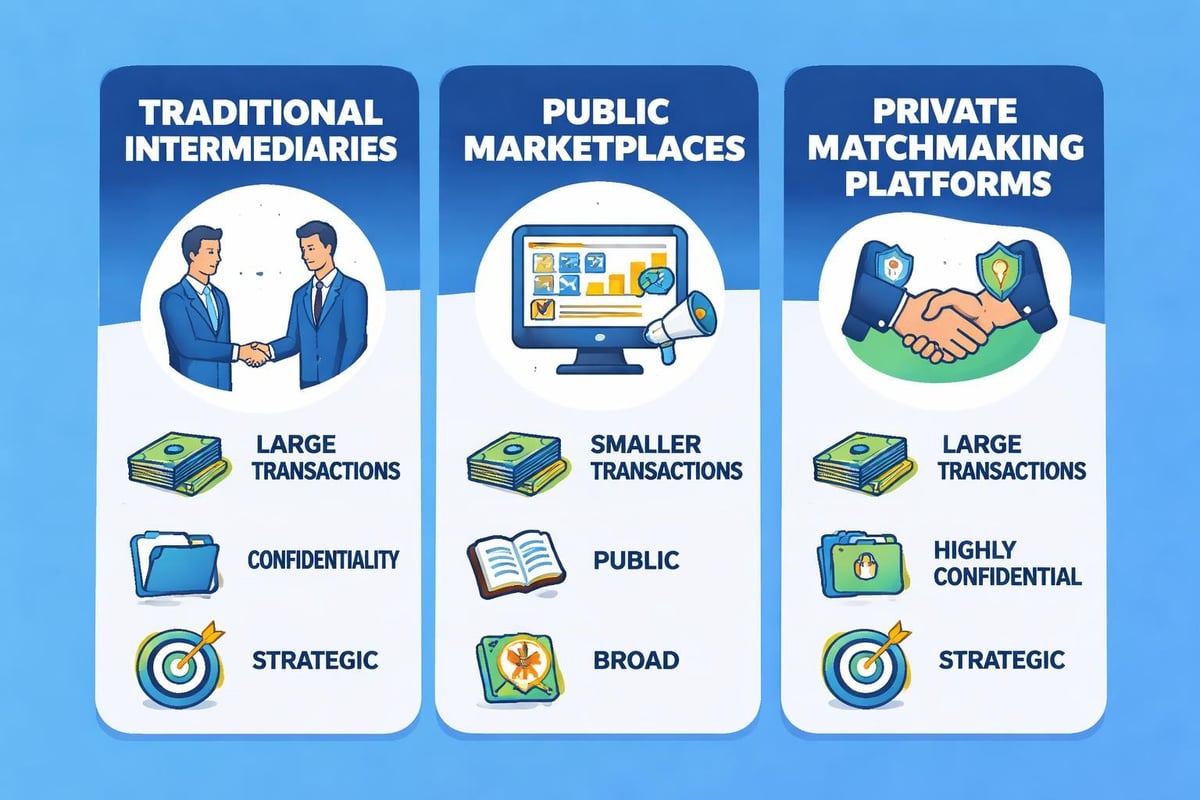
Traditional intermediaries remain the most recognized route. Investment bankers typically handle larger transactions exceeding $50 million in enterprise value, while business brokers serve the smaller end of the market. M&A advisors occupy the middle ground, often specializing in lower-middle-market deals ranging from $5 million to $100 million. These professionals bring expertise, buyer networks, and transaction management capabilities.
Public marketplaces represent another category where to sell your company. Platforms like BizBuySell and BizQuest allow business owners to list their businesses for sale publicly, reaching a broad audience of potential buyers. These venues work well for smaller businesses with straightforward operations, though they sacrifice confidentiality in exchange for visibility.
Private deal sourcing platforms have emerged as sophisticated alternatives, particularly for owners who value discretion and strategic fit. These platforms facilitate connections between qualified buyers and sellers without public listings, maintaining confidentiality while enabling meaningful pre-qualification conversations.
Confidentiality Considerations in the Sale Process
Maintaining confidentiality ranks among the top concerns when determining where to sell your company. Public listings on traditional marketplaces expose your sale intentions to competitors, employees, suppliers, and customers before you've secured a transaction. This exposure can destabilize operations, trigger employee departures, or weaken your negotiating position.
Private platforms address this vulnerability by operating on an invitation-only or qualified-access basis. Sellers maintain control over information disclosure, revealing identity and sensitive details only after establishing mutual interest with pre-screened buyers.
Aligned IQ M&A operates as a proprietary platform where business owners can explore potential transactions without public exposure. The platform's matchmaking process keeps seller identities confidential until both parties confirm strategic alignment, protecting your competitive position throughout early-stage conversations.
Strategic Fit vs. Traditional Transaction Metrics
The conventional approach to determining where to sell your company often prioritizes financial metrics like EBITDA multiples, revenue growth, and transaction speed. While these factors matter, they don't address a critical question: will the buyer understand and preserve what makes your business valuable?
Prioritizing Alignment in Buyer Selection
Strategic fit encompasses shared values, complementary expertise, cultural compatibility, and aligned growth visions. A buyer with industry experience and operational synergies can often unlock greater value than one simply offering the highest initial bid. In a typical scenario, an owner of a specialized manufacturing business might receive competing offers from a financial buyer offering 6.5x EBITDA and a strategic buyer offering 5.8x EBITDA but with deep industry relationships and proven integration capabilities. The strategic buyer's offer could ultimately deliver superior outcomes when considering earnout potential, employee retention, and legacy preservation.
The challenge lies in evaluating strategic fit before investing months in due diligence with the wrong counterparty. Traditional M&A processes often reverse this sequence, consuming significant time and resources before discovering fundamental misalignment.
Aligned IQ M&A differentiates itself by placing strategic fit at the foundation of its matchmaking algorithm. The platform analyzes users' transaction priorities, deal size parameters, and industry expertise before facilitating introductions. This methodology helps ensure conversations begin with parties who share compatible objectives, reducing wasted time on mismatched opportunities.
| Evaluation Criteria | Traditional Process | Strategic-First Approach |
|---|---|---|
| Initial Focus | Financial metrics, price range | Strategic alignment, shared priorities |
| Due Diligence Timing | After preliminary agreement | After confirming strategic fit |
| Confidentiality | Often compromised early | Maintained until mutual interest |
| Time to Quality Conversations | 3-6 months | 2-4 weeks |
Modern Platforms Transforming Where to Sell Your Company
The digital transformation of M&A has created new venues that combine technology with traditional deal-making expertise. Understanding the landscape helps owners make informed decisions about which platforms align with their goals.
Public Listing Marketplaces
These platforms function similarly to real estate listings, creating searchable databases of available businesses. They work best for:
- Businesses valued under $5 million
- Asset-heavy operations with clear financials
- Owners willing to accept broad market exposure
- Transactions where speed matters more than buyer selection
The primary drawback remains the public nature of listings, which can alert competitors and unsettle stakeholders before a transaction closes.
Proprietary Matchmaking Platforms
Representing the evolution of where to sell your company, these platforms combine qualified buyer networks with intelligent matching algorithms. Unlike public marketplaces, they operate on a more exclusive basis, emphasizing quality of connections over quantity of impressions.
Aligned IQ M&A exemplifies this category, offering business owners a venue to explore potential sales while maintaining operational confidentiality. The platform serves as a deal sourcing platform for qualified buyers, creating a two-sided marketplace where both parties can evaluate strategic compatibility before committing to formal processes. This approach particularly benefits owners who aren't certain about timing but want to understand their options, as well as those seeking specific buyer characteristics that align with their exit goals.

Preparing Your Company Regardless of Venue
Regardless of where to sell your company, preparation determines success. Preparing your business for sale requires attention to financial documentation, operational systems, and strategic positioning.
Financial and Operational Readiness
Buyers scrutinize three to five years of financial statements, tax returns, and operational metrics. Clean books with clear revenue recognition, documented expenses, and reconciled accounts accelerate due diligence and support valuation.
Key preparation steps include:
- Normalizing financial statements to reflect true business performance
- Documenting standard operating procedures to demonstrate transferability
- Resolving legal or compliance issues that could derail transactions
- Strengthening management teams to reduce key-person dependency
- Cleaning up customer concentration to minimize perceived risk
In a typical scenario, an owner might discover that 40% of revenue comes from a single customer. Addressing this concentration before going to market by diversifying the customer base over 12-18 months could increase valuation by 15-20% while reducing buyer concerns about post-acquisition revenue stability.
Enhancing Strategic Value
Beyond operational metrics, buyers evaluate strategic assets including intellectual property, market position, customer relationships, and growth potential. Identifying and documenting these intangible assets strengthens your position when discussing where to sell your company and what terms to accept.
Strategic value drivers often include proprietary technology, exclusive distribution agreements, recurring revenue models, and defensible competitive moats. Articulating these elements clearly helps buyers understand why your business merits premium consideration.
The Role of Virtual Data Rooms in Your Sale Process
Regardless of where to sell your company initially, successful transactions eventually require secure document exchange during due diligence. Virtual data rooms (VDRs) have become standard infrastructure for middle-market transactions, replacing physical data rooms and unsecured file-sharing services.
Understanding VDR Economics
Traditional virtual data room providers charge substantial fees, often starting at $10,000-$15,000 for lower-middle-market transactions. These costs can quickly escalate with additional users, storage, or extended timelines. Data room costs represent a meaningful expense in deal budgets, particularly for smaller transactions where every dollar impacts net proceeds.
Aligned IQ VDR addresses this cost barrier with competitive pricing designed specifically for lower-middle-market participants. The platform offers secure document management, granular permission controls, and activity tracking at pricing significantly below traditional providers. You can review detailed VDR pricing to compare against alternatives.
Complimentary VDR Access for Platform Users
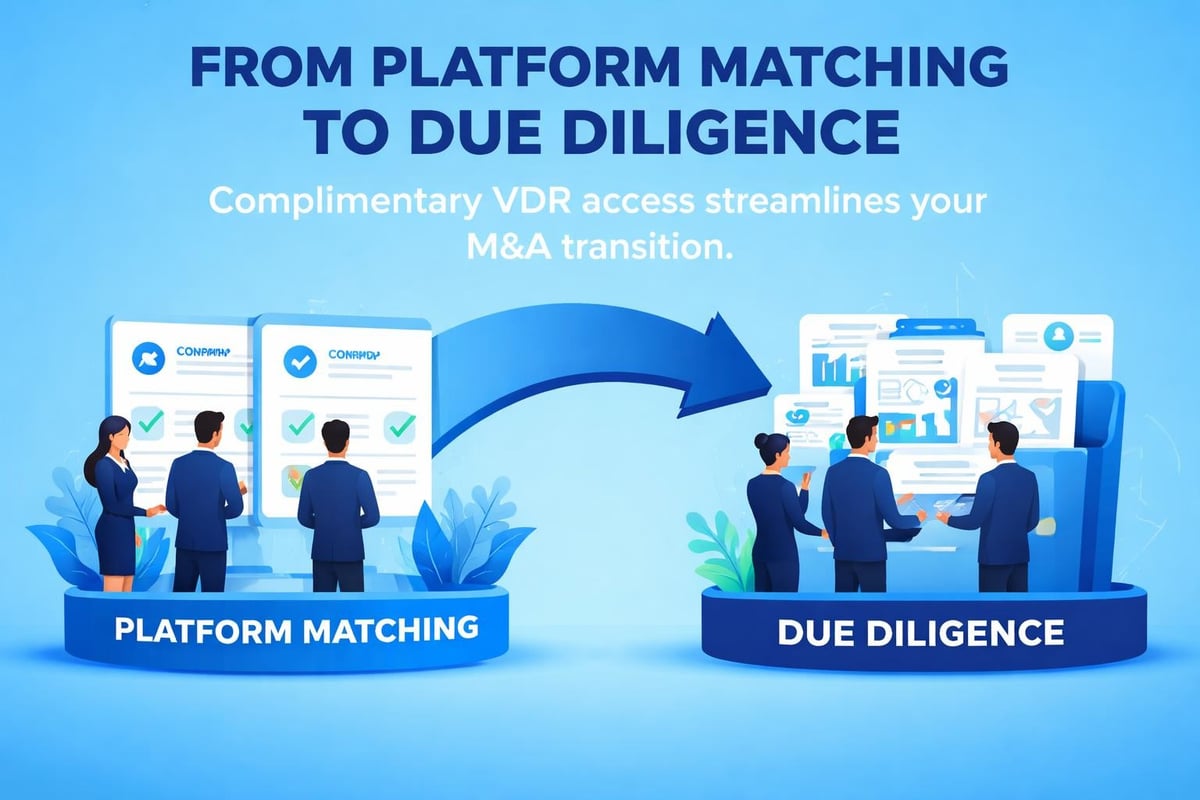
A distinctive advantage of using Aligned IQ M&A as your venue for where to sell your company is the complimentary VDR access provided after completing a match on the platform. This integration eliminates separate VDR procurement, reduces transaction costs, and ensures seamless transition from initial conversations to formal due diligence.
Sellers who match with buyers through the platform receive full VDR functionality at no additional cost, while the competitively priced offering remains available to other buyers, sellers, M&A advisors, investment bankers, and service providers who need standalone virtual data room capabilities.
| VDR Feature | Traditional Providers | Aligned IQ VDR |
|---|---|---|
| Base Cost | $10,000-$25,000 | See competitive pricing |
| User Limits | Often restricted | Flexible user management |
| Storage Caps | Tiered pricing | Scalable options |
| For Platform Matches | Not applicable | Complimentary for sellers |
Evaluating M&A Advisors and Service Providers
Many owners considering where to sell your company eventually engage professional advisors to manage the transaction process. The quality and incentive alignment of these relationships significantly impact outcomes.
Selecting the Right Advisor
Choosing the right M&A advisor requires evaluating industry expertise, transaction experience in your size range, fee structures, and cultural fit. Advisors charging retainers demonstrate commitment to working your deal, while success-fee-only arrangements can create pressure for quick closes regardless of terms.
Questions to ask potential advisors include:
- How many transactions in my industry and size range have you completed?
- What is your typical timeline from engagement to close?
- How do you maintain confidentiality during marketing?
- What is your fee structure, including retainers and success fees?
- Can you provide references from recent sell-side clients?
Service Provider Opportunities on Modern Platforms
The evolution of where to sell your company has created new opportunities for M&A service providers. Aligned IQ M&A enables advisors, attorneys, accountants, and other professionals to showcase their services, receive referrals, and earn compensation for connecting sellers with the platform.
This model creates aligned incentives where service providers can introduce clients to a confidential exploration process without forcing premature decisions. Owners benefit from professional guidance while maintaining control over timing and buyer selection.
Timing Your Market Entry
Determining not just where to sell your company but when to enter the market requires balancing personal readiness, business performance, and market conditions. Optimal timing typically occurs when the business demonstrates consistent growth, operations run independently of the owner, and market multiples favor sellers.
Market Cycle Considerations
M&A markets operate in cycles influenced by interest rates, credit availability, buyer appetite, and economic confidence. Selling during favorable conditions can add 20-30% to valuations compared to distressed or uncertain periods.
However, waiting for perfect market conditions can mean missing personal readiness windows or allowing business performance to deteriorate. The best approach often involves preparing thoroughly so you can move quickly when conditions align.
Exploratory Positioning
Many successful exits begin with exploratory conversations long before formal sale processes. This approach allows owners to understand market interest, refine positioning, and identify potential counterparties without commitment pressure.
Private platforms excel in supporting this exploratory phase. Aligned IQ M&A enables business owners to create profiles, evaluate potential matches, and engage in preliminary discussions without triggering formal sale obligations. This low-pressure environment helps owners make informed decisions about whether, when, and where to sell your company based on actual market feedback rather than assumptions.
Maximizing Value Through Strategic Buyer Selection
The venue you choose for where to sell your company directly influences the buyer pool you access. Different venues attract distinct buyer types with varying priorities, resources, and value creation approaches.
Buyer Categories and Their Priorities
Financial buyers including private equity firms focus on cash flow generation, multiple arbitrage, and portfolio synergies. They bring professional management and operational improvement expertise but may have shorter hold periods aligned with fund lifecycles.
Strategic buyers including competitors or adjacent industry players seek market share expansion, capability acquisition, or vertical integration. They often pay premium multiples for businesses that complement existing operations or eliminate competitive threats.
Individual buyers including entrepreneurial purchasers or family offices prioritize lifestyle businesses, legacy preservation, and long-term stewardship. They may offer more flexible structures but sometimes struggle with financing.
Understanding which buyer category best aligns with your priorities helps determine where to sell your company. Strategic fit considerations should guide this evaluation, ensuring the buyer type matches your vision for the business's future.
Showcasing Your Business to Quality Buyers
Regardless of venue, attracting quality buyers requires clear positioning, compelling value propositions, and professional presentation. Your business should answer:
- What makes this company defensibly valuable?
- How does it solve problems better than alternatives?
- What growth opportunities exist for the right buyer?
- Why is now an attractive entry point?
Platforms emphasizing strategic fit create space for nuanced answers to these questions before financial negotiations begin. This sequencing allows owners to select among interested parties based on alignment rather than just price.
Navigating the Transaction Process
Once you've determined where to sell your company and identified promising buyers, the formal transaction process begins. Understanding this journey helps set realistic expectations and maintain momentum through challenging phases.
Letter of Intent and Exclusivity
Preliminary agreements formalize interest and establish framework terms including valuation range, deal structure, timeline, and exclusivity periods. Exclusivity typically lasts 60-90 days, during which the buyer conducts due diligence without competitive pressure.
Negotiating exclusivity terms carefully protects your interests. Overly long periods favor buyers, while insufficient time creates pressure for incomplete diligence that surfaces issues post-close.
Due Diligence Coordination
Professional due diligence examines financial, legal, operational, and commercial aspects of your business. Organized data rooms, responsive management, and transparent disclosure accelerate this phase while building buyer confidence.
Aligned IQ VDR facilitates efficient due diligence through structured document organization, permission-based access, and activity tracking. Sellers can monitor which documents buyers review, how much time they spend on specific materials, and what questions arise, enabling proactive issue resolution.
Closing and Transition
Successful transactions conclude with definitive purchase agreements, financing confirmation, regulatory approvals, and transition planning. Post-close involvement varies based on deal structure, with many agreements requiring seller transition support ranging from 30 days to 12 months.
Alternative Exit Structures Beyond Outright Sales
Determining where to sell your company should include considering structures beyond traditional asset or stock sales. Alternative approaches can optimize tax outcomes, maintain partial ownership, or stage exits over time.
Earnout Arrangements
Earnouts tie portions of the purchase price to future performance metrics, bridging valuation gaps when buyers and sellers disagree about growth potential. These structures work well when historical performance doesn't fully reflect recent improvements or when the seller's continued involvement significantly impacts results.
Partial Sales and Recapitalizations
Selling majority stakes while retaining minority equity allows owners to monetize a portion of their value while participating in future upside. This approach particularly suits businesses with significant growth ahead where owners want liquidity but aren't ready for complete exit.
Employee Stock Ownership Plans
ESOPs create internal markets for your equity, transferring ownership to employees over time while providing tax advantages. This option appeals to owners prioritizing employee welfare and legacy preservation over maximum sale proceeds.
Understanding these alternatives helps frame conversations when exploring where to sell your company. Platforms facilitating strategic discussions before formal processes can help identify buyers open to creative structures aligned with your objectives.
The Collaborative Future of M&A
The traditional adversarial nature of M&A transactions is evolving toward more collaborative approaches where buyers and sellers work together to create mutual value. This shift influences where to sell your company by elevating venues that facilitate alignment over those emphasizing competitive tension.
Modern platforms enable this collaboration by creating transparent environments where both parties can explore fit before investing heavily in formal processes. This transparency reduces surprises, builds trust, and increases completion rates by filtering mismatched opportunities early.
Aligned IQ M&A embodies this collaborative philosophy by transforming deal-making into a matchmaking process where strategic priorities drive connections. Rather than forcing owners to navigate impersonal marketplaces or commit to lengthy advisor engagements before understanding options, the platform provides a middle path where exploration occurs safely and confidentially.
For owners ready to take the next step, the platform offers an opportunity to understand how buyers evaluate potential acquisitions while maintaining full control over timing and disclosure. This educational dimension helps sellers make informed decisions about whether, when, and where to sell your company based on market realities rather than assumptions.
Selecting where to sell your company requires balancing confidentiality needs, strategic priorities, transaction costs, and buyer access in ways that traditional venues often struggle to accommodate simultaneously. Modern platforms are reshaping this landscape by prioritizing fit over speed and collaboration over competition. Aligned IQ offers business owners a confidential venue to explore potential transactions with pre-qualified buyers who share their strategic priorities, complete with complimentary VDR access for matched sellers and competitively priced options for all market participants. Take a Tour to discover how a strategic-first approach can transform your exit journey into a collaborative search for the perfect counterparty.
No responses yet