

In a rapidly evolving business landscape, strategic business alignment is the difference between thriving organizations and those left behind. Yet, research shows that 90% of companies struggle to connect their strategies with execution, often missing out on growth and agility.
This guide reveals how businesses can achieve strategic business alignment to unlock sustainable success in 2026 and beyond. You will explore what alignment truly means, why it matters, and the core pillars that drive results.
Discover frameworks, step-by-step roadmaps, and real-world examples designed for practical application. Whether you lead a startup or a lower middle-market company, you will find actionable tools and strategies to drive results.
Ready to bridge the gap and empower your business? Take a Tour of proven alignment strategies and start your journey toward lasting success.
What Is Strategic Business Alignment?
Strategic business alignment is the process of ensuring that every element of an organization—its goals, resources, and daily activities—works together in pursuit of a single, unified vision. This approach goes beyond simply setting objectives. It demands that all teams, departments, and individuals move in the same direction, guided by a clear sense of purpose.
Many organizations struggle to connect their big-picture strategies with everyday actions. In fact, research shows that nearly 90 percent of companies fall short of bridging this gap, making strategic business alignment a mission-critical priority. When alignment is achieved, lower middle-market firms see higher project success rates, better agility, and stronger employee engagement.
A powerful way to understand strategic business alignment is through the lens of Blue Ocean Strategy, which highlights three core propositions: value, profit, and people. Value is about delivering what customers truly want. Profit ensures the business model is sustainable. People focus on motivating and empowering employees at every level. When these three elements align, organizations unlock lasting growth.
It is important to distinguish strategic business alignment from operational alignment. While operational alignment focuses on optimizing processes and workflows, strategic business alignment is about tying those operations directly to the company’s vision and long-term goals. For example, a lower middle-market manufacturer might realign its product development, sales, and customer service teams to support a new market entry, ensuring everyone shares a common objective.
Both startups and established businesses benefit from strategic business alignment. Startups use it to scale efficiently, while established firms rely on it to adapt to market changes. In either scenario, clear strategic roadmaps, regular communication, and transparent leadership are essential.
Common misconceptions persist. Some believe alignment is only for senior executives or that having goals is enough. In reality, alignment must be organization-wide, with everyone understanding how their work contributes to strategic objectives.
Popular frameworks like OKRs (Objectives and Key Results) and strategy canvases provide practical ways to embed strategic business alignment into daily operations. These tools help leaders track progress, identify gaps, and keep teams focused on what matters most.

The Pillars of Effective Strategic Alignment
Achieving strategic business alignment is not a one-time task but an ongoing discipline. It requires attention to core pillars that ensure every part of the organization moves together toward shared goals. Let’s break down these essential components and see how they shape success.

Aligning Vision, Mission, and Values
A clear vision and mission set the direction for strategic business alignment. When everyone understands where the company is headed and why, it becomes easier to unify resources and energy. For example, a lower middle-market manufacturer recently updated its mission to prioritize sustainable production, leading to sharper focus and higher morale.
Values play a powerful role in guiding decisions and shaping workplace culture. Strong, well-communicated values foster trust and collaboration across departments. Research shows that organizations with clear vision and values enjoy increased employee engagement and reduced turnover. When vision and values truly align, teams work with purpose, building a foundation for strategic business alignment.
Connecting Strategy to Execution
Turning high-level strategy into concrete results is a major challenge in strategic business alignment. Frameworks like OKRs help companies cascade objectives from leadership down to teams. For instance, one regional distributor uses quarterly OKR planning to keep everyone on track and accountable.
Measurable KPIs, linked to strategic objectives, ensure progress is visible and actionable. Without execution buy-in, even the best strategies risk being forgotten. For practical advice on bridging this gap, see these effective strategy execution tips. Companies that connect strategy and execution successfully outperform peers and adapt faster to changes.
Cross-Functional Collaboration and Communication
Silos can stall progress and innovation, undermining strategic business alignment. Regular cross-departmental meetings encourage shared goals and spark new ideas. Lower middle-market firms have seen project success rates rise simply by establishing transparent communication channels and using dashboards for visibility.
Collaboration tools, such as project management software and portfolio boards, help teams stay informed and coordinated. Open communication ensures that everyone understands priorities, making it easier to adjust quickly when needed. The result is a more resilient and agile organization.
Continuous Feedback and Adaptation
Continuous feedback loops are essential for maintaining strategic business alignment in dynamic markets. Agile review sessions or retrospectives allow teams to reflect, learn, and pivot as needed. A local manufacturing business, for example, holds monthly strategy reviews to identify improvements and celebrate wins.
Adaptability boosts organizational agility and helps businesses respond to shifts in customer needs or market conditions. By embedding feedback into daily routines, companies foster a culture of learning and sustained alignment.
Step-by-Step Roadmap to Achieving Strategic Alignment in 2026
Achieving strategic business alignment is not a one-time event. It is a repeatable process that connects your vision to everyday actions, ensuring your entire organization moves in sync. Here’s a practical, five-step roadmap for lower middle-market leaders seeking alignment that drives sustainable growth and minimizes risk.

Step 1: Establish Organizational Transparency
Transparency is the foundation of strategic business alignment. When teams have access to real-time strategic plans and progress updates, silos break down and decision-making improves.
Use visual tools such as strategy canvases and portfolio boards to display objectives, key results, and project status. In lower middle-market companies, leaders who model transparency set the tone for open communication and accountability. For example, a specialty manufacturer increased transparency by sharing dashboards with all staff, reducing isolated decisions and aligning everyone with the company’s direction.
Leadership must go beyond announcements. Encourage questions and make information accessible. Transparent organizations are less likely to encounter misalignment, as every team member understands priorities and progress.
Step 2: Communicate Strategy Across All Levels
Effective communication is essential for strategic business alignment. Leadership should use multiple channels—town halls, newsletters, and digital platforms—to cascade strategy throughout the organization.
A lower middle-market distributor found that monthly town halls and weekly email updates dramatically improved alignment. Employees who understand the strategy are more engaged and productive. According to Gallup, organizations with clear communication see up to 23% higher profitability.
Make communication two-way. Encourage feedback and clarify how each role contributes to overall goals. This approach ensures that strategy is not just understood, but embraced at every level. Consistent messaging and open dialogue foster a culture where alignment becomes second nature.
Step 3: Implement a Goal-Setting Framework (e.g., OKRs)
Translating strategy into measurable objectives is key to strategic business alignment. Frameworks like OKRs (Objectives and Key Results) help break down high-level goals into actionable steps.
Begin by setting company-wide objectives, then cascade them into team and individual goals. Use regular check-ins to track progress and adjust as needed. For example, a growing lower middle-market services firm adopted OKRs and saw improved focus, faster project delivery, and higher employee engagement.
Ensure goals are transparent and tied directly to your strategy. When every employee sees how their work connects to the big picture, alignment becomes a daily habit, not just a quarterly exercise.
Step 4: Foster Cross-Functional Collaboration
Collaboration across teams is vital for achieving strategic business alignment. Cross-functional teams bring together diverse skills, leading to innovative solutions and shared accountability.
Create project teams that span departments for major initiatives. For instance, a lower middle-market manufacturer formed a cross-functional group to launch a new product line, resulting in faster time-to-market and improved customer satisfaction. Tools like project management software and shared dashboards make collaboration seamless and track progress in real time.
Encourage open communication between departments. When collaboration is prioritized, organizations avoid the pitfalls of siloed decision-making and maintain alignment as markets evolve.
Step 5: Monitor, Measure, and Adapt
Continuous monitoring and adaptation are central to maintaining strategic business alignment. Establish regular review sessions to evaluate progress against KPIs such as project success rates, budget adherence, and employee engagement.
Use data-driven insights to adjust your strategy as needed. Many lower middle-market firms rely on real-time dashboards and agile feedback loops to stay responsive. Incorporating using strategy review meetings helps reinforce accountability and adaptability, ensuring your organization remains aligned through changing conditions.
Remember, alignment is not static. Embrace a culture of continuous improvement. Ready to see how these tools work in action? Take a Tour of Aligned IQ’s proprietary alignment solutions to unlock your next level of success.
Real-World Examples and Case Studies
Case studies are essential for illustrating how strategic business alignment plays out in diverse settings. These real-world examples showcase both the rewards of effective alignment and the pitfalls when it is lacking. The following cases span global success stories, cautionary tales, and practical applications in the lower middle market.
Dubai’s Strategic Alignment Success
Dubai offers a striking example of strategic business alignment in action. By aligning its value, profit, and people propositions, Dubai transformed from a regional trading post into a global hub. Investments in infrastructure, free trade zones, and a cosmopolitan environment drew international businesses and talent.
This alignment allowed Dubai to pursue both differentiation and cost leadership, supporting sustainable growth. The city’s leadership ensured that strategic roadmaps were widely communicated and that teams at every level understood their role. As highlighted in Blue Ocean Strategy, Dubai’s approach demonstrates how clear alignment drives exceptional outcomes.
Tata Nano: Lessons from Strategic Misalignment
The Tata Nano was launched as “The People’s Car,” aiming to make automobile ownership accessible to millions. However, the project struggled due to a lack of strategic business alignment. While the value proposition was compelling, there was a disconnect between product design, profit margins, and workforce motivation.
This misalignment led to execution challenges and ultimately market rejection. The case illustrates the importance of ensuring that product, business model, and people strategies all move in the same direction. According to the INSEAD Blue Ocean Strategy Institute, neglecting even one pillar can undermine an entire initiative.
Lower Middle-Market Success Story
Consider a lower middle-market manufacturer that embraced strategic business alignment to scale efficiently. Leadership crafted a clear vision, then communicated it through regular town halls and digital platforms. Cross-functional teams were formed to address key initiatives, breaking down silos and fostering collaboration.
By implementing OKRs, this business ensured that every department’s goals aligned with its strategic roadmap. The results were tangible: faster project delivery, higher employee retention, and improved customer satisfaction. Confidentiality and secure systems, similar to those offered by Aligned IQ, also played a role in building trust during periods of change.
The Role of Strategy Canvases and Dashboards
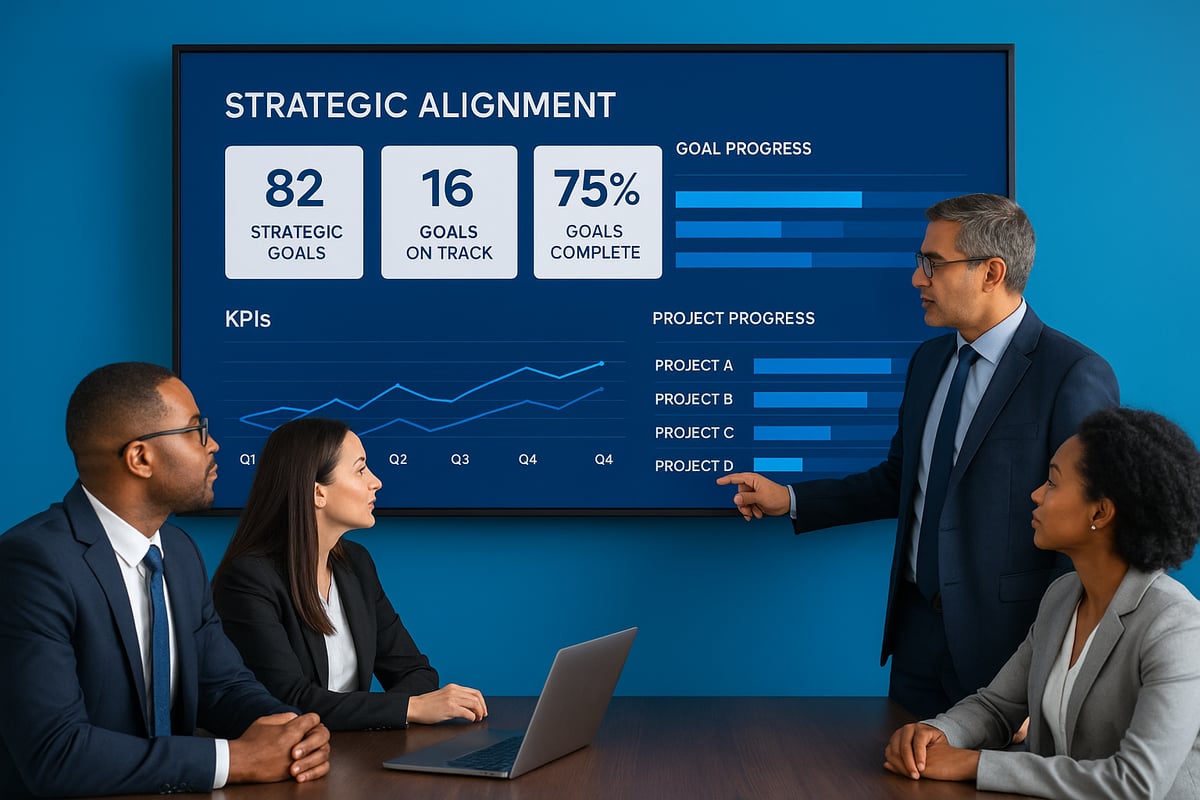
Visual tools such as strategy canvases and management dashboards make strategic business alignment visible and actionable. Companies use these tools to identify alignment gaps, monitor KPIs, and track progress toward objectives in real time. For example, organizations leveraging the Balanced Scorecard have seen measurable improvements in alignment and execution, as detailed in this Balanced Scorecard and Strategic Alignment Case Study.
Regular use of dashboards enables teams to adapt quickly and maintain focus on shared goals. For leaders seeking a confidential, low-risk approach, these tools offer a secure and practical way to keep everyone aligned. Take a Tour to explore how these solutions can drive results in your business.
Common Pitfalls and How to Avoid Them
Even the most promising strategic business alignment efforts can be derailed by common pitfalls. Many organizations, particularly in the lower middle market, underestimate the complexity of aligning vision, execution, and people. This can result in wasted resources, missed opportunities, and stagnating growth.
One frequent mistake is focusing on just one or two pillars of strategic business alignment. For example, a company might overemphasize profit at the expense of value or people, leading to disengaged employees or a product that fails to resonate with customers. True alignment demands equal attention to value, profit, and people across every level of the organization.
Common Pitfalls in Strategic Business Alignment
| Pitfall | Consequence |
|---|---|
| Focusing only on profit | Declining morale, customer churn |
| Siloed decision-making | Inefficient execution, miscommunication |
| Poor adaptation to market | Lost relevance, missed opportunities |
| Lack of feedback loops | Stagnant strategy, slow response |
Siloed decision-making is another major hurdle. When teams or departments operate in isolation, strategic intent rarely translates into effective action. To bridge this gap, organizations benefit from implementing clear decision rights, ensuring that everyone understands who decides what and why. This clarity reduces confusion and speeds up execution, especially during critical growth phases.
Failing to adapt strategy in response to changing market conditions is equally risky. Consider a lower middle-market manufacturer that ignored early signals of shifting customer preferences. Without regular reviews and feedback, they lost market share to more agile competitors. Strategic business alignment is not a one-time event; it requires continuous monitoring and adaptation.
PMI research reinforces this point:
Projects with strong alignment are 57% more likely to meet their goals, and 50% more likely to finish on time and on budget.
To avoid these pitfalls, leaders should:
- Conduct regular alignment reviews with cross-functional teams
- Hold leadership accountable for communicating strategy clearly
- Establish open feedback channels for rapid issue identification
- Use visual tools like dashboards to spot alignment gaps early
Holistic, ongoing strategic business alignment is the foundation for sustainable growth and resilience. Avoiding these pitfalls not only protects your organization but also positions it to thrive in a dynamic business landscape. Ready to strengthen your alignment efforts? Take a Tour of proven strategies and tools designed for lower middle-market success.
Essential Tools and Frameworks for Leaders
Selecting the right tools is crucial for achieving strategic business alignment in any organization. The right frameworks help translate vision into measurable outcomes, ensure clarity at every level, and support sustainable growth. Leaders who adopt proven tools position their teams to bridge the gap between planning and execution.
Key Tools for Strategic Business Alignment
Several essential tools support strategic business alignment for lower middle-market companies and growth-focused organizations:
| Tool | Purpose | Benefit | Best For |
|---|---|---|---|
| OKRs | Set, track, and review objectives | Aligns daily work with business strategy | All company sizes |
| Strategy Canvases | Visualize strategic priorities | Spot alignment gaps at a glance | Leaders, cross-functional |
| Management Dashboards | Real-time tracking of initiatives | Increases transparency and agility | Management, operations |
| Portfolio Boards | Oversee multiple projects and resources | Optimize resource allocation | Project teams, executives |
These frameworks create transparency and accountability in strategic business alignment, ensuring every team member knows how their work contributes to the bigger picture.
Implementing OKRs: Step-by-Step
OKRs (Objectives and Key Results) are a powerful way to embed strategic business alignment into day-to-day operations. To implement OKRs:
- Define clear, ambitious objectives linked to your strategic vision.
- Break each objective into measurable key results.
- Cascade OKRs from company to team to individual levels.
- Review progress regularly using dashboards or portfolio boards.
- Adapt OKRs based on feedback and changing priorities.
Lower middle-market companies often find OKRs invaluable for maintaining focus and flexibility as they scale. This approach supports both transparency and engagement across all levels.
Visual Tools and Selecting the Right Frameworks
Strategy canvases and management dashboards are indispensable for leaders seeking real-time insights. These visual tools help identify misalignment early and enable prompt course correction. Dashboards, in particular, make it easy to monitor KPIs and project milestones, supporting data-driven decisions.
When evaluating tools, consider company size, complexity, and confidentiality needs. For example, Aligned IQ offers proprietary dashboards and secure portfolio boards designed specifically for business buyers and sellers, providing a confidential alternative to the traditional M&A process. For more on how organizational systems drive alignment and value, explore Driving business value with systems.
Success Stories and Next Steps
Lower middle-market manufacturers have leveraged these frameworks to improve project delivery, boost employee retention, and raise customer satisfaction. By adopting strategic business alignment tools tailored to their unique needs, these organizations build resilience and unlock growth.
Ready to see which alignment tools fit your business? Take a Tour of the solutions that support secure, low-risk, and effective strategic business alignment for your next phase of success.
As we’ve explored, strategic alignment is at the heart of sustainable business success—bridging vision, execution, and collaboration to unlock real growth in 2026 and beyond. Whether you’re aiming to improve communication across teams, leverage proven frameworks like OKRs, or just want to see how other leaders are aligning strategy with results, there’s no better time to take the next step. If you’re ready to see these concepts in action and discover practical tools that make alignment achievable for your organization, I invite you to Take a Tour!
No responses yet