

Determining an accurate small company valuation remains one of the most challenging yet critical tasks for business owners planning an exit and buyers seeking acquisition opportunities. Unlike publicly traded companies with transparent market prices, small businesses require specialized approaches that account for limited financial history, concentrated ownership, and illiquid markets. Whether you're preparing to sell, evaluating an acquisition target, or simply benchmarking your company's worth, understanding the fundamental valuation methods and their appropriate applications can mean the difference between a successful transaction and a missed opportunity.
Understanding Small Company Valuation Fundamentals
Small company valuation differs substantially from large-cap corporate valuation due to several structural factors. Most small businesses lack the sophisticated financial reporting systems, independent boards, and diversified revenue streams that characterize larger enterprises. These characteristics introduce both risk and opportunity into the valuation process.
The foundation of any credible small company valuation rests on three classical approaches: the income approach, the market approach, and the asset-based approach. Each method provides a different lens through which to assess value, and experienced valuators typically employ multiple methods to triangulate a defensible range. The CFA Institute refresher materials on private company valuation provide professional-grade guidance on applying these frameworks to privately held enterprises.
Income Approach: Discounted Cash Flow Analysis
The income approach values a business based on its ability to generate future economic benefits. For small companies, this typically manifests as a discounted cash flow (DCF) analysis or a capitalization of earnings method.
DCF analysis involves projecting the company's future free cash flows and discounting them to present value using an appropriate risk-adjusted rate. The challenge lies in developing realistic projections for businesses that may have volatile historical performance and limited management depth.
Key considerations for small company DCF include:
- Normalization adjustments to remove owner compensation above market rates, non-recurring expenses, and discretionary costs
- Growth rate assumptions that reflect realistic market opportunities rather than aspirational plans
- Terminal value calculations that account for the company's sustainable competitive position
- Discount rate selection incorporating size premiums and company-specific risk factors
The discount rate for a small company typically ranges from 20% to 40%, significantly higher than the 8% to 12% often applied to established middle-market firms. This premium reflects higher business risk, key person dependency, customer concentration, and limited access to capital markets.

Market Approach and Comparable Company Analysis
The market approach derives value by comparing the subject company to similar businesses that have recently sold or to publicly traded companies in the same industry. This method provides real-world market validation but requires careful selection and adjustment of comparable transactions.
Transaction Multiples and Their Application
Small company valuations frequently rely on EBITDA multiples (Enterprise Value / Earnings Before Interest, Taxes, Depreciation, and Amortization) as the primary market-based metric. According to KPMG’s 2024 Cost of Capital Study, lower middle-market companies with EBITDA below $5 million typically command multiples ranging from 3.0x to 6.0x, though industry and growth characteristics create substantial variance.
| Company EBITDA | Typical Multiple Range | Key Value Drivers |
|---|---|---|
| Under $1M | 2.0x – 4.0x | Owner dependency, customer concentration |
| $1M – $3M | 3.0x – 5.5x | Systems, management team, recurring revenue |
| $3M – $5M | 4.0x – 7.0x | Scalability, market position, growth trajectory |
Revenue multiples serve as an alternative when earnings are volatile or negative, particularly common in high-growth sectors or asset-light service businesses. Technology-enabled companies may command revenue multiples from 0.5x to 2.0x, while traditional service businesses rarely exceed 0.75x revenue.
Understanding how to approach valuing a company requires recognizing that multiples serve as shorthand for complex value drivers rather than plug-and-play formulas. Two companies with identical EBITDA can have vastly different values based on revenue quality, customer retention, competitive moats, and growth potential.
Selecting Appropriate Comparables
The comparable company method only works when truly comparable transactions exist. For small companies in niche markets, finding relevant precedents becomes challenging. Buyers and sellers should focus on:
- Industry alignment with similar customer bases, business models, and competitive dynamics
- Size similarity recognizing that valuation multiples compress as company size decreases
- Geographic relevance accounting for regional economic conditions and market maturity
- Transaction timing giving more weight to recent deals reflecting current market conditions
Many small business owners overestimate their company's value by citing acquisition multiples for much larger companies in their industry. A regional HVAC company with $2 million in EBITDA cannot reasonably expect the same 8.0x multiple that a national consolidator with $50 million EBITDA might command.
Asset-Based Valuation Methods
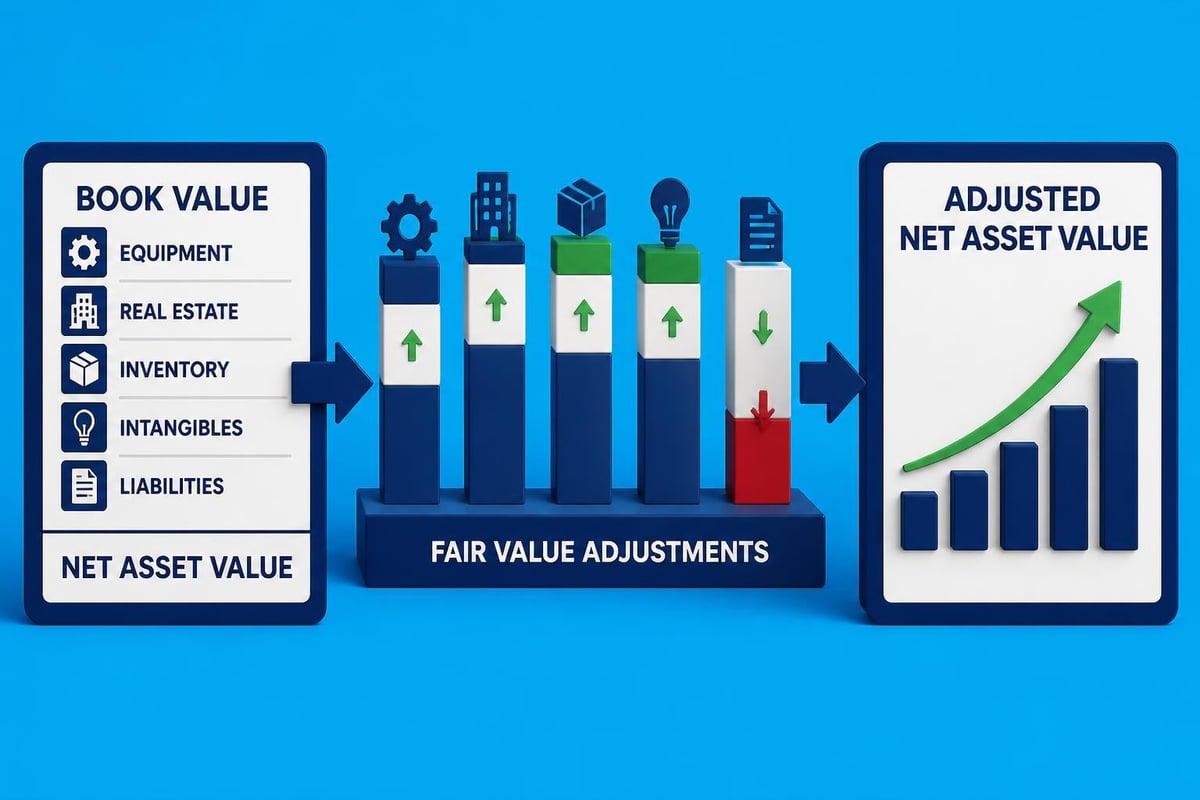
The asset-based approach calculates value by adjusting the company's balance sheet to reflect fair market values of assets and liabilities. This method proves most relevant for asset-intensive businesses, companies in financial distress, or holding companies with marketable securities and real estate.
For most operating small companies, the asset-based approach establishes a floor value rather than the primary valuation metric. A profitable business with going-concern value will almost always exceed its liquidation value.
Adjusted Net Asset Value
The adjusted net asset value (NAV) method involves:
- Identifying all tangible and intangible assets including equipment, inventory, customer relationships, and intellectual property
- Adjusting book values to fair market value through appraisals and market research
- Recognizing previously unrecorded intangible assets such as trained workforce, proprietary processes, or trade secrets
- Adjusting liabilities to reflect current obligations and contingent liabilities
- Calculating the difference between adjusted assets and adjusted liabilities
The IRS guidance on valuation of assets provides relevant frameworks for tax purposes, though transaction values may differ from tax valuations due to different objectives and standards.
Critical Adjustments for Small Business Valuations
Raw financial statements rarely tell the complete story for small companies. Professional valuators apply numerous adjustments to normalize earnings and present an accurate picture of sustainable economic performance.
Owner Compensation and Perquisites
Small business owners often run personal expenses through the company or pay themselves above or below market rates. A typical scenario might involve an owner taking $300,000 in total compensation when market rates for a hired CEO would be $150,000. This creates $150,000 in excess owner compensation that should be added back to earnings for valuation purposes.
Common normalization adjustments include:
- Excess owner compensation above fair market value for the role
- Personal vehicles, travel, and entertainment not directly related to business operations
- Family member salaries exceeding their actual contribution
- Owner health insurance and benefits that wouldn't continue under new ownership
- Professional fees for personal tax planning or estate work
One-Time and Non-Recurring Items
Businesses experience irregular events that distort annual performance. Credible small company valuation requires identifying and adjusting for:
- Lawsuit settlements or insurance recoveries
- Major equipment purchases or asset sales
- Customer bankruptcies or bad debt write-offs
- Significant marketing campaigns or trade show expenses
- Relocation costs or facility expansions
The goal is to present normalized, sustainable earnings that a buyer can reasonably expect to continue. When working with certified business appraisers, owners should proactively document these adjustments with supporting evidence rather than expecting valuators to identify them independently.
Working Capital and Deal Structure Considerations
Small company valuation extends beyond determining enterprise value. The deal structure, working capital requirements, and terms significantly impact the effective price and transaction success.
Working Capital Requirements
Most acquisitions require the seller to deliver minimum working capital levels at closing. Working capital-current assets minus current liabilities-represents the funds needed to operate the business day-to-day. Buyers typically expect to receive:
- Sufficient cash to cover payables and near-term obligations
- Adequate inventory at normal operating levels
- Current accounts receivable collectible under normal terms
- No excess accounts payable or deferred liabilities
A typical scenario involves establishing a normalized working capital target based on trailing twelve-month averages. If actual working capital at closing falls below this target, the purchase price adjusts downward dollar-for-dollar. Conversely, excess working capital above the target increases the price.
| Working Capital Component | Target Level | Actual at Closing | Adjustment |
|---|---|---|---|
| Cash | $75,000 | $85,000 | +$10,000 |
| Accounts Receivable | $200,000 | $190,000 | -$10,000 |
| Inventory | $150,000 | $145,000 | -$5,000 |
| Accounts Payable | ($125,000) | ($130,000) | -$5,000 |
| Net Working Capital | $300,000 | $290,000 | -$10,000 |
Understanding these mechanics proves essential when preparing a business for sale through platforms like Aligned IQ M&A, where buyers and sellers can confidentially explore strategic fit before negotiating detailed terms.
Valuation Multiples by Industry Sector
Industry dynamics create meaningful variation in small company valuation multiples. Understanding sector-specific benchmarks helps owners set realistic expectations and buyers identify outlier opportunities.
Service-Based Businesses
Professional services, consulting firms, and specialized contractors typically trade at lower multiples due to revenue dependency on key individuals and relationships. EBITDA multiples generally range from 2.5x to 5.0x for companies under $5 million in revenue.
High-value characteristics that push multiples toward the upper range include:
- Diversified client base with no single client exceeding 15% of revenue
- Long-term contracts or retainer agreements
- Standardized service delivery processes
- Strong second-tier management team
- Proprietary methodologies or intellectual property
Product-Based and Manufacturing Businesses
Companies that manufacture or distribute physical products often command higher multiples (4.0x to 7.0x EBITDA) due to more transferable operations and lower key-person risk. Valuation drivers include proprietary products, exclusive distribution rights, and recurring customer demand.
Technology and SaaS Companies
Software and technology-enabled businesses represent the highest multiple category, frequently valued on revenue rather than earnings. Small SaaS companies with strong recurring revenue may achieve 2.0x to 4.0x annual recurring revenue (ARR) multiples, while established profitable companies reach 4.0x to 8.0x EBITDA.
The premium reflects scalability, high gross margins, predictable revenue streams, and attractive unit economics. For more detailed industry-specific insights, NYU Stern’s valuation resources offer comprehensive data on sector multiples and adjustment factors.

The Role of Due Diligence in Validating Valuation
Initial small company valuation represents an educated estimate rather than final value. Buyer due diligence often uncovers issues that justify price adjustments, earn-outs, or deal restructuring.
Financial Due Diligence Findings
Common discoveries during financial review include:
- Revenue recognition issues or channel stuffing
- Deferred maintenance on equipment and facilities
- Understated warranty or customer service obligations
- Pending litigation or regulatory compliance gaps
- Customer concentration exceeding representations
Quality of earnings (QoE) reports prepared by independent accountants provide buyers confidence in normalized earnings calculations. For small deals, a focused financial review costing $10,000 to $25,000 often substitutes for full QoE studies that can exceed $50,000.
Operational and Strategic Due Diligence
Beyond financial validation, buyers assess operational sustainability and strategic fit. Red flags that impact small company valuation include:
- Key employee departure risks without retention agreements
- Technology infrastructure requiring significant investment
- Supplier dependency on single sources
- Market share erosion or competitive threats
- Regulatory changes affecting industry economics
Platforms like Aligned IQ M&A address these concerns by prioritizing strategic fit assessment before deep due diligence. This approach reduces wasted effort on incompatible transactions while allowing compatible parties to work collaboratively through discovery.
The Aligned IQ VDR provides secure document sharing during due diligence, with competitive pricing that makes professional-grade data rooms accessible for lower middle-market transactions. The virtual data room is complimentary for Aligned IQ M&A sellers after a match is completed, removing financial barriers to organized, secure information exchange.
Valuation Reports and Professional Standards
Formal valuation reports follow professional standards that dictate methodology, disclosure, and documentation requirements. Understanding these standards helps business owners evaluate valuator credentials and report credibility.
Levels of Valuation Reports
Professional business appraisers offer three report levels:
- Calculation of Value – Limited scope assignment providing estimate based on agreed-upon methods without extensive analysis or documentation
- Summary Valuation Report – Abbreviated reporting providing conclusion and support but less detail than comprehensive report
- Detailed Valuation Report – Complete analysis including company background, industry research, methodology discussion, and detailed support
Most small company valuations for transaction purposes utilize summary reports balancing cost (typically $5,000 to $15,000) against credibility. Detailed reports costing $15,000 to $40,000 become necessary for complex situations, disputes, or regulatory requirements.
Choosing Qualified Valuators
Credible small company valuation requires expertise in private company analysis, not just financial modeling. Relevant credentials include:
- Accredited Senior Appraiser (ASA) from the American Society of Appraisers
- Certified Valuation Analyst (CVA) from the National Association of Certified Valuators and Analysts
- Accredited in Business Valuation (ABV) from the American Institute of CPAs
- Chartered Financial Analyst (CFA) with private company specialization
When engaging professionals for valuing private companies, verify their experience with similar-sized businesses in your industry. A valuator with extensive public company experience may lack the practical knowledge to appropriately adjust for small company characteristics.
Preparing Your Business for Valuation-Driven Sale
Business owners planning an exit should begin optimizing value drivers 18 to 36 months before going to market. Strategic preparation can increase small company valuation by 20% to 50% compared to unprepared exits.
Documentation and Systems
Buyers pay premiums for businesses with transferable operations. Critical documentation includes:
- Standard operating procedures for all key functions
- Customer relationship management systems with complete interaction history
- Financial reporting with monthly statements, budgets, and variance analysis
- Employment agreements and organizational charts clarifying roles
- Vendor contracts and pricing agreements documented and transferable
Financial Performance Optimization
Clean, growing financial performance commands the highest multiples. Focus areas include:
- Demonstrating consistent revenue growth of 10% to 20% annually
- Improving gross margins through pricing discipline and cost management
- Reducing customer concentration below 20% for any single client
- Building recurring revenue streams or multi-year contracts
- Eliminating owner-dependent revenue or customer relationships
Management Team Development
Reducing key person dependency significantly enhances small company valuation. Investing in a capable management team that can operate independently demonstrates scalability and reduces buyer risk. Second-tier managers capable of running departments or functions without daily owner involvement justify 15% to 30% higher multiples.
The mergers and acquisitions platform environment rewards prepared sellers with better matches and stronger negotiating positions. Aligned IQ M&A's focus on strategic fit means well-prepared businesses connect with buyers who recognize and value their strategic attributes rather than shopping solely on price.
Navigating Valuation Gaps Between Buyers and Sellers
Valuation disagreements represent the most common deal-breaker in small company transactions. Bridging the gap requires creativity, objective analysis, and deal structure flexibility.
Common Sources of Valuation Gaps
Sellers and buyers often value the same business differently due to:
- Differing growth assumptions with sellers projecting aggressive expansion and buyers taking conservative views
- Synergy expectations where sellers expect buyers to pay for synergies while buyers want to capture them
- Risk assessment divergence around customer retention, competitive threats, or key employee departure
- Market timing with sellers anchoring to peak multiples and buyers adjusting for current conditions
Bridging Mechanisms
When fundamental valuation disagreements exist but strategic fit remains strong, deal structures can bridge the gap:
Earn-outs tie a portion of the purchase price to future performance, aligning seller compensation with actual results. A typical scenario might involve 70% cash at closing with 30% contingent on achieving specific EBITDA targets over two or three years.
Seller financing allows buyers to pay over time, reducing upfront capital requirements while giving sellers confidence in business sustainability. Interest rates typically range from 5% to 8% for three to seven-year notes.
Employment agreements provide sellers ongoing income while ensuring continuity. This approach works well when sellers want partial retirement but can contribute strategic value during transition.
| Deal Structure | Typical Terms | Best Application |
|---|---|---|
| All Cash | 100% at closing | Buyers with capital, sellers wanting clean exit |
| Seller Note | 20%-40% financed over 3-7 years | Capital-constrained buyers, stable businesses |
| Earn-out | 20%-40% contingent over 2-3 years | Valuation gaps, growth businesses |
| Equity Rollover | Seller retains 10%-30% equity | Platform buyers, high-growth situations |
The confidential, collaborative environment provided by platforms focused on strategic fit helps parties work through valuation differences productively rather than walking away at the first disagreement.
Tax Implications of Valuation Decisions
How small company valuation gets allocated among asset classes significantly impacts after-tax proceeds for sellers and tax basis for buyers. These considerations often influence deal structure more than headline price.
Asset vs. Stock Sales
Most small company sales structure as asset purchases where buyers acquire specific assets and assume limited liabilities. This structure provides buyers with stepped-up tax basis and allows them to depreciate and amortize acquired assets over time.
Sellers generally prefer stock sales that qualify for long-term capital gains treatment with maximum federal rates of 20% plus 3.8% net investment income tax. Asset sales often trigger ordinary income on certain assets like inventory, receivables, and depreciation recapture.
Purchase Price Allocation
When structuring asset deals, the purchase price allocation among asset classes drives tax consequences. Buyers prefer allocating more value to shorter-lived depreciable assets, while sellers favor capital gain treatment. The allocation must follow fair market value principles and satisfy IRS Form 8594 requirements.
Working with tax advisors before finalizing valuations helps optimize structures for both parties. In some cases, buyers can justify higher total prices when tax benefits create equivalent after-tax costs, expanding the zone of possible agreement.
Market Conditions and Valuation Trends in 2026
Small company valuation responds to broader economic conditions, interest rates, buyer competition, and capital availability. Understanding current market dynamics helps set realistic expectations.
Current Multiple Environment
The 2026 valuation environment for small companies reflects normalized conditions following the pandemic-era peak. With interest rates stabilized and economic growth moderate, EBITDA multiples for sub-$5 million EBITDA companies average 4.2x to 4.8x across industries.
Sellers' market characteristics in specific sectors include technology-enabled services, healthcare-related businesses, and companies with strong recurring revenue models. These sectors continue attracting significant interest from lower middle-market PE firms and strategic buyers.
Buyers' market dynamics affect traditional manufacturing, retail-dependent businesses, and companies with significant customer concentration or technological obsolescence. These businesses often require creative structures or significant seller financing.
Impact of Financing Availability
Leverage availability directly impacts small company valuation. When senior lenders provide 3.0x to 4.0x EBITDA in debt financing, buyers can pay higher multiples while maintaining acceptable equity returns. Tightened lending standards compress multiples as buyers require larger equity contributions.
Small business administration (SBA) 7(a) loans continue supporting transactions for companies with $1 million to $5 million in EBITDA, allowing buyers to finance up to 90% of the purchase price for qualified businesses. This financing availability sustains healthy valuations for well-positioned companies.
Sector-Specific Valuation Considerations
Beyond general methodologies, certain industries present unique valuation challenges and opportunities that require specialized knowledge.
Professional Services Firms
Law firms, accounting practices, engineering consultancies, and similar professional services businesses face specific valuation challenges related to licensure, client portability, and human capital dependency. Revenue multiples (0.5x to 1.5x) often supplement EBITDA analysis due to compensation structure variations.
Key value drivers include:
- Practice area specialization and barriers to entry
- Client diversification and retention rates
- Leverage ratios (partners to associates)
- Recurring engagement models
- Cross-selling capabilities across service lines
Distribution and Wholesale Businesses
Distribution companies typically trade at 3.5x to 6.0x EBITDA based on supplier relationships, territory exclusivity, and customer service capabilities. The valuation process emphasizes:
- Exclusive distribution agreements and contract terms
- Warehouse and logistics infrastructure
- Customer concentration and service requirements
- Inventory management systems and turnover rates
- E-commerce capabilities and omnichannel integration
Healthcare Services
Home health, outpatient therapy, dental practices, and other healthcare services command premium valuations (4.0x to 7.0x EBITDA) reflecting aging demographics and recurring patient needs. Regulatory compliance, reimbursement models, and referral relationships drive value.
Buyers focus on payor mix (private insurance vs. government), quality metrics, and scalability across additional locations when assessing small company valuation in healthcare sectors.
Accurately determining small company valuation requires balancing analytical rigor with practical market realities while accounting for industry dynamics, company-specific characteristics, and current deal environments. Whether you're preparing for an eventual exit or evaluating acquisition opportunities, understanding these methodologies positions you for more informed decision-making and successful transactions. Aligned IQ transforms the M&A process by prioritizing strategic fit before deep financial negotiations, helping business owners and buyers find the right counterparty for their unique goals while providing complimentary virtual data room access for matched sellers. Take a tour of our platform to discover how our proprietary matching process creates more collaborative, successful transactions.
No responses yet