
Determining the fair value of a private company presents unique challenges that differ substantially from valuing publicly traded firms. Without readily available market prices or transparent financial disclosures, buyers and sellers must rely on sophisticated methodologies that account for illiquidity, information asymmetry, and the absence of continuous price discovery. Private company valuation becomes particularly critical during mergers and acquisitions, where accurate assessments protect both parties and facilitate successful transactions. Understanding the core approaches and their practical application empowers business owners, buyers, and advisors to negotiate with confidence and reach agreements grounded in financial reality.
Core Methodologies for Private Company Valuation
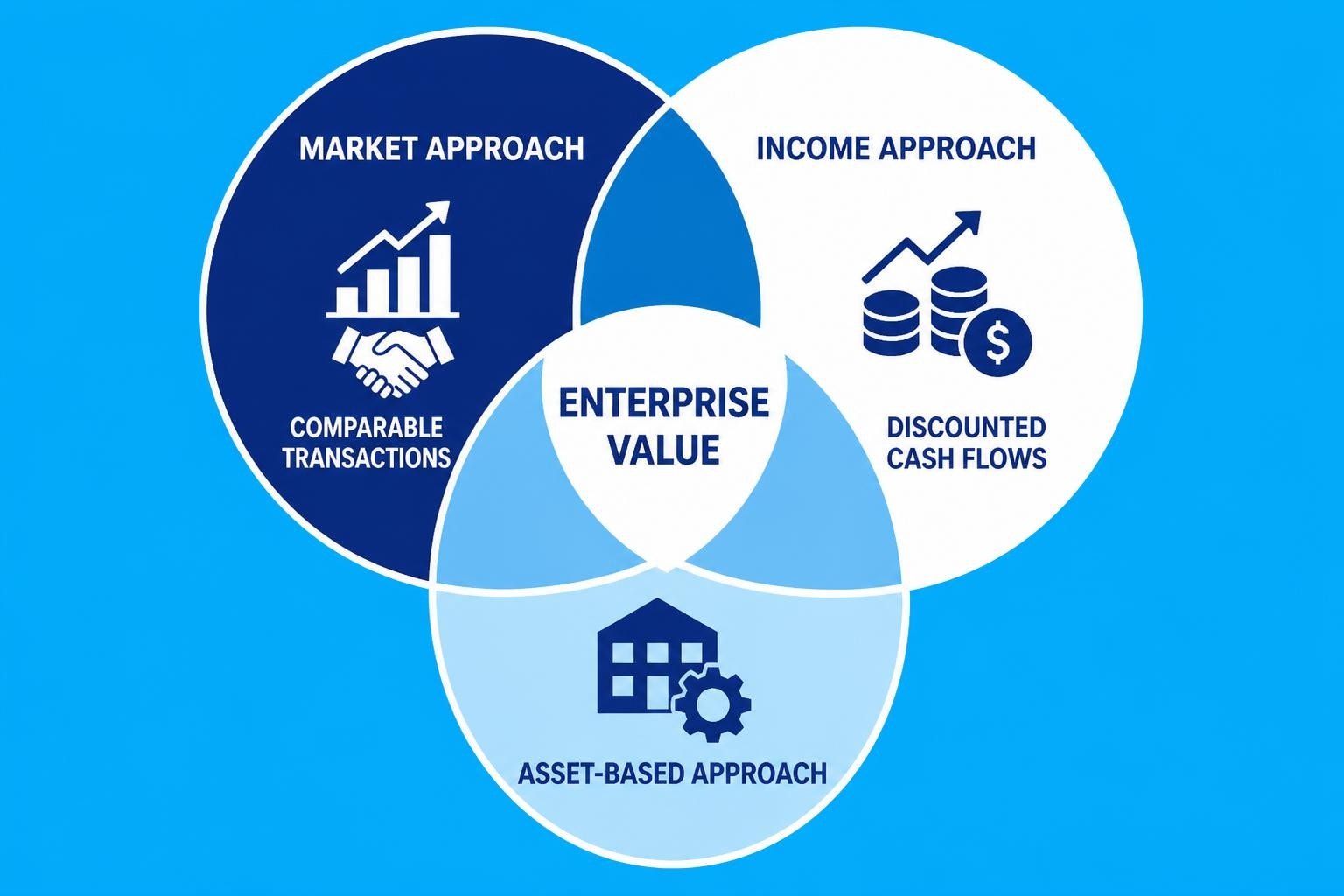
Professional valuators rely on three fundamental approaches when conducting private company valuation: the market approach, the income approach, and the asset-based approach. Each methodology offers distinct advantages depending on the company's characteristics, industry dynamics, and the quality of available information.
The market approach for private companies utilizes comparable transactions and guideline public companies to establish valuation multiples. Analysts identify similar businesses that have recently sold or are publicly traded, then apply relevant multiples such as enterprise value-to-EBITDA or price-to-revenue to the subject company. This method proves particularly effective when robust comparable data exists within the same industry segment.
Income Approach Fundamentals
The income approach centers on discounting expected future cash flows to present value, capturing the fundamental economic reality that a business is worth the sum of its future earnings. The discounted cash flow (DCF) method requires detailed financial projections, appropriate discount rates reflecting risk, and terminal value assumptions.
Key components of DCF analysis include:
- Projected free cash flows for explicit forecast period (typically 5-10 years)
- Weighted average cost of capital (WACC) or required rate of return
- Terminal value calculation using perpetuity growth or exit multiple
- Sensitivity analysis across varying assumptions

The income approach aligns particularly well with understanding enterprise value of a firm, as it captures both operating performance and capital structure considerations. Practitioners must exercise careful judgment when selecting discount rates, often referencing industry benchmarks and adjusting for company-specific risks such as customer concentration, management depth, and competitive positioning.
Market Approach Implementation
Applying the market approach to private company valuation requires access to quality transaction data and the analytical skill to make appropriate adjustments. The guideline public company method examines publicly traded firms with similar business models, growth profiles, and market dynamics. Valuators select relevant multiples such as EV/EBITDA, EV/Revenue, or Price/Earnings, then apply discounts for lack of marketability and size differences.
The guideline transaction method leverages data from actual private company sales within the same industry. Recent valuation insights and benchmarking for private markets provide critical context for understanding current multiples across sectors. This approach particularly benefits from specialized data sources that track middle-market transactions.
| Valuation Multiple | Description | Best Used When |
|---|---|---|
| EV/EBITDA | Enterprise value divided by earnings before interest, taxes, depreciation, amortization | Company has stable, positive EBITDA and comparable capital structures exist |
| EV/Revenue | Enterprise value divided by total revenue | Target is pre-profitable or operates in sector where revenue multiples dominate |
| P/E Ratio | Price divided by net earnings | Profitable company with stable earnings and minimal debt |
For technology and SaaS businesses, sector-specific multiples prove more relevant. Quarterly SaaS and technology valuation reports track private-company multiples, Rule-of-40 benchmarking, and growth-adjusted metrics that better capture the economics of recurring revenue models.
Making Appropriate Adjustments
Raw multiples from comparable companies rarely apply directly to private company valuation without modification. Analysts must account for differences in size, growth rates, profitability margins, customer diversification, and geographic footprint. Discounts for lack of marketability (DLOM) typically range from 15% to 35%, reflecting the difficulty of converting ownership into cash compared to publicly traded securities.
Control premiums or minority discounts also factor into valuations depending on whether the interest being valued represents controlling ownership. A controlling interest commands a premium because it conveys the power to direct strategy, appoint management, and control dividend policy.
Income Approach Deep Dive
Beyond basic DCF analysis, the income approach encompasses several variations suited to different private company contexts. The capitalization of earnings method simplifies the DCF framework by assuming a constant growth rate, dividing normalized earnings by a capitalization rate (discount rate minus growth rate). This proves useful for mature, stable businesses with predictable cash flows.
Steps in implementing capitalization of earnings:
- Normalize historical earnings by removing one-time items and owner discretionary expenses
- Determine sustainable earnings run-rate based on recent performance
- Calculate appropriate capitalization rate using build-up or WACC method
- Divide normalized earnings by capitalization rate to derive value
- Add excess working capital and non-operating assets
The NYU Stern valuation resources offer practical frameworks for estimating discount rates and growth assumptions across industries, particularly valuable when valuing early-stage or high-growth private firms where historical performance provides limited guidance.

For innovative businesses with significant optionality, real options valuation approaches capture the value of strategic flexibility that traditional DCF methods may overlook. This becomes particularly relevant when valuing companies with embedded growth options, abandonment options, or the ability to defer investment decisions.
Asset-Based Valuation Methods
The asset-based approach determines value by calculating the fair market value of all company assets minus liabilities. This method dominates in situations where a company's value derives primarily from tangible assets rather than earnings power, such as real estate holding companies, asset-intensive manufacturers, or distressed situations.
Two primary variants exist: the book value method and the adjusted net asset method. Book value simply uses balance sheet figures, while adjusted net asset value revalues assets and liabilities to current market prices. Real estate, equipment, inventory, and intangible assets often require professional appraisals to establish fair market value.
Common adjustments in asset-based valuations:
- Real estate marked to current market value based on appraisals
- Equipment and machinery adjusted for economic obsolescence
- Inventory reduced for slow-moving or obsolete items
- Intangible assets such as patents, trademarks, and customer relationships added at fair value
- Contingent liabilities and off-balance-sheet obligations incorporated
For small business valuation, the asset-based approach often serves as a floor value, ensuring the valuation doesn't fall below liquidation value. However, for service businesses, professional practices, and knowledge-based firms with minimal tangible assets, this method typically understates true economic value.
Special Considerations for Middle-Market Transactions
Private company valuation in the lower middle market (transactions between $5 million and $100 million in enterprise value) presents distinct challenges. These businesses often lack sophisticated financial reporting, may have customer or supplier concentration issues, and frequently depend heavily on owner involvement. Lower middle-market PE firms have developed specialized expertise in assessing these risks and incorporating appropriate discounts.
Quality of earnings (QoE) analysis becomes essential in middle-market deals, scrubbing financial statements to identify sustainable earnings and potential red flags. Professional buyers examine revenue recognition practices, accrual policies, related-party transactions, and the distinction between recurring and one-time revenues.
| Valuation Challenge | Middle-Market Impact | Mitigation Strategy |
|---|---|---|
| Limited comparables | Fewer directly comparable transactions | Use broader industry data with adjustments |
| Owner dependency | Business continuity risk post-transaction | Management transition planning and earnouts |
| Financial reporting | Non-GAAP practices and limited audits | Quality of earnings study and normalization |
| Customer concentration | Revenue risk from losing key customers | Customer diversification plans and longer earnout periods |
Earnouts and seller financing frequently bridge valuation gaps in middle-market deals, aligning buyer and seller interests while reducing upfront risk. These structures effectively split the valuation debate, allowing transactions to proceed when parties disagree on growth prospects or sustainability of current performance.
Sector-Specific Valuation Nuances
Different industries exhibit distinct valuation characteristics that practitioners must understand. Manufacturing businesses typically trade at 4-6x EBITDA with heavy emphasis on asset quality and production efficiency. Distribution companies may command 5-7x EBITDA with focus on supplier relationships and customer diversification. Professional services firms often transact at 0.8-1.2x revenue or 4-6x EBITDA, heavily influenced by client retention and recurring revenue percentages.
For businesses seeking to position themselves optimally before entering the market, working with advisors who understand these sector-specific dynamics proves invaluable. Buyers on platforms where business buyers source deals increasingly filter opportunities based on industry expertise and demonstrated knowledge of sector valuation norms.
Regulatory and Compliance Framework
Private company valuation must comply with various regulatory requirements depending on context. For tax purposes, IRS guidance on fair market value establishes standards for estate and gift tax valuations, ensuring taxpayers use defensible methodologies. Companies issuing stock options or other equity compensation must conduct 409A valuations to establish fair market value and avoid adverse tax consequences for employees.
AICPA valuation resources provide technical guidance widely used for compliance valuations, including detailed frameworks for selecting appropriate methodologies and documenting assumptions. Financial reporting requirements under ASC 820 (Fair Value Measurement) and ASC 805 (Business Combinations) impose specific valuation obligations when companies record acquisitions or measure assets at fair value.
Common regulatory valuation requirements:
- 409A valuations for stock option pricing
- ASC 805 purchase price allocations for acquisitions
- ASC 718 equity compensation measurements
- Estate and gift tax valuations
- Transfer pricing for related-party transactions
Professional credentials matter significantly in regulatory contexts. Accredited Senior Appraiser (ASA), Certified Valuation Analyst (CVA), and Chartered Financial Analyst (CFA) designations signal expertise and methodological rigor that withstands regulatory scrutiny.

Technology and Data-Driven Approaches
Advancements in valuation technology have transformed how practitioners conduct private company valuation. Business valuation software platforms now integrate market data, automate comparable company screening, and generate valuation reports with unprecedented efficiency. These tools democratize access to sophisticated methodologies previously reserved for large advisory firms.
Machine learning algorithms increasingly supplement traditional approaches, identifying patterns in transaction data and predicting valuations based on company characteristics. However, technology augments rather than replaces professional judgment, particularly when assessing qualitative factors such as management quality, competitive moats, and strategic positioning.
Data quality remains the critical constraint. Garbage in, garbage out applies forcefully to valuation analytics. Practitioners must validate inputs, cross-reference multiple data sources, and apply common-sense reality checks to outputs generated by even the most sophisticated platforms.
The Role of Virtual Data Rooms
Secure information exchange has become central to private company valuation during M&A processes. Virtual data rooms (VDRs) provide controlled environments where buyers access confidential financial information, operational data, and legal documents needed for thorough valuation analysis. The Aligned IQ VDR offers competitively priced solutions tailored for middle-market transactions, with transparent pricing that makes professional-grade security accessible to smaller deals.
For sellers using the Aligned IQ M&A platform, the VDR becomes complimentary after completing a match, streamlining the due diligence process while maintaining confidentiality. This integration reduces friction in the deal process and ensures sensitive valuation information remains protected throughout negotiations.
Integration with Strategic M&A Planning
Effective private company valuation extends beyond number-crunching to encompass strategic considerations that drive value creation. Buyers evaluate not just current cash flows but synergy potential, market expansion opportunities, and cultural fit. Sellers benefit from understanding how their business fits within various acquisition strategies, positioning themselves to attract buyers who will pay premiums for strategic value.
In a typical scenario, a lower middle-market manufacturer seeking an exit would engage advisors to conduct a comprehensive valuation using multiple methodologies. The market approach might suggest a value of $25 million based on 5.5x EBITDA, while DCF analysis incorporating modest growth assumptions yields $28 million. Asset-based valuation establishes a floor of $18 million. The advisor synthesizes these inputs, weights each methodology based on reliability and relevance, and concludes with a fair market value range of $24-27 million.
The business owner then considers whether to pursue traditional sale processes or explore alternatives like the Aligned IQ M&A platform, where strategic fit receives priority before extensive financial disclosure. This approach often uncovers buyers willing to pay for strategic synergies that pure financial buyers might overlook, potentially pushing valuations toward or above the high end of the range.
Financing Considerations in Valuation
Private company valuation intersects closely with financing availability and terms. Purchase price allocation between cash, seller notes, and earnouts reflects both valuation uncertainty and financing constraints. Buyers lacking full financing must structure creative deals where valuation methodology influences payment terms rather than headline price.
Working capital adjustments represent another valuation-adjacent negotiation point. Standard working capital targets, normalized for seasonality and growth, ensure sellers don't strip cash before closing while buyers receive sufficient working capital to operate the business post-acquisition. These adjustments can shift effective purchase price by 5-10% or more, making them material to overall valuation.
For business owners seeking financing to fund growth before a sale, partnering with firms like Enterprise Finest Solutions can optimize financial positioning and potentially enhance valuation by demonstrating revenue growth and improved profitability metrics that buyers reward with higher multiples.
Quality of Earnings and Valuation Adjustments
Professional buyers conduct detailed quality of earnings studies that directly impact final valuation conclusions. These analyses identify sustainable versus one-time revenues, examine working capital trends, validate key assumptions about growth and margins, and surface risks that warrant valuation discounts.
Typical QoE adjustments affecting private company valuation:
- Normalize owner compensation to market rates for equivalent talent
- Remove one-time or non-recurring revenues and expenses
- Adjust for related-party transactions not at arm's length
- Restate for proper revenue recognition under GAAP
- Incorporate run-rate impact of recent customer wins or losses
The magnitude of these adjustments often surprises sellers who view their financial statements at face value. A business reporting $5 million in EBITDA might show only $4.2 million in normalized, sustainable EBITDA after quality of earnings analysis, directly reducing valuation by 16% before any multiple is applied.
Deloitte’s annual fair valuation insights highlight how practitioners approach these normalizations and the methodologies gaining adoption across valuation practices, providing benchmarks for what constitutes market-standard adjustments versus overly aggressive normalization.
Discounts and Premiums in Private Transactions
Private company valuation necessarily incorporates various discounts and premiums reflecting the specific circumstances of the transaction and the rights being valued. Lack of marketability discounts account for the illiquidity of private company interests, typically ranging from 20% to 40% depending on the company's size, profitability, and prospects for eventual liquidity.
Minority interest discounts reduce value when the ownership stake lacks control over business decisions, dividend policy, or exit timing. Conversely, control premiums enhance value for majority stakes that convey the power to direct the company's future. KPMG’s practical guidance on share-based payments addresses these considerations in detail, particularly relevant for equity compensation valuations.
Size discounts further reduce valuations for smaller private companies, reflecting limited analyst coverage, higher failure rates, and restricted access to capital markets. Research suggests size discounts can range from 5% to 20% compared to larger companies with otherwise similar characteristics.
Bringing Valuation Insight to M&A Negotiations
Armed with rigorous private company valuation analysis, participants enter M&A negotiations with clarity about fair value ranges and the drivers supporting their positions. Sellers who understand the valuation basis for their asking price can articulate value propositions more effectively and defend pricing during discussions. Buyers leveraging comprehensive valuation analysis demonstrate credibility and professionalism that builds seller confidence.
The Aligned IQ M&A platform transforms this dynamic by prioritizing strategic fit before parties invest heavily in detailed valuation work. Business owners exploring exit options benefit from confidential exposure to qualified buyers whose strategic priorities align with what the business offers, increasing the likelihood that detailed valuation discussions ultimately lead to closed transactions.
Unlike traditional sell-side M&A processes that force broad market exposure and extensive upfront disclosure, the proprietary matching process allows sellers to maintain confidentiality while exploring fit with selected counterparties. This reduces the risk of value-diminishing information leaks while ensuring that when detailed valuation discussions commence, both parties have strong strategic motivation to reach agreement.
Private company valuation combines rigorous methodology with practical judgment, requiring practitioners to synthesize quantitative analysis with qualitative insights about growth prospects, competitive dynamics, and strategic value. Whether you're a business owner planning an eventual exit, a buyer seeking acquisition targets, or an advisor facilitating transactions, mastering these valuation principles enhances your ability to achieve successful outcomes. Aligned IQ streamlines the M&A journey by connecting buyers and sellers based on strategic fit first, ensuring that when you reach the valuation negotiation stage, both parties are committed to finding mutually beneficial terms. Take a tour today to discover how our platform can help you meet the perfect counterparty for your M&A goals.
No responses yet