

The excitement of closing a deal often overshadows one of the most critical phases of any transaction: what happens next. The post merger and acquisition process represents the true test of whether a deal creates value or destroys it. Research consistently shows that 70-90% of mergers fail to deliver expected value, and the primary culprit is poor integration planning and execution. For business buyers and sellers in the lower middle market, understanding this process before entering a transaction can mean the difference between strategic success and costly failure. When you prioritize strategic fit from the beginning, you set the foundation for smoother integration and better outcomes.
Understanding the Post Merger and Acquisition Process Timeline
The post merger and acquisition process typically unfolds across three distinct phases, each with unique challenges and opportunities. Integration doesn't begin after closing-it starts during due diligence and continues for 12-24 months afterward.
Pre-Close Integration Planning (30-60 days before close)
This phase involves assembling integration teams, identifying quick wins, and developing detailed transition plans. Smart buyers begin mapping organizational structures, identifying key personnel, and planning communication strategies well before ink hits paper. Sellers who understand this timeline can prepare their teams and systems accordingly, reducing disruption and preserving value.
Day One Readiness (Close to Day 100)
The first 100 days set the tone for the entire integration. This period focuses on operational continuity, employee retention, and customer reassurance. Leadership teams must execute pre-planned communications, stabilize operations, and begin implementing quick wins that demonstrate the transaction's value proposition.
The Critical First Year
Beyond the first 100 days, the post merger and acquisition process enters its most demanding phase. Organizations must balance maintaining business-as-usual performance while transforming operations, cultures, and systems. This period typically includes:
- Harmonizing compensation and benefits structures
- Integrating technology platforms and data systems
- Aligning sales processes and customer management approaches
- Consolidating vendor relationships and renegotiating contracts
- Establishing unified reporting and governance frameworks
Most integration experts recommend maintaining dedicated integration teams for at least 12-18 months to ensure accountability and momentum. Companies that rush this timeline or prematurely dissolve integration resources often experience common post-merger integration problems that erode value.

Cultural Integration and Change Management
Cultural alignment represents one of the most underestimated aspects of the post merger and acquisition process. Unlike financial or operational integration, cultural transformation cannot be accomplished through project plans and timelines alone-it requires authentic leadership commitment and patient execution.
Assessing Cultural Compatibility
Before closing, sophisticated buyers conduct cultural due diligence alongside financial and operational assessments. This involves evaluating:
| Cultural Dimension | Assessment Questions | Integration Impact |
|---|---|---|
| Decision-Making Style | Centralized vs. decentralized authority | Governance structure design |
| Risk Tolerance | Conservative vs. aggressive growth | Strategic planning alignment |
| Communication Norms | Formal vs. informal channels | Change management approach |
| Customer Philosophy | Relationship vs. transactional | Sales process integration |
Understanding these dimensions helps integration teams anticipate friction points and design appropriate interventions. In a typical scenario, a family-owned manufacturing business with consensus-based decision-making might struggle when acquired by a private equity firm with rapid, top-down directives. Recognizing this incompatibility early allows for transition planning that respects both cultures while moving toward a unified approach.
Managing Employee Anxiety and Retention
The post merger and acquisition process creates inevitable uncertainty for employees at all levels. Top performers often receive competing offers, and institutional knowledge walks out the door when key personnel leave. Successful integration strategies include:
- Transparent, frequent communication about organizational changes
- Retention bonuses for critical personnel, paid over 12-24 months
- Clear career pathways within the combined organization
- Early identification of leadership roles to reduce political maneuvering
- Cultural integration workshops that build relationships across legacy organizations
According to research on post-merger integration challenges, companies that invest in structured change management programs achieve 40% higher employee retention and 30% faster integration timelines compared to those relying on ad-hoc approaches.
Operational Integration Strategies
Operational integration represents the tangible work of combining two businesses into one efficient entity. The post merger and acquisition process requires methodical planning across every functional area, from supply chain to human resources.
Prioritizing Integration Initiatives
Not everything needs integration on Day One. Smart acquirers categorize initiatives based on value impact and implementation complexity:
Quick Wins (0-3 months):
- Vendor consolidation for immediate cost savings
- Elimination of duplicate subscriptions and services
- Cross-selling opportunities with existing customers
- Joint purchasing for improved pricing power
Medium-Term Initiatives (3-12 months):
- Technology platform consolidation
- Process standardization across locations
- Organizational restructuring and role clarification
- Benefits harmonization and compensation alignment
Long-Term Transformation (12-24 months):
- Complete ERP system integration
- Facility consolidation or expansion
- Brand integration or rationalization
- Cultural transformation completion
This phased approach prevents overwhelming integration teams while delivering continuous value realization. Organizations often face common post-merger risks when attempting too much simultaneous change without adequate resources or planning.

Technology and Systems Integration
Technology integration often becomes a bottleneck in the post merger and acquisition process. Legacy systems may be incompatible, data formats might differ, and cybersecurity protocols need harmonization. A typical scenario involves a buyer with cloud-based systems acquiring a seller operating on-premise servers-the migration requires careful planning to avoid operational disruption.
Critical technology integration considerations include:
- Data migration planning and validation processes
- Cybersecurity assessment and protocol alignment
- Email and communication platform unification
- Customer relationship management system consolidation
- Financial reporting and accounting system integration
Many organizations utilize virtual data rooms during this phase to maintain secure document sharing and collaboration. The Aligned IQ VDR offers competitive pricing specifically designed for lower middle-market transactions, with complimentary access for sellers who match through the Aligned IQ M&A platform and affordable rates for other buyers, sellers, and intermediaries.
Financial Integration and Synergy Realization
The post merger and acquisition process ultimately succeeds or fails based on financial performance. Buyers make acquisition decisions based on projected synergies and growth opportunities-integration must deliver these promised returns.
Tracking Synergy Realization
Disciplined synergy tracking separates successful integrations from disappointing ones. Integration teams should establish clear metrics and accountability for each synergy category:
| Synergy Type | Examples | Measurement Approach | Timeline |
|---|---|---|---|
| Revenue Synergies | Cross-selling, market expansion | Incremental revenue tracking | 12-36 months |
| Cost Synergies | Headcount reduction, vendor consolidation | Actual vs. budget variance | 6-18 months |
| Process Synergies | Automation, best practice adoption | Efficiency metrics, cycle time | 12-24 months |
| Financial Synergies | Tax optimization, capital efficiency | Cash flow improvement | 6-12 months |
Regular synergy reporting to stakeholders maintains accountability and allows for course correction when initiatives fall behind schedule. According to research on realizing synergies in post-merger integration, companies with formal synergy tracking mechanisms achieve 25% more of their projected synergies than those without structured approaches.
Financial Reporting Consolidation
Unified financial reporting represents both a compliance requirement and a management necessity during the post merger and acquisition process. Integration teams must establish:
- Chart of accounts mapping and consolidation
- Reporting calendar alignment across entities
- Budget and forecasting process unification
- Cash management and treasury consolidation
- Audit and compliance protocol harmonization
This financial infrastructure enables leadership to monitor combined performance, identify integration issues early, and make data-driven decisions about resource allocation.
Governance and Leadership Alignment
Strong governance structures determine whether the post merger and acquisition process stays on track or devolves into chaos. Clear decision rights, escalation paths, and accountability mechanisms prevent the organizational paralysis that often follows transactions.
Integration Management Office (IMO)
Best-in-class integrations establish a dedicated Integration Management Office to coordinate workstreams, resolve conflicts, and maintain momentum. The IMO typically includes:
- Executive steering committee providing strategic direction
- Integration program manager overseeing day-to-day execution
- Functional workstream leads for each integration area
- Change management team supporting employee transition
- Communications team managing stakeholder messaging
The IMO operates with defined authority to make decisions, allocate resources, and escalate issues requiring executive intervention. This structure prevents the committee-driven paralysis that derails many integration efforts.
Decision Rights and Escalation Protocols
Ambiguity about who makes decisions creates frustration and delays throughout the post merger and acquisition process. Successful integrations establish RACI matrices (Responsible, Accountable, Consulted, Informed) for key decision categories and clear escalation paths when conflicts arise.
In a typical scenario, a workstream team might have authority to make decisions under $50,000, while decisions between $50,000-$250,000 require IMO approval, and anything exceeding $250,000 needs steering committee authorization. These clear thresholds enable rapid execution while maintaining appropriate governance.
Communication Strategy Throughout Integration
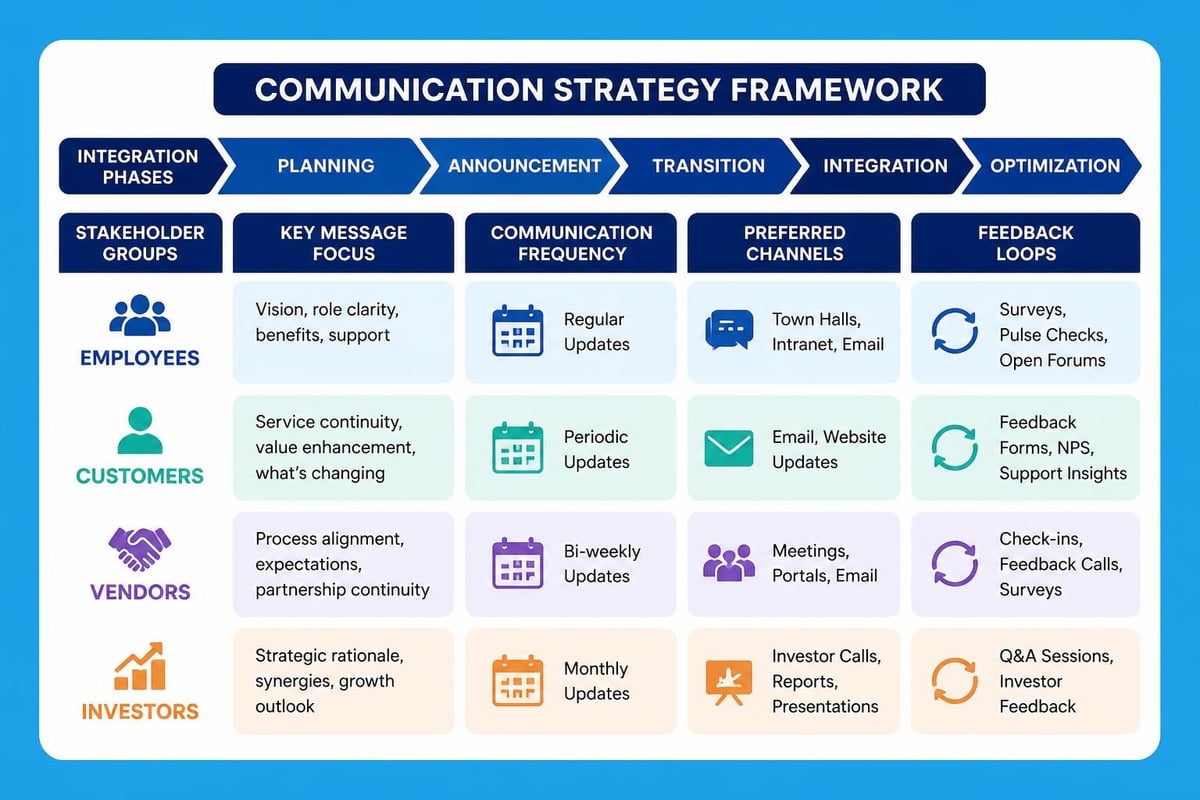
Effective communication represents the connective tissue holding the post merger and acquisition process together. Employees, customers, vendors, and other stakeholders all require timely, transparent information tailored to their concerns and interests.
Stakeholder-Specific Communication Plans
Different audiences need different information at different times. A comprehensive communication strategy addresses:
Employee Communications:
- Weekly leadership updates during first 90 days
- Town halls and Q&A sessions with integration leaders
- Department-specific briefings on changes affecting workflows
- Intranet resources answering common questions
- Anonymous feedback mechanisms to surface concerns
Customer Communications:
- Proactive outreach from account managers assuring continuity
- Clear explanation of any changes to products, services, or contacts
- Enhanced support during transition periods
- Periodic updates on integration progress affecting customer experience
Vendor and Partner Communications:
- Notification of procurement changes and new vendor management processes
- Introduction to new points of contact for ongoing relationships
- Explanation of any contract renegotiations or consolidations
- Continued collaboration on strategic initiatives
According to insights on post-merger change and project management, communication failures rank among the top three integration challenges, yet many organizations underinvest in this critical capability.
Risk Management During Integration
The post merger and acquisition process introduces numerous risks that can derail value creation if not properly managed. Proactive risk identification, mitigation planning, and monitoring separate successful integrations from failed ones.
Common Integration Risks and Mitigation Strategies
Talent and Leadership Flight
Key employee departures represent one of the highest risks during integration. Mitigation strategies include retention agreements, accelerated vesting on equity compensation, career development conversations, and cultural integration investments that make people want to stay.
Customer Attrition
Customers may view ownership changes as an opportunity to renegotiate terms or explore competitive alternatives. Proactive customer engagement, service level guarantees during transition, and dedicated support resources help minimize churn during the post merger and acquisition process.
Operational Disruption
System conversions, process changes, and organizational restructuring can temporarily decrease productivity and quality. Phased rollouts, pilot programs, robust testing, and rollback plans reduce operational risk during transformation initiatives.
Integration Fatigue
Extended integration timelines create exhaustion among teams juggling business-as-usual responsibilities alongside transformation work. Regular workload assessments, additional temporary resources, celebration of milestones, and realistic timeline expectations help manage fatigue.
Organizations that systematically identify and manage these risks achieve substantially better integration outcomes than those taking reactive approaches when problems emerge.
Technology Enablers for Successful Integration
Modern technology platforms can accelerate and improve the post merger and acquisition process when thoughtfully deployed. From project management tools to data analytics platforms, the right technology stack supports integration excellence.
Integration Management Platforms
Specialized software designed for merger integration helps teams track workstreams, monitor milestones, manage risks, and report progress to stakeholders. These platforms provide centralized visibility and accountability that spreadsheets cannot match.
Virtual Data Rooms for Ongoing Collaboration
While virtual data rooms traditionally support due diligence, they remain valuable throughout integration for secure document sharing, policy distribution, and cross-functional collaboration. The Aligned IQ VDR pricing offers competitive rates designed specifically for lower middle-market transactions, making enterprise-grade security accessible to smaller deals.
Analytics and Business Intelligence
Combined data from both organizations enables insights impossible when systems remain separate. Analytics platforms help integration teams identify synergy opportunities, track performance metrics, and make data-driven decisions about resource allocation and strategic priorities.
Change Management Technology
Employee surveys, pulse checks, collaboration platforms, and learning management systems support the cultural and organizational dimensions of the post merger and acquisition process. These tools enable leadership to measure sentiment, address concerns, deliver training, and build connections across legacy organizations.
Industry-Specific Integration Considerations
Different industries face unique challenges during the post merger and acquisition process. Regulatory requirements, customer expectations, and operational models vary significantly across sectors.
Manufacturing and Distribution
These sectors typically face complex supply chain integration, facility consolidation decisions, and equipment standardization challenges. Inventory management system integration and logistics network optimization often drive significant synergy opportunities.
Professional Services
Knowledge-based businesses prioritize talent retention, client relationship continuity, and service delivery consistency. Brand decisions-whether to maintain separate identities or consolidate under one brand-carry particular weight in professional services integrations.
Healthcare and Life Sciences
Regulatory compliance, credentialing requirements, and clinical protocol standardization create unique complexity in healthcare transactions. Privacy requirements under HIPAA and similar regulations demand careful attention during technology integration.
For businesses exploring opportunities in specialized sectors like automotive M&A, cannabis M&A, or construction and engineering M&A, understanding industry-specific integration challenges proves essential for deal success.
Measuring Integration Success
The post merger and acquisition process requires clear success metrics beyond simple financial performance. Comprehensive scorecards track progress across multiple dimensions and provide early warning when integration efforts veer off course.
Key Performance Indicators for Integration
Financial Metrics:
- Synergy realization vs. plan (revenue and cost)
- Combined company revenue growth rate
- EBITDA margin improvement
- Working capital efficiency gains
- Return on invested capital
Operational Metrics:
- Customer retention and satisfaction scores
- Employee retention rates (overall and key talent)
- Productivity measures by function and location
- Quality metrics and defect rates
- On-time delivery and service level achievement
Integration Process Metrics:
- Workstream milestone completion rates
- Budget vs. actual integration spend
- Issue resolution cycle time
- Stakeholder satisfaction with integration process
- Risk mitigation effectiveness
Regular reporting against these metrics maintains accountability and enables leadership to intervene when performance falls short of expectations.
Lessons from Integration Failures
Understanding why integrations fail provides valuable insights for those navigating the post merger and acquisition process. Common failure patterns include underestimating integration complexity, moving too quickly without adequate planning, neglecting cultural dimensions, and declaring victory prematurely.
Underestimation of Resource Requirements
Many organizations assume existing personnel can manage integration alongside regular responsibilities. Reality proves different-successful integrations require dedicated resources with clear mandates and protected time to focus on transformation.
Insufficient Executive Sponsorship
When senior leaders delegate integration to middle management without active involvement, initiatives lose momentum and political conflicts remain unresolved. The post merger and acquisition process demands visible, engaged executive leadership throughout the integration journey.
Premature Integration Team Dissolution
Organizations eager to return to normal operations often disband integration teams before transformation becomes embedded in operations. This premature transition leaves initiatives incomplete and allows organizations to revert to legacy practices.
Research on post-merger integration challenges demonstrates that companies learning from these common mistakes substantially outperform those repeating them.
Building Strategic Fit from the Beginning
The most successful integrations begin long before closing, during the partner selection process. When buyers and sellers prioritize strategic fit and cultural compatibility from initial conversations, they lay groundwork for smoother integration and better outcomes.
This approach differs fundamentally from traditional M&A processes where financial metrics dominate early discussions and strategic alignment receives superficial attention. By evaluating acquisition strategies and acquisition exit strategies through a strategic fit lens, both parties increase the probability of post-transaction success.
The Strategic Fit Advantage
Transactions built on genuine strategic fit typically experience:
- Faster integration timelines due to cultural alignment
- Higher employee retention as teams share common values
- Greater synergy realization from complementary capabilities
- Lower integration costs through reduced conflict and rework
- Superior long-term performance as strategies reinforce rather than conflict
For sellers considering their options, finding buyers who genuinely understand and value their business model, culture, and strategic vision creates foundation for successful transitions that protect employee welfare and customer relationships.
Aligning Pre-Transaction Planning with Post-Close Execution
The post merger and acquisition process benefits enormously from integration planning that begins during due diligence. Leading buyers develop detailed integration playbooks covering the first 100 days, identify critical personnel for retention, and map system integration approaches before closing occurs.
This pre-transaction planning allows teams to execute rapidly after close, capturing quick wins that build stakeholder confidence and demonstrate transaction value. It also surfaces potential deal-breakers-integration challenges so severe they might warrant deal restructuring or even abandonment.
Integration Due Diligence Checklist:
- Organizational structure mapping and leadership assessment
- Technology infrastructure compatibility evaluation
- Customer concentration and retention risk analysis
- Employee benefit comparison and harmonization planning
- Facility assessment and real estate consolidation opportunities
- Vendor contract review for consolidation potential
- Regulatory compliance gap analysis
- Brand strategy and marketing integration approach
Sellers who understand buyers will conduct this level of integration due diligence can prepare in advance, making their businesses more attractive and increasing the likelihood of smooth transitions.
Successfully navigating the post merger and acquisition process requires methodical planning, dedicated resources, transparent communication, and patient execution across multiple integration dimensions. Companies that approach integration as strategically as they approach deal origination substantially outperform those treating it as an afterthought. Aligned IQ transforms M&A into a more collaborative process by prioritizing strategic fit from the beginning, helping buyers and sellers find counterparties genuinely aligned on vision, values, and objectives-creating the foundation for integration success. Take a tour of our platform to discover how our match-making approach can help you find the perfect partner for your next transaction.
No responses yet