

In 2025, mergers and acquisitions strategy will define the next wave of business transformation, fueling growth and reshaping entire industries. Record-breaking M&A activity in recent years is creating both unprecedented opportunities and fierce competition in some industries.
This guide empowers business leaders, corporate strategists, and investors to master mergers and acquisitions strategy in a dynamic market. You’ll discover the evolution of M&A, key trends, a step-by-step roadmap, critical success factors, common pitfalls, and actionable best practices.
Ready to gain expert insights, real-world examples, and proven steps? Dive in and apply these strategies to achieve successful M&A outcomes in 2025.
The Evolution of M&A Strategy: Past, Present, and 2025 Trends
Mergers and acquisitions strategy has always been about adapting to win. What began as a military concept—“strategos,” the art of planning to outmaneuver rivals—has transformed into a powerful boardroom tool for modern organizations. Today, this strategy is not just about seizing opportunity but shaping the future.
Historical Context and Strategic Foundations
The roots of mergers and acquisitions strategy stretch back centuries. Early business leaders borrowed the concept of “strategy” from military generals, focusing on outsmarting competitors. In the 20th century, companies began viewing M&A as more than just opportunistic deals. It became a way to leapfrog rivals, enter new markets, or acquire valuable assets.
Disney’s journey is a textbook example. By acquiring Pixar, Marvel, Lucasfilm, and 20th Century Fox, Disney transformed from a classic entertainment company into a global powerhouse. Each acquisition was carefully chosen to fit Disney’s vision and reinforce its core identity.
How does this compare to traditional organic growth? Organic growth is gradual, built on expanding existing products or services. In contrast, mergers and acquisitions strategy offers a rapid pathway to scale, innovation, and market share.
| Growth Approach | Speed | Risk | Value Creation |
|---|---|---|---|
| Organic Growth | Slow | Low | Steady, incremental |
| M&A Strategy | Fast | Higher | Immediate, transformative |
Over the decades, the focus has shifted. Companies now use mergers and acquisitions strategy to achieve targeted, value-driven goals—whether that means acquiring new technology, entering fresh markets, or building unique capabilities.
2025 Market Trends and Drivers
Looking ahead, mergers and acquisitions strategy is entering a new era. Global deal volumes and values are reaching record highs. Economic factors play a big role: with average organic growth hovering around 5%, many firms turn to M&A for faster results. Innovation is no longer optional, and market saturation pushes leaders to seek bold moves.
Industry-specific forces are reshaping the landscape. Technology disruption, regulatory change, and globalization all drive strategic deals. Private equity and strategic buyers are more active than ever, intensifying competition for quality targets.
Consider Disney again—after its major acquisitions, the company’s stock soared 350% between 2006 and 2016, compared to the S&P 500’s 61%. Such results highlight the transformative power of a well-executed mergers and acquisitions strategy.
In 2025, speed, scale, and strategic fit are essential. Companies must move quickly to seize opportunities, but not at the expense of alignment or value. For a deeper look at these forces shaping the year ahead, explore Top M&A Trends for 2025.
Mastering mergers and acquisitions strategy in this environment means understanding both the lessons of the past and the demands of the future.
Core Components of a Winning M&A Strategy
Mastering a successful mergers and acquisitions strategy requires a blend of clear vision, disciplined execution, and a deep understanding of both corporate and deal-level objectives.
The core elements that define standout M&A outcomes in 2025 are alignment, clarity, and precision at every stage. Let’s break down these components and see how they set the stage for long-term value.

Aligning Corporate and M&A Strategy
A robust mergers and acquisitions strategy starts by understanding the difference between corporate strategy and M&A strategy. Corporate strategy sets the high-level direction—where to play and how to win—while M&A strategy determines how acquisitions or mergers support those overarching goals.
In 2025, alignment is more critical than ever. Companies must ensure every deal supports their mission, whether that means expanding into new markets, diversifying offerings, or boosting operational efficiency. For example, Amazon’s acquisition of Whole Foods wasn’t just about adding grocery stores; it was a calculated move to accelerate market access and distribution capabilities.
Leadership plays a pivotal role. Well-defined, measurable goals keep everyone focused, reducing the risk of costly distractions. Visionary leaders articulate why an acquisition matters, ensuring it’s more than a financial transaction.
For a deep dive into how alignment drives success, explore the Strategy-First Approach to M&A.
Identifying Strategic Objectives and Value Drivers
The next step in a winning mergers and acquisitions strategy is clarifying the objectives behind each move. Ask: Why pursue this deal? Is it for accelerated growth, intellectual property, talent, or new market entry?
Consider these examples:
- Google and Microsoft often acquire for intellectual property or emerging technologies.
- Some companies focus on “acqui-hiring”—bringing in top talent through acquisition.
- Coca-Cola’s purchase of Odwalla was about gaining fast access to the health beverage market.
It’s vital to define the synergies you expect—cost savings, revenue growth, or innovation. Communicate these objectives early to align all stakeholders and set clear expectations.
M&A can instantly double revenue, while organic growth might yield just 5% annually. The key is ensuring everyone, from executives to frontline teams, understands the rationale and the value drivers behind each deal.
Assessing and Prioritizing Targets
Selecting the right targets is the heart of any mergers and acquisitions strategy. Start by establishing clear criteria: strategic fit, cultural compatibility, and solid financial health.
Use structured evaluation tools like scorecards or industry benchmarks to compare potential targets objectively. Prioritize those that align with your goals and avoid the trap of “empire building”—acquiring for size rather than strategic value.
Here’s a quick comparison table:
| Criteria | Strategic Acquisition | Empire Building |
|---|---|---|
| Alignment with Goals | High | Low |
| Cultural Fit | Strong | Weak |
| Long-term Value | Sustainable | Risky |
Case studies abound: While focused deals often deliver strong returns, unfocused acquisitions can dilute brand value and strain resources. Disciplined target selection drives lasting success.
Step-by-Step Roadmap: Executing the M&A Process in 2025
Mastering the mergers and acquisitions strategy in 2025 means following a disciplined, step-by-step process. Each phase builds on the last, ensuring business leaders don’t just close deals—they create lasting value. Let’s break down the essential roadmap every successful M&A team should follow.
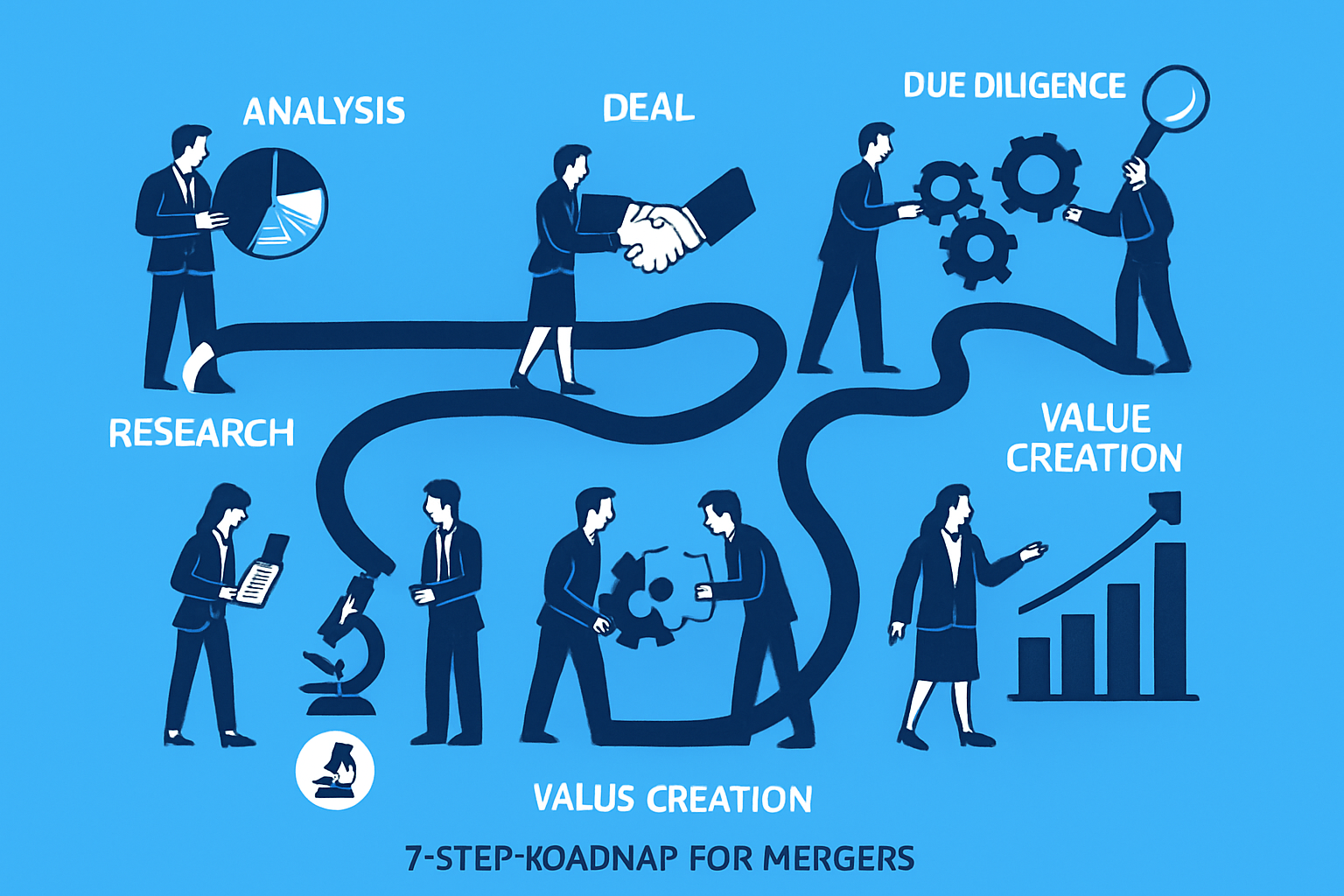
Step 1: Needs and Goals Analysis
Every effective mergers and acquisitions strategy begins with deep reflection. Start by assessing your organization’s strengths, weaknesses, and market position. What are your growth gaps? Do you need new technology, talent, or market access?
Use frameworks like SWOT analysis and strategic scorecards to pinpoint where M&A can deliver unique value. Define your goals clearly: are you aiming for revenue growth, diversification, or operational efficiency? Setting these objectives upfront prevents wasted resources and misaligned deals.
For a deeper dive into building a robust M&A foundation, explore M&A Acquisition Strategies, which outlines proven approaches for aligning business needs with targeted acquisitions.
Step 2: Market and Industry Evaluation
Once your needs are clear, turn outward. Analyze the competitive landscape, industry trends, and regulatory environment. A strong mergers and acquisitions strategy relies on accurate, unbiased market data.
Research sector-specific growth rates, recent deal activity, and evolving customer preferences. For example, technology and healthcare often face rapid disruption, while manufacturing may be more stable but slower to change.
Use market mapping and benchmarking to identify where opportunities—and threats—exist. This step ensures your strategy is informed by real-world dynamics, not assumptions.
Step 3: Strategic Fit Assessment
Now, evaluate potential targets for strategic fit. Will combining businesses create value neither could achieve alone? Look at product lines, geographic reach, and customer segments.
Cultural compatibility is also crucial; mismatched values or leadership styles can doom even the most promising deals. A mergers and acquisitions strategy that ignores culture often faces post-deal chaos.
Ask: Does the target reinforce your strengths, or distract from your core? Focused, strategic acquisitions outperform scattershot approaches in the long run.
Step 4: Synergy Identification and Validation
Synergies are the fuel behind many M&A deals. Identify and quantify expected benefits, such as cost savings, revenue growth, or innovation.
Use the table below to clarify types of synergies:
| Synergy Type | Example | Impact |
|---|---|---|
| Cost | Shared operations | Lower expenses |
| Revenue | Cross-selling | Higher sales |
| Innovation | Combined R&D teams | Faster launches |
A successful mergers and acquisitions strategy validates these synergies with data, not wishful thinking. If the numbers don’t add up, reconsider or renegotiate the deal.
Step 5: Due Diligence Preparation and Execution
Due diligence is where risks are uncovered and value is confirmed. Review finances, legal matters, operations, and culture.
Best practices include:
- Using digital tools for document management.
- Assigning cross-functional teams.
- Setting checklists and timelines.
A rigorous mergers and acquisitions strategy uncovers hidden liabilities and ensures alignment. Don’t rush—mistakes here can be costly and irreversible.
Step 6: Integration Planning and Execution
Integration is where potential becomes reality. Begin planning before the deal closes. Focus on:
- Retaining key talent.
- Aligning cultures.
- Merging systems and processes.
A mergers and acquisitions strategy that prioritizes integration sees better results. Use clear communication and proactive leadership to keep teams engaged and minimize disruption.
Case studies show that early integration planning predicts long-term success. Don’t wait until after closing to address these critical issues.
Step 7: Post-Merger Value Creation and Monitoring
After the deal, it’s time to deliver on promises. Track synergy realization, stakeholder satisfaction, and financial metrics.
Key steps include:
- Setting clear KPIs.
- Engaging stakeholders regularly.
- Adjusting plans as challenges emerge.
A dynamic mergers and acquisitions strategy doesn’t stop at deal close—it adapts and improves. Continuous monitoring ensures goals are met and lessons are applied to future deals.
Critical Success Factors and Common Pitfalls in M&A
Understanding the critical success factors and common pitfalls in a mergers and acquisitions strategy is essential for navigating today’s complex deal landscape. Even the most promising transactions can fail if key risks are overlooked. Let’s break down the main drivers of success and the traps that can derail your efforts.

Strategic and Cultural Fit
At the heart of every successful mergers and acquisitions strategy is the alignment between the acquiring and target companies. Strategic fit means the deal supports your core business goals rather than distracting from them. Without this, acquisitions can dilute brand value or create confusion within the organization.
Cultural fit is just as crucial. Even when numbers look perfect on paper, mismatched values or work styles can lead to friction, low morale, and high turnover. Iconic failures, such as the AOL-Time Warner merger, show how culture clashes can derail even the biggest deals. Early, honest assessment of compatibility should be a top priority in your mergers and acquisitions strategy.
Due Diligence and Valuation Accuracy
Thorough due diligence is the backbone of any effective mergers and acquisitions strategy. This process uncovers hidden risks, validates financials, and ensures the price is right. Failing here is costly—up to 70% of failed M&A deals cite inadequate diligence as a root cause.
Pitfalls include overpaying, missing liabilities, or assuming unrealistic synergies. To avoid these, leverage digital diligence tools and a disciplined approach. For a deeper dive into common mistakes, see Common Pitfalls in Exit Planning, which outlines issues that can derail even well-planned mergers and acquisitions strategy efforts.
Integration Management and Change Leadership
The real test of a mergers and acquisitions strategy comes after the deal closes. Integration is where value is either realized or lost. Many companies underestimate the complexity of merging systems, processes, and people.
Strong change leadership is essential. Leaders must communicate a clear vision, address concerns, and drive alignment across teams. Companies like Disney, known for seamless integration, prioritize early planning and cross-functional collaboration. Without these, even a well-structured mergers and acquisitions strategy can falter during execution.
Stakeholder Communication and Retention
Transparent and timely communication is a cornerstone of any successful mergers and acquisitions strategy. Employees, customers, and partners need to understand the rationale, benefits, and impact of the deal. Poor communication often leads to uncertainty, low morale, and the departure of key talent.
Retention strategies, such as “acqui-hiring,” help secure vital expertise and maintain business continuity. Regular updates and two-way feedback channels keep stakeholders engaged and aligned, smoothing the transition and maximizing deal value.
Avoiding Empire Building and Strategic Drift
A disciplined mergers and acquisitions strategy avoids the temptation of empire building. Acquisitions driven by ego or vague ambitions often stray from the company’s core strengths, leading to wasted resources and diluted focus.
The most successful organizations stay true to their competencies and pursue deals that reinforce, not distract from, their mission. By learning from both disciplined and undisciplined approaches, leaders can steer clear of common pitfalls and build sustainable value through a focused mergers and acquisitions strategy.
Best Practices and Innovative Tools for M&A Success in 2025
Navigating a successful mergers and acquisitions strategy in 2025 means staying ahead of the curve. Best practices are evolving fast, with digital innovation, team expertise, and industry focus driving real results. Let’s explore how to harness these forces for your next deal.
Leveraging Technology and Digital Platforms
In 2025, technology isn’t just a tool; it’s the backbone of a winning mergers and acquisitions strategy. Digital platforms now streamline every phase, from deal sourcing to post-merger integration. AI-driven analytics uncover hidden patterns in target evaluation, while virtual datarooms accelerate due diligence and protect confidentiality.
Consider how leading companies use platforms like DealRoom to centralize documents, automate workflow, and enable real-time collaboration. These tools reduce delays and minimize risk, allowing teams to focus on strategic decisions. The result? Faster, more informed deals and a clear edge in competitive markets.
Below is a quick comparison of digital M&A tools:
| Tool Type | Key Benefit | Example Use Case |
|---|---|---|
| Virtual Datarooms | Secure info sharing | Due diligence |
| AI Analytics | Target screening | Synergy identification |
| Integration Platforms | Project management | Post-merger integration |
As technology continues to evolve, integrating these innovations into your mergers and acquisitions strategy is essential for staying ahead.
Building a High-Performance M&A Team
No mergers and acquisitions strategy succeeds without the right people. A high-performance M&A team blends corporate development, legal, finance, and integration specialists. Cross-functional collaboration is critical, ensuring every angle—from compliance to culture—is covered.
Continuous learning is another hallmark of top-performing teams. Repeat acquirers refine their playbooks with every deal, improving speed and accuracy. According to Assembling Your M&A Team, defining clear roles and fostering open communication can make or break execution.
Key team roles for M&A success:
- Corporate Development Lead
- Legal Counsel
- Financial Analyst
- Integration Manager
Investing in your team is investing in your outcomes. The right mix of skills and experience transforms a solid mergers and acquisitions strategy into a repeatable success formula.
Focusing on Industry-Centric Strategies
Every sector has its own rules and rhythms. A mergers and acquisitions strategy tailored to your industry can uncover value others miss. For instance, tech deals often prioritize IP and talent, while manufacturing focuses on operational synergies.
Industry expertise is vital during target selection and integration. It helps spot red flags, anticipate cultural challenges, and identify best-fit opportunities. Trends show that healthcare, technology, and banking are seeing unique M&A drivers in 2025. For more on sector-specific strategies, explore M&A Trends 2025: Outlook for Healthcare, Tech, Banking, & More.
By aligning your approach with industry dynamics, you raise your odds of long-term deal success. The most effective mergers and acquisitions strategy is never one-size-fits-all—it’s custom-built for your market.
Case Studies and Real-World Examples: Lessons from Recent M&A Deals
In today’s rapidly evolving market, understanding how leading companies execute their mergers and acquisitions strategy is essential for business leaders and strategists. Let’s explore some of the most instructive deals of recent years and what they reveal about successful M&A outcomes.
Disney: Growth Through Strategic Acquisitions
Disney’s mergers and acquisitions strategy has transformed the entertainment industry. By acquiring Pixar, Marvel, Lucasfilm, and 20th Century Fox, Disney secured premium intellectual property and expanded its global reach. These moves were not mere opportunistic purchases—they were carefully aligned with a vision to dominate family entertainment.
Between 2006 and 2016, Disney’s stock soared by 350%, compared to the S&P 500’s 61%. This outperformance is often attributed to the synergy and market expansion gained through its M&A activities. According to the 2025 M&A Outlook: 4 Trends Driving an Anticipated Rebound, such strategic deals are expected to drive similar growth in the coming years. Disney’s example underscores the value of targeting acquisitions that fit both brand and long-term goals.
Amazon and Whole Foods: Targeted Market Expansion
Amazon’s acquisition of Whole Foods in 2017 exemplifies how a focused mergers and acquisitions strategy can unlock new markets. Amazon wanted more than just grocery stores; it aimed for greater market access, physical distribution, and fresh supply chain capabilities.
This deal shifted Amazon’s growth approach from broad expansion to a targeted entry into the competitive grocery sector. The integration wasn’t without challenges—aligning cultures and operations took significant effort. However, it enabled Amazon to blend digital innovation with brick-and-mortar presence, setting a new standard for omnichannel retail.
Tech Giants: Innovation via Acquisition
For tech leaders like Google and Microsoft, a robust mergers and acquisitions strategy is central to sustaining innovation. Both companies have used M&A to acquire intellectual property, new technologies, and top-tier talent—often referred to as “acqui-hiring.”
Google’s purchase of Android and YouTube, and Microsoft’s acquisitions of LinkedIn and GitHub, allowed them to leapfrog competitors and stay ahead of market shifts. These moves highlight how M&A can accelerate innovation cycles and strengthen competitive advantage. As noted in The Big Picture 2025: M&A, technology-driven deals will remain pivotal as industries continue to converge.
Lessons Learned: Successes and Cautionary Tales
Reviewing these cases reveals common threads in an effective mergers and acquisitions strategy. Strategic alignment, cultural fit, and integration discipline consistently separate winners from underperformers.
Key lessons include:
- Prioritize strategic fit over short-term gains.
- Assess cultural compatibility early.
- Invest in thorough due diligence.
| Success Factor | Example | Result |
|---|---|---|
| Strategic Fit | Disney | Sustained outperformance |
| Targeted Entry | Amazon | New market dominance |
| Innovation Focus | Google, Microsoft | Faster tech adoption |
In contrast, deals lacking these fundamentals often struggle. The recurring message? A disciplined, well-communicated mergers and acquisitions strategy is vital for long-term value creation.
If you’re thinking about making your next move in the world of M&A—whether you’re looking to grow, sell, or invest—remember, success starts with the right strategy and the right people by your side. We’ve covered how putting strategic fit and industry expertise first can make all the difference, but sometimes the most valuable insights come from a real conversation. If you want to talk through your goals, get personalized advice, or just ask a few questions about the process, let’s connect. Talk to an Expert!
No responses yet