

Planning for the future of your business requires more than operational excellence and revenue growth. For many business owners, the ultimate goal involves a strategic exit that maximizes value while ensuring the company's continued success under new ownership. A well-crafted merger and acquisition exit strategy serves as the blueprint for this critical transition, helping owners prepare their companies, identify ideal buyers, and navigate the complex transaction process. Understanding how to position your business for an M&A exit in today's marketplace requires careful consideration of strategic fit, timing, valuation, and the resources available to facilitate connections with qualified buyers.
Understanding the Merger and Acquisition Exit Strategy Framework
A merger and acquisition exit strategy represents a comprehensive plan for business owners to transfer ownership through either a merger with another company or an outright sale to an acquiring entity. Unlike other exit strategy options such as initial public offerings or management buyouts, the M&A exit focuses on finding a strategic buyer who can integrate the business into their existing operations or use it as a platform for expansion.
The foundation of any successful merger and acquisition exit strategy rests on understanding what makes your business attractive to potential acquirers. Strategic buyers typically seek companies that complement their existing operations, expand their market reach, or provide access to new technologies, customer bases, or capabilities. Financial buyers, including private equity firms, focus on businesses with strong cash flows, scalable operations, and opportunities for value creation through operational improvements.
Key Components of an Effective Exit Plan
Building a robust merger and acquisition exit strategy involves several interconnected elements that work together to maximize transaction value and ensure a smooth transition.
Business valuation and financial optimization form the cornerstone of exit preparation. Owners must understand their company's current market value and identify opportunities to enhance that value before initiating sale discussions. This includes:
- Cleaning up financial statements and ensuring GAAP compliance
- Documenting recurring revenue streams and customer contracts
- Eliminating owner-dependent processes and building management depth
- Strengthening intellectual property protections
- Optimizing working capital and capital structure
Market positioning and competitive differentiation help potential buyers understand why your business deserves premium valuation. Articulating unique value propositions, demonstrating market leadership, and showcasing sustainable competitive advantages all contribute to buyer interest and transaction multiples.
Strategic fit assessment has emerged as one of the most critical factors in successful M&A exits. Rather than simply finding any buyer willing to pay an acceptable price, sophisticated sellers recognize that strategic fit between buyer and seller creates the foundation for better valuations, smoother transactions, and more successful post-acquisition integrations.

Timing Your Merger and Acquisition Exit Strategy
The decision of when to execute your merger and acquisition exit strategy significantly impacts transaction outcomes. Multiple factors influence optimal timing, and understanding these variables helps business owners make informed decisions about initiating the sale process.
Market conditions play a substantial role in M&A valuations and deal flow. During periods of economic expansion, buyer appetite typically increases, competition for quality assets intensifies, and valuation multiples expand. Conversely, economic uncertainty often leads to more conservative valuations and longer transaction timelines as buyers conduct more extensive due diligence.
Industry-Specific Considerations
Different industries experience unique cycles that affect M&A activity and valuations. Technology sectors may see compressed timeframes due to rapid innovation and competitive pressures, while traditional manufacturing or service businesses might benefit from longer planning horizons. Understanding industry-specific M&A trends helps owners time their exits to coincide with periods of peak buyer interest.
| Timing Factor | Optimal Conditions | Challenging Conditions |
|---|---|---|
| Revenue Growth | 15-30% YoY growth trajectory | Flat or declining revenues |
| Market Position | Expanding market share | Losing ground to competitors |
| Economic Climate | Strong GDP growth, low interest rates | Recession fears, tight credit |
| Industry Trends | Consolidation wave, high deal multiples | Disruption, regulatory uncertainty |
| Personal Readiness | Clear post-exit plans, succession prepared | Unclear next steps, key person risk |
Personal factors also influence timing decisions. Business owners must honestly assess their readiness to transition out of day-to-day operations, their financial needs from the transaction, and their vision for the company's future. A merger and acquisition exit strategy works best when financial, operational, and personal timing factors align.
Finding the Right Buyer Through Modern Platforms
Traditional approaches to identifying potential acquirers often involved working exclusively with investment bankers or M&A advisors who controlled access to buyer networks. While these intermediaries continue to play valuable roles, modern deal sourcing platforms have transformed how buyers and sellers connect, particularly in the lower middle market.
The evolution of proprietary matching platforms has introduced new efficiency into the buyer discovery process. Rather than relying solely on broker networks or public listings that compromise confidentiality, business owners can now explore opportunities through curated, private environments that prioritize strategic fit before revealing sensitive information.
Evaluating Strategic Fit Before Deep Engagement
A sophisticated merger and acquisition exit strategy begins with understanding which buyer characteristics align with your company's strengths and future potential. Consider a typical scenario where a regional logistics company seeks an exit: the owner might prioritize buyers with complementary geographic coverage, experience scaling similar operations, and cultural values that ensure employee retention post-transaction. This strategic fit assessment helps narrow the universe of potential buyers to those most likely to see premium value in the acquisition.
Modern platforms enable sellers to evaluate multiple dimensions of fit simultaneously:
- Transaction priorities alignment: Understanding whether buyers seek platform acquisitions, bolt-on deals, or talent acquisitions
- Deal size compatibility: Matching enterprise values with buyer acquisition capacity and typical transaction ranges
- Industry expertise: Identifying buyers with relevant operational experience who understand sector-specific value drivers
- Geographic considerations: Finding buyers whose regional presence creates synergies rather than redundancies
- Cultural compatibility: Assessing management philosophies and approaches to employee development
This methodical approach to buyer identification differs significantly from the traditional sell-side M&A process, which often emphasizes broad market exposure over strategic alignment in early stages.

Preparing for Due Diligence and Documentation
Once a merger and acquisition exit strategy progresses to active buyer engagement, proper documentation and due diligence preparation become critical success factors. Sophisticated buyers will scrutinize every aspect of your business, and preparedness directly correlates with transaction speed, valuation preservation, and deal certainty.
Organizing Your Virtual Data Room
The virtual data room serves as the central repository for all due diligence materials, and its organization reflects on the business's overall operational quality. A well-structured data room demonstrates professionalism and makes buyer evaluation more efficient, potentially accelerating transaction timelines.
Financial documentation requirements include at least three years of audited or reviewed financial statements, tax returns, detailed accounts receivable and payable aging reports, capital expenditure schedules, and debt schedules with covenant compliance documentation. Management should also prepare quality of earnings analyses that explain any non-recurring items or accounting adjustments.
Operational materials encompass customer contracts and concentration analyses, supplier agreements, employee handbooks and organizational charts, real estate leases or property documentation, and intellectual property registrations. For technology companies, source code repositories and technical documentation gain particular importance.
Legal and compliance documents round out due diligence requirements. These include corporate governance documents, material contracts and agreements, litigation history and pending disputes, regulatory compliance certifications, and environmental assessments where applicable.
Modern solutions like complimentary virtual data rooms for matched sellers streamline this process by providing secure, organized environments for sharing sensitive information. For those seeking standalone solutions, competitively priced VDR options offer professional-grade security and organization without the premium pricing of legacy providers.
Maximizing Value Through Strategic Positioning
A successful merger and acquisition exit strategy extends beyond basic financial preparation to encompass strategic positioning that highlights your company's unique value proposition. This positioning work should begin 12-24 months before anticipated market entry, giving owners sufficient time to address weaknesses and amplify strengths.
Revenue quality enhancement focuses on demonstrating predictable, recurring revenue streams that buyers can confidently underwrite. This might involve:
- Converting project-based work to retainer relationships
- Lengthening average customer contract terms
- Reducing customer concentration by diversifying the client base
- Documenting renewal rates and lifetime value metrics
- Building subscription or SaaS revenue components where applicable
Operational excellence initiatives prove that the business can thrive without founder involvement. Implementing documented standard operating procedures, building middle management capability, investing in systems that reduce manual processes, and creating dashboards that provide real-time business visibility all demonstrate operational maturity that justifies premium valuations.
Building Strategic Differentiation
Buyers pay premiums for businesses with sustainable competitive advantages. Your merger and acquisition exit strategy should articulate these differentiators clearly. Whether through proprietary technology, exclusive partnerships, specialized expertise, superior customer service models, or unique market positioning, demonstrating why competitors cannot easily replicate your success justifies higher valuation multiples.
In typical scenarios, a specialized software company might emphasize its unique data integration capabilities that took years to develop, creating switching costs for customers. A service business might highlight its training methodology and employee development programs that produce consistently superior outcomes. These differentiators transform commoditized businesses into strategic assets worthy of acquisition.
Navigating Tax and Legal Considerations
The structure of your merger and acquisition exit strategy carries significant tax implications that can materially impact net proceeds. Understanding various tax and legal considerations early in the planning process enables proactive optimization rather than reactive damage control.
| Deal Structure | Tax Treatment | Seller Advantages | Buyer Advantages |
|---|---|---|---|
| Stock Sale | Capital gains on appreciated shares | Single level of taxation, simpler transaction | Carryover basis, assumes liabilities |
| Asset Sale | Ordinary income on some assets, capital gains on others | Can retain corporate shell, selective asset sale | Step-up in basis, selective liability assumption |
| Merger | Depends on structure (taxable vs. tax-free) | Potential tax deferral in stock-for-stock | Operational continuity, automatic transfer |
| Earnout Structure | Deferred recognition based on payment timing | Higher total consideration potential | Risk mitigation, alignment of interests |
Entity structure optimization should occur well before marketing the business. C-corporations face double taxation challenges that S-corporations and LLCs avoid. For businesses currently structured as C-corps, exploring qualified small business stock (QSBS) treatment or F-reorganizations might provide tax advantages, though these strategies require significant advance planning.
Representation and warranty insurance has become increasingly common in middle-market M&A, shifting risk from sellers to insurance carriers. While adding transaction costs, this insurance can facilitate cleaner exits with reduced escrow requirements and faster access to sale proceeds.
Leveraging Professional Resources and Networks
While business owners drive their merger and acquisition exit strategy, surrounding yourself with qualified advisors significantly improves transaction outcomes. The key lies in engaging specialists at appropriate stages and ensuring their incentives align with your objectives.
M&A advisors and investment bankers bring buyer networks, valuation expertise, and negotiation experience. For middle-market transactions, these professionals typically work on success-fee arrangements, though quality-of-earnings studies and other preparatory work may require upfront investment. Understanding when and how to engage these advisors helps owners avoid premature commitments or delayed engagement that limits advisor effectiveness.
Transaction attorneys specialize in purchase agreement negotiation, due diligence response, and closing mechanics. Unlike general corporate counsel, transaction specialists understand market terms, typical risk allocation, and strategies for preserving deal certainty while protecting client interests.
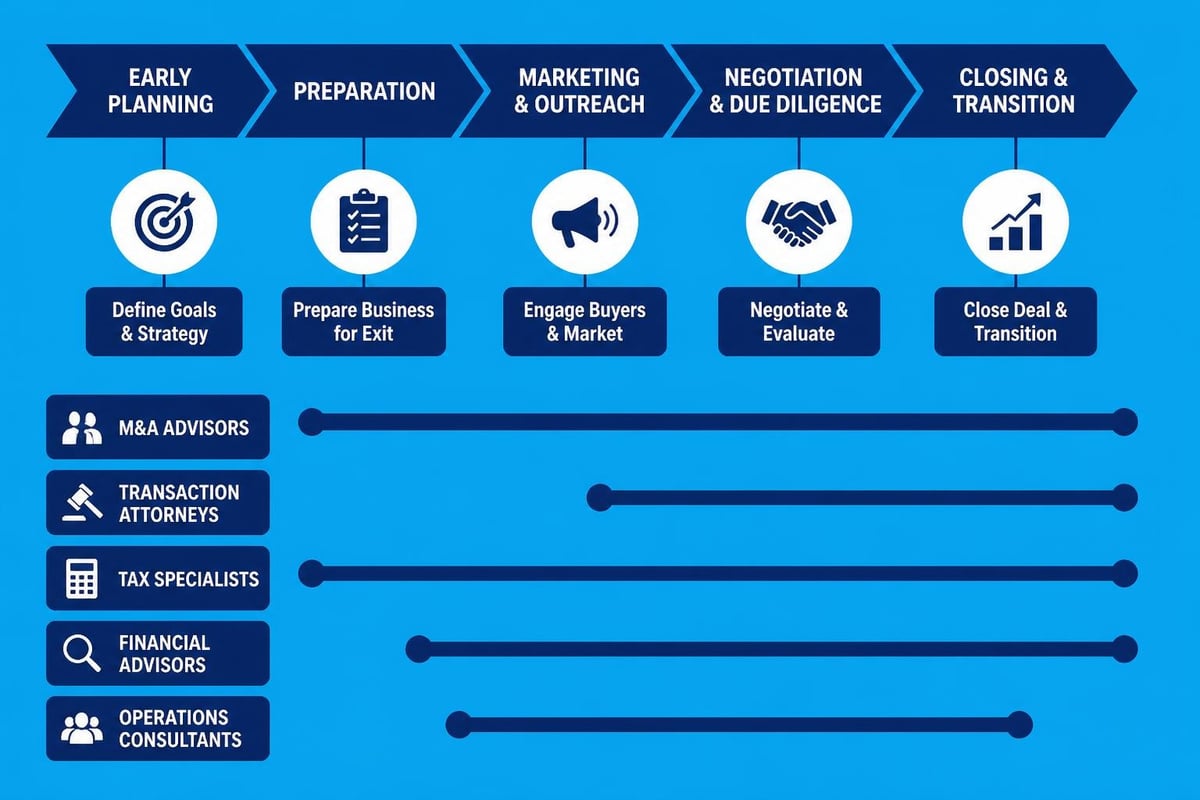
Tax advisors and wealth planners help structure transactions to minimize tax burdens and ensure post-exit financial security. These specialists should engage early in planning, as many tax optimization strategies require implementation well before transaction execution.
The Role of Modern M&A Platforms
Complementing traditional advisors, specialized platforms have emerged to address specific pain points in the M&A process. Rather than replacing intermediaries, these tools enhance efficiency and provide alternatives for owners seeking different approaches to market entry.
For lower middle-market PE firms and strategic buyers, proprietary platforms offer curated deal flow that matches their acquisition criteria. For sellers, these environments provide confidential, low-risk opportunities to explore strategic fit with potential buyers before committing to full-scale processes. This approach differs fundamentally from public business-for-sale listings that compromise confidentiality and may signal distress to competitors, customers, and employees.
The matchmaking functionality prioritizes strategic alignment based on transaction priorities, deal size parameters, and industry expertise. This creates more productive early conversations and reduces time wasted on misaligned opportunities. Service providers within these ecosystems can generate referral revenue while showcasing capabilities to transaction participants who may need specialized support.
Managing the Transaction Process
Once your merger and acquisition exit strategy advances to active deal execution, process management becomes critical. Transactions fail for numerous reasons, but poor process management ranks among the most preventable failure modes.
Letter of Intent Negotiation
The letter of intent (LOI) establishes key commercial terms while allowing both parties to invest in detailed due diligence. Strong LOIs address:
- Purchase price and earnout structures
- Working capital adjustments and closing mechanisms
- Exclusivity periods and breakup fee provisions
- Key employee retention requirements
- Timeline expectations and closing conditions
Negotiating favorable LOI terms requires balancing multiple objectives. While sellers naturally focus on purchase price, terms governing escrow amounts, indemnification caps and baskets, and earn-out measurement methodologies often prove equally important to net proceeds.
Due diligence management tests organizational preparation and can reveal issues requiring remediation. Responding promptly and thoroughly to information requests builds buyer confidence and maintains transaction momentum. Conversely, slow responses or discovered problems raise concerns about information quality and may trigger price adjustments or deal termination.
Maintaining business performance during the transaction process presents challenges, as ownership focus naturally shifts toward deal execution. However, performance deterioration during this period provides buyers legitimate grounds for repricing or walking away. Delegating business operations to management teams while founders focus on transaction matters helps prevent this common pitfall.
Alternative Structures Within M&A Exits
A comprehensive merger and acquisition exit strategy considers various transaction structures beyond simple cash-at-closing deals. Understanding these alternatives enables creative solutions that bridge valuation gaps or address specific buyer and seller objectives.
Earnout provisions defer portions of purchase price based on post-closing performance metrics. While increasing total consideration potential, earnouts introduce complexity around metric definition, operational control during earnout periods, and dispute resolution mechanisms. Typical earnout structures span one to three years and represent 10-30% of total transaction value.
Seller financing involves the seller providing debt financing for a portion of the purchase price. This structure can facilitate deals where buyer financing falls short, though it introduces credit risk for sellers who must rely on business performance for payment. Interest rates, subordination agreements, and personal guarantees from buyers affect risk-return tradeoffs.
Equity rollovers allow sellers to retain minority stakes in the combined entity, participating in future value creation. This structure appeals to sellers confident in growth potential under new ownership and buyers who value seller-continued involvement. Private equity acquirers frequently incorporate rollover equity, aligning management with post-acquisition value creation.
Staged Transaction Approaches
Rather than single-event exits, some merger and acquisition exit strategies employ staged approaches. Majority recapitalizations allow founders to take substantial liquidity while retaining meaningful ownership and operational roles. Subsequent exits, often to strategic buyers or through IPOs, provide second liquidity events.
This phased approach suits owners not quite ready for complete exit, businesses requiring additional growth before achieving optimal valuations, or situations where market timing favors partial rather than complete sales. Understanding various exit paths helps owners select structures aligned with their specific circumstances.
Building Buyer Readiness and Appeal
The most effective merger and acquisition exit strategy doesn't simply prepare the business for sale. It positions the company as an attractive platform or complementary asset that strategic buyers actively seek.
Growth trajectory demonstration proves the business hasn't plateaued. Showing expansion into new markets, successful product launches, or emerging revenue streams suggests continued opportunity rather than harvested mature cash flows. Documented growth initiatives with reasonable investment requirements appeal to buyers seeking platforms for additional build-outs.
Scalability evidence shows how the business can grow without proportional cost increases. Documented processes, technology infrastructure capable of supporting larger scale, and management teams with experience building similar businesses all indicate scalability that justifies premium valuations.
Customer testimonials and case studies provide third-party validation of value delivery. Strong Net Promoter Scores, documented customer success stories, and reference relationships with marquee clients strengthen buyer confidence in revenue sustainability.
In typical scenarios, a SaaS company might demonstrate scalability through unit economics showing declining customer acquisition costs, increasing lifetime values, and operating leverage in its cost structure. A manufacturing business might present capacity utilization data showing substantial headroom for volume growth without major capital investment.
Risk Mitigation in M&A Exits
Every merger and acquisition exit strategy must address potential transaction risks that could derail deals or erode value. Proactive risk identification and mitigation separate successful exits from frustrated attempts.
Customer concentration represents a common value detractor when few customers generate substantial revenue percentages. Top customer representing more than 15-20% of revenue raises sustainability concerns. Diversification efforts should begin well before market entry, as buyers heavily discount concentrated revenue streams or require customer contract assignments as closing conditions.
Key person dependencies create similar concerns when business success ties closely to founder expertise or relationships. Building management depth, documenting systems and processes, and demonstrating business operation during founder absences all address this risk. Transition planning that outlines founder involvement post-closing provides additional comfort.
Undisclosed liabilities discovered during due diligence damage credibility and justify reduced valuations or increased escrows. Common problem areas include:
- Deferred maintenance on facilities or equipment
- Environmental remediation obligations
- Pending litigation or regulatory investigations
- Employee classification issues or wage-and-hour violations
- Intellectual property infringement or licensing problems
Proactive legal and financial audits identify these issues early, allowing remediation before buyer discovery.
Confidentiality and Market Positioning
Maintaining confidentiality throughout the merger and acquisition exit strategy execution protects business value and provides flexibility if transactions fail to close. Premature disclosure risks employee departures, customer uncertainty, and competitor exploitation.
Controlled information release follows a staged approach. Initial buyer conversations occur under non-disclosure agreements using blind profiles that describe the business without identifying it. Only after mutual interest confirmation and signed confidentiality agreements does fuller disclosure occur.
Employee communication planning addresses how and when to inform teams about potential ownership changes. Many transactions maintain complete confidentiality until closing, while others brief key managers during due diligence to facilitate buyer meetings. Either approach requires careful planning around timing, messaging, and retention incentives.
Market positioning strategy differs significantly between private, curated platforms and public business-for-sale marketplaces. Confidential environments allow exploratory conversations without market signaling, while public listings may create urgency but compromise discretion. Matching confidentiality approach to business circumstances and owner priorities represents another strategic decision within the overall exit plan.
Modern platforms offering proprietary matchmaking provide middle ground between complete confidentiality and broad market exposure. Sellers maintain control over information release while accessing qualified buyers who've demonstrated acquisition capacity and strategic interest.
A successful merger and acquisition exit strategy requires careful planning, strategic positioning, and access to the right buyers who appreciate your business's unique value. By focusing on strategic fit from the outset and utilizing modern tools that prioritize alignment before deep engagement, business owners can navigate the M&A process more effectively while preserving confidentiality and maximizing value. Aligned IQ transforms this process by connecting buyers and sellers through a proprietary matching platform that emphasizes strategic fit, transaction priorities, and industry expertise, while providing complimentary secure virtual data rooms for matched sellers to streamline due diligence and protect sensitive information throughout the journey.
No responses yet