

Whether you're preparing to acquire a business or exploring an eventual exit, understanding how to accurately assess corporate value is fundamental to any successful transaction. The ability to find out how much a company is worth requires combining financial analysis, market intelligence, and strategic assessment. For business owners and acquirers in the lower middle market, mastering valuation techniques ensures you enter negotiations with confidence and realistic expectations about deal parameters.
Understanding the Fundamentals of Company Valuation
To find out how much a company is worth, you must first recognize that value exists in multiple contexts. Market value differs from book value, and both differ from what a strategic buyer might pay. The valuation approach you select depends on your transaction objectives, the company's characteristics, and available data quality.
The Three Pillars of Valuation
Professional valuators rely on three foundational methodologies:
- Income approach: Projects future cash flows and discounts them to present value
- Market approach: Compares the subject company to similar businesses that have sold
- Asset approach: Calculates the fair market value of tangible and intangible assets minus liabilities
Each method provides a different lens through which to assess value. The income approach using discounted cash flow models remains the gold standard for operating businesses with predictable earnings, while market multiples offer efficient benchmarking against industry norms.
Enterprise Value vs. Equity Value
When you find out how much a company is worth, clarity about what you're valuing prevents costly misunderstandings. Enterprise value (EV) represents the total value of operating assets, while equity value represents what shareholders own after subtracting debt.
| Metric | Definition | Calculation |
|---|---|---|
| Enterprise Value | Total company value | Market cap + Debt – Cash |
| Equity Value | Shareholder ownership value | Share price × Shares outstanding |
| Transaction Value | What a buyer pays | Equity value + Assumed debt |
Understanding the distinction between enterprise value and equity value ensures you structure offers correctly and compare acquisition opportunities on an apples-to-apples basis.

Financial Analysis Methods to Determine Company Worth
The income approach demands rigorous financial modeling. When applying discounted cash flow (DCF) analysis to find out how much a company is worth, you project unlevered free cash flows over a forecast period (typically five to ten years) and discount them using the weighted average cost of capital (WACC).
Building a DCF Model
A robust DCF valuation follows these essential steps:
- Normalize historical financials to remove one-time items and non-operating expenses
- Project revenue growth based on market dynamics, historical trends, and strategic initiatives
- Model operating margins with consideration for economies of scale and competitive pressures
- Calculate free cash flow by adjusting for capital expenditures and working capital changes
- Determine WACC using market data for cost of equity and after-tax cost of debt
- Estimate terminal value through perpetuity growth or exit multiple methods
- Discount all cash flows to present value and sum for enterprise value
The CFA Institute provides comprehensive guidance on determining appropriate discount rates and cost of capital inputs that materially affect your valuation conclusion.
Revenue and EBITDA Multiples
For lower middle-market transactions, valuation based on revenue multiples offers a straightforward approach when earnings are volatile or the company is in high-growth mode. Revenue multiples eliminate distortions from varying capital structures and accounting policies.
Common valuation multiples include:
- EV/Revenue (enterprise value to sales)
- EV/EBITDA (enterprise value to earnings before interest, taxes, depreciation, and amortization)
- Price/Earnings (P/E ratio for public companies)
- EV/EBIT (enterprise value to operating income)
Industry-specific multiples provide benchmarks. SaaS companies might trade at 5-10x revenue, while manufacturing businesses typically command 0.5-1.5x revenue but 4-8x EBITDA. When you value a company based on revenue, adjust for factors like recurring revenue percentage, customer concentration, and growth trajectory.
Strategic and Qualitative Factors Affecting Value
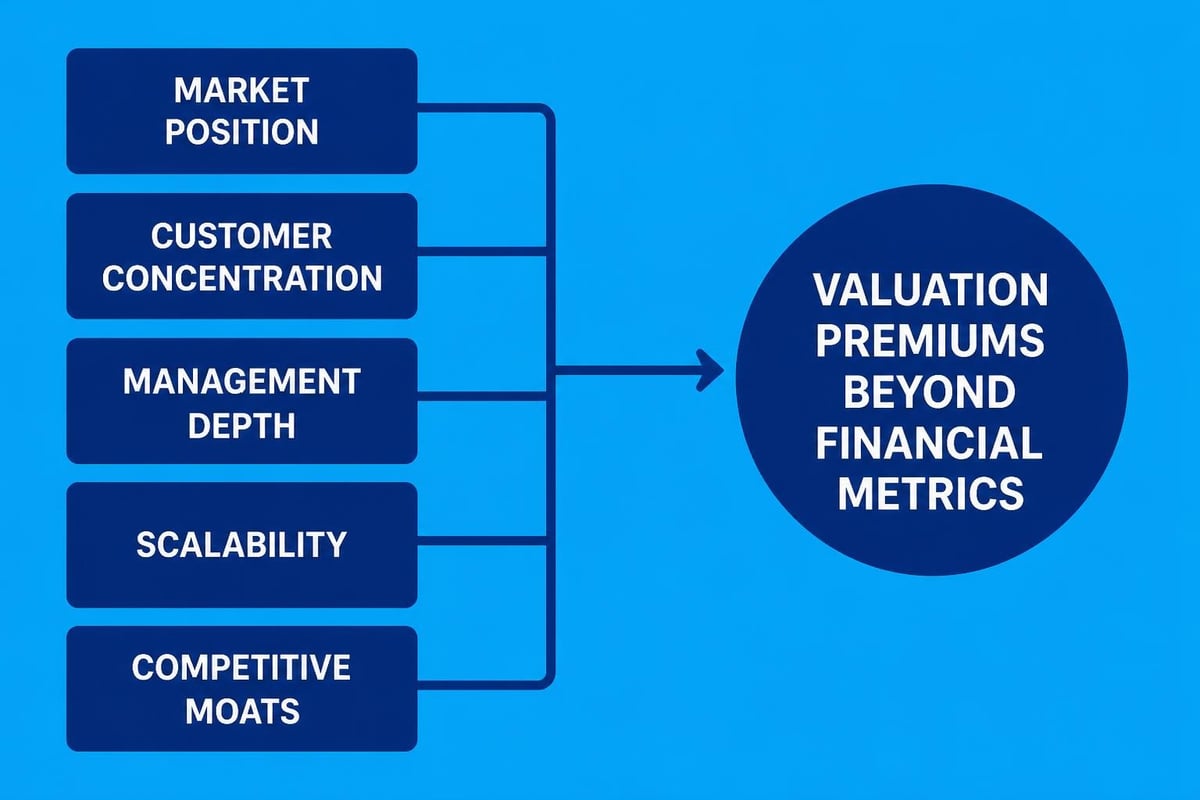
Beyond spreadsheets and formulas, strategic elements significantly influence what a buyer will pay. To comprehensively find out how much a company is worth, assess intangible assets and competitive positioning that create premium valuations.
Intangible Assets and Intellectual Property
Intangible assets under accounting standards include patents, trademarks, customer relationships, and proprietary technology. These assets often represent the majority of value in knowledge-based businesses but require careful identification and valuation.
Key intangible value drivers:
- Brand recognition and customer loyalty
- Proprietary software or processes
- Regulatory licenses or approvals
- Trained workforce and organizational culture
- Distribution networks and strategic partnerships
In M&A transactions, intangible assets are formally valued during purchase price allocation, with excess purchase price over fair value of identifiable assets recorded as goodwill subject to impairment testing.
Market Position and Competitive Advantages
A dominant market position justifies premium multiples. When assessing how to find out how much a company is worth from a strategic perspective, evaluate:
| Factor | Value Impact | Assessment Method |
|---|---|---|
| Market share | Higher share = pricing power | Compare to competitors |
| Customer retention | Recurring revenue reduces risk | Analyze cohort data |
| Switching costs | Lock-in increases stability | Survey customers |
| Barriers to entry | Protection from competition | Industry analysis |
| Management depth | Reduces key-person risk | Evaluate org chart |
These qualitative factors often determine whether a company sells at the 25th or 75th percentile of industry multiples.
Specialized Valuation Considerations for Private Companies
Private company valuation presents unique challenges that public market comparisons don't address. Without daily market pricing, you must make adjustments when you find out how much a company is worth in the private markets.
Lack of Marketability Discounts
Private company interests lack the liquidity of publicly traded shares. Professional appraisers typically apply marketability discounts of 15-35% when valuing minority interests in private companies. For controlling interests being sold through a structured process, these discounts may not apply.
Control Premiums and Minority Discounts
A controlling ownership stake commands premium pricing because it conveys decision-making authority. Control premiums of 20-40% above the pro-rata equity value reflect the power to:
- Determine operational strategy
- Appoint management
- Declare dividends
- Initiate a sale or merger
- Control asset deployment
Conversely, minority stakes suffer discounts since the holder cannot direct company actions.
Working with Professional Valuators
For transactions exceeding seven figures, engaging a qualified business appraiser provides defensible valuations for tax, litigation, or transaction purposes. The SBA offers guidance on when professional valuation becomes necessary and how to select appropriate professionals.
KPMG’s valuation services illustrate the scope of professional engagements, from transaction opinions to fair value measurements under accounting standards for financial reporting.
Industry-Specific Valuation Approaches
Different industries require tailored methodologies to accurately find out how much a company is worth. Standard formulas don't capture sector-specific value drivers.
Technology and SaaS Businesses
Software companies emphasize metrics like:
- Annual Recurring Revenue (ARR)
- Customer Acquisition Cost (CAC) vs. Lifetime Value (LTV)
- Net Revenue Retention (NRR)
- Gross margin percentage
- Rule of 40 (growth rate + profit margin)
Valuations often center on ARR multiples, with premium businesses commanding 8-15x ARR based on growth rates above 40% and retention exceeding 95%.
Manufacturing and Distribution
Asset-intensive businesses rely more heavily on:
- EBITDA multiples (4-7x for middle-market manufacturers)
- Replacement cost of equipment and facilities
- Working capital requirements
- Supply chain resilience
- Customer concentration risk
For companies in sectors like agribusiness M&A, seasonal cash flow patterns and commodity price exposure require specialized analysis.
Service-Based Businesses
Professional services, agencies, and consulting firms present valuation challenges due to key-person dependencies. Valuation approaches emphasize:
- Recurring client revenue vs. project-based work
- Employee retention and non-compete agreements
- Intellectual property and methodologies
- Transition planning and earn-out structures
Service businesses typically trade at 0.5-2.0x revenue or 3-6x EBITDA, with premiums for specialized expertise and diversified client bases.
Preparing Your Company for Valuation
Before you formally find out how much a company is worth through buyer discussions or professional appraisal, optimization increases value and marketability.
Financial Housekeeping
Clean financials attract higher valuations. Implement these practices 12-24 months before a potential transaction:
- Transition to accrual accounting if using cash basis
- Obtain audited or reviewed financial statements
- Normalize earnings by removing owner perquisites
- Document and justify all add-backs
- Reconcile tax returns to financial statements
- Track and document key performance indicators
Documentation and Diligence Readiness
Buyers assess risk based on information quality. Preparation includes:
| Document Category | Purpose | Value Impact |
|---|---|---|
| Customer contracts | Prove recurring revenue | Reduces risk discount |
| Employee agreements | Demonstrate retention | Increases multiple |
| IP documentation | Protect competitive advantage | Adds premium |
| Compliance records | Limit liability exposure | Prevents deductions |
| Growth initiatives | Show future potential | Justifies projections |
A well-organized virtual data room accelerates diligence and signals professional management. Aligned IQ VDR provides lower middle-market participants with secure document sharing at competitive pricing, complimentary for Aligned IQ M&A sellers after a match is completed.

Navigating the Valuation Process in M&A Transactions
When engaging with potential acquirers, understanding how buyers find out how much a company is worth helps you prepare for questions and negotiate effectively.
Initial Valuation and Indication of Interest
Serious buyers perform preliminary valuation using:
- Available financial summaries (typically three years)
- Industry research and comparable transactions
- High-level operational metrics
- Strategic fit assessment
This analysis produces an indication of interest (IOI) stating a valuation range, proposed structure, and key assumptions. IOIs are non-binding but establish negotiation parameters.
Quality of Earnings Analysis
After signing a letter of intent, buyers commission quality of earnings (QoE) studies to verify financial representations. The QoE provider examines:
- Revenue recognition policies and sustainability
- EBITDA adjustments and normalization appropriateness
- Working capital trends and requirements
- Capital expenditure needs
- Contingent liabilities and off-balance-sheet items
QoE findings frequently lead to purchase price adjustments. Sellers who proactively address these items minimize surprises and maintain deal momentum.
Purchase Price Mechanisms
Final transaction value emerges through several mechanisms:
- Cash-free, debt-free pricing: Buyer pays for equity value, with cash and debt settled separately
- Locked-box mechanism: Value fixed at historical date, with buyer receiving economic benefit thereafter
- Completion accounts: Final price adjusted based on closing balance sheet
- Earn-outs: Portion of consideration contingent on future performance
Understanding business valuation methodologies and transaction structures enables you to assess offers comprehensively, not just on headline multiples.
Leveraging Technology and Platforms for Valuation Insights
Modern M&A platforms provide data and connections that help participants find out how much a company is worth through market exposure and strategic matching.
Market Intelligence and Comparable Transactions
Access to recent deal data provides valuation benchmarks. While most private transactions remain confidential, aggregated industry data reveals trending multiples and structures. Platforms focused on financial valuation often provide anonymized market intelligence to users.
Strategic Fit Premium
The traditional M&A process often prioritizes financial metrics over strategic alignment, potentially leaving value on the table. When buyers and sellers match based on complementary strengths, synergies justify premium valuations.
Aligned IQ M&A transforms this dynamic by prioritizing strategic fit before delving into detailed valuation discussions. The platform's proprietary matching process considers:
- Transaction priorities and investment criteria
- Industry expertise and operational experience
- Deal size and structure preferences
- Geographic and market focus areas
This approach ensures both parties explore whether strategic rationale supports premium pricing before investing significant resources in due diligence. For sellers, the confidential, low-risk nature of exploring potential matches differs markedly from traditional processes that expose businesses to market speculation.
Showcasing Value to Potential Acquirers
Business buyers can use platforms like Aligned IQ M&A to source deals while presenting themselves as attractive exit options. By articulating clear acquisition strategies and demonstrating industry expertise, acquirers position themselves to recognize and pay for strategic value others might miss.
The semi-proprietary nature of such platforms means sellers control information flow, releasing details only to qualified, strategically aligned parties rather than broadcasting availability to the entire market.
Common Valuation Mistakes to Avoid
Even experienced dealmakers stumble when attempting to find out how much a company is worth. Awareness of common pitfalls improves accuracy and negotiation outcomes.
Over-Reliance on Rules of Thumb
Industry multiples provide useful benchmarks but shouldn't substitute for rigorous analysis. A "3x EBITDA" rule of thumb ignores:
- Quality and sustainability of earnings
- Growth trajectory and market position
- Working capital and capex requirements
- Risk factors specific to the business
Always adjust generic multiples for company-specific factors.
Ignoring Working Capital Requirements
Buyers acquire businesses expecting them to operate. Insufficient working capital at closing creates immediate funding needs. Normalize working capital to historical averages and adjust purchase price accordingly.
Unrealistic Growth Projections
Seller-provided projections often assume best-case scenarios. When building DCF models, stress-test assumptions against:
- Historical growth rates
- Market size and penetration
- Competitive dynamics
- Required investment levels
Conservative projections with demonstrated achievability support higher credibility than hockey-stick forecasts.
Neglecting Tax Implications
Asset purchases trigger different tax consequences than stock purchases. The allocation of purchase price across asset classes affects both buyer depreciation benefits and seller tax liability. Structure considerations can shift 10-20% of economic value between parties.
Valuation Trends Shaping 2026 Transactions
As markets evolve, understanding current trends helps you find out how much a company is worth in today's environment rather than relying on outdated benchmarks.
Key 2026 valuation trends include:
- Rising interest rates increasing discount rates and compressing multiples for highly leveraged businesses
- AI and automation capabilities commanding premiums as efficiency drivers
- ESG factors influencing valuations, particularly in regulated industries
- Remote workforce models reducing geographic constraints and facility requirements
- Subscription revenue models attracting premium multiples across industries
Lower middle-market companies demonstrating resilience, technology adoption, and sustainable competitive advantages continue commanding strong valuations despite macroeconomic headwinds.
Successfully determining company value requires combining quantitative analysis with qualitative judgment about strategic positioning and market dynamics. Whether you're exploring valuing private companies for acquisition or preparing your own business for an eventual exit, mastering these methodologies provides the foundation for successful transactions. When you're ready to connect with strategically aligned counterparties who appreciate your company's unique value drivers, Aligned IQ offers a confidential platform that prioritizes fit over financial metrics alone, transforming M&A into a collaborative process where both parties achieve their goals. Take a tour to discover how our unique matching approach helps you find the perfect transaction partner.
No responses yet