

Corporate valuation stands as the cornerstone of successful mergers and acquisitions, determining whether a transaction creates value or destroys it. For business owners contemplating an exit and strategic buyers seeking the right acquisition, understanding how companies are valued transforms abstract financial concepts into actionable intelligence. The difference between a well-executed valuation and a rushed estimate can mean millions of dollars in deal value, along with the success or failure of post-transaction integration. In 2026, as middle-market M&A continues to evolve, sophisticated valuation techniques have become accessible to a broader range of dealmakers, not just large investment banks and private equity firms.
Understanding the Foundations of Corporate Valuation
Corporate valuation represents both an art and a science, blending rigorous financial analysis with strategic judgment about future performance. At its core, the practice seeks to answer a deceptively simple question: what is a business worth? The answer depends on who is asking, why they are asking, and what assumptions drive the analysis.
Three primary approaches dominate corporate valuation practice:
- Income-based methods that discount future cash flows to present value
- Market-based approaches that compare the target to similar companies or transactions
- Asset-based techniques that assess the value of underlying assets and liabilities
Each methodology serves different purposes and produces different results. A strategic buyer evaluating synergies will approach valuing a firm differently than a financial buyer focused purely on cash generation, and both will differ from a seller's perspective on fair value.
The Strategic Context Behind Valuation
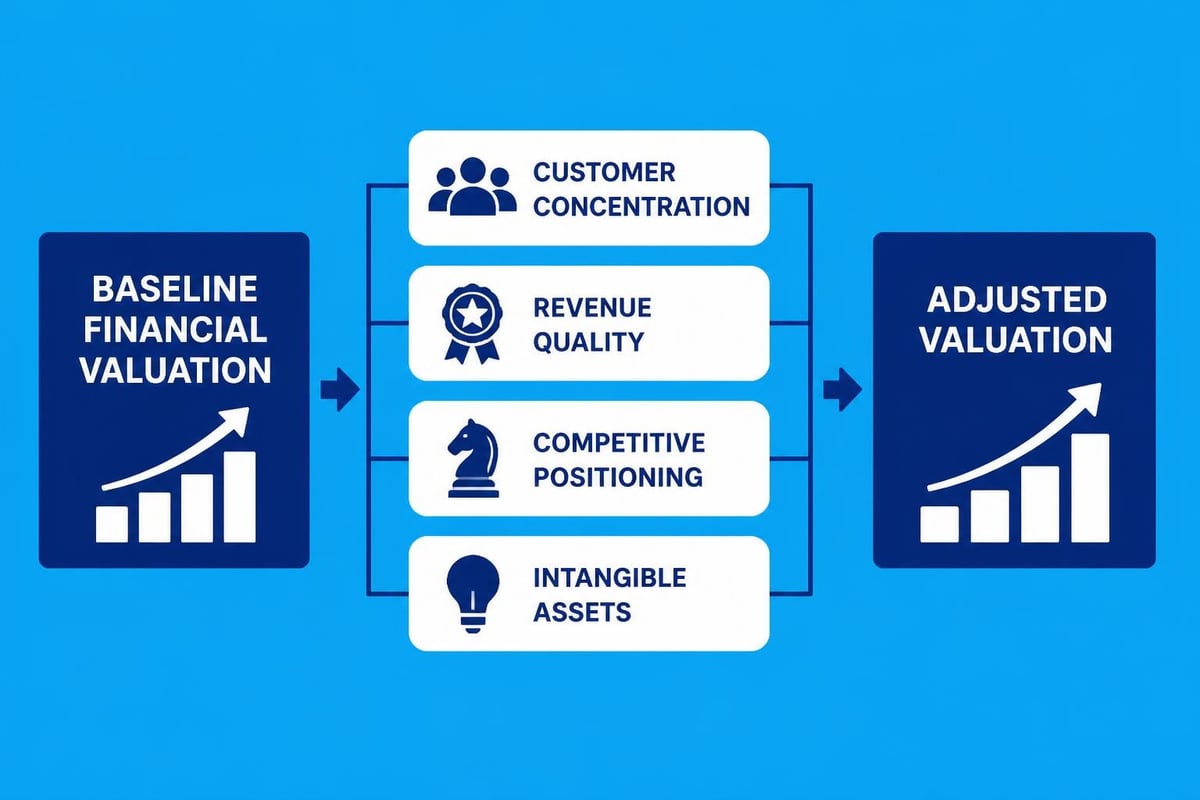
The numbers alone never tell the complete story. Corporate valuation must account for strategic fit, market positioning, competitive dynamics, and growth potential. Two companies with identical financial statements may command vastly different valuations based on their customer relationships, intellectual property, or management teams.
When business owners and buyers connect through proprietary platforms that prioritize strategic alignment before diving into detailed financials, the valuation discussion begins from a position of mutual understanding. This approach reduces the risk of wasted time on deals that ultimately fail due to misaligned expectations or incompatible strategic visions.

Income Approach: Discounted Cash Flow Analysis
The discounted cash flow (DCF) method represents the gold standard for intrinsic valuation, particularly when evaluating established businesses with predictable cash flows. This approach projects future free cash flows and discounts them to present value using a risk-adjusted discount rate that reflects the cost of capital.
Building a robust DCF model requires several critical inputs and decisions. The forecast period typically extends five to ten years, capturing enough time for the business to reach a stable growth trajectory. Revenue projections must balance optimism with realism, grounded in historical performance, market analysis, and specific growth initiatives.
| DCF Component | Key Considerations | Common Challenges |
|---|---|---|
| Revenue Growth | Historical trends, market size, competitive position | Overoptimistic projections, market saturation |
| Operating Margins | Efficiency improvements, scale economies | Unsustainable margin expansion assumptions |
| Capital Expenditures | Maintenance vs. growth investments | Underestimating required reinvestment |
| Working Capital | Cash conversion cycle, seasonal patterns | Ignoring working capital requirements |
| Terminal Value | Perpetuity growth or exit multiple | Outsized impact on total valuation |
The discount rate calculation deserves particular attention. The weighted average cost of capital (WACF) blends the cost of equity and after-tax cost of debt, weighted by the target capital structure. For private companies or divisions without publicly traded comparables, estimating the cost of equity requires careful analysis of beta, market risk premiums, and size premiums. Resources like the KPMG cost of capital study provide valuable benchmarking data for these critical inputs.
Terminal Value and Long-Term Assumptions
The terminal value typically represents 60 to 80 percent of total enterprise value in a DCF analysis, making it the single most influential assumption. Two approaches predominate: the perpetuity growth method and the exit multiple method.
The perpetuity growth approach assumes the business will grow at a constant rate forever, typically between 2 and 3 percent to align with long-term GDP growth. The exit multiple method applies a terminal EBITDA or revenue multiple based on comparable companies or transactions at the end of the forecast period.
Conservative practitioners often calculate terminal value using both methods and reconcile the results. Significant differences between the two approaches signal potential issues with forecast assumptions or discount rate calculations that warrant deeper investigation.
Market-Based Valuation Approaches
Comparable company analysis and precedent transaction analysis provide market-based validation for corporate valuation conclusions. These methods anchor valuation in observable market data rather than subjective projections, though they introduce their own challenges around comparability and market conditions.
Trading Comparables and Public Market Multiples
Public company comparables establish valuation multiples based on how the market prices similar businesses. Common multiples include enterprise value to EBITDA, price to earnings, and revenue multiples, each suited to different industries and business models.
Selecting truly comparable companies requires judgment and industry knowledge. Size matters significantly. A $500 million revenue public company trades at different multiples than a $20 million private business, even in the same industry. Geographic footprint, growth rates, margin profiles, and competitive positions all influence which companies qualify as legitimate comparables.
Critical adjustments when using trading multiples:
- Control premium – add 20-40% to reflect control benefits unavailable to minority public shareholders
- Liquidity discount – subtract 20-30% for private companies lacking public market liquidity
- Size premium – adjust for systematic undervaluation of smaller companies
- Company-specific factors – account for unique strengths or weaknesses
Professional resources like those from Aswath Damodaran at NYU Stern offer extensive databases of industry multiples and guidance on proper application of market-based methods.
Precedent Transaction Analysis
Precedent transactions reflect actual prices paid in M&A deals, incorporating control premiums and synergy values that buyers were willing to pay. This approach often produces higher valuations than trading comparables because transaction multiples include strategic value beyond standalone operations.
Building a precedent transaction set requires accessing deal databases and filtering for relevant comparables. Recency matters because market conditions and industry dynamics shift over time. Most practitioners focus on transactions completed within the past two to three years, with greater weight on recent deals.
The challenge lies in obtaining reliable data. Many middle-market transactions never reach public databases, and disclosed deal terms may exclude earn-outs, seller financing, or other contingent considerations that affect true valuation. Service providers who work extensively in specific industries often maintain proprietary transaction databases that provide superior comparability to public sources.

Valuation Adjustments for Private Companies
Private company valuation introduces complexities that don't exist when valuing public corporations. Valuing private companies requires adjustments for owner compensation, non-recurring expenses, and discretionary spending that may not reflect true economic performance.
Normalization adjustments seek to present earnings on a sustainable, market-based compensation structure. Owner-operators often pay themselves above or below market rates for tax or personal reasons. Real estate held personally but used by the business, family member salaries, and one-time legal or consulting expenses all warrant adjustment.
Quality of Earnings and EBITDA Adjustments
Buyers increasingly demand quality of earnings reports prepared by independent accounting firms. These reports identify and quantify necessary adjustments, assess revenue recognition policies, evaluate working capital trends, and highlight risks in the financial presentation.
Common EBITDA adjustments include normalizing owner compensation, adding back non-recurring professional fees, adjusting for related-party transactions, and removing personal expenses run through the business. The goal is presenting normalized EBITDA that a market-rate management team could generate under normal operating conditions.
Aggressive adjustment requests from sellers sometimes strain credibility. "This customer just left but we'll replace them" or "margins will improve once we implement this strategy" discount future promises that belong in synergy discussions, not in standalone valuation. Professional intermediaries and certified business appraisers provide objective third-party validation of appropriate adjustments.
Strategic Considerations Beyond the Numbers
Pure financial analysis captures only part of what drives corporate valuation in M&A contexts. Strategic factors often justify premiums or discounts that seem irrational from a standalone cash flow perspective but make perfect sense when considering buyer-specific value creation.
Customer concentration represents a critical strategic consideration. A business generating 40 percent of revenue from one customer trades at a discount regardless of profitability because of concentration risk. Conversely, a highly diversified customer base with strong retention metrics commands a premium.
Recurring revenue models consistently earn higher valuations than project-based or transactional businesses. Subscription models, maintenance contracts, and long-term agreements provide visibility and stability that buyers value highly. The CFA Institute’s equity valuation guidance emphasizes the importance of cash flow predictability in determining appropriate discount rates and valuation multiples.
The Role of Intangible Assets
Intellectual property, brand value, customer relationships, and proprietary processes drive substantial value but don't appear on balance sheets. Technology companies may possess minimal tangible assets while commanding enormous valuations based on software, patents, or user networks.
Harvard Business Review’s research on customer-based company valuation demonstrates how customer lifetime value, acquisition costs, and retention rates provide alternative frameworks for understanding business value, particularly in subscription or recurring revenue models. These approaches complement traditional financial methods by focusing on the fundamental value drivers.
Bridging the Valuation Gap Between Buyers and Sellers
Valuation disagreements kill more deals than any other single factor. Sellers anchor on peak-year performance or strategic value they believe exists. Buyers discount for risk, integration challenges, and uncertainty. Professional intermediaries understand these dynamics and structure discussions to find common ground.
Earn-outs and contingent consideration provide mechanisms to bridge valuation gaps when buyers and sellers disagree about future performance. The seller receives additional payments if the business achieves specific milestones post-closing, aligning incentives and sharing risk.
Common earn-out structures:
- Revenue or EBITDA targets over one to three years
- Retention of key customers or contracts
- Achievement of specific product or market milestones
- Percentage of excess performance above baseline thresholds
Earn-outs introduce complexity and potential conflict. Clear definitions, auditable metrics, and seller involvement in achieving targets increase success rates. Many experienced buyers and sellers prefer clean transactions without earn-outs, accepting price adjustments instead to reach agreement.
Valuation Governance and Documentation
Professional standards and governance around corporate valuation have tightened significantly. Deloitte’s fair valuation surveys track how companies implement controls, documentation requirements, and review processes to ensure valuation quality and compliance.
Written valuation reports should document methodology selection, key assumptions, data sources, comparable company or transaction selection criteria, and sensitivity analysis around critical inputs. Third-party valuation opinions provide credibility when dealing with sophisticated buyers, lenders, or investors who will scrutinize the analysis.
For lower middle-market transactions where full fairness opinions may be cost-prohibitive, detailed internal documentation still serves important purposes. It protects against future disputes, supports financing applications, and demonstrates professional rigor that builds buyer confidence.
Managing Valuation in the Deal Process
When business owners explore strategic alternatives through confidential platforms that prioritize fit before detailed valuation discussions, the timing and sequencing of valuation work changes fundamentally. Rather than leading with price expectations that may not reflect market reality, parties first establish strategic alignment and mutual interest.
This approach reduces the emotional investment in specific numbers before understanding whether a deal makes strategic sense. By the time detailed enterprise value discussions occur, both parties have invested in understanding the strategic rationale, making valuation a negotiation toward fair value rather than a confrontational starting point.
The traditional M&A process often involves broad market exposure before establishing serious buyer interest, potentially revealing valuation expectations publicly and creating auction dynamics that may not serve seller interests. Alternative approaches that control information flow and prioritize qualified, strategically aligned buyers provide owners more flexibility in managing valuation discussions.
Technology and Tools in Modern Valuation
Spreadsheet-based models remain the workhorse of corporate valuation, but specialized software and platforms have emerged to streamline analysis and improve accuracy. Cloud-based financial modeling tools enable real-time collaboration between deal teams, automatic updates from data sources, and scenario analysis that would be prohibitively time-consuming manually.
Virtual data rooms have evolved beyond simple document repositories into sophisticated deal management platforms. Secure environments where buyers can access financial information, ask questions, and conduct due diligence while sellers maintain control over information flow and track buyer activity. For sellers who have established preliminary matches through strategic fit-focused platforms, competitively priced VDR solutions like those available at Aligned IQ VDR provide professional infrastructure without the traditional cost barriers.
| Valuation Technology | Primary Benefits | Typical Users |
|---|---|---|
| Financial modeling platforms | Collaboration, version control, scenario analysis | M&A advisors, corporate development teams |
| Comparable company databases | Industry multiples, screening, peer selection | Analysts, business appraisers |
| Virtual data rooms | Secure document sharing, buyer tracking, Q&A management | All transaction participants |
| Valuation software suites | Automated DCF, Monte Carlo analysis, reporting | Valuation firms, investment banks |
The democratization of these tools means middle-market participants now access capabilities previously reserved for large investment banks. Business appraisal services can deliver institutional-quality analysis at accessible price points, leveling the playing field for private company owners and buyers.
Industry-Specific Valuation Considerations
Different industries require tailored valuation approaches that reflect unique economics and value drivers. Software companies with recurring revenue, negative working capital, and minimal capital expenditure requirements merit different treatment than manufacturing businesses with heavy equipment needs and cyclical demand.
Service businesses often trade on revenue multiples because EBITDA can be managed through owner compensation and discretionary expenses. Professional services firms with revenue concentrated in key relationships may see those relationships valued separately from the business operations. Manufacturing and distribution companies typically trade on EBITDA multiples, with adjustments for equipment age, facility ownership, and customer concentration.
Regulated industries add compliance and licensing considerations that affect both valuation and deal structure. Healthcare, financial services, and transportation businesses require understanding regulatory requirements that create barriers to entry (enhancing value) or compliance burdens (reducing value).
The Valuation Professional Ecosystem
Corporate valuation for M&A transactions involves multiple professional disciplines. Investment bankers and M&A advisors provide sell-side or buy-side representation, including valuation analysis as part of comprehensive deal services. Independent business appraisers offer third-party valuations for tax, estate planning, or litigation purposes, often required for fairness opinions in transactions involving fiduciary duties.
Acquisition strategies developed by corporate development professionals or private equity firms incorporate valuation parameters into broader strategic frameworks. These strategies define acceptable valuation ranges, return thresholds, and deal structure preferences that guide transaction execution.
Accountants perform quality of earnings analysis and financial due diligence that validates or challenges valuation assumptions. Legal advisors structure transactions to optimize tax treatment and allocate risk, both of which affect net proceeds and effective valuation. The most successful transactions coordinate these disciplines rather than operating in silos.
Choosing Professional Support
Business owners approaching a potential exit face decisions about what professional support they need and when to engage it. Premature engagement of full investment banking services may be inefficient if strategic fit hasn't been established. Delayed engagement of qualified advisors may leave owners disadvantaged in negotiations with sophisticated buyers.
Platforms that facilitate confidential exploration of strategic fit before traditional process steps allow owners to sequence professional engagement more efficiently. Once serious interest from a strategically aligned buyer materializes, bringing in valuation professionals, quality of earnings advisors, and legal counsel proceeds from a position of demonstrated mutual interest rather than speculative exploration.
Valuation Trends Shaping 2026 M&A Markets
Several trends are influencing how corporate valuation is practiced and how deals are structured in the current environment. Rising interest rates compared to the 2020-2021 period have increased discount rates and compressed valuation multiples across most industries. Buyers exercise greater discipline, focusing on cash flow certainty rather than speculative growth stories.
The quality of earnings matters more than ever. Strategic buyers and private equity firms conduct deeper due diligence, scrutinizing revenue recognition, customer retention, and normalized profitability with heightened skepticism. Sellers who proactively address these areas through strong financial controls and documentation command premium valuations.
Key valuation trends in 2026:
- Greater emphasis on recurring revenue and customer lifetime value
- Increased scrutiny of working capital and cash conversion cycles
- Higher hurdle rates and more conservative growth assumptions
- Focus on EBITDA quality rather than absolute size
- Preference for clean deals with minimal earn-out complexity
Industry-specific dynamics overlay these broader trends. Technology and healthcare continue attracting premium valuations due to favorable long-term growth prospects. Traditional manufacturing and distribution face margin pressure but remain attractive to strategic buyers seeking consolidation opportunities or lower middle-market PE firms implementing operational improvement strategies.
Practical Application for Middle-Market Transactions
For business owners in the $5 million to $50 million enterprise value range, corporate valuation requires balancing professional rigor with practical constraints. Full investment banking engagements may cost hundreds of thousands of dollars, making them prohibitive for smaller transactions or exploratory discussions.
Alternative approaches that provide owners access to qualified buyers through confidential, strategic-fit-focused matching reduce the need for broad market processes while maintaining valuation discipline. When both parties have established mutual interest based on strategic alignment, valuation discussions proceed more efficiently because the fundamental question of "why does this deal make sense" has already been answered affirmatively.
A typical scenario might involve a business owner in a specialized B2B services niche seeking an exit within two to three years. Rather than immediately engaging full sell-side advisory and broadcasting availability to the market, the owner could explore strategic fit with specific buyer profiles that align with the company's unique value proposition. Once a qualified buyer with genuine strategic interest emerges, detailed valuation work, quality of earnings analysis, and negotiation proceed with greater probability of successful closing.
This sequencing protects confidentiality, reduces unnecessary professional costs during exploratory phases, and positions the owner to negotiate from a position of demonstrated buyer interest rather than speculative market testing.
Corporate valuation provides the analytical foundation for successful M&A transactions, but its real power emerges when combined with strategic insight about what makes deals succeed beyond the numbers. Business owners and buyers who prioritize strategic fit before diving into detailed financial analysis create more efficient processes and better outcomes. Aligned IQ transforms traditional M&A dynamics by enabling confidential exploration of strategic alignment through its proprietary matching platform, helping both parties determine if a transaction makes fundamental sense before investing heavily in detailed valuation work. Take a tour to discover how our approach to prioritizing strategic fit can help you find the right counterparty for your M&A goals.
No responses yet