

A well-defined company acquisition strategy separates successful acquirers from those who struggle with post-deal integration challenges and value erosion. In 2026, the landscape for mergers and acquisitions has evolved significantly, with technology platforms transforming how buyers and sellers identify potential counterparties and prioritize strategic fit before diving into complex negotiations. Whether you're a private equity firm building a platform, a strategic corporate buyer expanding market share, or a first-time acquirer seeking growth, your approach to acquisitions must balance disciplined evaluation with speed of execution.
Strategic Foundations of Acquisition Success
The most effective company acquisition strategy begins with clarity about why you're pursuing acquisitions in the first place. Growth objectives vary dramatically across organizations, from geographic expansion and product line diversification to talent acquisition and technology integration.
Defining Your Acquisition Thesis
Your acquisition thesis serves as the north star for all deal activity. This foundational document should articulate:
- Target industry sectors and subsectors aligned with your core competencies
- Deal size parameters based on available capital and integration capacity
- Geographic preferences that match your operational footprint
- Financial criteria including revenue thresholds, EBITDA margins, and growth rates
- Strategic priorities such as customer base expansion or intellectual property acquisition
Without a clearly articulated thesis, acquisition teams waste valuable time evaluating opportunities that don't align with long-term objectives. Acquisition strategy frameworks provide structured approaches to developing this foundational element.
Transaction Priority Alignment
One of the most overlooked aspects of company acquisition strategy is ensuring transaction priorities align between buyer and seller from the earliest conversations. Traditional M&A processes often push parties into detailed negotiations before confirming that both sides share compatible goals regarding deal structure, timing, and post-transaction involvement.
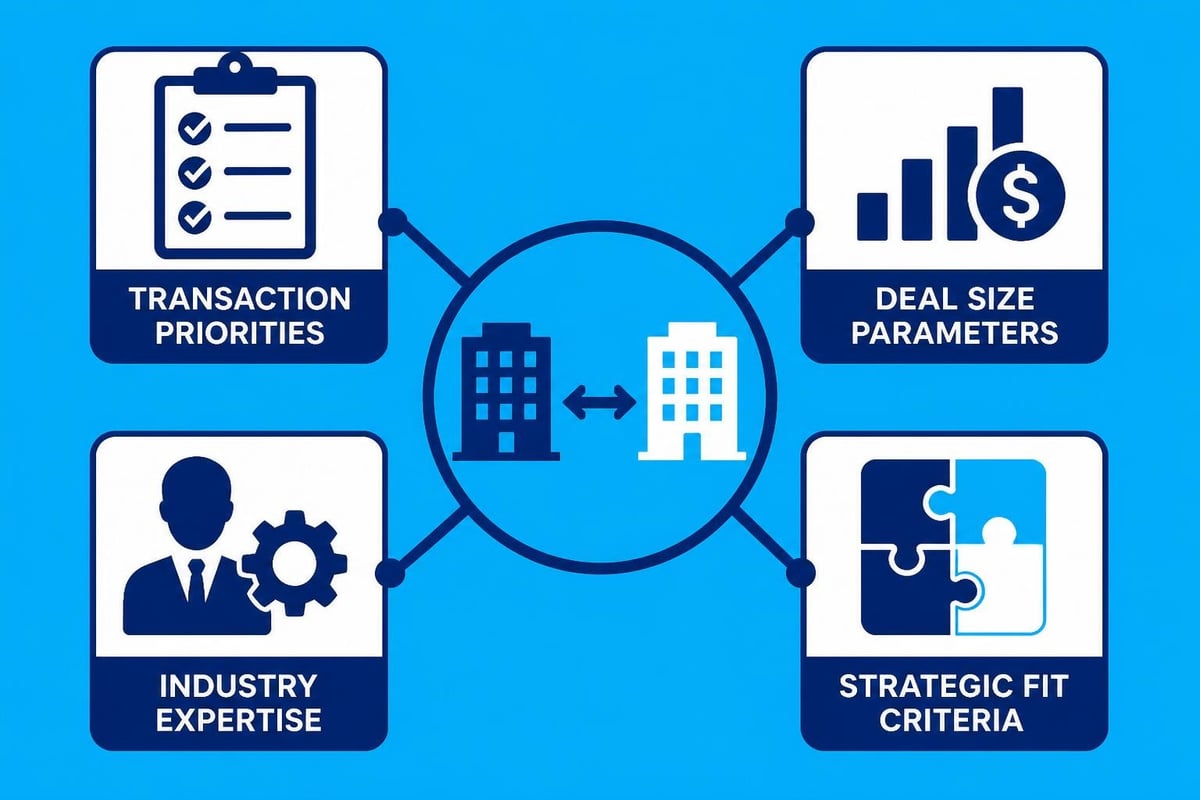
Smart acquirers recognize that strategic fit determines deal success more reliably than purchase price alone. A typical scenario might involve a regional service company seeking an acquirer who values customer relationships and plans to retain existing management, rather than a buyer focused purely on cost synergies and rapid restructuring.
Capital Structure and Funding Mechanisms
Your company acquisition strategy must address how you'll finance transactions across different scenarios. Capital structure decisions impact not only deal feasibility but also post-acquisition flexibility and returns.
Funding Options for Different Acquirer Profiles
| Acquirer Type | Primary Funding Sources | Typical Leverage Ratio | Key Considerations |
|---|---|---|---|
| Strategic Corporate | Cash reserves, stock, debt | 2.0-4.0x EBITDA | Balance sheet capacity, dilution concerns |
| Private Equity | Fund capital, bank debt, mezzanine | 4.0-6.0x EBITDA | Return hurdles, exit timeline |
| Search Fund | SBA loans, investor equity | 2.5-3.5x EBITDA | Personal guarantee requirements |
| Family Office | Direct capital, minimal leverage | 0-2.0x EBITDA | Flexibility, patient capital advantages |
The 2026 lending environment has created opportunities for creative deal structuring, particularly for lower middle-market PE firms pursuing add-on acquisitions. Seller financing has gained renewed popularity as business owners recognize the tax advantages and risk mitigation benefits of structured earnouts.
Optimizing Your Capital Stack
A disciplined company acquisition strategy incorporates multiple funding layers to optimize cost of capital while maintaining operational flexibility. Senior debt provides the lowest-cost capital but comes with covenant restrictions. Mezzanine financing fills the gap between senior debt and equity, offering flexible terms at moderate cost.
Business acquisition strategy in 2026 requires sophisticated understanding of how different capital sources interact. Equity preserves debt capacity for future acquisitions, making it particularly valuable for platforms executing roll-up strategies in fragmented industries.
Deal Sourcing and Target Identification
The most sophisticated company acquisition strategy fails without access to quality deal flow. How you source potential acquisitions fundamentally impacts the competitive dynamics and ultimate transaction outcomes.
Proprietary Deal Flow Advantages
Proprietary and semi-proprietary deal processes offer substantial advantages over broadly marketed auctions. When fewer competing bidders participate, sellers often accept lower valuations in exchange for certainty and cultural alignment. The traditional M&A process, with its investment banker roadshows and multi-round bidding, creates adversarial dynamics that can derail deals even after letters of intent are signed.
Modern M&A platforms have transformed deal sourcing by enabling direct connections between compatible parties before formal processes begin. A typical scenario involves a business owner confidentially exploring exit options years before they're ready to sell, building relationships with potential acquirers who demonstrate operational expertise and values alignment.
Building Your Target Pipeline
- Industry mapping – Identify all companies within your target sectors and size parameters
- Outreach campaigns – Develop personalized communication highlighting strategic rationale
- Relationship cultivation – Maintain regular contact even when targets aren't actively selling
- Network leverage – Activate industry contacts, board members, and service providers
- Platform utilization – Engage with specialized platforms that prioritize strategic fit
Research on global company acquisitions demonstrates that network effects significantly influence acquisition patterns and outcomes. Acquirers with stronger industry networks identify targets earlier and negotiate more favorable terms.

Due Diligence and Risk Mitigation
Once you've identified a promising target aligned with your company acquisition strategy, thorough due diligence becomes critical. This investigative phase uncovers potential deal-breakers and informs valuation adjustments.
Comprehensive Due Diligence Framework
Financial Due Diligence examines historical performance, working capital trends, revenue quality, and adjusted EBITDA. Quality of earnings analysis identifies one-time expenses, personal expenditures run through the business, and accounting adjustments that impact normalized cash flow.
Operational Due Diligence evaluates customer concentration, supplier relationships, employee retention risks, and process dependencies. Understanding operational leverage helps predict how the business will scale post-acquisition.
Legal and Compliance Due Diligence reviews contracts, intellectual property, litigation history, regulatory compliance, and environmental liabilities. These reviews often uncover issues requiring price adjustments or deal restructuring.
| Due Diligence Area | Timeline | Key Outputs | Common Red Flags |
|---|---|---|---|
| Financial | 3-4 weeks | QofE report, working capital analysis | Revenue concentration, margin erosion |
| Operational | 2-3 weeks | Process documentation, org chart validation | Key person dependencies, aging infrastructure |
| Legal | 3-5 weeks | Contract review, litigation summary | Pending lawsuits, IP disputes |
| Commercial | 2-3 weeks | Customer interviews, market positioning | Concentration risk, competitive threats |
Secure Virtual Data Rooms
Effective due diligence requires secure information exchange platforms. The Aligned IQ VDR provides lower middle-market buyers, sellers, M&A advisors, investment bankers, and other advisors with a secure virtual data room environment. For sellers matched through the Aligned IQ M&A platform, this service is complimentary after match completion, while competitive pricing serves other market participants.
The confidential, low-risk nature of modern virtual data rooms contrasts sharply with the traditional M&A process, where information leakage risks can damage seller businesses even when deals don't close.
Valuation Methodologies and Price Negotiation
Your company acquisition strategy must incorporate realistic valuation frameworks that balance market multiples with target-specific factors. Overpaying destroys value regardless of integration execution quality.
Multiple Valuation Approaches
Experienced acquirers triangulate value using several methodologies. Comparable company analysis benchmarks the target against similar businesses recently sold. Discounted cash flow modeling projects future cash generation and discounts to present value using risk-adjusted rates. Precedent transaction analysis examines multiples paid in similar deals.
A typical scenario in the lower middle market might show a target company trading at 4.5-5.5x EBITDA based on comparables, while DCF analysis suggests a value of 5.0-6.0x depending on growth assumptions. The ISS acquisition strategy case study demonstrates how serial acquirers develop sophisticated valuation discipline across hundreds of transactions.
Structuring Win-Win Deals
Price represents only one element of deal structure. Payment timing, earnout provisions, seller notes, employment agreements, and non-compete terms all impact economic outcomes for both parties. Creative structuring bridges valuation gaps while aligning incentives for post-close collaboration.
Integration Planning and Execution
The difference between successful and failed acquisitions often comes down to integration execution. Your company acquisition strategy should dedicate substantial resources to planning how acquired businesses will operate post-close.

Pre-Close Integration Preparation
Integration planning begins during due diligence, not after deal closing. Day 1 readiness requires coordinating IT systems access, payroll transitions, banking relationships, insurance coverage, and communication plans. A detailed 100-day playbook outlines priorities across all functional areas.
- Week 1-2: Leadership introductions, communication cascade, quick wins identification
- Week 3-6: Process mapping, system assessment, culture integration initiatives
- Week 7-10: Performance metric alignment, reporting consolidation, efficiency opportunities
- Week 11-14: Strategic planning integration, customer relationship management, talent retention programs
The Cisco acquisition strategy provides valuable insights into how technology companies approach integration with structured methodologies that preserve target company innovation while capturing synergies.
Culture and Talent Retention
Research on acquisitions’ effects on R&D productivity highlights the critical importance of retaining key talent post-acquisition. Cultural misalignment drives employee departures that erode the strategic value underlying the transaction.
Successful acquirers invest heavily in understanding target company culture during diligence and developing integration approaches that preserve what makes the business valuable. This proves particularly important in knowledge-intensive industries where talent represents the primary asset.
Roll-Up Strategies for Fragmented Markets
For acquirers targeting fragmented industries, a company acquisition strategy focused on serial acquisitions or platform builds requires different capabilities than one-off strategic deals.
Platform-Based Acquisition Approaches
Private equity platforms typically begin with a larger platform acquisition that provides management infrastructure, systems, and brand foundation. Subsequent add-on acquisitions benefit from established integration playbooks and centralized services.
The healthcare roll-up strategy case study illustrates how disciplined acquirers execute multiple transactions annually while maintaining integration quality and achieving projected synergies.
Standardized Integration Processes
Serial acquirers develop repeatable integration methodologies that reduce execution risk and timeline. Standard operating procedures cover everything from legal entity consolidation to customer communication templates. This operational discipline enables higher deal velocity without sacrificing outcomes.
A typical scenario might involve a platform company completing six add-on acquisitions over eighteen months, each following a proven integration playbook that delivers cost synergies within 90 days and revenue synergies within six months.
Technology and Data-Driven Deal Making
Modern company acquisition strategy increasingly relies on technology platforms and data analytics to improve decision quality and execution speed. The days of relationship-driven, gut-feel acquisitions have given way to more systematic approaches.
Platform-Based Matching and Discovery
Traditional M&A processes often fail to identify optimal buyer-seller pairings because information flows inefficiently. Business owners seeking eventual exits may never connect with acquirers who would value their companies most highly. Meanwhile, buyers waste time pursuing targets that don't align with strategic priorities.
Aligned IQ M&A transforms this dynamic through a proprietary matchmaking process that prioritizes strategic fit before parties invest significant time and resources. The platform's matching algorithm considers transaction priorities, deal size parameters, and industry expertise to connect compatible buyers and sellers in a confidential, low-risk environment.
For business owners exploring exit options, this approach differs fundamentally from the traditional M&A process. Rather than hiring an investment banker to run a broad auction when you're ready to sell, you can confidentially connect with potential acquirers years earlier, building relationships and evaluating fit before committing to a formal process.
Analytics and Performance Tracking
Data-driven acquirers track key performance indicators across their deal pipelines and portfolio companies. Metrics include deals reviewed versus executed, average time from LOI to close, integration milestone achievement, and synergy realization rates. This performance data informs strategy refinements and capability investments.
Regulatory Considerations and Compliance
Your company acquisition strategy must account for regulatory requirements that vary by industry, deal size, and geographic scope. Non-compliance can derail transactions or trigger post-close penalties.
Hart-Scott-Rodino and Antitrust Review
Transactions exceeding size thresholds established by the Hart-Scott-Rodino Act require pre-merger notification to the Federal Trade Commission and Department of Justice. These agencies review proposed acquisitions for potential anticompetitive effects. Filing fees and waiting periods add time and cost to deal timelines.
Even smaller transactions may trigger antitrust scrutiny in concentrated industries. Understanding when regulatory approval is required prevents delays during critical transaction phases.
Industry-Specific Regulations
Certain sectors face heightened regulatory oversight. Healthcare acquisitions may require certificate of need approvals or payer contract assignments. Financial services deals trigger licensing and capital adequacy reviews. Understanding these requirements early in your company acquisition strategy prevents late-stage surprises.
Building Acquisition Capabilities and Team Structure
Executing a successful company acquisition strategy requires specialized skills and dedicated resources. Organizations serious about acquisitions invest in building internal capabilities rather than relying entirely on external advisors.
Internal vs. External Resources
| Function | Internal Resources | External Advisors | Optimal Approach |
|---|---|---|---|
| Strategy Development | Corporate development team | Strategy consultants | Internal lead with external input |
| Deal Sourcing | BD team, executives | Investment bankers, brokers | Hybrid model leveraging networks |
| Financial Analysis | Corporate finance | Quality of earnings firms | Internal modeling, external QofE |
| Legal Structuring | In-house counsel | M&A attorneys | External counsel with internal oversight |
| Integration Execution | Integration PMO | Consultants for specific workstreams | Internal leadership, targeted external support |
For corporate acquisitions, building a dedicated corporate development function signals commitment to programmatic deal activity. These teams develop institutional knowledge that improves with each transaction, reducing reliance on expensive external advisors.
Developing Acquisition Expertise
Organizations new to acquisitions often underestimate the learning curve involved in successful deal execution. First-time acquirers benefit from engaging experienced advisors who can transfer knowledge while supporting specific transactions. Over time, internalizing this expertise reduces costs and improves speed.
Participation in industry conferences, peer learning groups, and specialized training programs accelerates capability development. The most sophisticated acquirers view deal execution as a core competency requiring continuous investment and refinement.
A comprehensive company acquisition strategy balances disciplined evaluation frameworks with execution excellence across sourcing, diligence, valuation, and integration. Success requires clarity about strategic priorities, access to quality deal flow, and systematic approaches that improve with experience. Whether you're a business buyer seeking your first acquisition or an experienced platform building through add-ons, connecting with strategically aligned counterparties creates the foundation for mutually beneficial transactions. Aligned IQ provides the matchmaking platform and secure collaboration tools that transform M&A into a more strategic, relationship-driven process-take a tour to discover how prioritizing fit before process can help you find the perfect counterparty for your acquisition goals.
No responses yet