

Calculating valuation of a startup represents one of the most challenging yet critical tasks in mergers and acquisitions. Unlike established companies with predictable cash flows and tangible assets, startups often operate at losses while pursuing aggressive growth, making traditional valuation methods less applicable. For business buyers exploring opportunities on platforms designed for strategic matching, understanding how to assess a startup's worth becomes essential for making informed acquisition decisions. The valuation process requires balancing quantitative analysis with qualitative judgments about market potential, team capabilities, and competitive positioning.
Understanding the Fundamentals of Startup Valuation
The process of calculating valuation of a startup differs fundamentally from valuing mature businesses. Startups typically lack the historical financial performance that anchors traditional valuation models, forcing buyers and sellers to rely more heavily on forward-looking assumptions and comparable transactions.
Why Traditional Valuation Models Fall Short
Mature companies generate predictable cash flows that can be discounted to present value, but startups often consume cash as they scale. This reality makes discounted cash flow (DCF) analysis challenging, though not impossible. The key variables-revenue growth rates, margin expansion timelines, and terminal values-carry enormous uncertainty in early-stage contexts.
Key challenges include:
- Limited or negative historical earnings
- Unpredictable revenue trajectories
- Unproven business models
- High failure rates requiring risk adjustments
- Intangible assets (technology, team, data) dominating value
When buyers and sellers connect through a match-making platform that prioritizes strategic fit, these valuation complexities become conversation starters rather than deal killers. Understanding why a particular buyer values specific startup attributes helps bridge the valuation gap.

Primary Methods for Calculating Valuation of a Startup
Professional valuators and M&A practitioners employ several distinct approaches when calculating valuation of a startup. Each method brings unique strengths and limitations, and experienced buyers often triangulate across multiple techniques to arrive at a reasonable range.
The Comparable Company Analysis Approach
Comparable company analysis examines publicly traded companies or recent M&A transactions in similar industries. This market-based approach applies valuation multiples-such as revenue multiples or EBITDA multiples-to the target startup's metrics.
| Metric | Application | Typical Range (SaaS) | Adjustment Factors |
|---|---|---|---|
| Revenue Multiple | Enterprise Value / ARR | 3x – 15x | Growth rate, retention, margins |
| User Multiple | Enterprise Value / Active Users | Varies widely | Monetization, engagement, CAC |
| EBITDA Multiple | Enterprise Value / EBITDA | 8x – 25x | Profitability trajectory, scale |
For pre-revenue startups, comparables become even more subjective. Modern AI-powered approaches to relative valuation help reduce bias by analyzing larger datasets of comparable transactions, though judgment remains essential.
When exploring potential acquisitions, buyers should document which comparables they selected and why certain adjustments were necessary. This transparency facilitates more productive negotiations when strategic buyers and sellers begin discussing valuation based on revenue and other key metrics.
Discounted Cash Flow for Growth-Stage Startups
Despite its challenges, DCF analysis remains valuable for calculating valuation of a startup that has achieved product-market fit and demonstrates a clear path to profitability. The method forecasts free cash flows over 5-10 years, then discounts them to present value using a risk-adjusted discount rate.
Critical DCF inputs for startups:
- Revenue projections: Build bottom-up models based on customer acquisition, pricing, and expansion
- Margin assumptions: Map the journey from current negative margins to target steady-state profitability
- Discount rate: Typically 25-50% for early-stage companies, reflecting high risk and illiquidity
- Terminal value: Estimate value beyond the forecast period using perpetuity growth or exit multiples
In a typical scenario, a SaaS startup projecting $50 million ARR in five years with 25% steady-state margins might justify a current valuation of $15-25 million depending on risk assumptions. Buyers evaluating such opportunities need to stress-test these projections against realistic customer acquisition costs and market saturation risks.
Pre-Revenue Valuation: The Scorecard Method
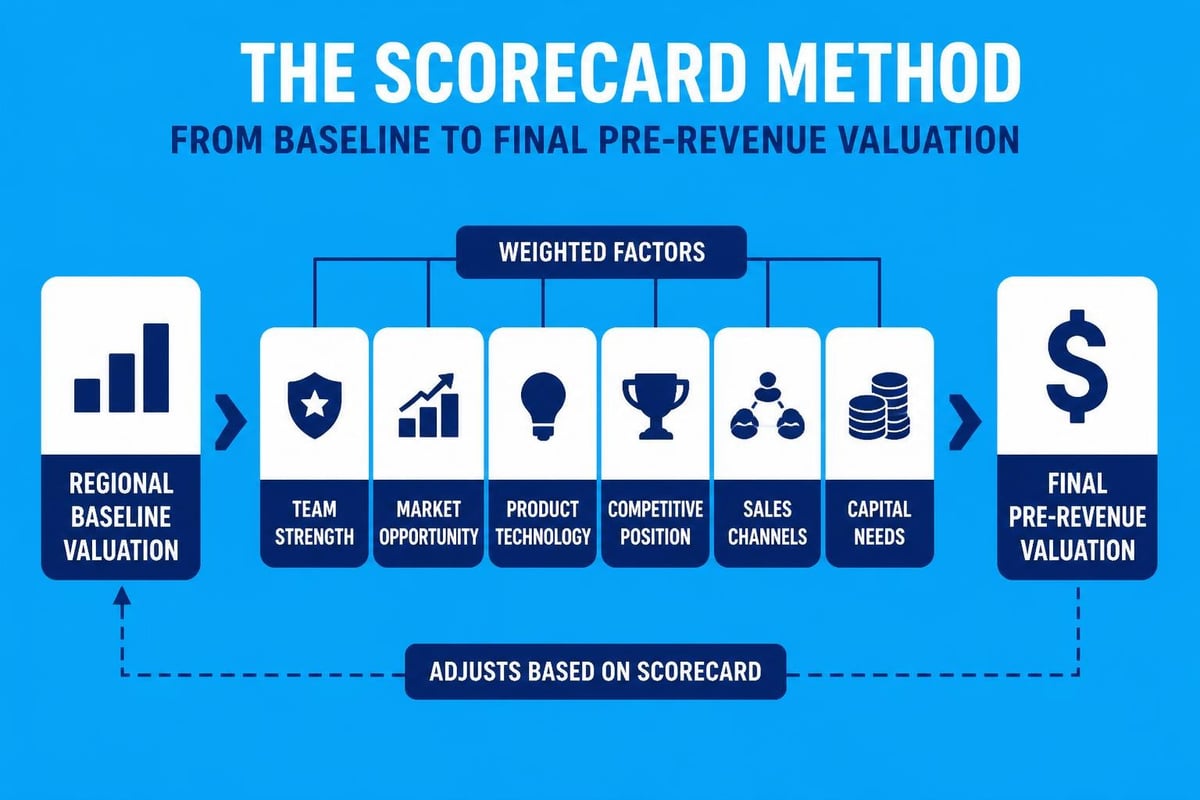
The Scorecard Valuation Method provides a structured framework specifically designed for pre-revenue startups. This approach starts with the average pre-money valuation for similar-stage companies in a region, then adjusts based on comparative strengths and weaknesses.
The methodology evaluates seven key factors:
- Strength of the team (0-30% weight): Experience, domain expertise, completeness
- Size of the opportunity (0-25% weight): Total addressable market, growth potential
- Product/technology (0-15% weight): Competitive advantage, IP, development stage
- Competitive environment (0-10% weight): Barriers to entry, market positioning
- Marketing/sales channels (0-10% weight): Go-to-market strategy, partnerships
- Need for additional investment (0-5% weight): Capital efficiency, runway
- Other factors (0-5% weight): Industry-specific considerations
In a typical scenario, if the regional average pre-money valuation for seed-stage B2B SaaS companies stands at $3 million, a startup with an exceptional team (125% of average) but a crowded market (75% of average) might arrive at an adjusted valuation of $2.8 million after weighting all factors.
The Berkus Method for Very Early Startups
Dave Berkus developed a pragmatic method for valuing very early-stage companies by assigning dollar amounts to five key success factors, each worth up to $500,000, resulting in a maximum pre-money valuation of $2.5 million.
The five Berkus value components:
- Sound idea (basic value): Does the product address a real pain point?
- Prototype (reduces technology risk): Has the team built a working demonstration?
- Quality management team (reduces execution risk): Can this team deliver?
- Strategic relationships (reduces market risk): Are customers/partners engaged?
- Product rollout or sales (reduces production risk): Is there early traction?
This method excels in its simplicity and forces buyers to articulate which specific risks they believe the startup has already mitigated. For M&A service providers working with very early-stage companies, the Berkus approach provides a defendable starting point for discussions.
Advanced Considerations in Startup Valuation
Beyond the core methodologies, calculating valuation of a startup requires understanding several technical elements that significantly impact the final number.
Convertible Instruments and Cap Table Complexity
Many startups raise initial capital through convertible notes or SAFEs (Simple Agreements for Future Equity). These instruments defer valuation until a priced equity round but create significant complexity for acquisition scenarios. Understanding Y Combinator’s SAFE mechanics becomes essential when evaluating a startup's true ownership structure.
Key SAFE terms affecting valuation:
- Valuation cap: The maximum valuation at which the SAFE converts to equity
- Discount rate: The percentage discount investors receive on the next round's price
- Most Favored Nation (MFN): Rights to better terms if subsequent SAFEs have superior provisions
YC’s technical primer on post-money SAFEs provides detailed calculations showing how these instruments affect fully-diluted ownership. When acquiring a startup with outstanding SAFEs, buyers must model conversion scenarios to understand their actual ownership percentage post-acquisition.
Industry-Specific Valuation Nuances
Different startup sectors command different valuation paradigms. B2B SaaS companies trade on revenue multiples and retention metrics, while consumer marketplace businesses emphasize gross merchandise value (GMV) and take rates. Biotech startups require probability-weighted valuations across multiple development milestones.
| Industry | Primary Metrics | Typical Multiples (2026) | Key Value Drivers |
|---|---|---|---|
| B2B SaaS | ARR, NDR | 5x – 12x revenue | Net retention >110%, gross margins >70% |
| Marketplaces | GMV, Take Rate | 1x – 4x GMV | Network effects, repeat usage, CAC payback |
| D2C E-commerce | Revenue, LTV/CAC | 1x – 3x revenue | Unit economics, brand strength, repeat rates |
| Fintech | Revenue, Users | 3x – 8x revenue | Regulatory moat, transaction volume growth |
Professional valuators, including those referenced in Deloitte’s annual valuation survey, adjust these benchmarks based on macroeconomic conditions, sector momentum, and company-specific factors.
The Role of Due Diligence in Valuation Refinement
Initial valuation calculations establish a starting range, but thorough due diligence often reveals adjustments. Quality of earnings analyses uncover revenue recognition issues, customer concentration risks, or unsustainable growth tactics that warrant valuation reductions.
Common due diligence findings affecting valuation:
- Revenue pulled forward through aggressive prepayment discounts
- Customer churn masked by heavy discounting of renewals
- Key technology dependencies on departing team members
- Intellectual property vulnerabilities or licensing gaps
- Undisclosed technical debt requiring significant investment
When buyers and sellers match on a platform designed for strategic fit, the due diligence phase becomes a collaborative process of validating assumptions rather than an adversarial discovery exercise. Sellers who proactively share challenges alongside achievements build trust that smooths valuation negotiations.
For M&A professionals managing this process, utilizing a secure virtual data room streamlines document sharing and maintains confidentiality. The Aligned IQ VDR offers competitively priced solutions specifically designed for lower middle-market transactions, with detailed pricing information that makes high-quality data rooms accessible even for smaller deals.

Practical Application: Building Your Valuation Model
Calculating valuation of a startup requires more than selecting a methodology-it demands building a defensible model that incorporates multiple perspectives and withstands scrutiny from counterparties, advisors, and financing sources.
Triangulation Across Multiple Methods
Sophisticated buyers rarely rely on a single valuation approach. Instead, they triangulate across three or more methods to establish a reasonable range. UC San Diego’s practical valuation guide demonstrates this multi-method approach for early-stage companies.
Example triangulation for a growth-stage SaaS startup:
- DCF analysis: $18 million (assuming 40% discount rate, 3% terminal growth)
- Comparable company multiples: $22 million (7x ARR based on similar publicly traded firms)
- Precedent transactions: $20 million (recent acquisitions in same vertical)
- Venture capital method: $16 million (working backward from projected exit value)
This range of $16-22 million provides a starting point for negotiations, with the buyer's strategic value creation opportunity potentially justifying a premium above the midpoint.
Documenting Assumptions and Sensitivity Analysis
Every valuation rests on assumptions that may prove optimistic or conservative. Professional valuators document these assumptions explicitly and conduct sensitivity analyses showing how valuation changes if key variables shift.
Critical assumptions to document:
- Revenue growth rates by year and the drivers behind them
- Customer acquisition cost trends and payback period assumptions
- Churn/retention rate trajectories and supporting evidence
- Margin expansion timelines and the operational changes required
- Discount rates and how they reflect comparable company risk profiles
- Exit multiples or terminal growth rates and their market basis
In a typical scenario, a sensitivity table might show that a 10% increase in customer churn reduces valuation by 15%, while a 10% improvement in gross margin increases valuation by 12%. These insights help buyers identify which risks matter most and structure earn-outs or contingent payments accordingly.
The Strategic Buyer Premium
Financial buyers value startups based purely on cash flow potential, but strategic buyers often justify premium valuations based on synergies, market access, or competitive positioning. When valuing a company based on revenue multiples, strategic considerations can expand the applicable range significantly.
Strategic value drivers that support premium valuations:
- Technology acquisition that accelerates buyer's product roadmap by 12-18 months
- Customer base that provides immediate access to new market segments
- Team expertise that fills critical capability gaps
- Competitive removal that strengthens buyer's market position
- Data assets that enhance buyer's existing platform value
Buyers exploring acquisition opportunities through a platform that prioritizes strategic fit have already identified alignment on these dimensions before diving into detailed valuation discussions. This sequencing-fit first, then price-often leads to more successful transactions because both parties understand the strategic rationale supporting the valuation.
Negotiation Dynamics and Valuation Gaps
Even with sophisticated models, buyers and sellers frequently arrive at different valuations. Bridging this gap requires understanding the psychological and structural factors driving each party's number.
Common Sources of Valuation Disagreement
Founders often overvalue their startups due to emotional attachment, survivorship bias (comparing themselves to unicorn success stories), and anchoring on inflated valuations from earlier funding rounds during market peaks. Buyers may undervalue due to risk aversion, focus on challenges rather than opportunities, or negotiating tactics.
Structural techniques for bridging valuation gaps:
- Earn-outs: Defer a portion of purchase price contingent on hitting performance milestones
- Seller financing: Seller provides debt financing, reducing upfront cash while maintaining economic exposure
- Equity rollovers: Founder retains ownership in combined entity, aligning interests
- Staged acquisitions: Initial acqui-hire with option to acquire IP/customer base later
- Working capital adjustments: Normalize for unusual cash, debt, or working capital positions
These structures allow transactions to close even when parties cannot agree on a single valuation number today. They shift the question from "What is this company worth?" to "How can we share the risk and reward in a way that works for both parties?"
The Confidential Advantage of Strategic Matching
Traditional M&A processes often force sellers to broadly market their companies, creating competitive tension but also introducing confidentiality risks and time pressure that distort valuation discussions. Platforms designed for private, strategic matching between pre-qualified parties enable more thoughtful valuation conversations.
When sellers explore options in a low-risk, confidential environment-prioritizing strategic fit before diving into detailed financials-they can have honest discussions about valuation ranges without the pressure of a ticking auction clock. This approach often surfaces creative deal structures that serve both parties better than a rushed bidding process.
Valuation in the Context of Lower Middle-Market M&A
Most startup valuations occur in the lower middle market, where deal sizes range from $1 million to $50 million. This segment requires practical approaches that balance rigor with cost-effectiveness.
Resource-Appropriate Valuation Approaches
While large transactions justify expensive fairness opinions and extensive modeling, lower middle-market deals require proportional effort. Buyers in this segment should focus on:
- Using comparable multiples as primary method, validated by simplified DCF
- Conducting focused due diligence on key value drivers rather than exhaustive reviews
- Leveraging standardized term sheets and deal structures to reduce legal costs
- Utilizing technology platforms for data sharing and collaboration
The emergence of specialized M&A platforms has democratized access to professional deal infrastructure previously available only to large transactions. These tools level the playing field, allowing smaller buyers and sellers to execute sophisticated transactions efficiently.
The Role of M&A Advisors in Valuation
Experienced M&A advisors bring market intelligence about comparable transactions, realistic growth assumptions, and credibility to valuation discussions. For sellers, a quality advisor can articulate strategic value that justifies premium pricing. For buyers, advisors provide independent validation that prevents overpaying.
M&A service providers working within specialized platforms can showcase their expertise while earning referral fees for connecting quality opportunities with appropriate buyers. This model aligns incentives around successful transaction completion rather than maximizing transaction volume.
Technology's Impact on Valuation Processes
The valuation process itself is being transformed by data analytics, AI-powered comparable screening, and collaborative platforms that streamline information sharing.
Data-Driven Valuation Refinement
Modern buyers access larger datasets of comparable transactions, allowing more precise multiple selection and adjustment. Machine learning models can identify similar companies based on dozens of variables beyond simple industry classification, improving the relevance of comparables.
These technological advances make calculating valuation of a startup more objective and defensible, though human judgment about strategy, market dynamics, and execution risk remains irreplaceable.
Collaborative Valuation Platforms
Rather than exchanging static spreadsheets, buyers and sellers increasingly collaborate in shared environments where assumptions, models, and supporting data live in one accessible location. This transparency builds trust and accelerates the path to agreement.
When combined with secure virtual data rooms that organize due diligence materials and track access, these platforms compress transaction timelines while improving quality of analysis. The reduction in friction allows parties to focus on strategic discussions rather than administrative coordination.
Calculating valuation of a startup requires balancing quantitative rigor with qualitative judgment about growth potential, team capabilities, and strategic fit. By triangulating across multiple methodologies and documenting assumptions transparently, buyers and sellers can arrive at defensible valuation ranges that support successful transactions.
Whether you're a buyer seeking your next strategic acquisition or a seller exploring exit options, Aligned IQ provides a confidential platform designed to prioritize strategic fit before diving into complex valuation discussions. Our proprietary matching process connects buyers and sellers based on transaction priorities, deal size, and industry expertise, transforming M&A into a more collaborative journey where both parties find the perfect counterparty to meet their goals. For M&A service providers, Aligned IQ offers opportunities to earn sell-side referrals while showcasing professional capabilities, and our complimentary VDR for matched sellers ensures you have the infrastructure needed to execute sophisticated transactions efficiently. Take a tour today to discover how strategic-first matching can lead to better valuations and more successful outcomes.
No responses yet