

In the complex landscape of mergers and acquisitions, the difference between a transaction that closes and one that creates lasting value often hinges on the quality of business value services supporting the deal. As we navigate 2026, middle-market transactions demand more than traditional advisory support-they require comprehensive business value services that align strategic objectives, quantify outcomes, and ensure both parties realize the benefits they envisioned when first exploring a potential partnership. For business buyers, sellers, and M&A service providers, understanding how to leverage these specialized services has become essential to achieving successful transaction outcomes.
Understanding Business Value Services in Modern M&A
Business value services represent a specialized category of professional support designed to identify, measure, and realize the strategic and financial benefits inherent in business transactions. Unlike traditional transaction advisory, which focuses primarily on deal execution and closing, business value services encompass the entire lifecycle-from initial strategic assessment through post-transaction integration and benefit realization.
Core components of business value services include:
- Strategic fit assessment and validation
- Financial modeling and value quantification
- Risk identification and mitigation planning
- Post-transaction value tracking and optimization
- Performance measurement frameworks
- Integration roadmap development
The evolution of these services reflects a fundamental shift in how sophisticated acquirers and sellers approach transactions. According to Forrester’s analysis of the services market, co-innovation and outcome-based pricing models are setting new standards for how professional services deliver measurable value. This trend has profound implications for M&A service providers who must demonstrate tangible results beyond simply facilitating a closing.
For participants in the lower middle market, accessing quality business value services historically presented challenges. Large advisory firms often reserved their most sophisticated value realization frameworks for mega-deals, leaving smaller transactions with generic support. Modern platforms addressing this gap enable lower middle-market PE firms and strategic acquirers to access professional-grade value assessment tools previously unavailable at their transaction size.
The Strategic Fit Imperative
Business value services begin with a fundamental question: Does this transaction create value for both parties based on strategic alignment? This represents a significant departure from the traditional M&A process, where financial metrics and price discovery dominated early conversations, often before parties fully understood whether the combination made strategic sense.

In a typical scenario, a manufacturing business seeking an exit partner might prioritize operational continuity, employee retention, and legacy preservation. A buyer focused solely on cost synergies and rapid integration would represent a poor strategic fit, regardless of price. Business value services help both parties articulate and assess these priorities systematically before investing significant time and resources into due diligence.
Key strategic fit dimensions assessed through business value services:
- Operational alignment – compatibility of business models, processes, and systems
- Cultural compatibility – shared values, management philosophy, and stakeholder priorities
- Market positioning – complementary customer bases, geographic coverage, or product lines
- Resource synergies – opportunities to leverage combined capabilities for competitive advantage
- Risk profile compatibility – aligned tolerance for operational, financial, and market risks
Research highlighted in Harvard Business Review’s analysis of B2B relationships demonstrates that product usage and value realization metrics are critical indicators of customer health and long-term satisfaction. Applied to M&A contexts, this research underscores why strategic fit assessment must precede financial structuring-the most attractive price becomes irrelevant if the combined entity cannot realize projected synergies.
Value Quantification and Deal Structuring
Once strategic fit is established, business value services shift focus to quantifying the potential value creation and structuring the transaction to optimize outcomes for both parties. This phase requires sophisticated financial modeling, scenario analysis, and risk assessment capabilities.
Financial Modeling and Synergy Analysis
| Value Driver Category | Typical Analysis Scope | Measurement Approach |
|---|---|---|
| Revenue synergies | Cross-selling, market expansion, pricing power | Addressable market × conversion × margin |
| Cost synergies | Operational consolidation, procurement leverage | Function-by-function opportunity assessment |
| Capital efficiency | Working capital optimization, asset utilization | Benchmark comparison and gap analysis |
| Risk mitigation | Customer concentration, regulatory exposure | Probability-weighted impact modeling |
| Strategic optionality | Platform for future growth, market positioning | Real options valuation framework |
Professional business value services apply rigorous methodologies to each category, moving beyond simple pro forma adjustments to develop detailed value creation roadmaps. For bolt-on acquisition strategies, this analysis becomes particularly nuanced-the value derives not just from the target's standalone performance but from how effectively it integrates with and enhances the existing platform.
The PwC Value Realization Managed Services approach demonstrates how governance, analytics, and delivery frameworks protect and sustain transformation value. Applied to M&A transactions, this managed services model ensures that the value identified during due diligence actually materializes post-closing through disciplined execution and continuous monitoring.
Technology-Enabled Value Realization
Modern business value services increasingly leverage technology platforms to enhance transparency, collaboration, and outcome tracking throughout the transaction lifecycle. Secure virtual data rooms have evolved beyond simple document repositories to become value realization command centers where all parties can track progress against strategic objectives.
Advanced data room capabilities supporting business value services include:
- Integrated financial modeling and scenario analysis tools
- Real-time collaboration spaces for value creation planning
- Milestone tracking and benefit realization dashboards
- Secure communication channels for sensitive strategic discussions
- Audit trails documenting key decisions and value assumptions
When evaluating data room providers, transaction participants should assess not just security and compliance features but also the platform's ability to support ongoing value realization activities. The most effective solutions offer competitive pricing structures that make sophisticated capabilities accessible to middle-market transactions, not just large corporate deals.
Implementing Business Value Services Throughout the Deal Lifecycle
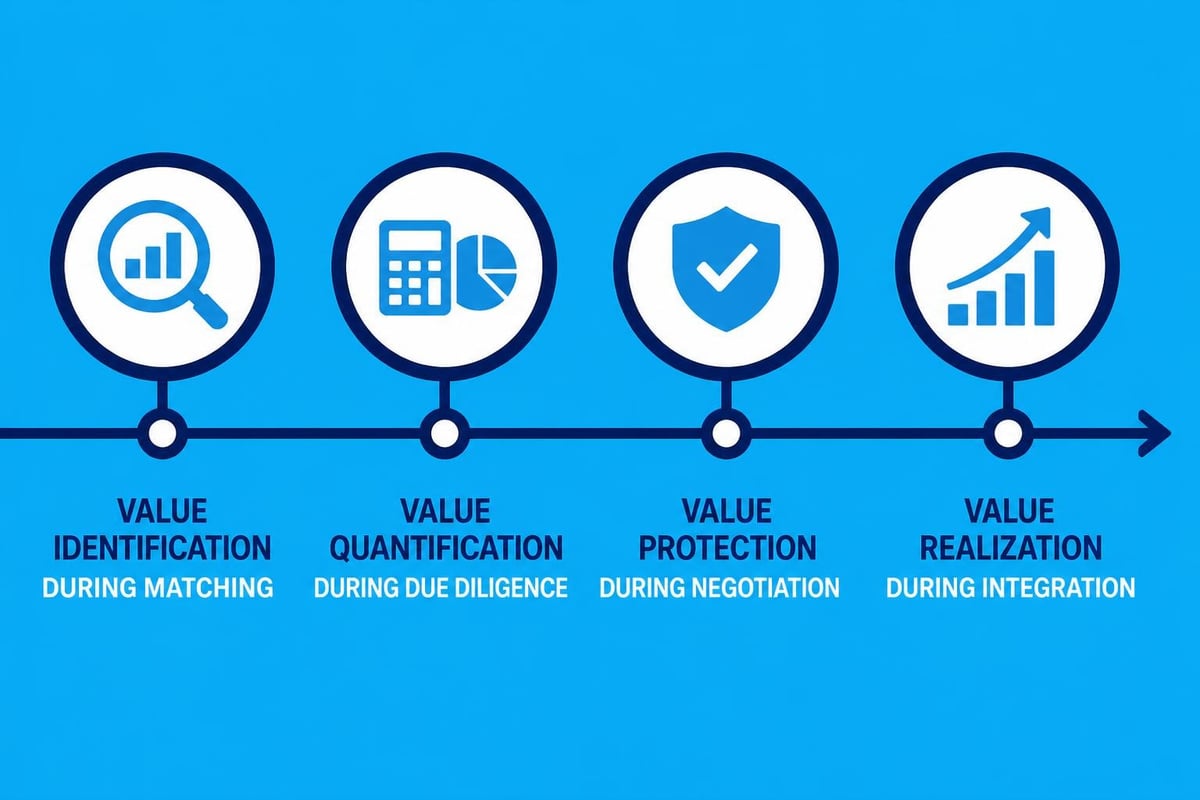
Business value services deliver maximum impact when integrated across every phase of the transaction process, from initial exploration through post-closing integration and benefit realization. This comprehensive approach ensures continuity and accountability for value creation commitments.
Pre-Transaction Value Discovery
The foundation of successful business value services begins before formal negotiations commence. For business owners exploring eventual exit options, this means developing a clear understanding of what creates value in their business and what attributes would attract the right strategic partner.
In a typical scenario, a distribution company with strong customer relationships but aging systems might position itself around customer retention value and market knowledge rather than competing solely on EBITDA multiples. Business value services help articulate this positioning and identify buyers whose strategies would benefit most from these strengths.
For potential acquirers, pre-transaction value discovery involves developing clear investment theses and target profiles based on strategic priorities rather than opportunistic deal flow. Platforms that facilitate sourcing deals through strategic fit matching enable this disciplined approach by connecting buyers with opportunities that align with their value creation capabilities.
Due Diligence and Value Validation
Once a potential match is identified, business value services shift to validating and refining value creation hypotheses through structured due diligence. This phase goes well beyond traditional financial and legal review to assess operational realities, integration feasibility, and synergy achievability.
Critical validation activities include:
- Management interviews focused on strategic capabilities and change readiness
- Operational assessments examining process maturity and improvement opportunities
- Customer and supplier discussions validating relationship strength and transferability
- Technology infrastructure review identifying integration costs and capability gaps
- Cultural assessment through workforce surveys and leadership alignment sessions
The ISO 21513 standard for post-project evaluation and benefit realization provides governance frameworks that business value services can adapt to M&A contexts. These standards emphasize defining measurable success criteria, establishing baseline metrics, and creating accountability structures for value delivery.
Accenture's research on the cloud value gap and transformation value offers relevant insights for technology-intensive acquisitions. Many transactions fail to realize projected technology synergies because integration planning underestimates complexity or overestimates the acquirer's transformation capabilities. Business value services address this gap through realistic capability assessment and phased integration roadmaps.
Negotiation and Value Protection
During negotiation, business value services shift from value identification to value protection-structuring deal terms that align incentives, mitigate risks, and create accountability for delivering projected outcomes. This includes not just price and payment terms but also governance mechanisms, integration commitments, and performance milestones.
| Deal Structure Element | Value Protection Mechanism | Business Value Service Role |
|---|---|---|
| Earnout provisions | Ties payment to achievement of specific value drivers | Define measurable performance thresholds and validation methodology |
| Transition services | Ensures operational continuity during integration | Scope critical dependencies and appropriate pricing |
| Key employee retention | Protects intellectual capital and customer relationships | Identify critical talent and design appropriate incentives |
| Integration governance | Creates accountability for synergy realization | Establish steering committees, reporting cadence, and decision rights |
| Adjustments and indemnities | Allocates risks discovered post-closing | Quantify exposure and appropriate protection mechanisms |
For sellers prioritizing confidentiality and control, the proprietary nature of match-making platforms offers significant advantages over traditional M&A processes. Rather than broad market exposure through intermediaries, business value services can facilitate discreet conversations with a curated set of strategically aligned buyers, reducing execution risk and preserving negotiating leverage.
Measuring and Sustaining Realized Value
The true test of business value services occurs after transaction closing, when projected synergies must convert into actual performance improvements. This final phase requires disciplined execution, transparent measurement, and adaptive management as integration realities emerge.
Integration Planning and Execution
Effective integration begins with detailed planning during the pre-closing period, translating value creation hypotheses into specific initiatives with assigned owners, timelines, and success metrics. Business value services facilitate this planning by connecting deal team insights with operational leaders who will execute the integration.
Integration priorities typically include:
- Day-one readiness – critical systems, communications, and operational continuity
- Quick wins – high-impact, low-risk initiatives that build momentum and credibility
- Synergy capture – systematic execution of cost reduction and revenue enhancement opportunities
- Culture integration – building unified identity while preserving valuable differences
- Capability building – investing in skills, systems, and processes for long-term competitiveness
In a typical scenario, a services business acquired by a larger platform might achieve quick wins through shared back-office functions and cross-selling to existing customers, while longer-term value requires technology platform migration and service offering integration. Business value services help sequence these initiatives based on value potential, feasibility, and risk.
Performance Measurement and Course Correction
Sustained value realization requires continuous monitoring against baseline metrics and proactive course correction when actual results diverge from projections. Business value services establish measurement frameworks that balance financial outcomes with operational indicators and stakeholder satisfaction.
Key performance dimensions tracked through business value services:
- Financial performance – revenue growth, margin expansion, cash flow improvement versus baseline
- Operational metrics – customer retention, employee turnover, productivity indicators, quality measures
- Synergy realization – achievement of specific cost reduction and revenue enhancement initiatives
- Strategic progress – market share gains, capability development, competitive positioning improvements
- Stakeholder outcomes – customer satisfaction, employee engagement, community impact measures
Technology platforms supporting these measurement activities provide centralized dashboards where integration teams can track progress, identify variances, and coordinate responses. The most effective solutions integrate financial data, operational metrics, and qualitative assessments to provide comprehensive value realization visibility.

Selecting and Working with Business Value Service Providers
For transaction participants seeking to leverage business value services, selecting the right providers and engagement models significantly impacts outcomes. The market includes large advisory firms, specialized consultancies, technology platforms, and hybrid models combining multiple capabilities.
Provider Evaluation Criteria
When assessing business value service providers, consider both technical capabilities and cultural fit with your transaction approach and stakeholder priorities. The most expensive provider rarely delivers the best value for middle-market transactions, where responsiveness, flexibility, and aligned incentives often matter more than brand reputation.
Critical evaluation dimensions include:
- Relevant experience in your industry, transaction size, and deal type
- Methodology rigor with documented frameworks and proven track records
- Technology capabilities including collaboration platforms and analytics tools
- Resource flexibility to scale support based on transaction phases and emerging needs
- Pricing models that align provider incentives with value realization outcomes
- Cultural compatibility with your approach to stakeholder engagement and decision-making
For big company acquisitions with complex integration challenges, comprehensive business value services from established advisory firms may justify premium pricing. Smaller transactions often achieve better outcomes through specialized providers or platform-enabled self-service approaches that deliver core capabilities at accessible price points.
Engagement Models and Pricing Approaches
Business value services providers offer various engagement models, from traditional time-and-materials consulting to outcome-based pricing tied to realized synergies. Each model creates different incentive structures and risk allocations that transaction participants should consider carefully.
| Engagement Model | Pricing Structure | Best Suited For | Key Considerations |
|---|---|---|---|
| Project-based | Fixed fee for defined scope | Discrete value assessment or planning needs | Clearly define deliverables and change process |
| Retainer | Monthly fee for ongoing support | Extended integration with evolving priorities | Balance flexibility with accountability for outcomes |
| Success-based | Payment tied to realized value | High-conviction transactions with measurable synergies | Align on measurement methodology and baseline assumptions |
| Platform subscription | Annual or per-transaction fee | Multiple transactions or ongoing deal sourcing | Evaluate tool capabilities versus advisory support needs |
| Hybrid | Combination of base fee plus performance incentives | Complex transactions requiring both planning and execution support | Structure incentives around most critical value drivers |
Sophisticated buyers and sellers increasingly favor hybrid models that share risk while ensuring provider engagement quality. A typical structure might include base fees covering planning and due diligence support, with performance bonuses tied to achieving specific integration milestones or synergy realization targets.
Future Trends Shaping Business Value Services
As M&A markets evolve and technology capabilities advance, business value services continue to adapt, incorporating new methodologies, tools, and service delivery models. Several trends emerging in 2026 will likely reshape how these services operate and deliver value over the coming years.
Artificial intelligence and predictive analytics are enabling more sophisticated value forecasting and risk assessment. Machine learning models trained on thousands of historical transactions can identify patterns that predict integration success, synergy achievability, and post-closing performance with increasing accuracy. Business value services leveraging these capabilities help clients make more informed decisions and set realistic expectations.
Outcome-based pricing and managed services models are gaining traction as buyers demand greater accountability from service providers. Rather than paying for activities or time, clients increasingly want to pay for results-whether measured through realized synergies, successful integration milestones, or sustained performance improvements. This shift forces business value service providers to develop stronger execution capabilities and share more risk with clients.
Ecosystem collaboration platforms are replacing fragmented point solutions and siloed service providers. Modern business value services increasingly operate through integrated platforms where all transaction participants-buyers, sellers, advisors, lenders, and service providers-collaborate in unified digital workspaces. These platforms reduce coordination friction, improve transparency, and create comprehensive audit trails documenting value creation decisions and outcomes.
Sustainability and stakeholder value metrics are expanding the definition of transaction success beyond pure financial returns. Business value services now routinely assess environmental impact, social outcomes, and governance improvements as core value drivers rather than compliance afterthoughts. This reflects both regulatory pressures and genuine buyer recognition that sustainability performance correlates with long-term financial performance.
For M&A service providers, these trends create both opportunities and imperatives. Firms that develop capabilities in advanced analytics, outcome delivery, platform collaboration, and stakeholder value measurement will differentiate themselves in increasingly competitive markets. Those clinging to traditional advisory models focused purely on deal execution will find their relevance and pricing power declining.
Business value services represent the evolution of M&A advisory from transaction execution to comprehensive value realization, ensuring that strategic objectives translate into measurable outcomes throughout the deal lifecycle. For buyers and sellers seeking partners who share their vision for long-term success, platforms that prioritize strategic fit and collaborative value creation offer distinct advantages over traditional processes. Aligned IQ transforms M&A into a more collaborative experience by matching transaction participants based on priorities, deal size, and expertise while providing complimentary secure data room services for matched sellers and competitively priced solutions for all M&A participants. Take a tour to discover how our platform can help you find the perfect counterparty and realize your M&A goals.
No responses yet