

Finding the right business for sale or identifying the perfect buyer for your company has transformed dramatically over the past few years. The traditional M&A process, once dominated by brokers and intermediaries working through extensive networks, now incorporates sophisticated digital platforms that prioritize strategic alignment before financial discussions begin. Today's business owners and buyers benefit from technology-driven solutions that maintain confidentiality while creating meaningful connections based on compatibility, not just capital. This evolution addresses longstanding frustrations in the M&A marketplace where deals often collapsed due to cultural mismatches or misaligned expectations discovered too late in the process.
Understanding the Modern Business for Sale Landscape
The marketplace for businesses available for acquisition has expanded significantly, yet quality over quantity remains paramount. Business owners exploring exit strategies in 2026 face numerous pathways, from traditional business brokers to digital marketplaces and specialized M&A platforms. Each channel serves different needs and deal sizes, with the lower middle market particularly benefiting from recent technological innovations.
The Shift Toward Strategic Fit
Traditional listings often emphasize financial metrics first: revenue multiples, EBITDA, and asking prices dominate initial conversations. However, successful acquisitions depend equally on operational compatibility, cultural alignment, and shared vision for growth. When a business for sale connects with the right buyer based on strategic priorities rather than purely financial considerations, both parties increase their likelihood of closing and thriving post-transaction.
Modern platforms address this by:
- Matching buyers and sellers based on industry expertise
- Evaluating transaction priorities before financial negotiations
- Protecting confidentiality throughout early-stage exploration
- Reducing time wasted on incompatible discussions
This approach differs substantially from public listings where business details appear on open marketplaces, potentially compromising confidentiality and attracting unqualified inquiries.

Why Business Owners Choose Confidential M&A Platforms
Business owners considering putting their company on the market face legitimate concerns about confidentiality, employee morale, customer relationships, and competitive intelligence. Broadcasting that your business for sale through public channels creates risks that many owners find unacceptable, particularly when exploring options years before an actual transaction.
Privacy-First Approach Benefits
A proprietary platform model offers distinct advantages over traditional public listings. Business owners can explore their options without committing to a sale, connecting with pre-qualified buyers who meet specific criteria. This low-risk exploration phase allows sellers to:
- Assess market interest without public disclosure
- Evaluate potential buyers' qualifications privately
- Maintain operational focus without distraction
- Preserve relationships with employees and customers
- Control the timing and pace of engagement
In a typical scenario, a manufacturing business owner might want to understand their options three to five years before retirement. Rather than formally listing the business for sale and triggering potential concerns, they can create a confidential profile on a specialized M&A platform, defining their ideal buyer characteristics and transaction priorities while maintaining complete anonymity until they choose to engage.
The Service Provider Ecosystem
M&A service providers, including advisors, investment bankers, and consultants, play critical roles in successful transactions. Modern platforms recognize this by creating opportunities for professionals to participate in the ecosystem. Service providers can showcase their expertise, connect with potential clients, and receive compensation for qualified referrals, creating a collaborative environment where all parties contribute value.
How Buyers Benefit from Match-Making Technology
Business buyers face their own challenges in the acquisition marketplace. Sifting through hundreds of businesses for sale listings consumes enormous time and resources, with most opportunities proving incompatible upon deeper investigation. Search funds, independent sponsors, and strategic acquirers need efficient methods to identify targets that align with their investment thesis and operational capabilities.
Creating Buyer Credibility
Platform-based matching allows buyers to build comprehensive profiles demonstrating their qualifications, experience, and value proposition. Rather than being anonymous inquirers on a listing, buyers can showcase:
| Buyer Credential | Strategic Value |
|---|---|
| Industry expertise | Demonstrates operational understanding |
| Transaction history | Proves execution capability |
| Integration resources | Shows post-acquisition support |
| Financial capacity | Validates deal viability |
| Growth strategy | Illustrates future vision |
This transparency helps sellers evaluate potential partners before investing time in discussions, creating more productive initial conversations and reducing the risk of wasted effort on both sides.
Efficient Deal Sourcing
Modern deal sourcing platforms transform the acquisition process from reactive browsing to proactive matching. When a business for sale matches a buyer's specific criteria including industry focus, geographic preferences, and transaction size the platform facilitates an introduction based on mutual compatibility.
In a typical scenario, a buyer specializing in healthcare services with experience in the Northeast market would receive notifications only about relevant opportunities, rather than sorting through unrelated listings. This efficiency allows buyers to pursue quality opportunities while maintaining their current professional responsibilities.

The Role of Virtual Data Rooms in Modern Transactions
Once a business for sale connects with a qualified buyer, the due diligence phase begins. This critical period requires secure document sharing, organized information presentation, and controlled access to sensitive materials. Virtual data rooms (VDRs) have become essential infrastructure for middle-market transactions, replacing physical document repositories and unsecured file-sharing methods.
VDR Functionality and Features
Professional virtual data rooms provide structured environments for managing the due diligence process. Key capabilities include:
- Document organization across financial, legal, operational, and strategic categories
- Access controls determining who views specific materials and when
- Activity tracking showing which documents receive attention from potential buyers
- Q&A management centralizing questions and responses in organized threads
- Security protocols protecting sensitive information throughout the process
The Aligned IQ VDR platform serves lower middle-market participants with competitive pricing that makes enterprise-grade security accessible to smaller transactions. Unlike premium VDR providers charging prohibitive fees, the platform offers transparent, affordable data room pricing appropriate for deals ranging from $2 million to $100 million in enterprise value.
Complimentary Access for Platform Users
When business owners and buyers connect through the Aligned IQ M&A platform and complete a match, sellers receive complimentary access to the Aligned IQ VDR. This integrated approach eliminates the friction of selecting and onboarding a separate data room provider, accelerating the transition from match to active discussion.
For users engaging in transactions outside the platform ecosystem, the VDR remains competitively priced for buyers, sellers, M&A advisors, investment bankers, and other service providers. This flexibility ensures the solution serves the broader M&A community beyond platform matches.
Comparing Traditional and Modern M&A Processes
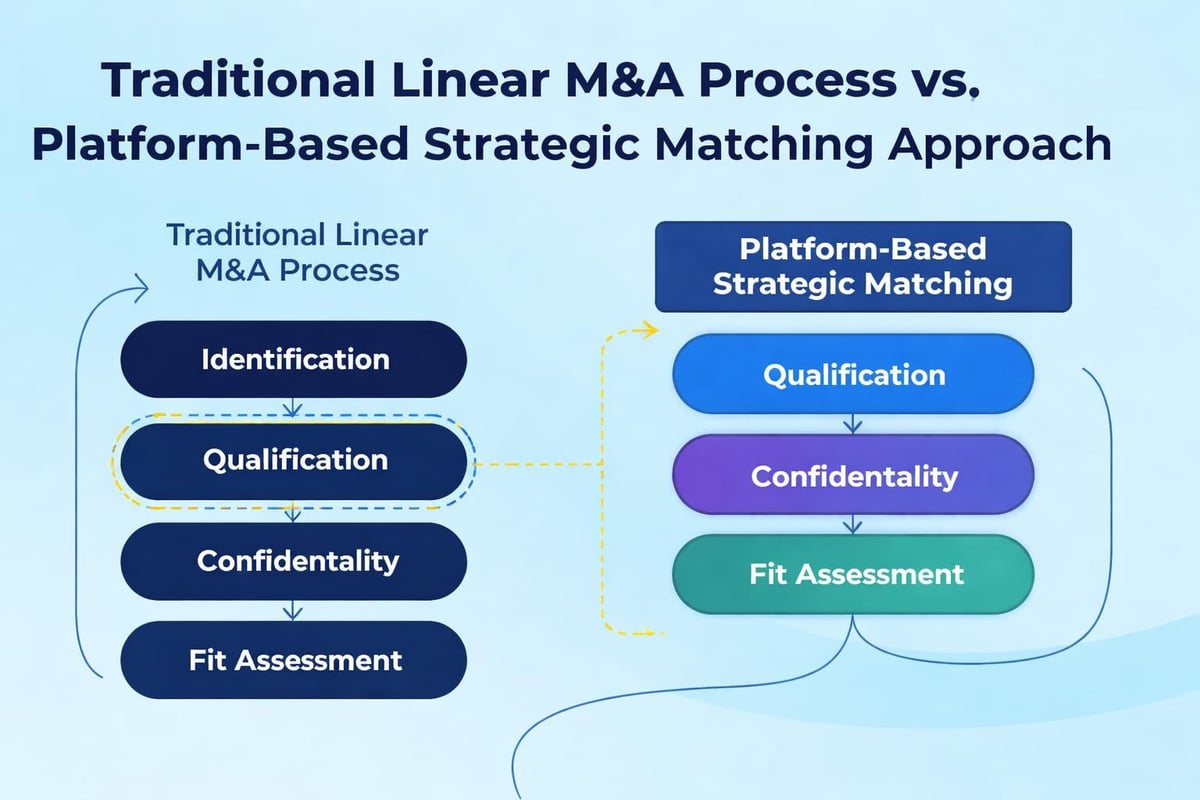
Understanding how contemporary platforms differ from conventional approaches helps both buyers and sellers make informed decisions about their transaction strategy. The traditional business for sale process typically follows a linear path with distinct limitations.
Traditional M&A Process Characteristics
The conventional approach generally involves:
- Engaging a broker or intermediary who lists the business publicly
- Creating a confidential information memorandum (CIM) after initial interest
- Managing inquiries from a broad pool of potential buyers
- Conducting preliminary discussions before qualifying buyer capability
- Negotiating letters of intent with limited prior relationship building
- Entering due diligence with buyers who may lack strategic alignment
This process works for certain transactions, particularly larger deals with institutional buyers. However, it creates challenges for lower middle-market companies where business value and marketability depend heavily on finding the right strategic partner.
Platform-Based M&A Process Advantages
Modern match-making platforms invert this traditional sequence by establishing strategic fit before deep engagement:
| Traditional Process | Platform-Based Process |
|---|---|
| Public listing first | Private matching first |
| Financial metrics emphasized | Strategic fit prioritized |
| Broad buyer outreach | Targeted compatible connections |
| Late-stage qualification | Early-stage compatibility screening |
| Broker-mediated communication | Direct party engagement option |
| Generic presentation | Customized mutual exploration |
This reordering reduces wasted effort, protects confidentiality, and increases the probability of successful transactions that create value for all stakeholders.
Preparing Your Business for Sale
Whether engaging through traditional channels or modern platforms, business owners benefit from thoughtful preparation before entering the market. Understanding your transaction priorities proves essential for identifying compatible buyers and structuring successful deals.
Value Creation Before Market Entry
Smart sellers invest time strengthening their business before seeking buyers. Key preparation areas include:
- Financial documentation: Clean, audited financials increase buyer confidence and valuation
- Operational systems: Documented processes reduce perceived transition risk
- Customer concentration: Diversified revenue streams enhance marketability
- Management depth: Strong teams capable of operating without owner presence
- Growth trajectory: Clear opportunities for buyer value creation
Revenue quality impacts exit options significantly, with recurring, contractual revenue commanding premium valuations compared to project-based or transactional income streams. Business owners planning exits should evaluate revenue composition years before entering the market.
Understanding Your Business Value
Before listing a business for sale or creating a platform profile, owners should establish realistic value expectations. Using comparables to estimate value provides market context, though every business possesses unique characteristics affecting valuation. Professional valuations from qualified experts offer objective assessments that inform pricing strategies and negotiation positions.
Understanding that business value extends beyond financial metrics to include strategic assets, market position, and growth potential helps owners present their companies effectively to qualified buyers.
Navigating the Buyer Journey
Acquiring a business for sale requires discipline, patience, and strategic thinking. Successful buyers approach the market with clear criteria, realistic expectations, and thorough due diligence processes that validate assumptions before committing capital.
Defining Acquisition Criteria
Effective buyers establish specific parameters before searching:
- Industry focus where they bring operational expertise
- Geographic preferences aligned with management capabilities
- Financial thresholds including minimum and maximum deal sizes
- Growth potential matching their value creation strategies
- Cultural compatibility supporting successful integration
These criteria guide search activities and prevent distraction from opportunities outside core competencies. Platform matching accelerates this process by presenting only businesses that meet predefined parameters.
Due Diligence Best Practices
Once a business for sale matches buyer criteria and preliminary discussions prove promising, comprehensive due diligence begins. Professional buyers organize investigations across multiple dimensions:
- Financial analysis validating historical performance and projections
- Legal review identifying liabilities, contracts, and compliance issues
- Operational assessment evaluating systems, processes, and dependencies
- Commercial diligence confirming market position and competitive dynamics
- Cultural evaluation determining organizational compatibility
Getting to no in the deal negotiating process proves as valuable as reaching agreement. Identifying fundamental incompatibilities early saves resources and maintains positive relationships for potential future opportunities.
The Evolving M&A Technology Ecosystem
The business for sale marketplace continues evolving as technology enables new approaches to longstanding challenges. Platforms addressing different segments serve distinct needs within the broader M&A ecosystem.
Platform Specialization Trends
Various platforms serve specific niches:
- Small business marketplaces focus on Main Street businesses under $2 million
- Middle-market platforms target transactions between $5 million and $500 million
- Industry-specific networks connect parties within defined sectors
- Private equity platforms facilitate institutional capital deployment
- Cross-border solutions enable international transactions with specialized support
Understanding which platform type aligns with specific transaction characteristics helps both buyers and sellers invest time in appropriate channels. According to insights shared by experienced business brokers, the small business marketplace faces unique challenges that differ substantially from middle-market dynamics.
Integration of Supporting Services
Modern M&A platforms increasingly integrate supporting services beyond simple listing or matching. Virtual data rooms, valuation tools, legal templates, and advisor networks create comprehensive ecosystems serving parties throughout the transaction lifecycle. This integration reduces friction, accelerates timelines, and improves outcomes by eliminating gaps between discrete process stages.
The Aligned IQ ecosystem exemplifies this integration by connecting the M&A match-making platform with secure data room software, creating seamless progression from initial match through due diligence completion.
Alternative Exit Strategies Worth Considering
While third-party sales dominate discussions about businesses for sale, owners should evaluate multiple exit pathways before committing to specific strategies. Each approach offers distinct advantages depending on circumstances, goals, and timeline flexibility.
Management and Employee Transitions
Ownership transition to management or employees provides continuity benefits that external sales cannot match. Employee Stock Ownership Plans (ESOPs), management buyouts, and gradual equity transfers allow owners to exit while preserving company culture and employee relationships.
These approaches work particularly well when:
- Business depends heavily on existing team relationships
- Owner prioritizes legacy over maximum financial return
- Management demonstrates capability and commitment
- Financing structures support gradual transitions
- Employee retention proves critical to ongoing success
Strategic Considerations Beyond Price
Transaction success extends beyond financial terms. When evaluating whether to list a business for sale or pursue alternative strategies, owners should consider:
Personal goals: Retirement timing, ongoing involvement preferences, legacy priorities
Business needs: Leadership continuity, cultural preservation, employee welfare
Market conditions: Buyer demand, valuation multiples, financing availability
Tax implications: Structure optimization, capital gains strategies, estate planning
Risk tolerance: Deal certainty versus potential upside, earnout acceptability
Thoughtful evaluation of these factors, potentially through exercises like start-stop-continue brainstorming, helps owners make informed decisions aligned with comprehensive objectives rather than purely financial motivations.
Selecting the Right M&A Advisory Support
Many business owners benefit from professional guidance when putting their business for sale or pursuing acquisitions. The sell-side M&A advisory landscape includes various firm types serving different deal sizes and owner needs.
Advisory Firm Categories
Professional support options include:
- Business brokers typically handling transactions under $5 million
- M&A advisory firms serving the lower middle market from $5 million to $100 million
- Investment banks focusing on larger transactions above $50 million
- Boutique specialists concentrating on specific industries or transaction types
- Independent advisors providing targeted support on specific deal aspects
Selecting appropriate advisors depends on deal complexity, business characteristics, and owner preferences regarding process control versus full-service support.
Platform and Advisor Collaboration
Modern M&A platforms complement rather than replace advisory relationships. Service providers participate in platform ecosystems by:
- Referring qualified clients to matching services
- Receiving compensation for successful referrals
- Showcasing expertise to potential clients
- Accessing deal flow aligned with their specializations
- Utilizing platform tools like virtual data rooms for client transactions
This collaborative model recognizes that technology enhances rather than eliminates the value of experienced professional guidance throughout complex transactions.
International Considerations for Cross-Border Deals
As business owners and buyers explore opportunities beyond domestic markets, cross-border M&A deals introduce additional complexity requiring specialized knowledge and support.
Canada-US Transaction Dynamics
Cross-border deals between Canada and the United States represent significant opportunity given economic integration and geographic proximity. However, parties must navigate:
- Different regulatory frameworks governing business transactions
- Tax implications in multiple jurisdictions
- Currency considerations affecting valuation and returns
- Legal structure optimization for cross-border ownership
- Cultural differences influencing business practices
Platforms facilitating international connections should provide resources helping parties understand these complexities or connect with specialized advisors possessing relevant expertise.
Platform Advantages for International Deals
Digital matching platforms offer particular value for cross-border transactions by:
- Connecting parties across geographic boundaries efficiently
- Maintaining confidentiality during early exploration phases
- Providing secure environments for sensitive document sharing
- Enabling asynchronous communication across time zones
- Standardizing processes despite jurisdictional differences
These capabilities reduce traditional barriers to international deal exploration while maintaining security and professionalism throughout the process.
Successfully navigating the business for sale process in 2026 requires understanding both traditional M&A fundamentals and emerging technology-enabled approaches that prioritize strategic fit and confidentiality. Whether you're a business owner exploring exit options or a buyer seeking the right acquisition target, modern platforms transform how compatible parties discover and evaluate opportunities. Aligned IQ provides the infrastructure for this new approach, connecting buyers and sellers through strategic matching while offering secure virtual data room solutions that facilitate efficient due diligence. Take a tour of the platform to discover how prioritizing compatibility before financial discussions creates better outcomes for all parties in the M&A process.
No responses yet