

The landscape of mergers and acquisitions has evolved dramatically in recent years, with technology platforms and data-driven approaches transforming how companies identify, evaluate, and execute transactions. Understanding effective business merger and acquisition strategies is crucial for lower middle-market companies seeking growth through acquisitions or planning eventual exits. Whether you're a serial acquirer, private equity professional, or business owner exploring strategic alternatives, the right approach can mean the difference between a transformational deal and a value-destroying transaction.
Understanding the Core Types of M&A Strategies
Business merger and acquisition strategies generally fall into four primary categories, each serving distinct strategic objectives and offering unique advantages.
Horizontal Integration
Horizontal mergers involve combining with competitors in the same industry and market segment. This approach delivers immediate market share gains, economies of scale, and enhanced competitive positioning.
Benefits of horizontal integration include:
- Rapid revenue growth through customer base consolidation
- Cost synergies from eliminating duplicate operations
- Increased pricing power in the marketplace
- Shared technology and intellectual property resources
- Geographic expansion opportunities
However, horizontal deals face heightened regulatory scrutiny and potential antitrust concerns, particularly for larger transactions.
Vertical Integration
Companies pursuing vertical strategies acquire businesses along their supply chain, either upstream toward suppliers or downstream toward distribution channels. This approach enhances control over critical inputs, reduces dependency on third parties, and can improve margins through disintermediation.
Manufacturing companies acquiring raw material suppliers exemplify backward integration, while distributors purchasing retail operations demonstrate forward integration. The comprehensive framework for M&A strategies explains how vertical deals create operational advantages.
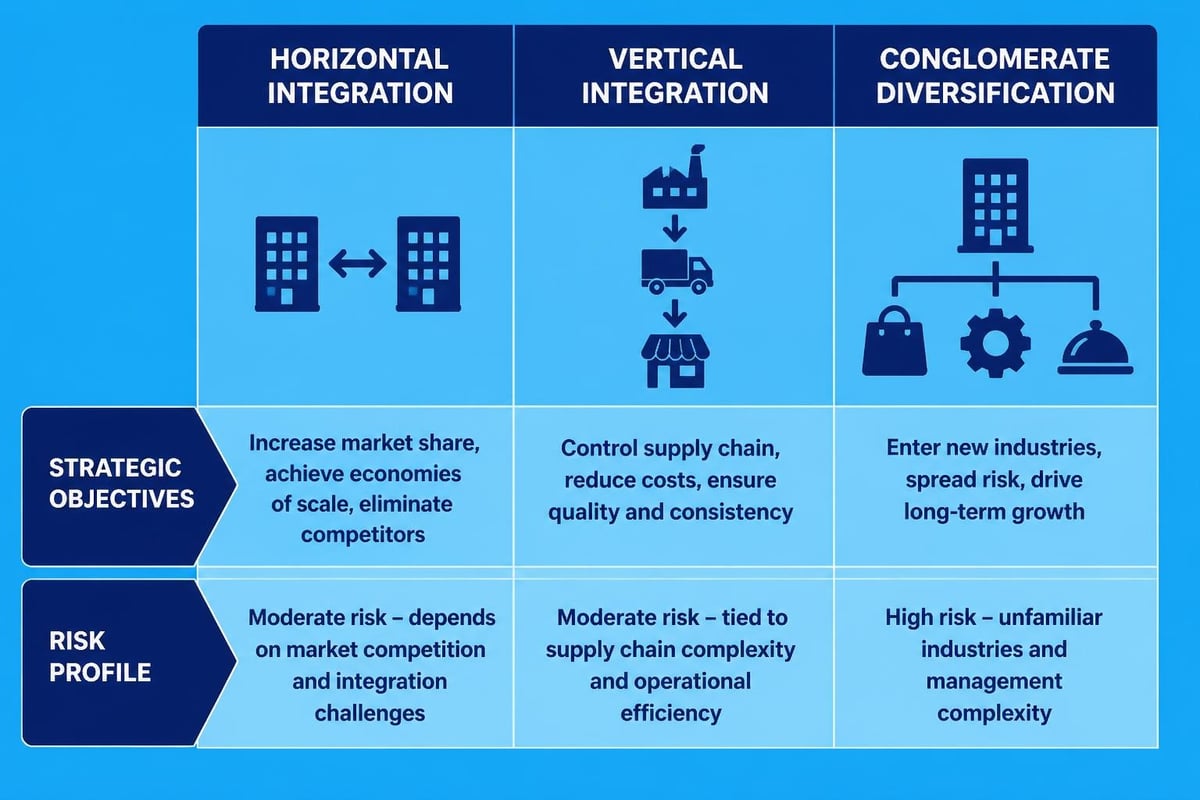
Conglomerate Diversification
Conglomerate strategies involve acquiring businesses in unrelated industries to diversify revenue streams and reduce concentration risk. While less common in today's market, this approach appeals to companies seeking portfolio balance and cyclical hedging.
The primary advantages include:
- Risk mitigation through industry diversification
- Capital deployment across multiple sectors
- Cross-selling opportunities between business units
- Talent and management capability sharing
The challenge lies in managing disparate operations without relevant industry expertise.
Market Extension Strategies
Market extension acquisitions target companies offering similar products in different geographic regions or customer segments. This strategy accelerates market penetration while leveraging existing operational capabilities and product knowledge.
Developing a Disciplined Acquisition Thesis
Before pursuing transactions, successful acquirers develop a clear acquisition thesis that aligns with corporate strategy and creates measurable value. This thesis serves as the foundation for all business merger and acquisition strategies.
| Thesis Component | Key Questions | Success Criteria |
|---|---|---|
| Strategic Rationale | Why acquire versus organic growth? | Clear competitive advantage |
| Target Profile | What characteristics define ideal targets? | Specific industry, size, geography parameters |
| Value Creation | How will we generate returns? | Quantified synergy expectations |
| Integration Capability | Can we successfully integrate acquisitions? | Proven playbook and resources |
A disciplined thesis prevents opportunistic deals that distract from core objectives. The structured acquisition strategy framework for 2026 emphasizes thesis development as the critical first step.
Identifying and Evaluating Potential Targets
The traditional M&A process often begins with broad market scans and investment banker introductions, but this approach creates inefficiencies and misalignment between buyers and sellers.
Modern platforms prioritize strategic fit before financial details, fundamentally changing how parties connect. Rather than casting wide nets and conducting extensive preliminary diligence on mismatched opportunities, sophisticated acquirers now focus on alignment across transaction priorities, deal size expectations, and industry expertise.
For businesses exploring corporate acquisition opportunities, this fit-first approach reduces wasted time and increases deal completion rates.
Key Evaluation Criteria
When assessing potential targets, acquirers should evaluate multiple dimensions:
- Financial performance metrics including revenue growth, profitability trends, and working capital efficiency
- Market position and competitive dynamics within the target's industry segment
- Customer concentration and retention to understand revenue sustainability
- Management team quality and depth for post-transaction continuity
- Operational scalability and integration compatibility with existing systems
- Cultural alignment between organizations to facilitate smooth transitions
A typical scenario might involve a regional service company seeking to expand into adjacent markets. Rather than reviewing dozens of generic opportunities through traditional channels, a strategic fit-focused approach identifies businesses with complementary service offerings, compatible client bases, and aligned growth philosophies before significant resources are invested.
Structuring Deals for Mutual Success
Effective business merger and acquisition strategies require creative deal structuring that addresses both parties' objectives while managing risk appropriately.
Common Deal Structures
Asset purchases allow buyers to select specific assets and liabilities while avoiding unwanted obligations. This structure provides tax advantages through step-up basis but requires individual asset transfers.
Stock purchases transfer entire entities including all assets, liabilities, contracts, and obligations. While simpler administratively, buyers assume all risks including unknown liabilities.
Merger structures combine entities legally, often used in larger transactions or public company deals where shareholder approval is required.
Consideration Types
| Payment Method | Buyer Advantages | Seller Advantages | Risk Considerations |
|---|---|---|---|
| Cash | Clean transaction, immediate close | Liquidity, tax certainty | Requires financing, dilutes cash reserves |
| Stock | Preserves cash, shares risk | Upside participation, tax deferral | Valuation complexity, dilution concerns |
| Earnouts | Performance-based pricing | Higher potential value | Integration conflicts, measurement disputes |
| Seller Financing | Reduces upfront capital needs | Income stream, confidence signal | Collection risk, ongoing relationship |
Many lower middle-market deals incorporate multiple consideration types to bridge valuation gaps and align incentives post-closing.

Conducting Thorough Due Diligence
Due diligence represents the most critical phase in executing business merger and acquisition strategies. This comprehensive investigation validates assumptions, identifies risks, and informs final pricing and terms.
Due Diligence Scope Areas
Financial due diligence examines historical results, quality of earnings, working capital requirements, and forecast assumptions. Independent accountants typically conduct quality of earnings studies to normalize results and identify one-time items.
Legal due diligence reviews corporate structure, contracts, litigation, intellectual property, regulatory compliance, and employment matters. Material contracts require special attention for change of control provisions and assignment restrictions.
Operational due diligence assesses processes, systems, vendor relationships, and scalability. Understanding operational dependencies helps plan integration activities and identify improvement opportunities.
Commercial due diligence validates market position, competitive dynamics, customer relationships, and growth prospects through independent market research and customer interviews.
Technology due diligence evaluates IT infrastructure, software licenses, cybersecurity posture, and technical debt that could require post-closing investment.
Virtual Data Rooms and Information Security
Secure information exchange is fundamental to professional M&A execution. While many data room providers serve the market, pricing and features vary significantly.
For transactions originated through match-making platforms, complimentary data room access for sellers after matching eliminates a significant cost barrier. Aligned IQ VDR provides secure virtual data room capabilities for lower middle-market PE firms, M&A advisors, and other transaction participants, with competitive pricing available at https://vdr.alignediq.net/pricing for broader market usage.
The confidential nature of M&A discussions requires enterprise-grade security, granular permission controls, and detailed audit trails showing document access. Unlike sharing files through consumer platforms, professional virtual data rooms protect sensitive business information throughout the transaction lifecycle.
Negotiating Terms and Closing Transactions
Successful negotiation in business merger and acquisition strategies balances assertiveness with collaboration. The key strategies for navigating M&A emphasize preparation, flexibility, and relationship preservation.
Letter of Intent Considerations
Letters of intent establish preliminary agreement on key terms before significant legal and due diligence expenses. While typically non-binding except for exclusivity and confidentiality provisions, LOIs set expectations and framework for definitive agreements.
Critical LOI terms include:
- Purchase price and structure (cash, stock, earnouts, holdbacks)
- Working capital adjustment mechanisms
- Exclusivity period (typically 60-90 days)
- Key conditions to closing (financing, due diligence, regulatory approvals)
- Indemnification framework and survival periods
- Treatment of existing debt and transaction expenses
Purchase Agreement Negotiation
Definitive purchase agreements codify all transaction terms, representations, warranties, covenants, and conditions. These complex documents allocate risk between parties and govern post-closing obligations.
Representations and warranties create liability for inaccurate statements about the business. Buyers seek comprehensive reps covering all material aspects, while sellers prefer limitations and qualifications based on their knowledge.
Indemnification provisions specify remedies for breaches, including survival periods, deductibles (baskets), caps on liability, and claim procedures. Indemnification cap negotiations often prove contentious, with buyers seeking full purchase price exposure and sellers preferring 10-25% limitations.
Conditions precedent must be satisfied before closing obligations arise. Common conditions include due diligence satisfaction, financing confirmation, regulatory approvals, and material adverse change limitations.
Planning and Executing Integration
Integration planning separates successful transactions from disappointing deals. The M&A process stages and integration best practices demonstrate how thoughtful integration preserves value and realizes synergies.
Pre-Closing Integration Planning
Integration work should begin during due diligence, not after closing. Effective business merger and acquisition strategies include dedicated integration teams addressing:
- Day One readiness ensuring critical systems, communications, and operations function seamlessly at closing
- Quick wins identification highlighting immediate improvement opportunities that build momentum
- Organization design determining reporting structures, leadership assignments, and role eliminations
- Systems integration roadmap planning technology consolidation, data migration, and process standardization
- Cultural integration approach addressing differences in values, communication styles, and decision-making processes
Post-Closing Execution
The first 90 days post-closing prove critical for integration success. Leadership visibility, clear communication, and decisive action establish credibility and direction.
A typical scenario might involve a manufacturer acquiring a competitor with overlapping customer bases and redundant facilities. The integration plan would sequence facility consolidation, customer communication, and employee transitions to minimize disruption while capturing cost synergies. Establishing integration metrics and accountability ensures progress tracking and course correction.
| Integration Milestone | Target Timeline | Success Metrics |
|---|---|---|
| Leadership alignment | Week 1 | Org chart finalized, key roles filled |
| Employee communication | Weeks 1-4 | All-hands meetings, retention of critical talent |
| Customer outreach | Weeks 2-6 | Account transitions, retention rates |
| Systems integration | Months 2-6 | Data migration complete, single platform |
| Process standardization | Months 3-9 | Best practices adopted, efficiency gains realized |
| Culture integration | Months 6-12 | Engagement scores, turnover normalization |
Measuring Success and Learning from Experience
Sophisticated acquirers track acquisition performance against initial thesis assumptions and refine their business merger and acquisition strategies based on results.
Key Performance Indicators
Financial return metrics compare actual results to pro forma projections, including revenue growth, EBITDA margin expansion, and return on invested capital. Tracking these metrics quarterly for 24-36 months post-closing reveals whether value creation assumptions materialized.
Synergy realization measures cost savings and revenue enhancements against initial estimates. Detailed tracking by category (procurement, headcount, facilities, cross-selling) identifies strong and weak areas in integration execution.
Talent retention rates for key employees signal cultural integration success. High turnover of critical personnel often indicates cultural misalignment or integration mismanagement.
Customer retention and satisfaction metrics ensure acquired customer relationships remain intact. Declining retention rates frequently reflect inadequate transition planning or service disruptions.

Adapting Strategies for Different Market Segments
Business merger and acquisition strategies must adapt to market segment characteristics and participant sophistication levels.
Lower Middle Market Dynamics
Transactions below $50 million enterprise value exhibit distinct characteristics compared to larger deals. Seller motivations often include retirement planning, estate planning, or management burnout rather than purely financial optimization.
The best acquisition strategy for this segment emphasizes relationship building and strategic alignment over aggressive price competition. Many business owners prioritize employee retention, legacy preservation, and cultural fit alongside financial terms.
Confidentiality concerns run particularly high for privately held businesses where premature disclosure of sale processes could damage employee morale, customer relationships, and competitive position. Traditional broker processes broadcasting opportunities to broad audiences create risks that deter quality sellers.
Modern platforms addressing these concerns through private, confidential matching based on strategic fit criteria transform seller willingness to engage. By prioritizing alignment on transaction priorities, deal size, and industry experience before widespread disclosure, these approaches reduce seller risk while improving buyer efficiency.
Private Equity Platform Strategies
Private equity platforms pursue different strategies than strategic corporate acquirers. Platform investments establish footholds in attractive industries, followed by add-on acquisitions that build scale and capabilities.
Platform-building requires identifying management teams capable of leading consolidation strategies and integrating multiple acquisitions. Add-on acquisition criteria emphasize geographic expansion, service line additions, and operational improvement opportunities that enhance platform value.
The disciplined approach outlined in successful M&A strategies proves essential for PE firms executing buy-and-build strategies across multiple platforms simultaneously.
Avoiding Common Pitfalls
Even experienced acquirers encounter challenges that derail transactions or destroy value post-closing. Recognizing common pitfalls improves business merger and acquisition strategies.
Overpaying Through Competitive Tension
Auction processes create artificial urgency and competitive dynamics that drive valuations beyond rational levels. While sellers benefit from competitive bidding, buyers often suffer winner's curse, paying premiums that prevent attractive returns.
Disciplined valuation frameworks with walk-away prices prevent emotional decision-making during competitive situations. Walking away from overpriced deals preserves capital for better opportunities.
Underestimating Integration Complexity
Cultural differences, system incompatibilities, and organizational resistance create integration challenges that exceed initial expectations. Inadequate integration planning and resourcing frequently prevent synergy realization.
Dedicating experienced personnel to integration leadership and providing adequate budgets demonstrates commitment to value creation. Integration should never be treated as secondary to deal completion.
Ignoring Cultural Compatibility
Financial and strategic logic cannot overcome fundamental cultural misalignment between organizations. Differing approaches to decision-making, risk tolerance, customer service, and employee development create persistent friction.
Assessing cultural fit during due diligence through employee interviews, observation, and reference checks identifies potential issues before closing. When significant differences exist, explicit cultural integration strategies become essential.
Neglecting Communication
Inadequate communication creates uncertainty, rumors, and anxiety among employees, customers, and vendors. Uncertainty drives talented employees to seek alternatives and customers to evaluate competitive options.
Comprehensive communication plans addressing all stakeholder groups with consistent, transparent messaging builds confidence and reduces transition risk. Over-communication proves better than under-communication during M&A transitions.
The Evolution Toward Strategic Fit-First Approaches
The M&A industry continues evolving toward more efficient, collaborative processes that prioritize alignment over adversarial negotiations. Traditional intermediary-led processes often create mismatches between buyers and sellers, resulting in wasted time, unnecessary expenses, and damaged relationships.
Progressive business merger and acquisition strategies now emphasize early alignment on critical dimensions before significant resources are committed. Rather than extensive preliminary work on opportunities lacking fundamental fit, sophisticated participants focus efforts where genuine strategic, financial, and cultural alignment exists.
This transformation benefits all stakeholders. Sellers maintain confidentiality while exploring options with pre-qualified, genuinely interested parties. Buyers access opportunities matching their criteria without reviewing irrelevant deals. Transaction success rates improve as better-matched parties proceed through diligence and negotiation.
For business owners eventually planning exits, low-risk exploration of potential counterparties years before anticipated transactions provides valuable market intelligence and relationship development. This contrasts sharply with traditional processes where sellers engage once committed to near-term transactions, limiting options and negotiating leverage.
M&A service providers similarly benefit from platforms facilitating quality connections that result in completed transactions and advisory mandates. Rather than pursuing broad marketing generating low-conversion activity, targeted engagement with matched parties produces better outcomes.
The mergers and acquisitions platform approach represents this evolution, transforming M&A from adversarial negotiations into collaborative partnerships built on strategic alignment and mutual benefit.
Effective business merger and acquisition strategies combine disciplined thesis development, thorough evaluation processes, creative deal structuring, and committed integration execution to create sustainable value. By prioritizing strategic fit and cultural alignment alongside financial metrics, acquirers and sellers achieve better outcomes with reduced risk and friction. Aligned IQ transforms the M&A process through confidential match-making that connects buyers and sellers based on transaction priorities, deal size, and industry expertise before traditional intermediary engagement, while Aligned IQ VDR provides secure virtual data room capabilities at competitive rates. Take a tour to discover how our platform can help you find the perfect counterparty for your M&A objectives.
No responses yet